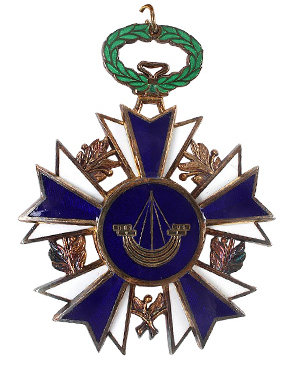
The Order of Public Health

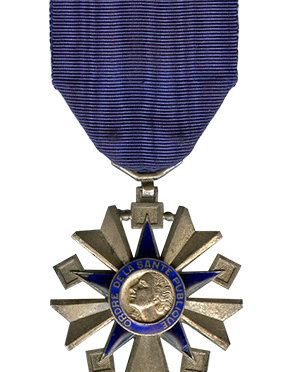
The Order of Public Health (or Ordre de la Santé publique) was a French order of merit, created by presidential decree of President Albert Lebrun on 18 February 1938 and amended on 22 May 1954, and awarded for services to the public health and protection of children.

The Order had three classes, and was only awarded to people who was minimum 30 years old.

  • Commander (40 awards)
  • Officer (170 awards)
  • Knight (806 awards)

The Order of Academic Palms

  • Time Period: Pre-WW1
  • Institution: Decoration: 1808, Order: 1955
  • Country: France

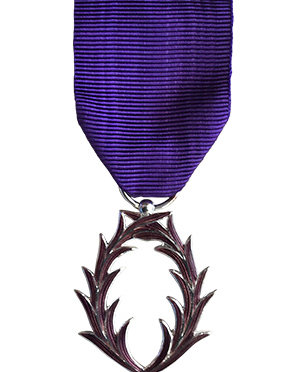
The Order of Academic Palms (“Ordre des Palmes académiques“) is a national order bestowed by the French Republic to distinguished academics and figures in the world of culture and education.

Originally established in 1808 by Emperor Napoleon as a decoration to honor eminent members of the University of Paris, it was changed into its current form as an order of merit on 4 October 1955 by President René Coty.

The early Palmes académiques was instituted on 17 March 1808 and was bestowed only upon teachers or professors. In 1850, the decoration was divided into two known classes:

  • Officier de l’Instruction Publique (Golden Palms);
  • Officier d’Académie (Silver Palms).

In 1866, the scope of the award was widened to include major contributions to French national education and culture made by anyone, including foreigners. It was also made available to any French expatriates making major contributions to the expansion of French culture throughout the rest of the world.

The Order of Academic Palms Design

Since 1955, the Ordre des Palmes académiques has comprised three grades, each grade having a fixed number of recipients:

  • Commander (Commandeur) — gold cross of 60 mm with a coronet (“couronne”) worn on necklet.
  • Officer (Officier) — gold cross of 55 mm worn on ribbon with rosette on the left breast.
  • Knight (Chevalier) — silver cross of 50 mm worn on ribbon on the left breast.

The Order of Arts and Letters

The Order of Arts and Letters (or Ordre des Arts et des Lettres in French) is an Order of France, established on 2 May 1957 by the Minister of Culture. Its purpose is the recognition of significant contributions to the arts, literature, or the propagation of these fields.

French government guidelines stipulate that citizens of France must be at least thirty years old, respect French civil law, and must have, “significantly contributed to the enrichment of the French cultural inheritance” to be considered for award. Membership is not, however, limited to French nationals; recipients include numerous foreign luminaries. Foreign recipients are admitted into the Order, “without condition of age“.

The Order has three grades:

  • Commandeur (Commander) — medallion worn on necklet; up to twenty recipients a year.
  • Officier (Officer) — medallion worn on ribbon with rosette on left breast; up to sixty recipients a year.
  • Chevalier (Knight) — medallion worn on ribbon on left breast; up to 200 recipients a year.

The Order of Arts and Letters Design

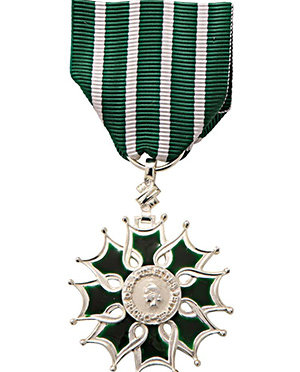
The medal of the Order is an eight-point, green-enameled asterisk, in gilt for Commanders and Officers and in silver for Knights; the obverse central disc has the letters “A” and “L” on a white enameled background, surrounded by a golden ring emblazoned with the phrase “République Française“.

The reverse central disc features the head of Marianne on a golden background, surrounded by a golden ring bearing the words “Ordre des Arts et des Lettres“. The Commander’s badge is topped by a gilt twisted ring.

The ribbon of the Order is green with four white stripes.

The Expedition Cross

The Expedition Cross (or Expeditiekruis in Dutch) was a military decoration of Kingdom of the Netherlands created by King William III.

The Expedition Cross (or Expeditiekruis in Dutch) officially known as the Cross for Important Military Operations (Ereteken voor Belangrijke Krijgsbedrijven) was a military decoration of Kingdom of the Netherlands created by royal decree on 19 February 1869 by King William III.

The cross was awarded for participation in major military operations between 1846 and 1942.

The Expedition Cross Medal Design

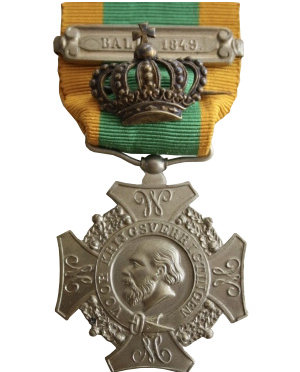
The Expedition Cross is a four-armed silver metal cross measuring 39 millimeters (1.5 in) in diameter.

The obverse bears the effigy of King William III in a round center medallion, surrounded by a garter with the inscription VOOR KRIJGSVERRIGTINGEN (for military operations). Between the arms of the cross is a wreath of oak leaves. On each of the four the arms is a “W” monogram. The reverse is plain.

The ribbon is light green with yellow-orange borders.

The Cross for the Four Day Marches

The Cross for the Four Day Marches is a decoration awarded for successful participation in the International Four Days Marches Nijmegen.

The Cross for the Four Day Marches (or Vierdaagsekruis in Dutch) is a Dutch decoration awarded for successful participation in the International Four Days Marches Nijmegen (Vierdaagse in Dutch) held annually at Nijmegen, The Netherlands.

The full title of the decoration is the Cross for Marching Proficiency (Kruis Voor Betoonde Marsvaardigheid). It is more commonly referred to as the Vierdaagse Cross or Vierdaagsekruis.

The cross was established in 1909 at the time of the first march, to award successful military participants of the Vierdaagse. Since 1910 it has been awarded to all participants who successfully complete all four days, both military and civilian.

The Cross is awarded by the Royal Dutch Walking League (KWBN or Koninklijke Wandel Bond Nederland) who organize the Nijmegen Marches. Prior to 2015 the League was known as the Royal Dutch League for Physical Education (KNBLO or Koninklijke Nederlandsche Bond Voor Lichamelijke Opvoeding) and before 1959, when it received the Royal (Koninklijke) prefix, as the NBVLO.

As well as the Vierdaagse at Nijmegen, the cross was also awarded to those who completed the four-day marches organized in various locations in the Dutch East Indies between 1935 and 1939.

Every year a walker successfully completes the march is marked either by a special cross, or a number to be attached to the ribbon of the last cross awarded. A cross is awarded in bronze for the first march, silver for the fifth and gold for the tenth, with a crown added above the cross for the year after each cross is awarded.

The Cross for the Four Day Marches Medal Design

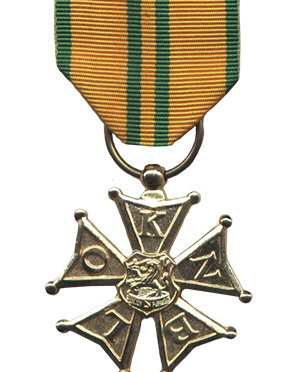
The decoration is a five-armed cross, with each arm bearing an initial of the awarding organization. It has a width of 36 mm at its widest point and is suspended from a green-and-yellow (often orange-yellow) ribbon.

Until 1958 the initials on the five arms read: ‘NBVLO’, with ‘KNBLO’ since 1959 to reflect the Koninklijke (Royal) prefix. There have been other minor changes in design over the years. For example, in 1977 the previous silver-gilt and silver crosses were replaced by base metal versions, with other design modifications in order to reduce costs.

The reverse is plain except for the name of the manufacturer.

All medals were made by Koninklijke Begeer of the South Holland town of Voorschoten until 1976, when the contract moved to W. van Veluw of Zeist, near Utrecht.

The Mobilisation War Cross

The Mobilization War Cross (or Mobilisatie-Oorlogskruis in Dutch) is a Dutch medal awarded for service during World War II.

The Mobilisation War Cross (or Mobilisatie-Oorlogskruis in Dutch) is a Dutch medal awarded for service during World War II.

The Mobilisation War Cross was established on 11 August 1948 by royal decree of Queen Wilhelmina. Those eligible for the award include military personnel who served for at least six months between 6 April 1939 – 20 May 1940. However, the Cross can also be awarded to non-military personnel or people who did not serve a full six months, as long as the subject performed military tasks for the Kingdom of the Netherlands.

On 1 December 1992, the original royal decree was rescinded and replaced.

The Mobilisation War Cross Design

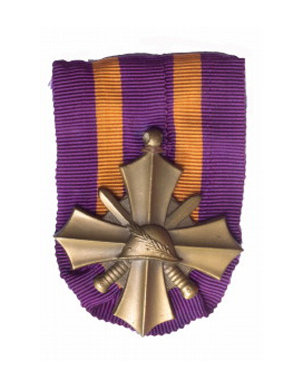
The decoration is a cross in bronze over a ribbon of colors purple and orange. The obverse shows a helmet and set of swords.

The Resistance Star East Asia

The Resistance Star East Asia (Verzetsster Oost-Azië) was created to commemorate the resistance against the Japanese occupation of Indonesia.

The Resistance Star East Asia (or Verzetsster Oost-Azië in Dutch) was created by royal decree on 26 October 1948 by Queen Juliana to commemorate the resistance against the Japanese occupation of Indonesia, which went underground after the capitulation of the Royal Dutch East Indies Army. This resistance suffered tremendous losses in live.

The medal honors the Dutch subjects in the Netherlands East Indies who showed strength of mind, determination, or solidarity, and performed praise-worthily help for Dutchmen that were made a prisoner of war or interned by the enemy during World War II. Also those of the Dutch resistance in Southeast Asia are honored.

Due to the loss of the archive of the Resistance Star a lot of historiography about this award is lost. Since 1948 the Resistance Star is awarded in total of 471 times. The star is a high award and has precedence just after the Bronze Lion.

The Resistance Star East Asia Design

The bronze six-pointed star with a flaming sun and the words “de geest overwint” (The spirit triumphs) was designed by Frans Smits.

The star is attached to a purple ribbon which has two golden lanes in the middle. The colors are symbolic: the gold-yellow remembers the custom in Southeast Asia to wrap a valuable gift in a gold-colored cloth. At the reverse side the text “maart 1942 – O.Azië – augustus 1945” (“March 1942 – East Asia – Augustus 1945”) is inscribed.

The Order of the Golden Ark

The Most Excellent Order of the Golden Ark is a Dutch order of merit established in 1971 by Prince Bernhard of the Netherlands.

The Most Excellent Order of the Golden Ark (or Orde van de Gouden Ark in Dutch) is a Dutch order of merit established in 1971 by Prince Bernhard of the Netherlands.

The order is awarded to people for major contributions to nature conservation. Although not awarded by the government of the Netherlands, it is considered by the government as a recognized chivalrous order.

Since its inception, over 300 people have been recognized by the award. Now that Prince Bernhard has died, the future of the order is uncertain.

The order has three grades:

  • Commander
  • Officer
  • Knight

The Order of Orange-Nassau

The Order of Orange-Nassau is a civil and military Dutch order of chivalry founded on 4 April 1892 by the Queen regent Emma.

The Order of Orange-Nassau (or Orde van Oranje-Nassau in Dutch) is a civil and military Dutch order of chivalry founded on 4 April 1892 by the Queen regent Emma, acting on behalf of her under-age daughter Queen Wilhelmina and open to “everyone who has earned special merits for society”.

These are people who deserve appreciation and recognition from society for the special way in which they have carried out their activities. The lower grades of the order are comparable with the ranks of the Order of the British Empire in the United Kingdom, but titles, prefixes or post-nominals (other than academic ones) are not used in the Netherlands.

During World War II, the Order of Orange-Nassau was bestowed upon both members of the Netherlands military and members of foreign services who had helped liberate the Netherlands from Nazi German occupation, and those who helped liberate the former Dutch colonies in the Pacific.

In the modern age, the Orange-Nassau is still the most active civil and military decoration of the Netherlands and ranks after the Order of the Netherlands Lion. The order is typically awarded each year on the Monarch’s official birthday with around 3500 appointments to the order made public.

The order is also used to honor foreign princes, ministers, dignitaries and diplomats. The King or Queen Regnant of the Netherlands is the Grand Master of the Order of Orange-Nassau.

The Order of Orange-Nassau Design

The Order of Orange-Nassau has two divisions, civil and military, the former denoted by a wreath of laurel on the badges, and the latter by crossed swords on both the badges and the stars.

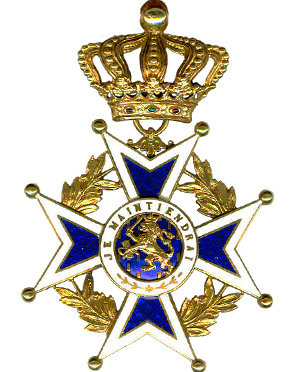
The badge of the order is a blue-enameled, white enamel-bordered Maltese Cross, in gilt for the officers and above, in silver for knights and members. The obverse central disc displays the King’s coat of arms in gold and blue enamel, surrounded by a white enamel ring bearing the national motto Je Maintiendrai (I shall maintain). The reverse central disc has the crowned monogram “W” (for Queen Wilhelmina) surrounded by the motto God Zij Met Ons (God be with us). The badge hangs from a royal crown.

The star of the order is a silver star with straight rays, in 8 points for Grand Cross and in 4 points for Grand Officer; the central disc has the King’s arms in gold and blue enamel, surrounded by a white enamel ring bearing the Dutch national motto Je Maintiendrai. The military division has crossed swords.

Since 1996

In addition to the two divisions, since 1996 the Order of Orange-Nassau has been issued in six classes:

  1. Knight Grand Cross – badge may be worn on a sash on the right shoulder, plus an 8-pointed star on the left chest;
  2. Grand Officer – badge may be worn by men on a necklet, and by women worn on a ribbon tied as a bow at the left chest. Also a 4-pointed star is worn on the left chest;
  3. Commander – badge may be worn by men on a necklet, and by women worn on a ribbon tied as a bow at the left chest;
  4. Officer – wears the badge on a ribbon with a rosette on the left chest;
  5. Knight – wears the badge on a ribbon on the left chest;
  6. Member – wears a smaller badge on a ribbon on the left chest.

For the grades of Knight and Member, the badges are made of silver. For the other grades, the silver is gilded.

For the grades of Knight Grand Cross, Grand Officer and Commander, the badges have a diameter of 60 mm. For the grades of Officer and Knight, they have a diameter of 46 mm. For the grade of Member, a diameter of 35 mm.

After 1966

Until 1996, the Order of Orange-Nassau consisted of five grades. In addition, honorary medals were issued in Gold, Silver and Bronze, but these were only affiliated with the order; the bearers of the medal were not members of the order. Now no longer issued, these were replaced by the sixth grade: “Member”. Recipients wore the medal on a ribbon on the left chest.

The Order of the Netherlands Lion

The Order of the Netherlands Lion is a Dutch order of chivalry founded by King William I of the Netherlands on 29 September 1815.

The Order of the Netherlands Lion (also known as Order of the Lion of the Netherlands or De Orde van de Nederlandse Leeuw in Dutch and L’Ordre du Lion Néerlandais in French) is a Dutch order of chivalry founded by King William I of the Netherlands on 29 September 1815.

The Order of the Netherlands Lion was until recently awarded upon eminent individuals from all walks of life, including generals, ministers of the crown, mayors of large towns, professors and leading scientists, industrialists, high-ranking civil servants, presiding judges and renowned artists. Since 1980 the Order has been primarily used to recognize merit in the arts, science, sport and literature.

The Order ranks after the Military William Order, which is only awarded for military merit. The King of the Netherlands is the Grand Master of the Order.

The following classes and grades exist for the Order:

  1. Knight Grand Cross – Reserved for members of the Royal Family, foreign Heads of State and a select group of former prime ministers, princes and cardinals. Wears the badge on a sash on the right shoulder, plus the star on the left chest.
  2. Commander – Usually conferred upon Dutch Nobel Prize winners, a few distinguished artists, writers and politicians. Wears the badge on a necklet, plus an identical breast cross on the left chest.
  3. Knight – Wears the badge on a ribbon on the left chest.
  4. Brother – No longer issued; see section below. Wore the medal on a ribbon on the left chest.
The Order of the Netherlands Lion Design

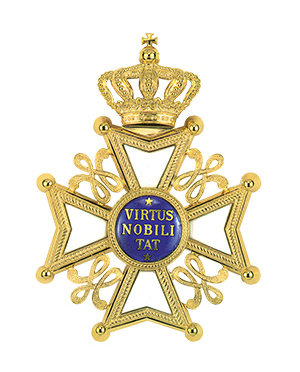
The badge of the Order is a gilt, white-enameled Maltese Cross, with the monogram “W” (for King William I) between the arms of the cross.

The obverse central disc is in blue enamel, bearing the motto Virtus Nobilitat (Virtue Ennobles). The reverse central disc is plain golden, with the lion from the Netherlands coat-of-arms. The badge hangs from a royal crown.

As with all honors awarded by the Netherlands, the insignia comprises a decoration, a miniature and optionally a breast star. The decoration and breast stars are only worn at formal occasions or while in state office. While wearing a smoking, it is allowed to wear the miniature. Decorations are not worn on any other type of clothing.

The badge of honour for Brothers was a silver medal, with the lion from the Netherlands coat of arms on the obverse, and the motto Virtus Nobilitat (English: Virtue Ennobles) on the reverse. The ribbon for Brothers was blue with a single orange central stripe.