The Military Order of William

The Military William Order (Militaire Willems-Orde in Dutch, MWO) is the oldest and highest honor of the Kingdom of the Netherlands.

The Military William Order (also known as Military Order of William or Militaire Willems-Orde in Dutch, abbreviated MWO), is the oldest and highest honour of the Kingdom of the Netherlands.

The Order’s motto is Voor Moed, Beleid en Trouw (For Bravery, Leadership and Loyalty). The chivalric order was established on 30 April 1815 by King William I and was presented for feats of excellent bravery on the battlefield and as a meritorious decoration to senior military officers. Comparable with the French Légion d’Honneur but far less often awarded, the Military William Order is a chivalry order of merit open to everyone regardless of rank and nobility, and not only to Dutch military but also foreigners. To date membership of the Order is extremely rarely awarded and only for excellent bravery in battle. Most knighthoods of the Military Order of William were awarded in 1815 and shortly afterwards to military of the Allies that fought Napoleon at the Battle of Waterloo, in total over 1,000 knighthoods were awarded at this time.

By 1945, the following classes of the Military William Order were in existence.

  • Knight Grand Cross – wears the badge on a sash on the right shoulder, plus the star on the left chest;
  • Commander – wears the badge on a necklet, plus an identical breast cross on the left chest;
  • Knight 3rd Class – wears the badge on a ribbon with rosette on the left chest;
  • Knight 4th Class – wears the badge on a ribbon on the left chest.

The oath to be taken by the accolade to the Military Order of William states: “I swear that I shall conduct myself as a faithful and valiant Knight, to stand ever ready to defend King and Country with my Life, and with all my Powers to always strive to be worthy of this Distinction, which the King has bestowed upon me. So help me God almighty.”

The Military Order of William Design

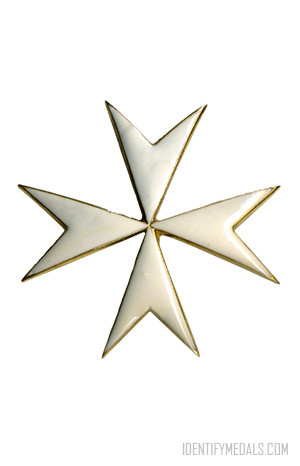
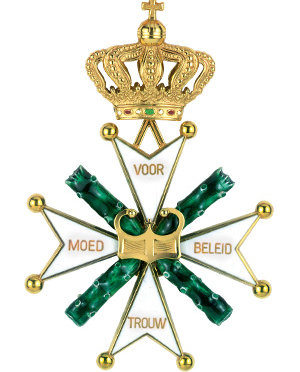
The badge of the Order is a white-enameled Maltese Cross, in silver for the 4th Class and in gilt for higher classes; a green enameled Burgundy Cross appears between the arms of the Maltese Cross.

The obverse bears a golden firesteel at the center, and the motto Voor Moed – Beleid – Trouw (For Bravery – Leadership – Loyalty) on the arms of the Maltese Cross. Both the Burgundy Cross and the firesteel were symbols of the House of Valois-Burgundy during their lordship of the Netherlands and probably are meant to recall its crucial unifying role in the history of the Netherlands. The reverse central disc bears a crowned monogram “W” (for King William I) surrounded by a laurel wreath. The badge hangs from a royal crown.

The star of the Grand Cross is a silver, 8-pointed star with straight rays; the obverse of the badge of the Order, minus the crown, appears at its centre. The breast cross of the Commander is completely identical to the obverse of the badge of the Order. The ribbon of the Order is orange (Royal House of Orange) with blue (Nassau-blue) stripes near the border.
The Kuban Shield

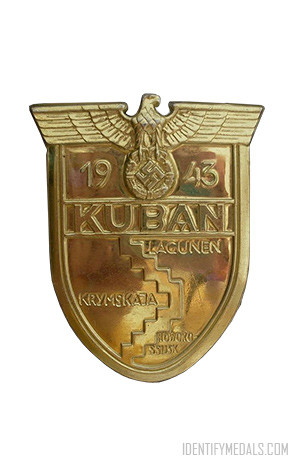
The Kuban Shield is a World War II military decoration awarded to those who fought at the Kuban bridgehead in the Soviet Union.

The Kuban Shield (or Ärmelschild Kuban in German) is a World War II military decoration of Nazi Germany, awarded to those who fought at the Kuban bridgehead in the Soviet Union from February 1943 until it was abandoned in October 1943.

The criteria for award of the shield to military personnel:

  • Served in the bridgehead for 60 days; or
  • Been wounded while defending the bridgehead; or
  • Had been engaged in a single major operation at the bridgehead.

The Kuban Shield Design

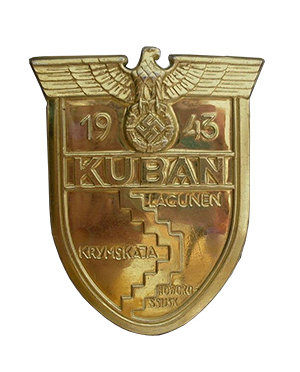
The shield is designed in a similar fashion to the Crimea Shield and was struck in sheet metal or zinc and treated with a bronzed wash.

It features a German eagle with outstretched wings clutching a laurel wreath with a swastika. On each side the wreath are the numbers 19 and 43. Directly below the eagle is written KUBAN in block capital letters. Below this name is a stylized map of the Kuban region, with a line representing the defensive line that the men fought to preserve with the location of the bridgeheads – KRYMSKAJALAGUNEN, and NOWOROSSIJSK.

The shield was worn on the upper left sleeve of the tunic. A back plate, which held in place a piece of cloth matching the recipients’ branch of service, was applied to the shield:

  • Green for Heer (army)
  • Blue for Luftwaffe (air force)
  • Black for Panzer units (armoured units)

More Nazi Germany Shields (Ärmelschilde)

These campaign shields were awarded to members of the Wehrmacht (the unified armed forces of Nazi Germany from 1935 to 1945). They were given for participation in specific battles or campaigns and worn on the left upper arm of the uniform jacket.

German WW2 Nazi Awards: The Warsaw Shield

The Warsaw Shield

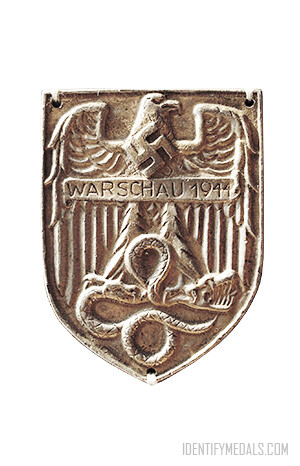
The Warsaw Shield (Ärmelschild Warschau) is a German military decoration for those who took part in the suppression of the Warsaw uprising.

Read More »

The Lappland Shield

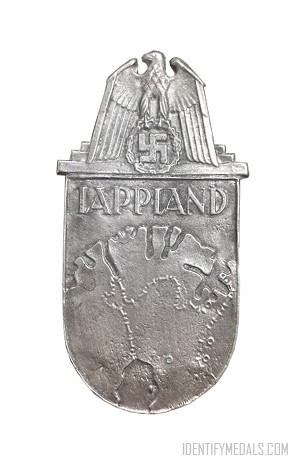
The Lappland Shield (Lapplandschild) is a World War II German military decoration awarded to military personnel who fought in Lapland.

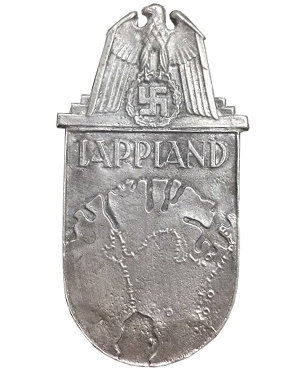
The Lappland Shield (or Lapplandschild in German) is a World War II German military decoration awarded to military personnel which had been fighting a two-front campaign against the advancing Finnish and Soviet Red Army forces in Lapland between November 1944 and the war’s end in May 1945.

The badge was awarded to men of General Franz Böhme’s 20th Mountain Army who had “honorably served” for six months in the region or had been wounded during operations therein. It was authorized in February 1945 and was the last officially instituted German campaign shield of the war.

The Lappland shield continued to be awarded after the end of the war in May, 1945 by the unit commander.

The Lappland Shield Design

The badge consists of a basic shield with flat top and rounded bottom. It incorporates an eagle at the top but without a swastika. Directly below this, in capital letters, is written “LAPPLAND” and beneath it appears a map of the region.

Four small holes were punched in the shield to allow it to be sewn on the upper left sleeve of the uniform, however, it had no back-plate or uniform cloth section attached.

More Nazi Germany Shields (Ärmelschilde)

These campaign shields were awarded to members of the Wehrmacht (the unified armed forces of Nazi Germany from 1935 to 1945). They were given for participation in specific battles or campaigns and worn on the left upper arm of the uniform jacket.

The Demyansk Shield

Demyansk Shield is a World War II German military decoration awarded to military personnel who fought in the Demyansk pocket.

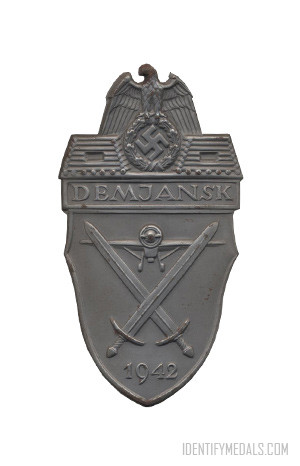
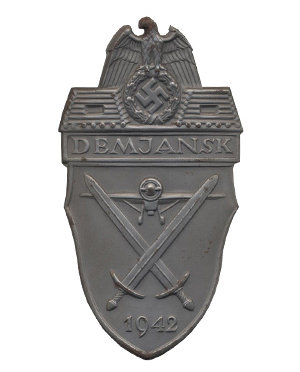
Demyansk Shield (or Ärmelschild Demjansk in German) is a World War II German military decoration instituted on 25 April 1943 by Adolf Hitler and awarded to military personnel who fought in the Demyansk pocket, achieved through the use of an airbridge.

The pocket of German troops had been encircled and cut off by the Red Army around Demyansk, south of Leningrad, during World War II on the Eastern Front. It was not bestowed after 1 July 1944.

Requirements for army, Waffen-SS and auxiliary units included honorable service in the besieged area for 60 days or wounded in the besieged area. For Luftwaffe personnel — 50 combat or re-supply missions over the besieged area.

The Demyansk Shield Design

The Demyansk shield features at its apex an eagle with swooped down wings clutching a laurel wreath that surrounds a swastika in the obverse. This is flanked by two pillboxes with gun ports. Below this is capital letters is written DEMJANSK.

The central portion of shield features a head-on single engine aircraft, two crossed swords and at the base, the year 1942. Two minor variations of the aircraft’s propeller exist with either a curved or straight propeller.

The shield was die struck and produced in silver-washed zinc and later in plain zinc. It was affixed to the upper left sleeve of the uniform via a cloth that matched the color of the uniform of the recipient:

  • Light green-grey (field-grey) for Heer (army)
  • Blue for Luftwaffe (air force)
  • Black for Panzer units (armoured units)
  • Field-grey for Waffen-SS

More Nazi Germany Shields (Ärmelschilde)

These campaign shields were awarded to members of the Wehrmacht (the unified armed forces of Nazi Germany from 1935 to 1945). They were given for participation in specific battles or campaigns and worn on the left upper arm of the uniform jacket.

The Narvik Shield - German WW2 Medals, Badges and Awards

The Narvik Shield

The Narvik Shield (Narvikschild) is a WW2 German military decoration awarded to German forces that took part in the battles of Narvik.

Read More »
German WW2 Nazi Awards: The Warsaw Shield

The Warsaw Shield

The Warsaw Shield (Ärmelschild Warschau) is a German military decoration for those who took part in the suppression of the Warsaw uprising.

Read More »

The Crimea Shield

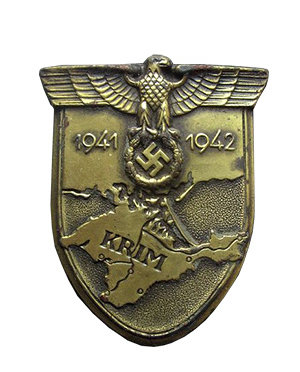
The Crimea Shield (Krimschild) is a WW2 German military decoration awarded to military personnel who fought against Soviet Red Army forces.

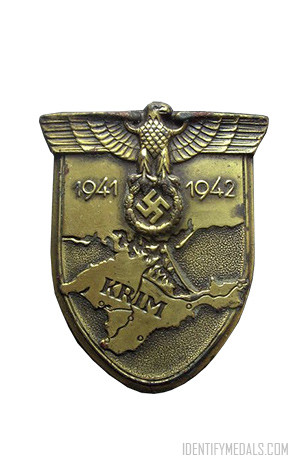
The Crimea Shield (or Krimschild in German) is a World War II German military decoration instituted on 25 July 1942 and awarded to military personnel who fought against Soviet Red Army forces and captured the Crimea region between 21 September 1941 and 4 July 1942 under the command of Generalfeldmarschall Erich von Manstein.

The Wehrmacht’s Army Group South advanced through the Crimean peninsula between the Autumn of 1941 and Summer of 1942. The hostilities that ended with the German capture of Sevastopol on 4 July 1942.

The Crimea Shield was the most widely distributed of the various German ones, with approximately 250,000 of them being awarded. It could be awarded to all members of the Wehrmacht and to Luftwaffe and other units affiliated to the campaign in the specified dates. The following conditions needed to have been met for the award:

  • Served in the area for at least 90 days; or
  • Been wounded while serving in the area; or
  • Had been engaged in at least one major operation against the enemy.

Romanian troops serving in the Crimea were also eligible for the award.

The Crimea Shield Design

The Crimea shield is headed, on the obverse, by the German eagle clutching a laurel wreath surrounding a swastika. Flanking the eagle are the dates 1941 and 1942, which represent the start and end dates of the campaign. This sits on the backdrop of the Crimean peninsula, where the fighting took place, which has the word KRIM stamped across it.

A special pure-gold version of the Crimea Shield was also produced and first bestowed upon Marshal Ion Antonescu, the military dictator of Romania, at the end of the Siege of Sevastopol on 3 July 1942. It was awarded to him in Bucharest by Erich von Manstein, on Adolf Hitler’s behalf. The second and last Golden Krimschild was awarded to von Manstein himself, on 24 November 1942.

More Nazi Germany Shields (Ärmelschilde)

These campaign shields were awarded to members of the Wehrmacht (the unified armed forces of Nazi Germany from 1935 to 1945). They were given for participation in specific battles or campaigns and worn on the left upper arm of the uniform jacket.

The Narvik Shield - German WW2 Medals, Badges and Awards

The Narvik Shield

The Narvik Shield (Narvikschild) is a WW2 German military decoration awarded to German forces that took part in the battles of Narvik.

Read More »

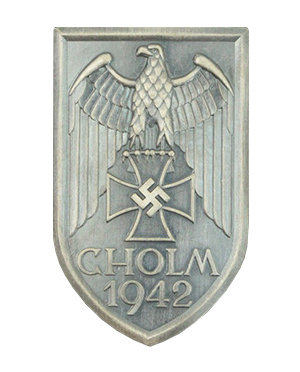
The Cholm Shield

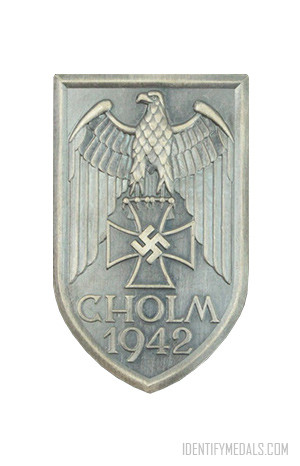
The Cholm Shield (Cholmschild) is a World War II German military decoration awarded to those who fought in the Cholm Pocket.

The Cholm Shield (or Cholmschild in German) is a World War II German military decoration instituted on 1 July 1942 and awarded to those who fought in the Cholm Pocket between 21 January and 5 May 1942.

In January 1942, the Soviet Red Army began a series of counteroffensives against the German Army, while the German occupied city of Cholm. By the end of January the city was surrounded and cut off which led to the creation of the Kholm Pocket. A mixed group of Wehrmacht, Luftwaffe and police personnel led by Generalleutnant Theodor Scherer were supplied by air until they were relieved on 5 May 1942.

To receive the shield, military personnel had to:

  • Have served honourably within the Cholm Pocket between the specified dates; or
  • Have flown and landed at the airfield within the pocket for resupply operations

The Cholm Shield is the rarest of the German combat shields with approximately 5,500 recipients. Bestowing of the award ceased as of 1 April 1943.

The Cholm Shield Design

The design of the commemorative shield was done by Polizei-Rottwachtmeister Schlimmer and sent to Adolf Hitler for approval. Professor Richard Klein made a few minor changes to the design.

The award features the outline of a shield with a large “open-winged” Wehrmacht-style eagle grasping an Iron Cross with a swastika at its center. Below, in capital letters, is written CHOLM and the date 1942In 1957, the Cholm Shield was denazified (removal of the swastika) to allow recipients to wear the shield on their uniform.

All shields were hollow stamped metal washed in silver. A backing plate was attached to the shield with a number of prongs and affixed to a piece of coloured cloth. The Cholm Shield was worn on the left upper sleeve of the uniform of soldiers and airmen. For civilian clothes a smaller shield roughly 16mm across with a needle fitting could be worn on the left lapel.

More Nazi Germany Shields (Ärmelschilde)

These campaign shields were awarded to members of the Wehrmacht (the unified armed forces of Nazi Germany from 1935 to 1945). They were given for participation in specific battles or campaigns and worn on the left upper arm of the uniform jacket.

The Crimea Shield - German WW2 Medals, Badges and Awards

The Crimea Shield

The Crimea Shield (Krimschild) is a WW2 German military decoration awarded to military personnel who fought against Soviet Red Army forces.

Read More »
The Narvik Shield - German WW2 Medals, Badges and Awards

The Narvik Shield

The Narvik Shield (Narvikschild) is a WW2 German military decoration awarded to German forces that took part in the battles of Narvik.

Read More »
German WW2 Nazi Awards: The Warsaw Shield

The Warsaw Shield

The Warsaw Shield (Ärmelschild Warschau) is a German military decoration for those who took part in the suppression of the Warsaw uprising.

Read More »

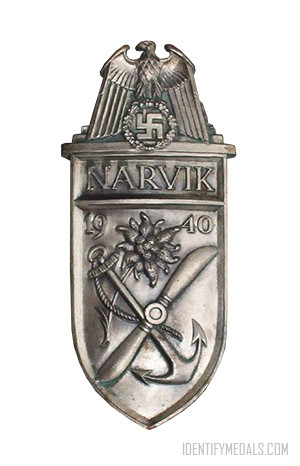
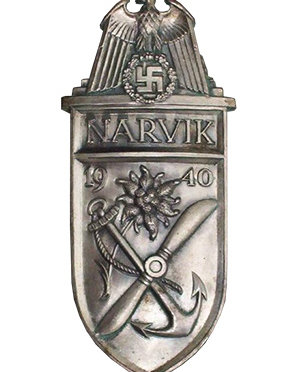
The Narvik Shield

The Narvik Shield (Narvikschild) is a WW2 German military decoration awarded to German forces that took part in the battles of Narvik.

The Narvik Shield (or Narvikschild in German) is a World War II German military decoration awarded to all German forces that took part in the battles of Narvik between 9 April and 8 June 1940.

The decoration was instituted on 19 August 1940 by Adolf Hitler. The Oberkommando der Wehrmacht (OKW) published the order the same day.

A total of 8,577 military personnel received the award. It was bestowed by General Eduard Dietl, the commander of Army Group Narvik.

In 1957, the Narvik Shield, along with many other German military decorations of World War II, was reauthorized for wear by qualifying veterans. The new version was without the eagle and swastika symbol of the Third Reich.

The Narvik Shield Design

Designed by Professor Dr Richard Klein of Munich, the narrow shield features a pointed bottom and, at its apex, an eagle with down-swept wings clutching a laurel wreath that surrounds a swastika. Below this in capital letters is written NARVIK.

The body of the shield features an edelweiss (representing the Heer mountain troops), an anchor (representing the Kriegsmarine), and propeller (for the Luftwaffe). The anchor and propeller are crossed, with the edelweiss placed at the top of the X. The numbers 19 and 40 appear at the top corners of the main body of the shield.

The shield was hollow backed and stamped from sheet metal which was usually zinc. It was worn on the upper left arm of the uniform. The shield was awarded in two versions; silver-gray versions for army and Luftwaffe and a gilded (golden coloured) version for Kriegsmarine.

More Nazi Germany Shields (Ärmelschilde)

These campaign shields were awarded to members of the Wehrmacht (the unified armed forces of Nazi Germany from 1935 to 1945). They were given for participation in specific battles or campaigns and worn on the left upper arm of the uniform jacket.

The Narvik Shield - German WW2 Medals, Badges and Awards

The Narvik Shield

The Narvik Shield (Narvikschild) is a WW2 German military decoration awarded to German forces that took part in the battles of Narvik.

Read More »

The Order of Merit of the Bavarian Crown (Star)

The Order of Merit of the Bavarian Crown is an order of merit of the Kingdom of Bavaria established by King Maximilian Joseph I.

The Order of Merit of the Bavarian Crown (or Verdienstorden der Bayerischen Krone in German) is an order of merit of the Kingdom of Bavaria established by King Maximilian Joseph I on 19 March 1808. The order was awarded in several grades: Grand Commander, Grand Cross, Commander, Knight, and medals in gold and silver.

The motto of the order is Virtus et Honos (‘Courage and Honour’). King Maximilian I Joseph founded the order to reward civil servants of the state of all classes and other foreigners who were deserving of recognition of the Kingdom of Bavaria. Both the orders brought non-noble recipients in the collection of personal nobility with the title “Ritter von”.

The Order of Merit of the Bavarian Crown Design

The order is a silver eight-pointed multi-rayed star in silver gilt and enamels and the inscription Virtus et Honos (‘Courage and Honour’), the motto of the order, in red, green, white and blue enamel.

The Order of Merit of the Bavarian Crown measures 53 mm (or 80 mm including the crown suspension). The ribbon is light blue with white stripes.

The Order of the Red Eagle

The Order of the Red Eagle (Roter Adlerorden) was an order of chivalry of the Kingdom of Prussia awarded to military personnel and civilians.

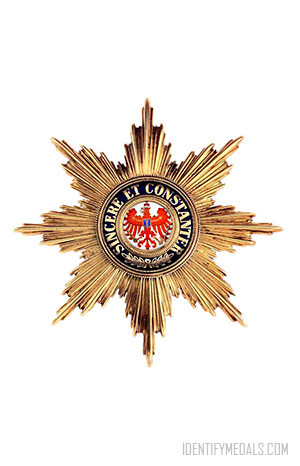
The Order of the Red Eagle (or Roter Adlerorden in German) is an order of chivalry of the Kingdom of Prussia awarded to both military personnel and civilians to recognize valor in combat, excellence in military leadership, long and faithful service to the kingdom, or other achievements.

The predecessor to the Order of the Red Eagle was founded on November 17, 1705, by the Margrave Georg Wilhelm of Brandenburg-Bayreuth as the Ordre de la Sincerité. It was revived in 1712 and again in 1734 in Brandenburg-Ansbach, where it first received the name of “Order of the Brandenburg Red Eagle”. The Kingdom of Prussia absorbed both Brandenburg-Bayreuth and Brandenburg-Ansbach in January 1792, and on June 12, 1792, King Frederick William II again revived the order as a Prussian royal order.

The Order of the Red Eagle could only be awarded to commissioned officers or civilians of approximately equivalent status. However, there was a medal of the order, which could be awarded to non-commissioned officers and enlisted men, lower ranking civil servants and other civilians.

The Order of the Red Eagle Design

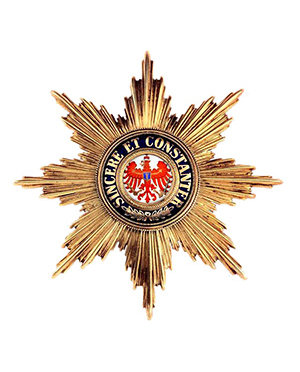
The badge is a gold (gilt after 1916) Maltese Cross enameled in white, with red enameled eagles between the arms of the cross. The central disc, in gold, bears the Royal monogram surrounded by a blue enameled ring bearing the motto of the Order, Sincere et Constanter.

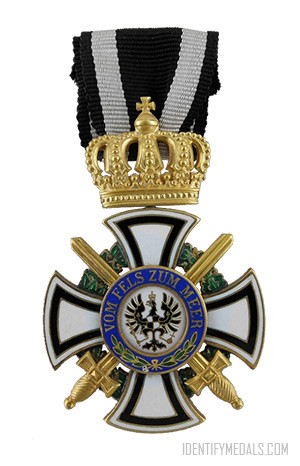
The badge for the 1st to 3rd classes is a gold (gilt after 1916) cross pattée, enameled in white; that for the 4th class was similar but with smooth, plain silver arms. The enlisted man’s medal was of a relatively simple, round design, topped with the Prussian crown.

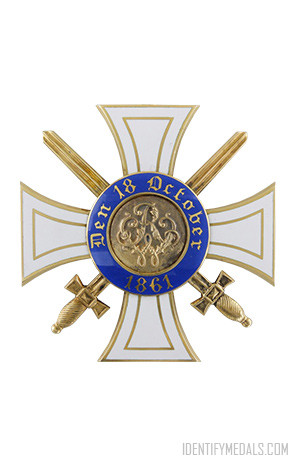
After September 16, 1848, awards of all classes (except the medal) bestowed for military merit had two golden swords crossed through the central medallion.

The traditional ribbon of the order was white with two orange stripes at the edges, but combat awards were frequently conferred with a black and white ribbon similar to that of the Iron Cross.

Find This Medal

Right Now on eBay 
Clicking a link to eBay may result in a referral commission being paid if a purchase is made.
Loading...

More Prussian Orders

Throughout Prussian history, these orders played a significant role in the social hierarchy and served as tangible expressions of royal favor and recognition. They continued to be awarded even after the dissolution of the Kingdom of Prussia, remaining as enduring symbols of valor, service, and honor in German society. Here are some more about Prussian Orders:

The Order of the Black Eagle

The Order of the Black Eagle was the highest order of chivalry in the Kingdom of Prussia. It was founded in 1701 by Elector Friedrich III.

The Order of the Black Eagle (or Hoher Orden vom Schwarzen Adler in German) was the highest order of chivalry in the Kingdom of Prussia. The order was founded on 17 January 1701 by Elector Friedrich III of Brandenburg (soon after Friedrich I, King in Prussia).

In his Dutch exile after World War I, deposed Emperor Wilhelm II continued to award the order to his family (he made his second wife, Princess Hermine Reuss of Greiz, a Lady in the Order of the Black Eagle.

Membership in the Order of the Black Eagle was limited to a small number of knights, and was divided into two classes: On the one hand, members of reigning houses, and on the other capitular knights (before 1847 membership was limited to nobles). Capitular knights were generally high-ranking government officials or military officers.

The Order of the Black Eagle had only one class, but could also be awarded at the king’s prerogative “with the Chain” (“mit der Kette“) or without (“ohne Kette“).

From its founding in 1701 to 1918, the Order of the Black Eagle was awarded 407 times, with 57 of these installations occurring during the reign of Friedrich I (1701–1713).

The Order of the Black Eagle Design

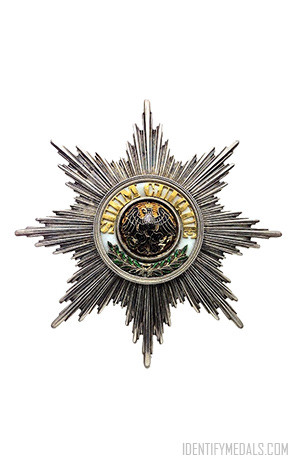
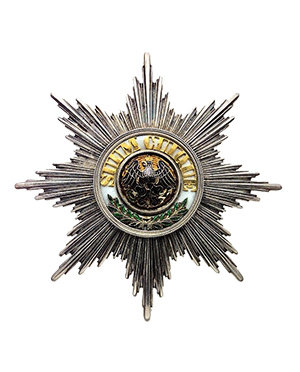
The badge is a gold Maltese cross, enameled in blue, with gold-crowned black eagles between the arms of the cross. The gold center medallion bears the royal monogram of Friedrich I (“FR”, for Fredericus Rex).

The badge was worn from either a broad ribbon or a collar. The ribbon was an orange moiré sash worn from the left shoulder to the right hip, with the badge resting on the hip. The sash color was chosen in honor of Louise Henriette of Nassau, daughter of the prince of Orange and first wife of the great elector.

The collar or chain (Kette) was worn around the neck and resting upon the shoulders, with the badge suspended from the front center.

The star of the Order is a silver eight-pointed star, with straight or faceted rays depending on the jeweler’s design. The center medallion displays a black eagle gripping a wreath of laurels in its left claws and a scepter in its right on a golden background, surrounded by a white enamelled ring bearing a wreath of laurels and the motto of the Order.

At certain ceremonies, the knights wore red velvet capes with blue linings. Embroidered on the left shoulder of each cape was a large star of the Order.

More Prussian Orders

Throughout Prussian history, these orders played a significant role in the social hierarchy and served as tangible expressions of royal favor and recognition. They continued to be awarded even after the dissolution of the Kingdom of Prussia, remaining as enduring symbols of valor, service, and honor in German society. Here are some more about Prussian Orders: