The General Service Medal (1918)

The General Service Medal recognizes service in minor Army and Royal Air Force operations for which no separate medal was possible.

The General Service Medal (also known as 1918 GSM) recognizes service in minor Army and Royal Air Force operations for which no separate medal was possible. Local forces such as police qualified for many of the clasps, as could units of the Indian Army prior to 1947.

The General Service Medal was equivalent to the 1915 Naval General Service Medal. Both these medals were replaced by the GSM in 1962.

The General Service Medal 1918 Design

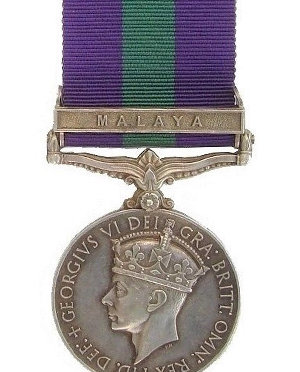
The 1918 General Service Medal is a circular silver medal. The obverse bears the crowned effigy of the reigning monarch. The reverse shows a standing winged figure of Victory in a Corinthian helmet and carrying a trident, also bestowing a wreath on the emblems of the Army (the sword) and the RAF (the wings).

A bronze oak leaf emblem is worn on the ribbon of the medal to signify a mention in dispatches for a campaign for which the General Service Medal was awarded.

Eighteen clasps were approved for the 1918 General Service Medal. They consist of small metal bars into which the name of the relevant campaign or theatre of operations was molded. The clasps were: South Persia, Kurdistan, Iraq, NW Persia, Southern Desert Iraq, North Kurdistan, Palestine, S.E. Asia 1945–46, Bomb and Mine Clearance 1945–49 and 1949-56, Palestine 1945–48, Berlin Airlift, Malaya, Canal Zone, Cyprus, Near East, Arabian Peninsula and Bruinei.

The 1918 General Service Medal was never awarded without a clasp.
The Naval General Service Medal (1915)

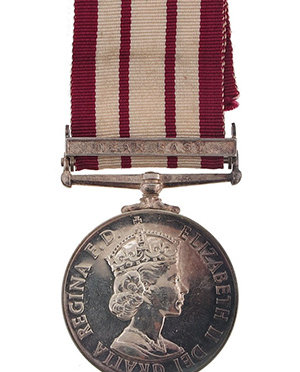
The Naval General Service Medal is a British military medal instituted in 1915 to recognize service by the Royal Navy and Royal Marines.

The Naval General Service Medal (also known as 1915 NGSM) is a British military medal instituted in 1915 to recognize service by the Royal Navy and Royal Marines in minor campaigns that would not otherwise earn a specific campaign medal. The Army/Air Force equivalent was the General Service Medal (1918). Both these medals were replaced by the General Service Medal in 1962.

The Naval General Service Medal Design

The medal is made of silver and measures 36 millimeters (1.4 in) in diameter. The obverse bears the image of one of three successive Sovereigns, King George VKing George VI and Queen Elizabeth IIThe reverse shows a mounted figure of Britannia in a chariot pulled by two sea-horses, her left hand resting on a union shield.

The 32 millimeters (1.3 in) wide ribbon is crimson-colored with three white stripes. From 1920 a bronze oak leaf emblem was also worn on the ribbon of the medal to signify a mention in dispatches for a campaign for which the NGSM was awarded.

The 1915 NGSM was never awarded without a clasp. These are the seventeen clasps that were authorized: Persian Gulf 1909–1914, Iraq 1919–1920, N.W. Persia 1920, Palestine 1936–39, S.E. Asia 1945-46, Minesweeping 1945–51, Palestine 1945–48, Malaya, Yangtze 1949, Bomb and Mine Clearance 1945–46, Bomb and Mine Clearance 1945–53, B & M Clearance Mediterranean, Canal Zone, Cyprus, Near East, Arabian Peninsula and Brunei.
The Transport Medal

The Transport Medal was a campaign medal awarded by the Lord Commissioners of the Admiralty to masters and officers of merchant ships.

Time Period: Pre-WW1
Year of Institution: 8 November 1903
Country: Great Britain

The Transport Medal was a British campaign medal awarded by the Lord Commissioners of the Admiralty to masters and officers of merchant ships employed by the Transport Service to move troops to either South Africa during the South African War or to China during the Boxer Rebellion.  The Transport Medal was created on 8 November 1903 and officers of hospital ships used in the campaigns also qualified.

It was intended that the medal would be awarded for future conflicts, but was not awarded again after the South Africa and China wars.

The Transport Medal Design

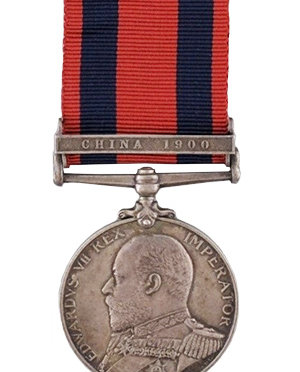
The obverse of the medal bears the head of King Edward VII in Royal Navy uniform, with the inscription EDWARDVS VII REX IMPERATOR. The reverse depicts HMS Ophir beneath a map of the world with, below, the words in Latin OB PATRIAM MILITIBUS PER MARE TRANSVECTIS ADJUTAM which translates as for services rendered in transporting troops by sea.

Two clasps were awarded: S.AFRICA 1899–1902 (for services related to the South African War) and CHINA 1900 (for services related to the Boxer Rebellion).

A total of 1,719 medals were awarded, 1,219 with the ‘S. Africa 1899-1902’ clasp, 322 with the ‘China 1900’ clasp and 178 with both clasps.

The Tibet Medal

The Tibet Medal is a British military medal awarded to members of the Tibet Mission and accompanying troops who served at or beyond Siliguri.

The Tibet Medal is a British military medal awarded to all members of the Tibet Mission and accompanying troops who served at or beyond Siliguri from 13 December 1903 to 23 September 1904 and authorized in February 1905.

Approximately 3,350 silver Tibet Medals were awarded, including about 600 to the first battalion the Royal Fusiliers and about 2,600 to members of the Indian Army, in addition to staff and support personnel. More than 2,500 bronze medals were awarded, mainly to those employed in transporting supplies, including to the Peshawar Camel Corps and locally recruited coolies.

The Tibet Medal Design

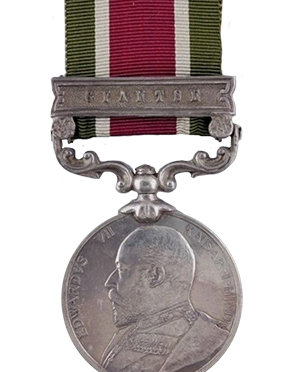
The obverse of the medal, designed by G. W. de Saulles, a British medallist that worked under Queen Victoria and Edward VII) shows the bust of Edward VII in Field Marshal’s uniform and the legend ‘EDWARDVS VII KAISAR-I-HIND’.
The reverse, designed by E. G. Gillick, a British sculptor, depicts the Potala (winter palace of the Dalai Lamas) in Lhasa on top of the red hill with the words ‘TIBET 1903-04’ below.

The medal was awarded in silver to combatant troops and in bronze to camp followers, with both eligible for the ‘Gyantse’ clasp. The clasp ‘GYANTSE’ was given to those present in operations between 3 May and 6 July 1904 in or near Gyantse Fortress. The suspender is of the swiveling ornate scroll type.

The India General Service Medal (1909)

The Indian General Service Medal is a British campaign medal issued to officers and men of the British and Indian armies and approved in 1909.

The Indian General Service Medal (also known as 1909 IGSM) is a British campaign medal issued to officers and men of the British and Indian armies and approved on 1 January 1909. From 1919 it was also awarded to officers and men of the Royal Air Force (the Waziristan 1925 clasp was awarded solely to the RAF).

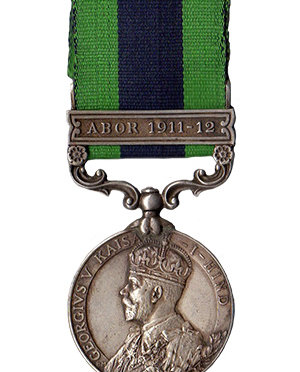
The 1909 Indian General Service Medal was awarded for various minor military campaigns in India from 1908 to 1935, and each campaign is represented by a clasp, of which 12 were sanctioned.

The Indian General Service Medal Design

The medal measures 36 millimeters (1.4 in) in diameter. For early campaigns it was awarded in silver to combatants and in bronze to native bearers and servants. From 1919 on. all awards were in silver.

There are three versions of the Indian General Service Medal obverse (King Edward VII 1908-10, King George V 1911-25 and King George V 1930-35). The reverse depicts Jamrud Fort at the Khyber Pass with the word ‘India’ below between a wreath of oak and olive branches.

The Medal with the Waziristan 1925 bar was awarded to only 46 officers and 214 men of the Royal Air Force. It is by far the rarest bar given with an India General Service Medal.

From 1920, those mentioned in dispatches in a campaign for which the medal was awarded could wear a bronze oakleaf on the medal ribbon.

The Hohenzollern Commemorative Medal for Combatants 1848-1849

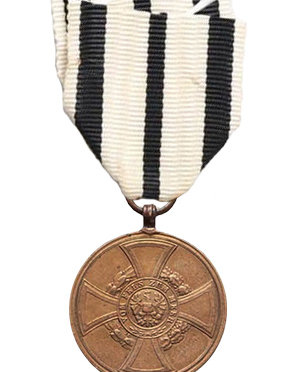
The Hohenzollern Commemorative Medal for 1848-1849 Campaign was instituted by the King of Prussia Friedrich Wilhelm IV on August 23, 1851.

The Hohenzollern Commemorative Medal for 1848-1849 Campaign was instituted by the King of Prussia Friedrich Wilhelm IV on August 23, 1851  in association with the House Order of Hohenzollern. It was awarded to those officers and soldiers who remained loyal during the rebellions of 1848 and 1849.

A Hohenzollernsche Denkmünze für 1848-1849 was also awarded to Prussian troops for battles in Denmark in 1849 during the First Schleswig War.

The Prussian army played a crucial role in suppressing not only the rebellions in Prussia but also in Baden and Saxony. Nonetheless, Prussia became a constitutional state in 1849.

The Hohenzollern Commemorative Medal Design

The Hohenzollern Commemorative Medal is made of circular gilt bronze with a laterally-pierced ribbed loop for ribbon suspension. The obverse shows the face with the image of the cross pattée alisée of the Royal House Order of Hohenzollern and in the reverse is inscribed ‘FRIEDRICH WILHELM IV’ with the dates ‘1848’ and ‘1849’ above and below parallel lines and a circumscribed ‘SEINEN BIS IN DEN TOD GETREUEN KRIEGERN’ (His warrior loyal unto death).

The Commemorative Medal for the Victory Over Greece

The Commemorative Medal for the Victory Over Greece was an Italian medal from the World War II period awarded after repelling their attack.

The Commemorative Medal for the Victory Over Greece is an Italian medal from the WW2 period.

Italy invaded Greece on 28 October 1940 from the Italian-occupied Albania. By April 1941, the Hellenic Army had repelled the attack and had pushed the Italians deep inside the Albanian territory. Trying to prevent the imminent Italian defeat, Germany attacked Greece and Yugoslavia, from/with Bulgaria, on 6 Apr. 1941 and forced the continental Greek Forces to capitulate 3 weeks later.

The Commemorative Medal for the Victory Over Greece Design

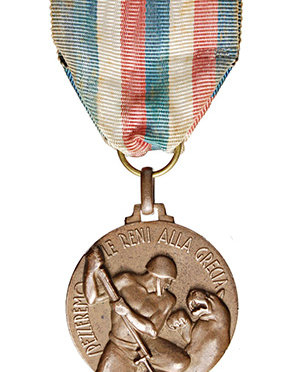
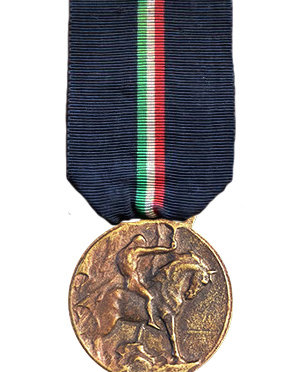
The medal shows on the obverse a dramatic scene of Italian soldier driving bayonette into a lioness. The medal measures 32.5mm in diameter. On the obverse there is the famous phrase of Mussolini “Spezzeremo le reni alla Grecia” (we will split the kidneys of Greece) during his speech on the radio on Nov. 19 1940.

The Medal for the Fascist Campaign 1919-1922

The Fascist Campaign Medal was an Italian award distributed to all who participated in the Fascist Campaign of 1919-1922.

The Fascist Campaign Medal (also Medal for the Fascist Campaign 1919-1922, or “Medaglia per le campagne fasciste 1919-1922″ in Italian) is an Italian award distributed to all who participated in the Fascist Campaign of 1919-1922.

This period marks the rise of Fascism in Italy, culminating in the March on Rome, which brought Benito Mussolini and his Fascist Party to power. The medal honors those who supported the movement during its early, tumultuous years, recognizing their contributions to the establishment of the Fascist regime. The design typically features Fascist symbols and inscriptions commemorating the campaign and its significance in Italian history.

The Fascist Campaign Medal Design

The dimensions of the Medal for the Fascist Campaign 1919-1922 are 3,5 x 14 cm. The medal shows a dramatic equestrian scene on the obverse, and joined hands and inscription “Per L’Italia, Ora e Sempre” (For Italy, Now and Always) on its reverse.

The Commemorative Medal Marcia su Roma

The Commemorative Medal Marcia su Roma was designed by sculptor Eugenio Baroni and produced by FM Lorioli & Castelli-Milano.

The Commemorative Medal Marcia su Roma (or Medaglia commemorativa della Marcia su Roma in Italian) was designed by sculptor Eugenio Baroni and produced by FM Lorioli & Castelli-Milano.

The medal was awarded in gold to Benito Mussolini, to the quadrumviris and to the administrative secretary of the PNF Giovanni Marinelli; in silver to the 19 commanders of the columns of the teams organized to converge on Rome; and in bronze to all members of the National Fascist Party that had participated in the march between 27 October and 1 November 1922.

Through Royal Decree No. 273 of January 31, 1926, it was also authorized for members of the Volunteer Militia for National Security. A second provision, given on 1 November 1928, granted its use to those soldiers who on 28 October 1922 did not provide effective service in the Armed Forces of the State.

The full right to use the banner of all members of the FF.AA., was granted by Royal Decree No. 1179 of July 15, 1938.

The Commemorative Medal Marcia su Roma Design

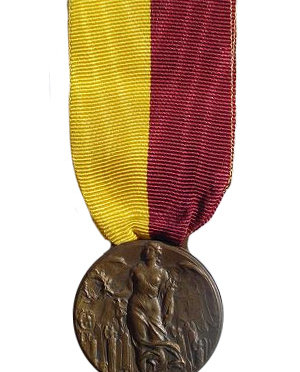
The ribbon colors of the Commemorative Medal Marcia su Roma are those of the city of Rome. It was coined made by Mussolini on the occasion of first Anniversary and distributed to all participants in this event that brought fascism to power in november 1, 1922.

The medal consists of a disk with a total diameter of 34 mm. and cambretta attachment. The obverse of the Commemorative Medal Marcia su Roma medal shows a winged victory holding a crown of oak with his right hand and holding a lictorian beam with his left hand. Behind the figure there are legionary signs, fasces and Roman daggers.

The reverse of the medal shows in the center an empty quadrangular space where the recipient could have his name engraved. At the base of the square space is the abbreviation FM Lorioli & Castelli Milano et EB Mod. Rip. Ris (incense). The square space is delimited by four lictor beams. Circularly the edge is bordered by a double circle in which the legends Marcia Su Roma are engraved on the top, and 27 October-1 November 1922 , at the bottom. Among the legends there are two small stars.

The Womens Army Corps Service Medal

The Women’s Army Corps Service Medal is a United States Army military award created in 1943 by President Franklin Roosevelt.

The Women’s Army Corps Service Medal is a United States Army military award created on July 29, 1943 by Executive Order 9365 by President Franklin Roosevelt. The medal recognizes the service of women to the Army during the Second World War.

The Women’s Army Corps Service Medal was awarded to any service member of the Women’s Army Auxiliary Corps between July 10, 1942 and August 31, 1943 or the Women’s Army Corps between September 1, 1943 and September 2, 1945. The medal ranked in order of precedence below the American Defense Service Medal and above the American Campaign Medal.

The Women’s Army Corps Service Medal is considered obsolete as the United States Army is a combined service without separate service corps for women. The medal was issued as a once-awarded medal, and there are no devices authorized for additional presentations. 

The Women’s Army Corps Service Medal Design

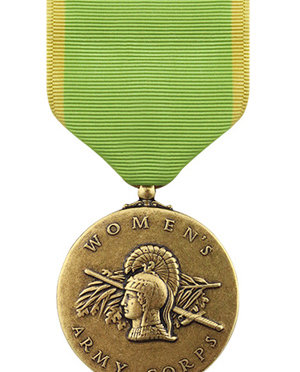
The profile featured on the medal is that of the goddess Pallas Athena; the same profile was used for the Women’s Army Corps branch insignia.

No devices are authorized to be worn on the medal.

Find This Medal Online

Right Now on eBay 
Clicking a link to eBay may result in a referral commission being paid if a purchase is made.
Loading...