The USSR Marshal’s Star

The Marshal’s Star (or маршальская звезда in Russian) is a badge of rank worn by marshals of the armed forces of the Soviet Union.

The Marshal’s Star (or маршальская звезда in Russian) is a badge of rank worn by marshals of the armed forces of the Soviet Union (and then the Russian Federation). Officially their names have changed, depending on what ranks received the right to wear them, and are known as the large marshal’s star and the small marshal’s star.

Marshal’s stars were first awarded to the marshals and admirals of the fleet of the Soviet Union. In time, smaller stars were awarded to “marshals of an arm of service” and “chief marshals of an arm of service”, admirals of the fleet, and later generals of the army of the Soviet armed forces.

On the death of the recipient, the award is returned to the diamond fund for re-use. Approximately 200 of this type of marshal’s star were produced.

The USSR Marshal’s Star Design

The medal is a gold five-pointed star with smooth diagonal rays on the front side. In the center is a platinum, five-pointed star with diamonds. The diameter of the gold star is 44.5 millimeters (1.75 in) and the platinum stars are 23 millimeters (0.91 in) in diameter. The star has a depth of 8 millimeters (0.31 in).

The marshal’s star has a triangular eyelet in the upper beam which is connected to an oval eyelet measuring 14 millimeters (0.55 in). The diamonds in the center have a total weight of 2.62 carats and in the rays, there are 25 diamonds weighing a total of 1.25 carats. Between the edges of rays are 5 diamonds weighing a total of 3.06 carats. 

A Marshal of the Soviet Union’s star used a red satin ribbon suspension; ribbons for marshals of a branch varied accordingly: gold for artillery, light blue for aviation, burgundy for armored troops, crimson for engineers, blue for signals, and turquoise for the navy.

The armed forces of the former Soviet Union and the Russian Federation wear two insignia around neck when in parade uniform. There are two different sizes of stars. In 2013, new shoulder insignias were instituted for generals of the army, fleet admirals, and generals of the army. These insignias have one large marshal’s star on the board similar to the style worn by Soviet generals from the early 1970s through 1997.

The South Vietnam Campaign Medal

The Republic of Vietnam Campaign Medal (or Chiến Dịch Bội Tinh), is a South Vietnamese military campaign medal created in 1949.

The Republic of Vietnam Campaign Medal (or Chiến Dịch Bội Tinh in Vietnamese), is a South Vietnamese military campaign medal created in 1949 and awarded for two different periods of service in Vietnam.

The medal was first awarded to French military personnel during the First Indochina War (from 8 March 1949 to 20 July 1954). During the Vietnam War (Second Indochina War), the South Vietnamese government awarded the Republic of Vietnam Campaign Medal with Device (1960– ) to members of the South Vietnamese military for wartime service and on March 24, 1966, to members of the U.S. military for support of operations in Vietnam. In May 1966, other allied foreign military personnel became eligible for the award.

On 30 April 1975, Saigon was captured by the North Vietnamese army and South Vietnam surrendered and disbanded. The medal was not awarded after 28 March 1973, when the last U.S. troops left South Vietnam in accordance with the Paris Peace Accords.

In the United States, Public Law 88–257 permits military personnel to accept the medal for service performed in Vietnam from 1 March 1961 to 28 March 1973, inclusive. Since March 1966, the medal may also be awarded to any service member who, while serving outside the geographical limits of the Republic of Vietnam, contributed direct combat support to the Republic of Vietnam Armed Forces for six months.

The Republic of Vietnam Campaign Medal was awarded to Australian military personnel for service in South Vietnam during the period 31 July 1962 to 28 March 1973. The medal was awarded to New Zealand Forces for service in Vietnam for six months between 1964 (arrived Vietnam June 1964) and 1973 (left Vietnam 22 December 1972).

The South Vietnam Campaign Medal Design

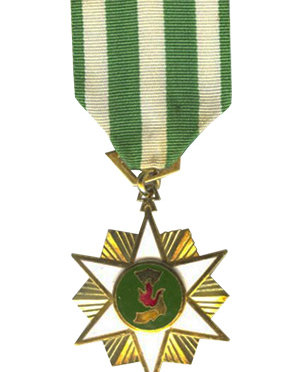
The medal is made of a gold-colored metal in the shape of a 36 mm wide six-pointed white enameled star with six-pointed gold rays between the arms of the star. During the Vietnam War, the Republic of Vietnam Campaign Medal with Device (1960–) was manufactured in the United States.

In the obverse, in the center of the star is an 18 mm green colored disc bearing a gold-colored map of Vietnam with three painted flames in red between North and South Vietnam, signifying the three regions of Vietnam. On the reverse of the medal is a circle bearing the inscription Chiến Dịch (Campaign) above and Bội Tinh (Medal) below the word VIET-NAM in the center.

The suspension ribbon and service ribbon of the medal is stripes in green (to represent freedom) with three vertical white (to represent purity).

Find This Medal Online

Right Now on eBay 
Clicking a link to eBay may result in a referral commission being paid if a purchase is made.
Loading...

The Imperial Order of Saint Alexander Nevsky

The Imperial Order of Saint Alexander Nevsky was an order of chivalry of the Russian Empire created in memory of Saint Alexander Nevsky.

The Imperial Order of Saint Alexander Nevsky was an order of chivalry of the Russian Empire first awarded by Empress Catherine I of Russia on 1 June 1725 and created in memory of the deeds of Saint Alexander Nevsky, patron Saint of Saint Petersburg to award to distinguished Russian citizens who had served their country with honor, mostly through political or military service.

The introduction of the Order was envisioned by Emperor Peter I of Russia (r. 1682–1721) for rewarding military bravery in battle, however he died before he could create it. It was first awarded on the occasion of the wedding of Grand Duchess Anna Petrovna of Russia and Charles Frederick, Duke of Holstein-Gottorp in 1725.

The Order of Saint Alexander Nevsky was abolished after the 1917 Russian Revolution, along with all other orders and titles of the Russian Empire. It was revived in 1942 by the Soviet Union as a purely military decoration and renamed it the more secular Order of Alexander Nevsky. The heads of the Russian Imperial House in exile have continued to award the Order of St. Alexander Nevsky.

The Imperial Order of Saint Alexander Nevsky Design

The star of the Order is an eight-point silver star, each arm composed of clusters of five individual smooth rays with braided borders. It measures 92 mm (w) x 92 mm (h) and weighs 80.6 grams. Its obverse features, in the center, the crowned Latin monogram of St. Alexander on a white enamel roundel, surrounded by the Order’s motto “ZA TRUDY I OTECHESTVO” (or “For Labours and Fatherland“) on a red enamel background with two green laurel branches crossed and crowned. The reverse bears a central pin assembly.

The badge of the order is a Maltese cross with red enamels and finely detailed Romanov imperial eagles in each quadrant. It measures 54.35 mm (w) x 60.31 mm (h) and weighs 31.6 grams. The obverse bears a central applique with an expertly hand-painted depiction of Alexander Nevsky mounted on a white horse, inside a stylized, hand-etched Gold ring. The reverse has central applique consisting of a white enameled medallion bearing a hand-painted monogram of Alexander Nevsky.

The ribbon is a red silk sash.

The Imperial Order of Saint Catherine

The Order of Saint Catherine is an award of Imperial Russia established in 1714 by Peter the Great for his marriage to Catherine I of Russia.

The Order of Saint Catherine (or Императорский Орден Святой Екатерины in Russian) is an award of Imperial Russia established on 24 November 1714 by Peter the Great on the occasion of his marriage to Catherine I of Russia. The Order was, for the majority of the time of Imperial Russia, the only award for women.

The order was under the patronage of Saint Catherine of Alexandria, the patron saint of the Empress. Peter the Great personally bestowed the insignia of the Order upon Empress Catherine on the Empress’ name day, making her Grand Mistress of the Order. No further members were inducted until 1726 and Dowager Empress Maria Feodorovna (who died in 1928) was the last Grand Mistress of the Order.

The award was bestowed in two classes:

  • Dame Grand Cross, and
  • Dame Lesser Cross.

Every Russian Grand Duchess was conferred the Grand Cross of the Order at her christening (or at her marriage into the Romanov family), and Princesses of the Imperial Blood were invested upon attaining their majority at 18. The 12 Dames Grand Cross were typically female members of foreign ruling houses, and the Dames Small Cross were all women of the highest nobility.

The Imperial Order of Saint Catherine Design

The badge of the Order is a cross with a large medallion set in the center of it.

On the obverse is depicted the order’s patron saint, Catherine of Alexandria, holding a large white cross, the symbol of her martyrdom. In the four quadrants formed by the cross are written the initials, “D.S.F.R.” (“Domine Salvum Fac Regem”, or “God Save the Tsar“). The Badge was attached to the riband, a sash of scarlet moiré with silver edges embroidered with the inscription: “За Любовь и Отечество” (“Za Lyubov’ i Otechestvo”, or “For Love and the Fatherland”).

The star is a medallion set on a silver, eight-pointed star with rays and encrusted with diamonds. On the obverse of the red medallion, in the center, is depicted the wheel of Saint Catherine (symbol of her martyrdom) surmounted by a cross. Encircling the medallion is the motto of the order.

On 24 December, the feast day of Saint Catherine of Alexandria, the members of the Order would wear the robes and the insignia and go in procession from the Imperial Chapel to a banqueting hall (usually the Hall of Saint Catherine in the Great Kremlin Palace in Moscow) specially prepared for the occasion. The coloring and decoration of the hall incorporate those of the Order.

The Kimberley Star and Kimberley Medal

The Kimberley Star and Kimberley Medal were instituted in 1900 and awarded by the Mayor and Council of Kimberley to the defenders of the mining town against the Boer forces.

Two medals were struck in gold but about 5000 were produced in silver. The Kimberley medal (as opposed to the star) is a much scarcer award.

The Kimberley Star and Medal Design

The Star

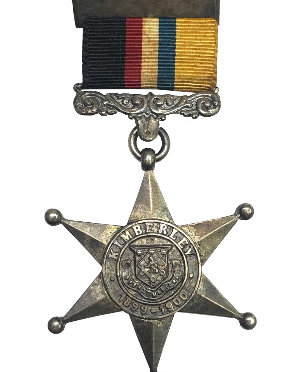
The Kimberley Star is a six-pointed star with ball finials and a circular center and measures 43 millimeters high and 41 millimeters wide.

On the obverse is the inscription “KIMBERLEY 1899-1900” with the civic arms in the middle. The reverse is plain, except for the inscription “MAYOR’S SIEGE MEDAL 1900”. The medal’s ribbon is half yellow, half black, separated by narrow stripes of red, white and blue.

The suspension is a plain ring from a scrolled bar.

The Medal

The Kimberley Medal is a circular, struck in silver and measures 38 millimeters in diameter.

The obverse features the figure of Victory above the Kimberley Town Hall, with the dates 1899-1900 in the exergue. The reverse bears two shields with the inscription “INVESTED 15 OCT. 1899” and “RELIEVED 15 FEB. 1900”. The imperial crown appears above and the royal cipher underneath, with the legend “TO THE GALLANT DEFENDERS OF KIMBERLEY” around the circumference.

The Uganda Star

The Uganda Star is a British campaign medal approved by the Foreign Office and sanctioned by Queen Victoria in 1897 to acknowledge the loyalty of African tribal leaders.

In a few cases, the medal was also awarded to Sudanese troops (one Tunisian) who fought gallantry in quelling the serious mutiny of Sudanese troops of the Uganda Rifles.

It was for this action that British, Indian and Local forces were awarded to East and Central Africa Medal with the bar for Lubwa’s.

Only a total of 39 stars were awarded.

The Uganda Star Design

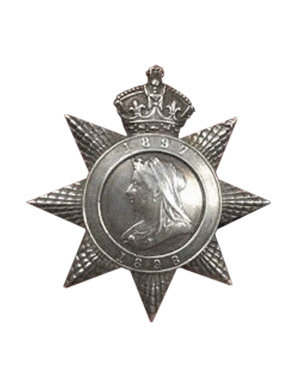
The medal is an eight-pointed uniface star struck in silver and surmounted by a crown. It was manufactured by Carrington of London and issues in a blue plush-lined case.

The obverse shows the dates 1897 and 1898 on a circular rim enclosing the Old Head or Veiled Bust of Queen Victoria. The reverse is plain.

The medal was awarded without a ribbon and was brooch-mounted.

The General Gordon’s Star for the Siege of Khartoum

The General Gordon’s Star for the Siege of Khartoum is a British campaign medal established in 1884 and created by Charles Gordon to boost the morale of the garrison at Khartoum.

Several serious defeats of Egyptian forces in 1884 led to a concerted British campaign in defence of Egyptian claims, but control could not be recovered. The British withdrew their forces to Egypt and to Khartoum, where General Gordon defended the city whilst awaiting a relief column that, beset by Mahdist attacks, arrived too late. Gordon had the star cast locally in a sand mould, using his own breast star of the Turkish Order of Mejidieh as the model.

When a recipient had to purchase their medal, the proceedings went to a fund to feed the poor. Payne reported a story which suggests that owners of these stars became particular targets of the Mahdi’s vengeance.

The General Gordon’s Star for the Siege of Khartoum Design

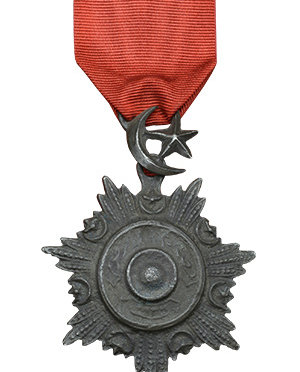
The medal is a seven-pointed silver or pewter star measuring 80 mm high and 54 mm wide, with three concentric circles and seven groups of rays. On each ray are superimposed seven crescents and stars.

The obverse depicts a central boss in a circle with three Arabic enclosed inscriptions and chevrons between them. The reverse is plain.

The medal is suspended by a ring from a Crescent and Star ornament. The ribbon is deep blue or red.

The Khedive’s Star

The Khedive’s Star is a campaign medal established in 1882 by Khedive Tewfik Pasha to reward those who had participated in the military campaigns in Egypt and Sudan between 1882 and 1891.

The British success in the war strengthened the position of the Khedive of Egypt, Tewfik Pasha, a supporter of the British government, who decided to reward all British and Indian soldiers who took part in the fighting and who had received the British Egypt Medal.

The award included British forces who served during the 1882 Anglo-Egyptian War and the subsequent Mahdist War, who received both the British Egypt Medal and the Khedive’s Star. The Khedive also made a small number of awards of the Star to Egyptian civilians for non-military service.

Because the award was frequently worn alongside the Egypt Star, it frequently suffered abrasion from its points.

The Khedive’s Star Design

The medal is a five-pointed bronze star darkened by means of lacquer. It was manufactured by Henry Jenkins and Sons of Birmingham, who also made the Kabul to Kandahar Star of 1880.

The obverse depicts, in the centre of the star, an image of the sphinx with the pyramids in the background, all within a ring bearing the word “EGYPT” and the appropriate date, under the corresponding Arabic inscription. The reverse bears the monogram of Tawfiq Pasha, crowned.

The suspension bar for the blue 37 mm wide ribbon bears a crescent and a star. The medal was issued unnamed, although some recipients arranged privately for their details to be engraved on the reverse.

The Imperial Order of Elizabeth and Theresa

The Imperial and Royal Decoration of Elizabeth and Theresa was a decoration of the Austro-Hungarian Empire, created in Vienna in 1750.

The Imperial and Royal Decoration of Elizabeth and Theresa (or Elisabeth-Theresien-Orden in German) was a decoration of the Austro-Hungarian Empire, created in Vienna in 1750 by Elisabeth Christine of Brunswick-Wolfenbüttel, widow of Charles VI, Holy Roman Emperor, in her testament, to reward the deserving officers who distinguished in battles.

The number of awarded officers reached hardly 20 originally. Those had to serve faithfully in the army of the House of Austria for 30 years and have reached at least the rank of colonel, and had to be inscribed in the Court Council of War, but without distinction of fatherland, birth, or religion. The Order only has one rank: Knight.

The Order was granted with 16,000 florins of annuity to be divided among the recipients. There were originally three grades of annuity: 1000, 800, and 500 florins.

The Imperial and Royal Decoration of Elizabeth and Theresa was revised in 1771 by her daughter Empress Maria Theresa I, as the Elizabetho-Theresian Military Foundation (Elisabeth-Theresianische Militärstiftung). The yearly pension amount was reviewed and the number of maximum members was settled in 21.

The Order was canceled by the Austrian Republic in 1918.

The Order of Elizabeth and Theresa Design

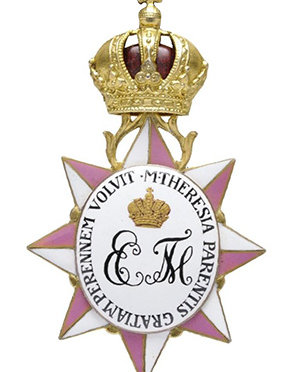
The decoration consists of a star of gold with eight triangles enameled in half-red, half-silver and supported by the imperial crown. It’s charged with an oval shield in the heart with the initials of the two empresses (“ECMT” for Elizabeth Christine Maria Theresa), all topped by a crown, surrounded by the legend: “MARIA THERESIA PARENTIS GRATIAM perennem VOLUIT”.

The ribbon of the Order is black. The decoration was hanging from a triangular knot of that black ribbon on the left chest.

The Imperial Service Order and Medal

The Imperial Service Order is a decoration of Great Britain established by King Edward VII in August 1902 and awarded on retirement to the administration and clerical staff of the Civil Service throughout the British Empire for long and meritorious service.

A person must have served for 25 years at home, 20 years and 6 months in India and 16 years in the tropics to become eligible. In exceptional cases, awards were made for “eminently meritorious service” irrespective of the qualifying period.

There is one class: Companion. Both men and women are eligible, as women were admitted in 1908. and recipients of this order are entitled to use the post-nominal letters ‘ISO’. No awards have been made since 1995.

The Imperial Service Medal was instituted at the same time as the ISO but was intended for junior grades of the Civil Service.

The Imperial Service Order Design

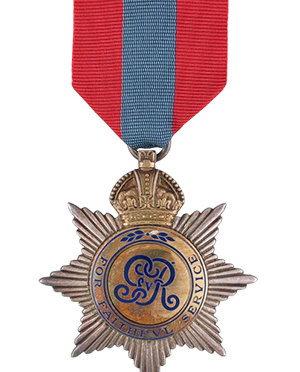
The medal is struck in silver with gold overlay and measures 61 mm high and 55 mm wide.

The insignia of the order for men is an eight-pointed silver star, with the top ray obscured by a crown; the golden central medallion bore the cipher of the reigning monarch surrounded by the legend ‘For Faithful Service‘. The medal is suspended on a ribbon of crimson with a blue central stripe. The insignia for women is the same medallion as for men, surrounded by a silver laurel wreath and topped by a crown, suspended on a bow of crimson with a blue central stripe. The medal is struck in silver and bronze, circular and measures 32 mm. In 1920 it was transformed from a silver plaque into a circular medal with the sovereign’s effigy on the obverse, and a reverse depicting a naked man resting from his labors. The exergue reads “FOR FAITHFUL SERVICE”.

The ribbon measures 38 mm wide and has three equal sections of crimson, blue and crimson.

The George VI issue comes in two types: The early ones with GRI cypher, and the later with CVIR.