The Order of Service Merit

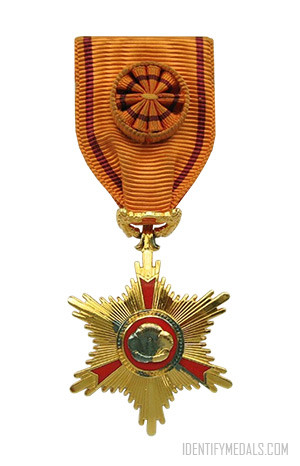
The Order of Service Merit (근정훈장 in Korean) is one of South Korea’s orders of merit.

The Order is awarded by the President of South Korea to public officials, private school teachers, and special post office employees for “outstanding meritorious services by applying himself/herself to his/her duties.”

The Order of Service Merit is divided into five grades:

  • ROK Order of Service Merit (1st Class) Blue Stripes.png 1st Blue Stripes (청조)
  • ROK Order of Service Merit (2nd Class) Yellow Stripes.png 2nd Yellow Stripes (황조)
  • ROK Order of Service Merit (3rd Class) Red Stripes.png 3rd Red Stripes (홍조)
  • ROK Order of Service Merit (4th Class) Green Stripes.png 4th Green Stripes (녹조)
  • ROK Order of Service Merit (5th Class) Aquamarine Stripes.png 5th Aquamarine Stripes (옥조)

The Order of Military Merit Design

All classes of the Order, established in 1961, had the same ribbon color and stripe pattern (yellow with two navy blue stripes). To distinguish them, there were different attachments added to the bar, with no attachment for the 7th class. These could be auspicious clouds and/or bamboo leaves struck in different materials.

In 1962, all pendants were made smaller and the ribbon colors were changed. There were further changes in 1967, 1969, 1971, 1973, and 1984. Since then, the Order has had five classes.
The Order of Civil Merit or Order of the White Star

  • Time Period: Post-WW2
  • Institution: 22 December 1951 (as Order of the White Star)
  • Country: South Korea

The Order of Civil Merit (국민훈장 in Korean) is one of South Korea’s orders of merit. It is awarded by the President of the country for “outstanding meritorious services in the area of politics, economy, society, education, art or science in the interest of improving citizens’ welfare and promoting national development.” The Order was awarded to government employees who distinguished themselves with outstanding services in the performance of their duties. Military personnel and civilian employees were excluded from this award.

The Order is based on the Order of the White Star, which was translated as Order of Civil Merit in the 1958 and 1964 versions. In 1967, the Order was renamed to The Order of Service Merit.

The Order of Civil Merit is divided into five grades:

  • ROK Order of Civil Merit (1st Class) Mugunghwa Medal.png 1st Mugunghwa Medal (무궁화장)
  • ROK Order of Civil Merit (2nd Class) Moran Medal.png 2nd Moran Medal (모란장)
  • ROK Order of Civil Merit (3rd Class) Dongbaek Medal.png 3rd Dongbaek Medal (동백장)
  • ROK Order of Civil Merit (4th Class) Mongnyeon Medal.png 4th Mongnyeon Medal (목련장)
  • ROK Order of Civil Merit (5th Class) Seongnyu Medal.png 5th Seongnyu Medal (석류장)

The Order of Civil Merit Design

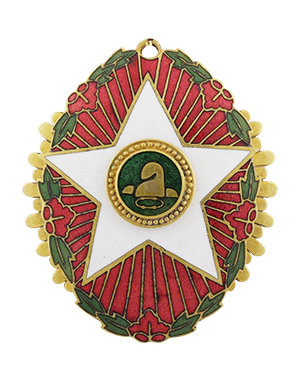
The Order of Civil Merit has four classes. Its design shows a cap in the center of the star, with a chain band around it and a small ring, which binds the ribbon to the cap.

This symbol represents the formal dress of civil officials during the Yi Dynasty (1392-1910). The Mungunghwa and its leaves symbolize national prosperity. The sun rays, national prestige. And the books or scrolls on the suspension the knowledge and wisdom expected from government officials.

The Order of the Sacred Tripod

The Order of the Sacred Tripod or Pao Ting is a military award of the Rep. of China created in 1929 for contributions to national security.

The Order of the Sacred Tripod (or 寶鼎勳章 in Chinese), also referred to as the Order of the Precious Tripod or Pao Ting, is a military award of the Republic of China created on 15 May 1929 and awarded for significant contributions to national security.

The medal is the general medal of the three services of the Republic of China to commend those who defend against foreign aggression. Its rank is lower than the Blue Sky and White Sun Medal and higher than the Yun Yun Medal.

The order is organized into nine grades:

  • 1st, with Special Grand Cordon.
  • 2nd, with Grand Cordon.
  • 3rd, with Red Grand Cordon.
  • 4th, with Special Cravat.
  • 5th, with Cravat.
  • 6th, with Special Rosette.
  • 7th, with Rosette.
  • 8th, with Special Ribbon.
  • 9th, with Ribbon.

The grade received vary according to military rank. The first to fourth are awarded to general officers. The third to sixth ranks are awarded to school officers. The fourth to seventh ranks are awarded to lieutenants. Waiting officers, warrant officers, and soldiers are awarded the sixth to ninth class.

The Order of the Sacred Tripod Design

The central design of the order’s insignia is an image of a tripod surrounded by golden rays. The symbolism of this is that as the tripod is considered a national treasure, so too is the recipient of the order.

The Order of Liberation

The Order of Liberation is a Chinese military award given to heroes of the Liberation of mainland China during the Second Chinese Civil War.

The Order of Liberation (解放勋章 in Chinese, Jiěfàng Xūnzhāng in pinyin) was a Chinese military award awarded to heroes of the Liberation of mainland China during the Second Chinese Civil War between 3 September 1945 and 30 June 1950.

The Order was established by the Standing Committee of the National People’s Congress and awarded by the President of the People’s Republic of China. The recipients of the award were the soldiers and civilian personnel of the Chinese People’s Liberation Army and the former members of the Republic of China Army who participated in the uprising.

The medal was awarded in three grades:

  • First Class Medal.
  • Second Class Medal.
  • Third Class Medal.

The Order of Liberation Design

The liberation medals bear a central red star and Tiananmen Square. It’s rumored that the First Class Liberation Medal is struck in pure gold.

The ribbon has one, two, or three red vertical red bars on a yellow background, depending on the class.

The Order of Independence and Freedom

The Order of Independence and Freedom is a military award of the Rep. of China created in 1955 and given for conspicuously gallantry.

The Order of Independence and Freedom (独立自由勋章 in Chinese, Dúlì Zìyóu Xūnzhāng in pinyin) was a military award from the People’s Republic of China created in 1955. It was decided by the Standing Committee of the National People’s Congress and awarded by the President of the People’s Republic of China. The medal was in use since 1955 but has now been suspended.

The Order was given in recognition to men who distinguished themselves “conspicuously by gallantry and intrepidity” in combat with an enemy of China in the Second Sino-Japanese War (a military conflict primarily waged between the Republic of China and the Empire of Japan).

There are three grades for the Order of Independence and Freedom:

  • First Class Medal: Awarded to brigade-level and above of the Eighth Route Army and New Fourth Army.
  • Second Class Medal: Awarded to brigade-level and above of the Eighth Route Army, the New Fourth Army, and the Anti-Japanese Guerrilla
  • Third Class Medal: Awarded to the battalion and company ranks.

The Order of Independence and Freedom Design

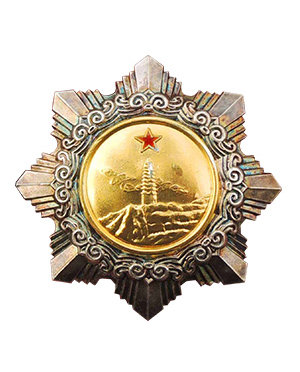
The outer contour of the medal is an octagonal star, and in the middle is the Yan’an Pagoda Mountain under the shining red star, which symbolizes the brilliance of the anti-Japanese armed forces led by Yan’an, the seat of the Central Committee of the Communist Party of China during the Anti-Japanese War.

The medal is struck in golden or gold-silver metal. The ribbon style is one to three yellow vertical bars on a green background indicating the level.

The Order of the Republic

The Order of the Republic is the highest order of honor of the People’s Republic of China. It was established on 29 September 2019.

The Order of the Republic is the highest order of honor of the People’s Republic of China. It was established on 1 January 2016 and first awarded on 29 September 2019.

The Order is awarded for great contributions to the defense of the country and outstanding service to Chinese society. Eligible recipients are military and civilians of Chinese nationality. The Order of the Republic was established by the National People’s Congress Standing Committee.

For 2019, eight people were recommended. This included researchers who participated in the development of China’s first-generation nuclear submarine. For 2020, the recognition of an exemplary figure covered outstanding contributions during the COVID-19 pandemic.

The recipients so far have been:

2019
  • Yu Min (于敏)
  • Shen Jilan (申纪兰)
  • Sun Jiadong (孙家栋)
  • Li Yannian (李延年)
  • Zhang Fuqing (张富清)
  • Yuan Longping (袁隆平)
  • Huang Xuhua (黄旭华)
  • Tu Youyou (屠呦呦)
2020
  • Zhong Nanshan (钟南山)

The Order of the Republic Design

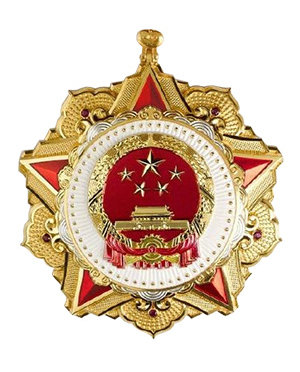
The medal is a five-pointed star in gold and red colors.

The obverse features the Yellow River, the Tangtye River, mountain peaks, and the peony flower. The medal hangs from a chain made of Chinese knots, the handicraft ruyi, orchids, andother elements. It’s decorated with filigree inlays and enamels.

The Order of Merit of the Republic of Poland

The Order of Merit of the Republic of Poland was created in 1974 and is awarded to persons who have rendered great service to the country.

  • Time Period: Post-WW2
  • Year of Institution: 10 April 1974
  • Country: Poland

The Order of Merit of the Republic of Poland (or Order Zasługi Rzeczypospolitej Polskiej in Polish) is an order of merit of Poland created in 1974, awarded to persons who have rendered great service to the country. It is granted to foreigners or Poles resident abroad. As such it is sometimes referred to as a traditional “diplomatic order“.

The order was established by an act of 10 April 1974, as the Order of Merit of the Polish People’s Republic. It was awarded in five classes: Grand Cordon of the Order, Commandery with Star, Commandery, Gold Badge of the Order, and Silver Badge of the Order. It was awarded by the Polish Council of State.

Under the 1992 act, the order is awarded to foreigners or Poles resident abroad for distinguished contributions to international cooperation or cooperation between Poland and other countries. It is awarded by the President of Poland.

From 1974 to 1991 the Order was awarded in the following classes:

  •  st class – Grand Cordon of the Order of Merit of the People’s Republic of Poland
  • 2nd class – Commandery with Star of the Order of Merit of the People’s Republic of Poland
  • 3rd class – Commandery of the Order of Merit of the People’s Republic of Poland
  • 4th class – Gold Badge of the Order of Merit of the People’s Republic of Poland
  • 5th class – Silver Badge of the Order of Merit of the People’s Republic of Poland

Since 1992 the Order is awarded in the following classes:

  • 1st class – Grand Cross of the Order of Merit of the Republic of Poland
  • 2nd class – Commander’s Cross with Star of the Order of Merit of the Republic of Poland
  • 3rd class – Commander’s Cross of the Order of Merit of the Republic of Poland
  • 4th class – Officer’s Cross of the Order of Merit of the Republic of Poland
  • 5th class – Knight’s Cross of the Order of Merit of the Republic of Poland

The Order of Merit of the Republic of Poland Design

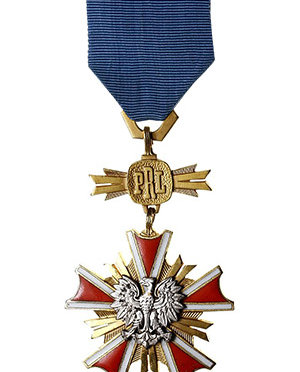
After the fall of communism in Poland in 1989, it was decided to retain the order, with necessary changes. The insignia was changed to the present ones by a presidential decree of 16 April 1991. The abbreviation “PRL” was changed to “RP,” the Eagle was given a crown in accordance with Poland’s new coat of arms, the date “1974” was removed from the reverse, and the color of the ribbon was changed from light cobalt blue to dark cobalt.

The Medal for Distinction in Military Service

The Medal for Distinction in Military Service was awarded to soldiers of the Soviet Army, Navy, border and internal troops.

The Medal for Distinction in Military Service (or Медаль «За отличие в воинской службе», Medal «Za otlichie v voinskoj sluzhbe» in Russian) was established on 28 October 1974 by Decree of the Presidium of the Supreme Soviet and awarded to soldiers of the Soviet Army, Navy, border and internal troops: for excellent performance in combat and political training; for special distinction in exercises and maneuvers in combat service and combat duty; for bravery, selflessness, and other services, shown during military service.

The award was one of the very few Soviet decorations to be retained “as is” following the dissolution of the USSR. The award was divided into two classes, first and second, the first class being the highest. They were awarded sequentially for continued merit. Each medal came with an attestation of award, this attestation came in the form of a small 8 cm by 11 cm cardboard booklet bearing the award’s name, the recipient’s particulars and an official stamp and signature on the inside.

The Medal for Distinction in Military Service Design

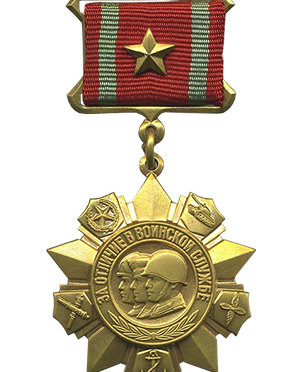
The medal is a five-pointed convex star measuring 38 millimeters wide and made of brass for the first class and cupronickel for the second class. Five shields bearing the emblems of the main branches of the service fill the gaps between its arms. 

The obverse bears a central concave medallion bearing the relief images of a soldier, sailor, and airman. The central medallion was framed by a ring bearing the relief inscription «За отличие в воинской службе» (“For Distinction in Military Service”) on the sides and top, at the bottom of the ring, two laurel branches. The plain reverse only bore the mark of the Moscow Mint «ММД» (“MMD”) at the bottom.

The medal was secured to a 29,5mm wide by 27,5mm square mount by a ring through the suspension loop. The mount was covered by a red silk moiré ribbon with two 3mm green stripes located 3mm from the ribbon edges.

The Order for Personal Courage (USSR)

The Order for Personal Courage was awarded to any USSR citizen showing outstanding courage and bravery during keeping of public order.

The Order for Personal Courage (or Орден «За личное мужество», Orden «Za lichnoe muzhestvo» in Russian) was established on 28 December 1988 and awarded to any USSR citizen showing outstanding courage and bravery during life-saving, keeping of public order and safeguard of State property, as well as for fighting crime, environmental catastrophes, and other exceptional events.

The order was first awarded on February 3, 1989, to a teacher of school No. 42 in the city of Ordzhonikidze (now Vladikavkaz) Natalia Vladimirovna Efimova. Her class was taken hostage and later freed in a police operation.

The Order for Personal Courage Design

The award was designed by Alexander Zhuk and represents a silver gilded silver star with the words «За личное мужество» (“For Personal Courage”) and CCCP (“USSR”) written on it.

Many medals were made but were mostly unissued.

The ribbon is red with three thin white lines on each side.

The USSR Mother Heroine Medal

The USSR Mother Heroine Medal was an honorary title established in 1944 and awarded to all mothers bearing and raising 10 or more children.

The USSR Mother Heroine Medal (or Мать-героиняMat’-geroinya in Russian) was an honorary title established on 8 July 1944 and awarded to all mothers bearing and raising 10 or more children.

The title was awarded upon the first birthday of the last child, provided that nine other children (natural or adopted) remained alive. Children who had perished under heroic, military, or other respectful circumstances were also counted. The title was accompanied by the bestowal of the Order “Mother Heroine” and a certificate conferred by the Presidium of the Supreme Soviet of the Soviet Union.

The state’s intent was not only to honor such large families but also to increase financial assistance for pregnant women, mothers of large families, and single mothers, and to promote an increased level of health in mother and child.

The award was established in 1944 and continued to exist until the fall of the Soviet Union in 1991. Approximately 430,000 women were awarded this title during its existence.

The USSR Mother Heroine Design

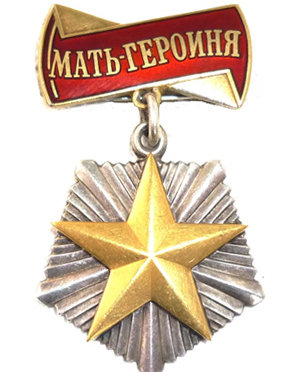
The medal is a solid gold star superimposed on a silver pentagon with rays facing outwards. It measures 30.74 mm in height including the eyelet and 27.27 mm in width. It weighs 12.1 gram without and 16.2 gram with suspension.

The suspension is a bar decorated in red enamel and bearing the words “Мать-героиня” (Mother Heroine).