The Royal Victorian Order

The Royal Victorian Order is a dynastic order of knighthood established in 1896 by Queen Victoria for distinguished service to the monarch.

The Royal Victorian Order is a dynastic order of knighthood established in 1896 by Queen Victoria to recognize distinguished personal service to the monarch of the Commonwealth realms, members of the monarch’s family, or to any viceroy or senior representative of the monarch. There is no limit on the number of individuals honored at any grade, and admission remains at the sole discretion of the monarch.

The reigning monarch is at the apex of the Royal Victorian Order as its Sovereign, followed by the Grand Master. The Order has five grades and one medal with three levels representing different levels of service. All those honored may use the prescribed styles of the order. The order’s motto is Victoria, and its official day is 20 June and its chapel is the Savoy Chapel in London.

The grades are as follows:

  • Knight / Dame Grand Cross.
  • Knight / Dame Commander.
  • Commander.
  • Lieutenant.
  • Member.

The Royal Victorian Order Design

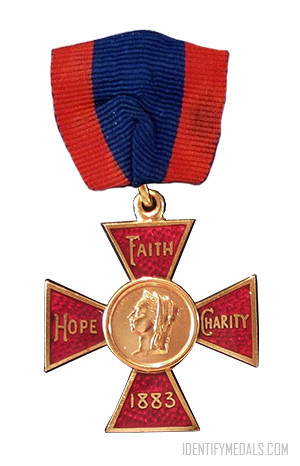
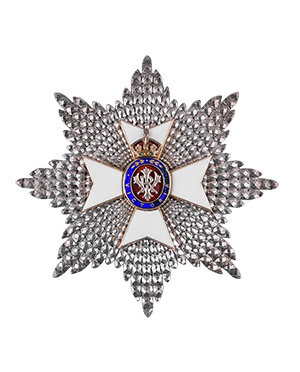
The badge of the Order is a Maltese cross with a central medallion depicting on a red background the Royal Cypher of Queen Victoria, surrounded by a blue ring bearing the motto of the order—VICTORIA—and surmounted by a Tudor crown and worn on a sash depending on the grade. For Knights and Dames Grand Cross, Commanders, and Lieutenants, the Maltese cross is rendered in white enamel with gold edging, while that for Knights and Dames Commander and Members is in silver. The size of the badge also varies by rank, that for the higher classes being larger.

The medal bears the effigy and name of the reigning sovereign at the time of its awarding, as well as the phrase DEI • GRATIA • REGINA (or REX) • F.D. (by the grace of God, Queen (or King), Defender of the Faith), and on the reverse is the Royal Cypher upon an ornamental shield within a laurel wreath.

The ribbon is blue with red-white-red stripe edging, and at formal events, or collar days, Knights and Dames Grand Cross wear the Royal Victorian Order’s livery collar, consisting of an alternating string of octagonal gold pieces.

The Order of St. Patrick

The Order of St. Patrick is a dormant British order of chivalry created in 1783 to reward the Irish during the American War of Independence.

The Order of St. Patrick (or The Most Illustrious Order of Saint Patrick) is a dormant British order of chivalry created in 1783 by George III to reward the loyalty of Irish peers during the American War of Independence. The knights of Saint Patrick lasted until 1922, when most of Ireland gained independence as the Irish Free State.

The patron of the Order is St Patrick, and its motto is “Quis separabit?” or “Who will separate [us]?” in Latin, an allusion to the Vulgate translation of Romans 8:35, “Who shall separate us from the love of Christ?

No knight of St Patrick has been created since 1936, and the last surviving knight, Prince Henry, Duke of Gloucester, died in 1974. The Queen, however, remains the Sovereign of the Order. Its equivalent in England is The Most Noble Order of the Garter, dating to the middle fourteenth century, and in Scotland it’s The Most Ancient and Most Noble Order of the Thistle, in its modern form to 1687.

The Order of St. Patrick Design

The star of the Order is an eight-pointed figure, with the four cardinal points longer than the intermediate points. Each point is a cluster of rays. In the center is the same motto, year, and the saltire cross of St Patrick in red enamel. The star was worn pinned to the left breast. The chain is made of gold and composed of six harps and six roses, the last alternating with white and red petals. The badge is pinned to the riband at the left hip. Made of gold, it depicts a shamrock bearing three crowns, on top of a cross of St Patrick and surrounded by a blue circle bearing the motto as well as the date of the Order’s foundation in Roman numerals (“MDCCLXXXIII“). The broad riband is a celestial blue sash worn across the body, from the right shoulder to the left hip.

For important occasions, such as Coronations, Knights of St Patrick wore elaborate vestments consisting of: The mantle, a celestial blue robe lined with white silk and a blue hood, the hat of the Order, changed from white satin to black velvet by George IV, plumed with three falls of feathers, one red, one white and one blue, and the collar, made of gold and consisting of Tudor roses and harps attached with knots and a central harp, from which the badge of the Order is suspended, surmounted by a crown.

Unlike the other two great orders, the sash is worn in the manner of the lesser orders, over the right shoulder.

The Order of the Thistle

The Order of the Thistle is an order of chivalry revived by King James VII of Scotland (James II) in 1687 and re-established in 1703.

The Order of the Thistle (or The Most Ancient and Most Noble Order of the Thistle) is an order of chivalry revived in 1687 by King James VII of Scotland (James II of England and Ireland). It’s believed the original Order dates back to 787 AD and alludes to .barefoot enemy soldiers who cried out when they trode on thistles, alerting the Scots of an imminent attack. The Order was re-established again by Queen Anne in December 1703.

It consists of the Sovereign and sixteen Knights and Ladies, as well as “extra” knights among which are members of the British Royal Family and foreign monarchs.

The Sovereign alone grants membership of the Order. The Order of the Thistle, which pertains to Scotland, is the second most senior in precedence in the United Kingdom. Its equivalent in England is The Most Noble Order of the Garter, dating to the middle fourteenth century. At death, the official insignia is returned to the Central Chancery.

The Order of the Thistle Design

The Order’s primary emblem is the thistle, the national flower of Scotland. Its motto is Nemo me impune lacessit (or “No one provokes me with impunity” in Latin).

The star of the Order is a silver St Andrew’s saltire, with clusters of rays between the arms thereof. In the center is depicted a green circle bearing the motto of the Order in gold; within the circle, there is depicted a thistle on a goldfield. The star is worn pinned to the left breast. The badge of the Order depicts St Andrew in the same form as the badge-appendant, surrounded by an oval collar bearing the Order’s motto, and surmounted by a gold cord fitted with a ring for suspension. There are examples of it in plain gold, or with enameling and set with jewels. 

For the Order’s great occasions, as well for coronations, the Knights and Ladies wear an elaborate costume consisting of: The mantle, a green robe worn over suits or military uniforms and lined with white taffeta, tied with green and gold tassels. The hat, made of black velvet and plumed with white feathers with a black egret’s or heron’s top in the middle, the collar, made of gold and depicting thistles and sprigs of rue, and the St Andrew, or badge-appendant, worn suspended from the collar.

The ribbon is plain dark green.

Find This Medal

Right Now on eBay 
Clicking a link to eBay may result in a referral commission being paid if a purchase is made.
Loading...

The Cross of Honor for Military Service Abroad

The Cross of Honour for Military Service Abroad (Croix d’Honneur pour Service Militaire à l’Étranger / Erekruis voor Militaire Dienst in het Buitenland) is a Belgian military decoration established on 16 June 1997 and originally awarded to Belgian servicemen who served for a long period of time in the Federal Republic of Germany, Zaire (now Congo), Rwanda or Burundi.

The medal was awarded in three classes, based on the duration of service in the relevant territory:

  • First Class is awarded for 15 years of service;
  • Second Class for 10 years of service;
  • Third Class for 5 years of service.

Depending on the region where the services were performed, one year of actual service may count for more than one year for the purpose of awarding the Cross of Honor.

The Cross of Honor for Military Service Abroad Design

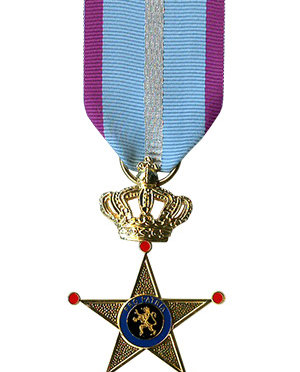
The medal is a gold star with a red pearl at each tip, suspended to the ribbon by a royal crown and a ring.

The obverse bears a central medallion with a golden lion on a black enameled background surrounded by a ring of blue enamel with the motto in gold letters Pro Patria. The reverse bears a crown of laurels surrounding two crossed swords.

The ribbon is azure blue with a purple vertical border on each side and in the center a vertical stripe the color of which depends on the class: gold for first-class, silver for second class, and red for third class.

The Blood Donor’s Medal

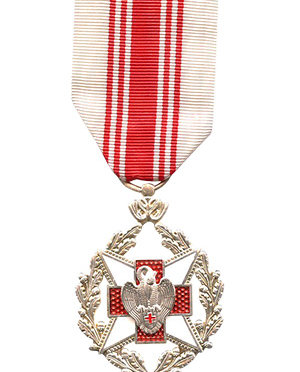
The Blood Donor’s Medal (Médaille de Donneur de Sang / Bloeddonor Medaille) is a Red Cross Belgian medal awarded for blood donations.

The Blood Donor’s Medal (Médaille de Donneur de Sang / Bloeddonor Medaille) is a Red Cross Belgian medal.

A circular bronze badge was awarded for 25 to 40 blood donations, a bronze medal for 40 to 60 donations and a silver medal for 60 to 80 donations.

Find Red Cross Medals Online

More Red Cross Medals

The 1830 Star of Honor

The 1830 Star of Honor (Étoile d’Honneur 1830) was established on 14 January 1831 by the provisional government in favor of the patriots who had distinguished themselves during the events of the Revolution.

The award was given to the patriots “who ensured the independence of the country” and for acts of bravery “leading to triumphant freedom“. Only services rendered before September 1, 1830 counted.

Right after being established, it was determined that the Provisional Government did not have the legal authority to create such a reward, and a law passed on May 28 of the same year preventing its award.

The 1830 Star of Honor Design

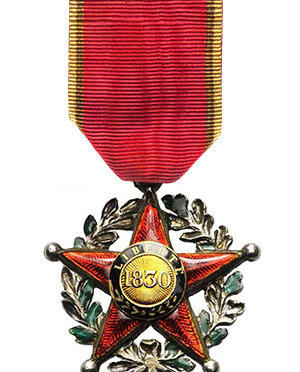
The badge is a red enameled star with 5 arms, placed on a laurel and oak crown in green. The obverse has, in the center, two circles: one black with the words PATRIE and laurel leaves the second smallest golden with a lion. The reverse is composed of two circles, one black marked LIBERTE and laurel leaves, the second smaller gilded with 1830.

The award was given in three classes:

  • 1st class: In gold, it had a diameter of 40mm.
  • 2nd class: Identical but 30mm in diameter.
  • 3rd class: In silver and 30mm in diameter.

The ribbon is red, with a yellow and black border on each side.

The Order of the African Star

The Order of the African Star (Orde van de Afrikaanse Ster / Ordre de l’Étoile africaine) was established on 30 December 1888 by Leopold II of Belgium and awarded for services to Congo and for the “promotion of African civilization in general”.

The Order was incorporated into the Belgian honors system on 10 October 1908 following the annexation of the Congo Free State by Belgium. The motto of the Order is “Labour and progress”. The Grand Master is the King of the Belgians, and although the Congo is no longer a Belgian colony, it is still considered to be a Belgian Order by tradition.

The Order of the African Star Design

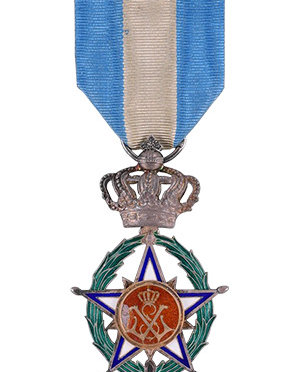
The Badge is a white enameled five-pointed star with blue borders, surrounded by a crown of green enameled palm leaves. The central disk shows a gold star on blue enameled background surrounded by a gold ring displaying the motto of the order: Travail et Progrès (work and progress). The reverse is similar but with a red central disc and a stylized ‘double L’ crowned Leopold II monogram superimposed. The badge is topped by a royal crown.

The medal of the order is round with a suspension in the form of a royal crown with two pendelia and a ribbon ring. The obverse bears a finely ribbed central area with bead surround and a star superimposed and the motto of the order: Travail et Progrès (work and progress).

The ribbon is azure blue with a large central pale yellow stripe. When awarded in wartime, it may be adorned with a silver of gold palm.

The Order of The Balkan Mountains

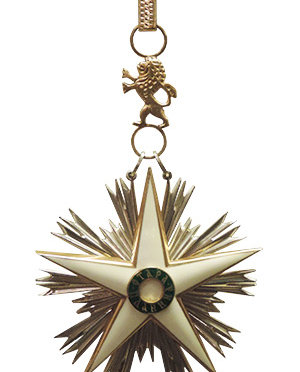
The Order of The Balkan Mountains is a Bulgarian medal established on 4 August 1966 and awarded to statesmen, ministers, diplomats, civil servants, and foreign citizens for the establishment and strengthening of friendly international relations with The People’s Republic Of Bulgaria.

If awarded for Military relationships the award was presented with swords. Designed by V. Starchev and K. Damjanov.

The Order Of Bravery (Bulgaria)

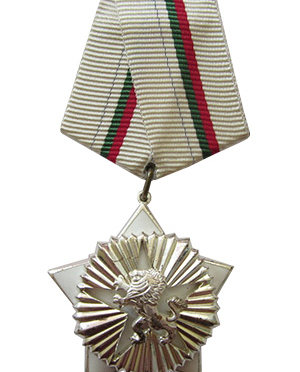
The Order Of Bravery is a Bulgarian medal awarded to Military Personnel and Civilians for bravery and courage in battle or for strengthening the integrity of the country and public safety.

Foreign soldiers of allied armies could also be awarded this order for participation in joint combat operations. There are two variations of this award, originally one which is numbered and then issued later, one which is unnumbered.