The Order of People’s Liberty

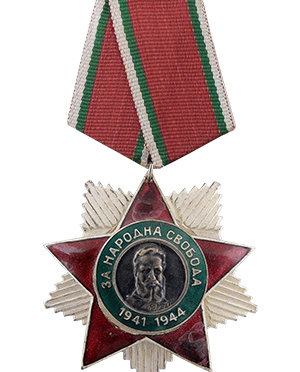
The Order of People’s Liberty is a Bulgarian Order established in 1945 and awarded to Bulgarian and foreign citizens for the participation in the revolutionary fight of Bulgarian people.

The Order of People’s Liberty Design

The medal was designed by B. Angelushev and was worn as a screw-back badge until 1960 (and from then on worn on a 5 sided soviet style suspension).It’s made of silvered bronze with red and green enamels, and measures 49.5 mm x 51.5 mm.

There are 4 variations of this award’s construction: A five-piece breast star (1945-1949), a four-piece breast star (1949-1958), a four-piece on a ribbon (1958-c1970) and a single piece on a ribbon (c1970 onwards).
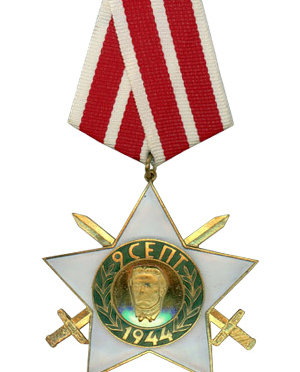
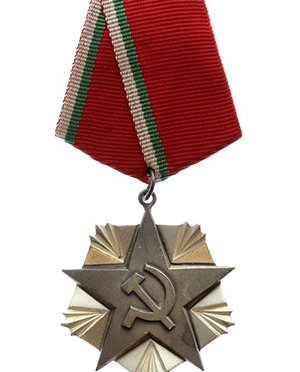
The Order of The 9 September 1944

The Order of The 9 September 1944 is a Bulgarian Order awarded to Bulgarian and foreign citizens who took part in the armed insurrection of 9 September 1944 and later to participants in the founding and consolidating of the people’s authority.

The Order was created on the first anniversary of the seizure of power by the Bulgarian Communists backed by the Soviet Russian Red Army and awarded to those who had participated actively in the fight against Nazi German forces and had worked actively to establish a Communist regime in Bulgaria.

There are 2 variations of this award for civilians and for military personnel, the military variation having additional swords. The Order was canceled in 1991.

The Order of The 9 September 1944 Design

The medal was designed by B. Angelushev and produced initially by the Strahil Miloshev workshops, later by the State Mint, Sofia. It was worn on a plain red neck ribbon until 1958, and from then on worn on a 5 sided soviet style suspension on the chest.

The National Order Of Labour

Time Period: Post-WW2
Year of Institution: 1945
Country: Bulgaria

The National Order of Labour was an Order of Merit awarded to Bulgarian and foreign citizens for excellence of outstanding achievements or innovations or excellence in organisation, as well as to artists and scientists for long service to the nation. It was established during the Kingdom of Bulgaria from 1945 to 1946, and continued through the People’s Republic of Bulgaria from 1946 to 1990.

The Order existed in three grades:

  • Knight/Dame Commander,
  • Knight/Dame Officer, and
  • Knight/Dame.

The National Order of Labour Design

Awarded until 1955 with either a tri-fold ribbon for males or a bow for females, after which the ribbon device was a 5 sided soviet design. The original design was created by D. Uzunov And L. Dimitrov. From 1977 the order was redesigned by B. Kozarevym and M. Markovym to a 5 sided star shape. The ribbon was red with a thin green stripe and a thin white stripe on the edge (the colors of the Bulgarian flag).

The Hero of Maternal Glory Medal

Time Period: Post-WW2
Year of Institution: 1950
Country: Bulgaria

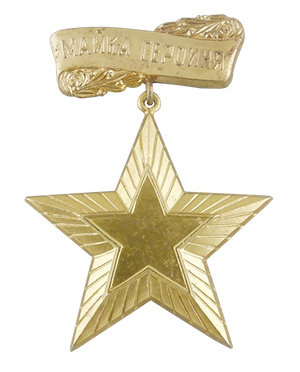
The Hero of Maternal Glory Medal is a Bulgarian honorary title awarded to mothers who gave birth to and raised ten or more children. It was established by a decree of the Presidium of the First National Assembly on December 13, 1950, and until June 9, 1952. Originally named Hero Of Maternal Glory, this award was renamed Mother Heroine on 9 June 1952.

The medal is the sixth of ten honorary titles in the award system of the People’s Republic of Bulgaria. The change of the original name was dictated by the establishment of the three-degree Mother’s Glory Order, which has a different status of the honorary title.

The Hero of Socialist Labor Medal (Bulgaria)

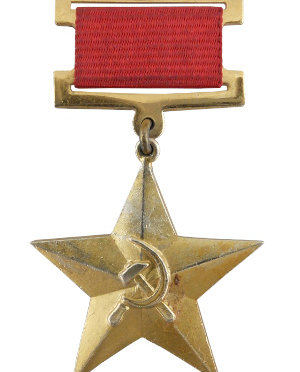
The Hero of Socialist Labour Medal is a Bulgarian Honorary Title awarded for exceptional achievements in the sphere of agriculture, science, education, culture, arts as well as for contributing to technical progress.

People awarded with this also received the Order Of George Dimitrov. The medal was renamed Hero Of Socialist Labor from Hero Of Labor on 13 December 1950.

The Hero of the People’s Republic of Bulgaria Medal

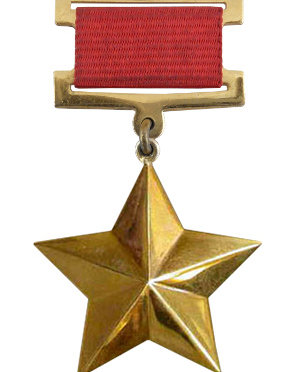
The Hero of the People’s Republic of Bulgaria (or “Герой на Народна република България” in Bulgarian) is an honorary title awarded to Bulgarian and foreign citizens for merits in defending Bulgaria and other countries allied to Bulgaria.

The medal was established on 15 June 1948, and awarded until 1990. It was the highest honor of the People’s Republic of Bulgaria.

The Society of the Army of the Potomac Medal

The Society of the Army of the Potomac was a military society founded in 1869 from officers and enlisted men of the Army of the Potomac.

The Society of the Army of the Potomac was a military society founded in 1869 from officers and enlisted men who served with the Army of the Potomac during the American Civil War.

When the Society of the Army of the Potomac was founded, Lieutenant General Philip Sheridan was elected as its first president. A total of 12 vice presidents were also elected, representing 10 corps which served with the army as well as the artillery and the general staff.

As the Society did not provide for hereditary membership, it gradually diminished as the veterans of the Civil War died off during the early twentieth century. It held its last annual reunion in 1927.

The Society of the Army of the Potomac Medal Design

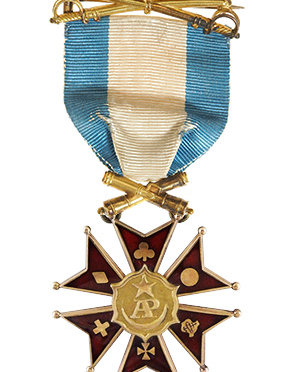
The elaborate insignia was made of gold and manufactured by Bailey, Banks and Biddle jewelers of Philadelphia. It has a top piece of crossed cavalry sabers, a blue and white ribbon, a pair of crossed cannons below the ribbon, and a planchet in the form of a six-armed cross enameled in red with the badges of six of the corps assigned to the army. In the center of the cross is a seal with a crescent moon, a star, and a cipher of the letters A and P.

The Gallipoli Star or 1915 Turkish Campaign Star

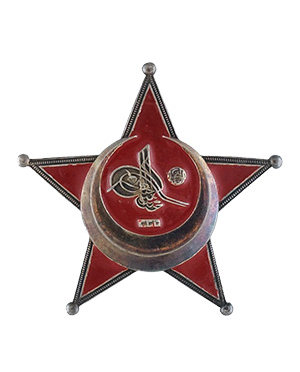
The Gallipolli Star or Ottoman War Medal is a military decoration awarded by the Ottoman Empire and instituted in 1915 for gallantry in battle.

The Gallipolli Star or Ottoman War Medal (Harp Madalyası in Turkish) is a military decoration awarded by the Ottoman Empire and instituted by Sultan Mehmed V on 1 March 1915 for gallantry in battle. This was the “entry level” gallantry award of the Turkish military in World War I, ranking below the silver Liyakat Medal.

The decoration was awarded to Ottoman and other Central Powers troops, primarily in Ottoman areas of engagement. It wasn’t a campaign medal, but a medal for military merit.

The decoration is the only Ottoman one which not awarded by authority of the Sultan, but rather was authorized by Enver Pasha, the Commander-in-Chief of the Ottoman military.

The Gallipoli Star Design

The Gallipoli Star is made of nickel-plated brass and measures 56 mm across the diagonal span of the arms. The tips of the star are capped by ball finials and enclosed in a raised silver edge with the field in red lacquer or enamel. A raised crescent, open at the top, encircles the center of the badge.

Inside the crescent on the obverse is the tughra or cipher of the decoration’s creator, Sultan Mehmed V Reşâd, over the date 1333 AH (AD 1915). The reverse is flat, unadorned and has a straight pin.

The original issue pieces of this award came in two varieties: silvered brass with red enamel and white metal with thin red lacquer. Those medals issued to officers were enameled and manufactured by a company that used the mark “BB&Co.“, a maker reputedly located in Berlin.

The award includes a badge, ribbon and campaign bar.

The Order of Osmanieh

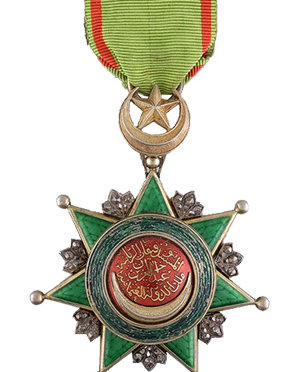
The Order of Osmanieh or Osmaniye is a civil and military decoration of the Ottoman Empire created in January 1862 by Sultan Abdülaziz.

The Order of Osmanieh or Osmaniye (or Osmanlı Devlet Nişanı in Turkish) is a civil and military decoration of the Ottoman Empire created in January 1862 by Sultan Abdülaziz.

It was awarded by the Sultan to Ottoman civil servants and military leaders for outstanding services to the state.

The order was originally established in three classes (expanded to four in 1867):

  • First class (50 members)
  • Second class (200 members)
  • Third class (1000 members)
  • Fourth class (2000 members)

The Order of Osmanieh Design

The badge of the order is a seven-pointed star in dark green enamel, with three short silver rays between each point of the star. In the obverse, the center medallion is in gold, with a red enameled field surrounded by a green enameled band. In the red central portion is a raised gold crescent, and a calligraphic inscription reading “Relying on the Assistance of Almighty God, Abdulaziz Khan, Sovereign of the Ottoman Empire“.

The reverse center medallion is silver, bearing a trophy of arms and the year AH. 699, the year of the creation of the Ottoman Empire.

The badge is suspended by a gold crescent and star, facing upwards.

The 9/11 Heroes Medal of Valor

The 9/11 Heroes Medal of Valor is a decoration presented by Pres. George W. Bush that honors public safety officers killed in 9/11.

The 9/11 Heroes Medal of Valor is a decoration in the United States presented by President George W. Bush and created specifically to honor the 442 public safety officers who were killed in the line of duty during the September 11, 2001 terrorist attacks at the World Trade Center and the empty wing of The Pentagon.

The Medals were presented by the President to the families of the fallen officers at The White House on September 9, 2005. During the ceremony nearly 4 years after the devastating terrorist attacks, President Bush would honor the lives of the public safety officers who died in the line of duty as well as comfort the families who were left behind and accepted the medals in remembrance of their deceased relatives. Around 1,200 family members and friends showed up at the ceremony to honor their friends and relatives who died on September 11.

Although not every name could be listed in President Bush’s brief speech, Attorney General Alberto Gonzales read all 442 names out loud so that all who gathered could honor every individual who gave his or her life on one of the most tragic days in American history.

The 442 public service officers included 343 New York City Fire Department members, 50 Port Authority police officers and assistants, 23 NYPD officers, 3 state court officers, and members of the Secret Service, FBI, and private ambulance workers.

The 9/11 Heroes Medal of Valor Design

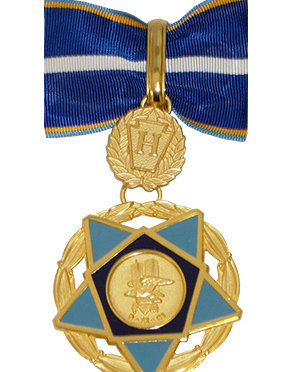
The medal intentionally resembles the Public Safety Officer Medal of Valor and the military’s Medal of Honor. It’s a gilt, light blue-enameled, five-pointed, upside-down star surrounded by a wreath of laurel.

In the obverse, the center has a dark blue-enameled pentagon representing The Pentagon, with a gilt disc bearing the twin towers of the World Trade Center, the American eagle holding the shield of the United States and laurel, and the date “9. 11. 01”.

The Medal is suspended on a gilt disc bearing a letter “H” (for Heroism) inside a keystone, (representing the Keystone State of Pennsylvania) surrounded by a wreath of laurels, which is in turn suspended on a neck ribbon, blue with gold and light blue edge stripes and a white center stripe.