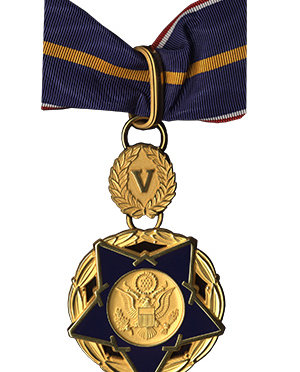
The Public Safety Officer Medal of Valor

The Public Safety Officer Medal of Valor was established in 2000 and is the highest decoration for bravery by public safety officers.

The Public Safety Officer Medal of Valor was established on June 29, 2000 by President Bill Clinton and is the highest decoration for bravery exhibited by public safety officers in the United States, comparable to the military’s Medal of Honor. The medal was originally called the Presidential Medal of Valor for Public Safety Officers.

Before the establishment of the medal, there were no Federal awards to specifically acknowledge the bravery performed by public safety officers throughout the United States (except for medals at state or government level).

Although the award is still presented by the President of the United States, it is now done in the name of the United States Congress. The Attorney General no longer makes recommendations directly to the President but can provide input into the process via the Department of Justice’s National Medal of Valor Office’s support of the Review Board.

The medal can be awarded posthumously.

The Public Safety Officer Medal of Valor Design

The medal intentionally resembles the military’s Medal of Honor and is a gilt, blue-enameled, five-pointed, upside-down star, with each arm formed by a letter “V” (for Valor), surrounded by a wreath of laurel.

In the obverse, the central disc bears the Great Seal of the United States. The reverse, the legend “FOR EXTRAORDINARY VALOR ABOVE AND BEYOND THE CALL OF DUTY” and the name of the recipient engraved at the center.

The medal is suspended on a gilt disc bearing a letter “V” surrounded by a wreath of laurels, which is in turn suspended on a neck ribbon, blue with white and red edge stripes (the national colors of the USA) and a gold center stripe (symbolizing honor). When the ribbon alone is worn, it carries a miniature gold gilt disc bearing a letter “V” surrounded by a wreath of laurels. There is also a lapel pin, which is the miniature of the medal without suspension.

Find This Medal Online

Right Now on eBay 
Clicking a link to eBay may result in a referral commission being paid if a purchase is made.
Loading...

The Hero of the Russian Federation Medal

The Hero of the Russian Federation Medal was established in 1992 and is the highest honorary title of the Russian Federation.

The Hero of the Russian Federation Medal (or Герой Российской Федерации in Russian) was established in 1992 and is the highest honorary title of the Russian Federation. It’s awarded to persons for “service to the Russian state and nation, usually connected with a heroic feat of valor”. Its recipients wear a golden star that identifies them.

The title “Hero of Russia” is a successor to Hero of the Soviet Union, which was established by Resolution of the Central Executive Committee of the Soviet Union of May 5, 1934. Following the dissolution of the Soviet Union, Russian Federation under president Boris Yeltsin retained a modified award.

The Hero of the Russian Federation Medal has been awarded more than 970 times since its establishment (440 times posthumously). 

The Hero of the Russian Federation Criteria

The title is bestowed by decree of the president of the Russian Federation and can be awarded to foreign citizens and both civilian and military personnel. The title can also be awarded posthumously if the heroic act costs the recipient his or her life.

Early recipients of the Hero of the Russian Federation Medal predominantly fell into two groups: participants in the Chechnya conflicts and cosmonauts. Many recipients were posthumously awarded the title, such as Major Denis Vetchinov, who was killed early in the 2008 South Ossetia War. This category also includes government officials who were assassinated, like Akhmad Kadyrov, the former governor of Chechnya. Kadyrov, a pro-Moscow leader, was killed in a bomb attack during the 2004 Victory Day parade in Grozny.

All Russian cosmonauts receive the Hero of the Russian Federation title following their space missions. Some cosmonauts, like Sergei Krikalev, have received both the Soviet and Russian hero titles, along with the Order of Lenin, for their distinguished service and achievements.

The Hero of the Russian Federation Medal Design

The insignia of the title is also called the “Gold Star” medal (медаль Золотая Звезда) and its design is similar to the Soviet Hero of the Soviet Union variant. It was created by the architect Miron Merzhanov.

The medal is a gold five-pointed star with smooth 15mm dihedral rays on the obverse. The otherwise plain reverse bears the prominent relief inscription in 2mm high letters “HERO OF RUSSIA” (Russian: “ГЕРОЙ РОССИИ”) at its center, in the upper portion, the award serial number in 1mm high numbers. 

The insignia is secured to a standard Russian square mount by a ring through the suspension loop. The mount is covered by a silk moiré tricolor ribbon of white, blue, and red.

The insignia is worn on the left side of the chest above all other medals and decorations and always in full size.

The Order of Friendship of Peoples

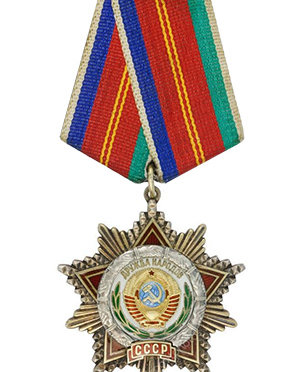
The Order of Friendship of Peoples (or Орден Дружбы народов in Russian) was an order of the Soviet Union established on December 17, 1972.

The Order of Friendship of Peoples (or Орден Дружбы народов in Russian) was an order of the Soviet Union established on December 17, 1972 and awarded to persons (including non-citizens), organizations, enterprises, military units and administrative subdivisions of the USSR for accomplishments in strengthening of inter-ethnic and international friendship and cooperation, for economical, political, scientific, military, and cultural development of the Soviet Union.

It was established on the occasion of the 50th anniversary of the creation of the Soviet Union and abolished in December 1991.

The Order of Friendship of Peoples Design

The design of order was created by Alexander Zhuk.

The Order of the October Revolution

The Order of the October Revolution is the second-highest Soviet Order, created for the 50th anniv. of the October Revolution.

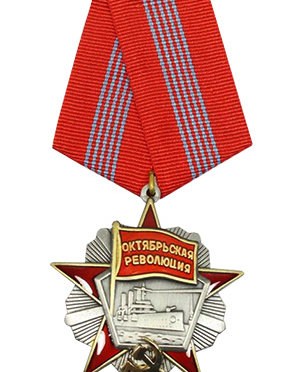
The Order of the October Revolution (or Орден Октябрьской Революции in Russian) is the second-highest Soviet order and was instituted on October 31, 1967, in time for the 50th anniversary of the October Revolution. It was conferred upon individuals or groups for services furthering communism or the state, or in enhancing the defenses of the Soviet Union, military and civil.

The Order was awarded to the citizens of the USSR and foreign citizens, soviet enterprises, establishments, organizations and other groups of workers, the military units and formations, as well as republics, krais, regions, cities and towns and for the revolutionary activity, a major contribution to the formation and consolidation of the Soviet rule, outstanding services in the building of socialism and communism, for a particular courage demonstrated during the struggle with the enemies of the Soviet state, outstanding merits in the strengthening of the country’s defense system, for the active development and intensification of the friendly relationships between the Soviet Union nations and other states, for the peace consolidation between the nations.

The re-awarding of the Order was rare. In total there have been over 100.000 holders of the Order of the October Revolution.

The Order of the October Revolution Design

The insignia of the Order is a red star with golden rays between the arms badge.

At the centre of the badge was a pentagon bearing the image of the cruiser Aurora participating in the October Revolution. Above this was a red flag bearing the words “October Revolution” (Октябрьской Революции). A Hammer and Sickle emblem was placed at the bottom.

The badge was worn on the left chest with a red ribbon bearing five blue stripes at the center.

The Order of Victory (USSR)

The Order of Victory was the highest military decoration awarded for World War II service in the Soviet Union, and one of the rarest made.

The Order of Victory (or Орден Победа in Russian) was the highest military decoration awarded for World War II service in the Soviet Union, and one of the rarest orders in the world.

The Order of Victory was awarded only to Generals and Marshals for successfully conducting combat operations involving one or more army groups and resulting in a “successful operation within the framework of one or several fronts resulting in a radical change of the situation in favor of the Red Army.” The Order has only been awarded twenty times to twelve Soviet leaders and five foreign leaders, with one revocation (that of Leonid Brezhnev, revoked posthumously in 1989 for not meeting the requirements for the award).

The order was also bestowed to top commanders of the Allied forces. Every order was presented during or immediately after World War II. Unlike all other Soviet orders, the Order of Victory had no serial number on it, the number was only mentioned in the award certificate. After a holder of the Order of Victory died, the award was to be given back to the state.

The Order of Victory Design

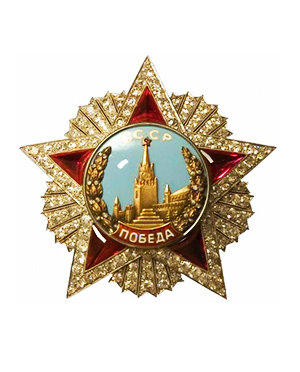
The Order of Victory measures 72 mm in diameter and is made out of platinum in the form of a pentangular star with rays between the arms.

On October 25, 1943, artist A. I. Kuznetsov, who was already the designer of many Soviet orders, presented his first sketch to Stalin. The sketch of a round medallion with portraits of Lenin and Stalin was not approved by the Supreme Commander. Instead, Stalin wanted a design with the Spasskaya Tower in the centre. Kuznetsov returned four days later with several new sketches, of which Stalin chose one entitled “Victory”. On the 5th of November a prototype was finally approved.

The star is studded with 174 diamonds weighing a total of 16 carats (3.2 g), while the arms of the star are made out of ruby. In the center of the star is a silver medallion, with the Moscow Kremlin wall, the Spasskaya Tower, and Lenin’s Mausoleum depicted in gold surrounded by bands of laurel and oak also colored in gold. The laurel and oak are bound with a red banner. The sky in the background is inlaid with blue enamel.

Against the sky, the letters “СССР” (USSR) appear in gold centered on the top of the medallion, while the word “Победа” (Victory) is displayed on the red banner at the bottom. The total mass of the order is 78g, which consists of 47g of platinum, 2g of gold, 19g of silver, 25 carats of ruby and 16 carats of diamond.

Instead of being made at a mint, each Order was made in a jeweler’s workshop. The ribbons of various Soviet orders have been combined to create the Order Ribbon. The total length of the ribbon is 44 mm and it is mostly worn on the field uniform.

The Order of Nakhimov

The Order of Nakhimov is a military decoration of the Russian Federation established during World War II and bestowed to naval officers.

The Order of Nakhimov (or Орден Нахимова in Russian) is a military decoration of the Russian Federation established during World War II, bestowed to naval officers for outstanding military leadership and named in honor of Russian admiral Pavel Nakhimov (1802–1855).

The Order was awarded in two classes to officers of the Navy for outstanding achievements in the development, implementation and prosecution of naval operations resulting in the successful repelling of an opponent’s offensive or for active fleet operations that caused considerable damage to the enemy while conserving fleet assets.

The Order first class was awarded 82 times, including twice to naval units, such as the 1st torpedo-boat brigade of Sevastopol and the 1st Red Banner torpedo-boat brigade of the Baltic Fleet. The Order second class was awarded 469 times, including twice to naval units.

Following the 1991 dissolution of the USSR, the Order of Nakhimov was retained unchanged by decision of the Supreme Soviet of the Russian Federation № 2424-1 of March 2, 1992 but it was amended to its present form, a ribbon mounted single class Order.

The Order of Ushakov Design

The Order of Ushakov is a 40 mm wide blue enamelled silver cross pattée, seven silver rays of increasing size protrude from the center between each cross arm.

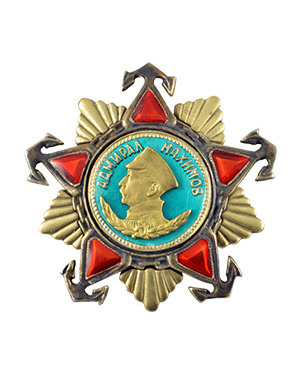
The Order of Nakhimov 1st class was of multi part construction consisting of a gold five pointed star displaying radiant rays (the bottom arm pointing straight down, a silver five pointed star with each arm ending in a naval sea anchor, its upper arm pointing straight up with the rays of the gold star protruding between its arms). A central gold medallion is covered with dark enamel and the gold left profile relief image of the bust of admiral Nakhimov over two laurel branches at the center of the medallion.

Above the head and along the medallion’s upper circumference is the inscription in gilt letters “ADMIRAL NAKHIMOV” (АДМИРАЛ НАХИМОВ). The hammer and sickle bisected the laurel branches on the central medallion. Five triangular red rubies were affixed to the silver star, one on each arm pointing out from the central medallion’s outer edge.

On the reverse of the silver star, a threaded screw and a 33 mm in diameter nut arrangement for attachment to clothing. The maker’s (mint) mark was located at the upper part of the gold star’s reverse, the award serial number was hand etched in the lower part. The Order of Nakhimov 2nd class was of two part construction and made entirely of silver with red enamel in lieu of rubies.

The only noticeable difference between the Soviet and early Russian Federation variants was the abrogation of the hammer and sickle from the latter.

The Order and Medal of Ushakov

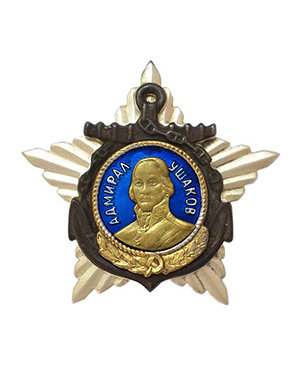
The Order of Ushakov is a military decoration of the Russian Federation bestowed to command grade naval officers for outstanding leadership.

The Order of Ushakov (or Орден Ушакова in Russian) is a military decoration of the Russian Federation bestowed to command grade naval officers for outstanding leadership. The Order is named in honor of admiral Fyodor Ushakov (1744–1817) who never lost a battle and was proclaimed patron saint of the Russian Navy.

The order was established in two classes during World War II by the decision of the Presidium of the Supreme Soviet of the USSR of March 3, 1944. Following the 1991 dissolution of the USSR, the Order of Ushakov was retained unchanged by the Decision of the Supreme Soviet of the Russian Federation. The Decree amended the Order to its present form, a ribbon mounted single class Order.

The Order of Ushakov Design

The Order of Ushakov is a 40 mm wide blue enamelled silver cross pattée, seven silver rays of increasing size protrude from the center between each cross arm. The Order’s 1st class was of multi part construction consisting of a five pointed star struck from platinum, an oxidized silver anchor and chain secured to the platinum star with four rivets, and a circular central medallion struck from gold.

On the obverse and superimposed on the anchor is the relief image of admiral Ushakov. The background is covered in dark blue enamel and around the admiral’s head is the inscription in gilt letters “ADMIRAL USHAKOV” («АДМИРАЛ УШАКОВ»). Below him, laurel and oak branches are bisected by the hammer and sickle.

The central medallion was secured to the platinum star by two rivets and surrounded by a gilt rope. On the reverse, a threaded screw and a 33 mm in diameter nut arrangement for attachment to clothing. 

The only noticeable difference between the Soviet and early Russian Federation variants was the abrogation of the hammer and sickle from the latter.

The Order of Glory (USSR)

The Order of Glory is a military decoration of the Soviet Union awarded to soldiers and non-commissioned officers of the Red Army.

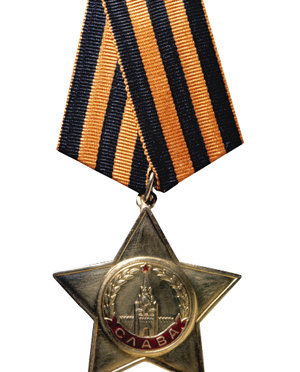
The Order of Glory (or Орден Славы in Russian) is a military decoration of the Soviet Union awarded to soldiers and non-commissioned officers of the Red Army as well as to aviation junior lieutenants, for bravery in the face of the enemy and established by Decree of the Presidium of the Supreme Soviet on November 8, 1943.

The Order of Glory, which was modeled closely after the Tsarist Cross of St. George, was divided into three distinct classes. A soldier would initially be recommended for the order’s lowest class, while subsequent distinct acts of valor could result in the soldier being recommended for the order’s two remaining classes. Soldiers who received each of the order’s three classes were referred to as a “Full Cavalier of the Order of Glory” (“полный кавалер ордена Славы”). 2,656 Red Army soldiers would attain Full Cavalier status.

The order became defunct with the dissolution of the Soviet Union.

The Order of Glory Design

The badge of the Order of Glory is a five-pointed star with a central medallion. The central medallion featured the Spasskaya Tower of the Kremlin, with a red enameled five-pointed star at its top and a red enameled scroll at the bottom bearing the word “GLORY” (СЛАВА). Laurel branches on each side along the medal circumference stopped just short of the red star.

The reverse had the Cyrillic inscription for “USSR” (СССР) within a ring with a raised rim. The award serial number was either stamped or engraved above the ring on the reverse of the star’s upper arm.

The order’s first class was made of 950 (23 karat) gold; the order’s second class was made of silver with a gilt central medallion and the order’s third class was made entirely of silver. The Order is suspended by a ring through the award’s suspension loop to a standard Russian pentagonal mount covered by a 24mm-wide silk moiré ribbon of St George.

The Order of Bogdan Khmelnitsky

The Order of Bohdan Khmelnitsky (Орден Богдана Хмельницкого) was a Soviet award established in 1943 and named after Bohdan Khmelnytsky.

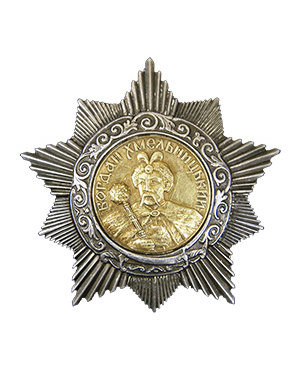
The Order of Bohdan Khmelnitsky (or Орден Богдана Хмельницкого in Russian) was a Soviet award established on October 10, 1943 and named after Bohdan Khmelnytsky, leader of the Ukrainian Cossack Hetmanate.

Zynoviy Bohdan Khmelnytsky (1595-1657) was a Polish–Lithuanian-born Hetman who led an uprising against the Commonwealth and its magnates (1648–1654) that resulted in the creation of a state led by the Cossacks of Ukraine.

The award was first established by the Presidium of Supreme Soviet of the USSR during World War II and discontinued after the dissolution of the Soviet Union. It was awarded to Soviet Armed Forces personnel and often the members of the Ukrainian Front for their exceptional duty in combat operations that led to the liberation of Soviet territory.

The Order of Bohdan Khmelnitsky was broken down into three different classes: 1st class, 2nd class and 3rd class. The 1st class medal is awarded to army commanders, especially at the front, for successful direction of combat operations that led to the liberation of a region or town where they were successful in inflicting heavy casualties on the enemy. The 2nd class medal is awarded to corps, divisions, brigade or battalion commanders for a breach of a defensive enemy line or a raid into the enemy’s rear. The 3rd class medal is awarded to officers, partisan commanders, sergeants, corporals and privates of the Red Army and partisan units for outstanding bravery and resourcefulness leading to a battle victory.

The Order of Bogdan Khmelnitsky Design

The Order of Bogdan Khmelnytsky is a five-pointed star, made in the form of diverging rays, in the center a shield with the image of Bogdan Khmelnitsky, under star divergent silver rays.

The badge of the Order was designed by artist Alexander Pashchenko and measures 56 mm (1st and 2nd Class) and 45 mm (3rd Class). The materials are: 1st Class in gold 19,3g, silver 26,7g. Weight 42,0g. 2nd Class in gold 6,5g, silver 35,4g. Weight 43,9g. 3rd Class in silver 29,6g. Weight 32,0g.

The Order of Kutuzov

The Order of Kutuzov is a military decoration of the Russian Federation established during World War II and named after the Field Marshal.

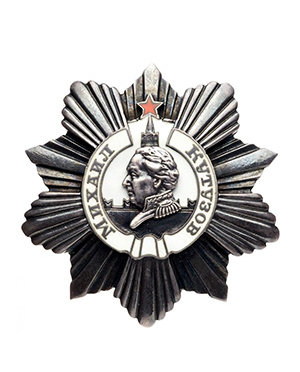
The Order of Kutuzov (or Орден Кутузова in Russian) is a military decoration of the Russian Federation established during World War II and named after famous Russian Field Marshal Mikhail Illarionovich Kutuzov (1745–1813).

The Order was created to reward senior Red Army officers. During World War II, 669 Orders of Kutuzov 1st class were awarded. The Order 2nd class was awarded to 3,325 corps, division, and brigade commanders. The Order 3rd class was awarded to regimental commanders, their chiefs of staff, battalion and company commanders and was only established on February 8, 1943. Of this type, 3,328 3rd class orders were awarded.

Following the 1991 dissolution of the USSR, the Order of Kutuzov was retained unchanged in both design and statute by decree of the Supreme Soviet of the Russian Federation No 2424-1 of March 2, 1992.

The Order of Kutuzov Design

The badge of the Order of Kutuzov is a 40mm wide silver cross pattée with gold rays protruding between its arms at an obtuse angle.

In the obverse, in the center is a silver medallion bordered by a wide white enameled band surrounded by a gilt laurel and oak wreath. The gold plated left profile bust of M.I. Kutuzov with the image of the Kremlin wall in the background. On the sides of the medallion’s white enameled band, the gilt inscription “Mikhail Kutuzov” («Михаил Кутузов»). The reverse is plain, the award serial number is inscribed on the reverse of the cross lower arm.

The Order of Kutuzov is suspended from a standard Russian pentagonal mount by a ring through the suspension loop. The mount is covered by an overlapping dark blue silk moiré ribbon with a central 5mm wide orange stripe.