The Order of Suvorov

The Order of Suvorov (or Орден Суворова) is a military decoration established in 1942 and named in honor of Count Alexander Suvorov.

The Order of Suvorov (or Орден Суворова in Russian) is a military decoration established on July 29, 1942 and named in honor of Russian Field Marshal Count Alexander Suvorov (1729–1800). The Order was originally a Soviet award, created to reward senior army personnel for exceptional leadership in combat operations.

The Order was divided into three different classes: 1st class, 2nd class, and 3rd class. The Order 1st class was awarded to army commanders for exceptional leadership of combat operations. The Order 2nd class was awarded to corps, division, and brigade commanders for a decisive victory over a numerically superior enemy. The Order 3rd class was awarded to regimental commanders, their chiefs of staff, and battalion and company commanders for outstanding leadership leading to a combat victory. 

Following the 1991 dissolution of the USSR, the Order of Suvorov was retained unchanged but it was not awarded in this form. The Presidential Decree 1099 of September 7, 2010 modernized and reorganized the entire Russian awards system away from its Soviet past changed the statute of the Order to a single-class medal. 

The Order of Suvorov Design

The Order of Suvorov measures 40 mm wide and is a gold plated cross pattée with silver rays protruding from the center outwards between the arms of the cross to form a square.

The obverse center has a circular convex medallion bearing the gilded bust of Alexander Suvorov in profile and facing left. Below, on the medallion lower edge, are crossed branches of oak and laurel. At the upper part and following its circumference is the inscription in red enameled embossed letters “ALEXANDER SUVOROV” (АЛЕКСАНДР СУВОРОВ). The reverse is bare except for the award serial number.

The Order is suspended by a ring through a suspension loop to a standard Russian pentagonal mount covered by a 24mm wide green silk moiré ribbon with a 5mm wide orange central stripe. The Order of Suvorov is to be worn on the left side of the chest and immediately after the Order of Alexander Nevsky.

The Order of Alexander Nevsky

The Order of Alexander Nevsky is an order of merit bestowed to civil servants for twenty years + of highly meritorious service.

The Order of Alexander Nevsky (or орден Александра Невского in Russian) is an order of merit of the Russian Federation bestowed to civil servants for twenty years or more of highly meritorious service and named in honor of saint Alexander Nevsky (1220–1263). It was awarded to Red Army commanders who displayed personal bravery in fighting for their country in World War II, for courage, bravery and skillful leadership that ensured success.

It was originally established by the Soviet Union as a military honor during World War II on July 7, 1942. Its statute was amended by Decree of the Presidium of the Supreme Soviet of the USSR of February 26, 1947.

The Order of Alexander Nevsky was reinstated by the Soviet Union for award to officers of the army for personal courage and resolute leadership. The Order was retained by the new Russian Federation following the dissolution of the USSR but was never awarded. The September 7, 2010 Decree №1099 amended the statute of the Order making it a purely civilian award.

The Order of Alexander Nevsky Design

The Order of Alexander Nevsky (in its Soviet and early Russian Federation version) is made of silver, measures 50 mm wide and is a high ruby-red enameled, five-pointed convex star superimposed on a decagon composed of polished diverging rays. The star had gold-plated rims and edges.

In the center of the star, a central medallion bearing the left profile relief image of a helmeted Alexander Nevsky and the inscription along the left and right circumference in prominent letters “ALEXANDER NEVSKY” («АЛЕКСАНДР НЕВСКИЙ»). The central medallion is surrounded by a gilt laurel wreath bisected at its base by a silver shield bearing the hammer and sickle, the shield is superimposed over gilded sword, spear, bow and quiver of arrows. Two gilt pollaxes cross behind the central medallion, their outward facing blades protruding on either side of the five pointed star’s top arm and extending slightly past the decagon’s outer edge, their base visible just inside of the star’s two lower arms.

The original Order was suspended by a ring through a suspension loop, which was changed in 1943 to a threaded stud and nut attachment on the reverse. The design of the early Russian Federation variant of the Order differed from the Soviet variant only in the abrogation of the hammer and sickle from the silver shield on the obverse.

The Order of the Patriotic War (USSR)

The Order of the Patriotic War (Орден Отечественной войны) is a  Soviet military decoration established in 1942 and awarded for heroic deeds.

The Order of the Patriotic War (or Орден Отечественной войны in Russian) is a  Soviet military decoration established on 20 May 1942 and awarded for heroic deeds during WW2 or the German-Soviet War to all soldiers in the Soviet armed forces, security troops, as well as to partisans.

This was the first Soviet order established during the war, and the first Soviet order divided into classes. Deeds are awarded with the order (shooting down three aircraft as a fighter pilot, destroying two heavy or three medium or four light tanks, capturing a warship, repairing an aircraft under fire after landing on a hostile territory, etc) were awarded with the first class.

The medal was also given to some allied troops and commanders, including western allies. Altogether, over 324,903 of the 1st class and 951,652 of the 2nd class were issued during the war. 

The Order of the Patriotic War Classes

The Order of the Patriotic War had two classes:

  1. First Class: Awarded for acts of bravery and courage displayed in combat against the enemy. It was typically bestowed upon soldiers, sailors, and airmen who demonstrated exceptional valor or leadership on the battlefield. Recipients of the First Class were often recognized for their direct involvement in significant military operations, such as leading successful assaults, repelling enemy attacks, or capturing strategic objectives.

  2. Second Class: Awarded for various contributions to the war effort, including acts of bravery, distinguished service, or significant achievements in support of the Soviet war machine. While the criteria for the Second Class were less stringent than those for the First Class, recipients were still required to demonstrate commendable conduct and dedication to the defense of the Soviet Union. This class of the order was often bestowed upon individuals who displayed courage under fire, rendered valuable assistance to their comrades, or made significant sacrifices for the cause of victory.

The Order of the Patriotic War Medal Design

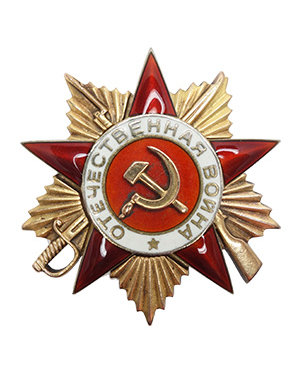
The Order of the Patriotic War medal features a red enamel five-pointed star, made of silver, with straight rays in the background, and crossed sabre and a Mosin rifle. The rays in the background are golden for the First Class and silver for the Second Class.

The central disc has a golden hammer and sickle on a red enamel background, surrounded by a white enamel ring with the words ОТЕЧЕСТВЕННАЯ ВОЙНА (“Patriotic War”). Anniversary orders of 1985 were made cheaper, as a single silver piece, gold-plated in the 1st class.

The ribbon varies slightly depending on the class:

  • Order of the Patriotic War – First Class Ribbon
  • Order of the Patriotic War – Second Class Ribbon
The Order of the Patriotic War - MEDIA

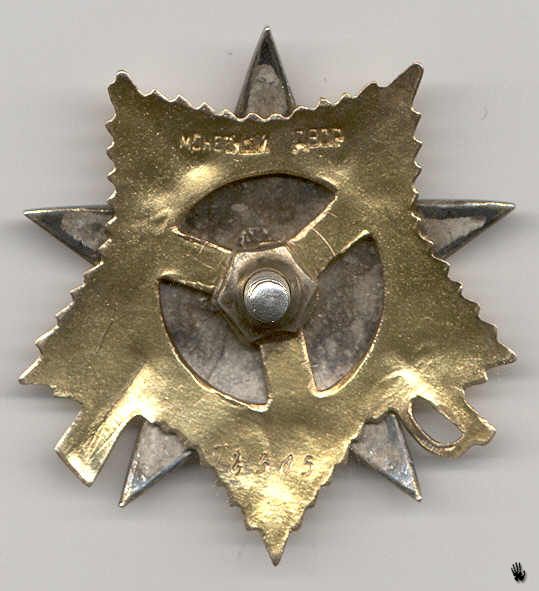
The Order of the Patriotic War, 1st class, reverse.
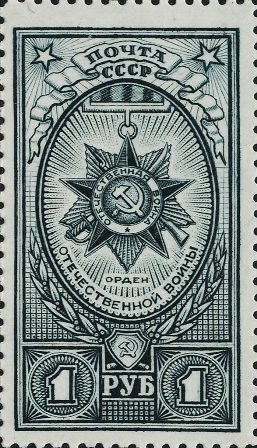
Order of the Patriotic War depicted on a 1943 postage stamp.
The Order of the Patriotic War depicted on a 1943 postage stamp. Wikipedia.

The Hero of Socialist Labor Medal

The Hero of Socialist Labour Medal was the highest Soviet degree of distinction for exceptional achievements in national economy and culture.

The Hero of Socialist Labour Medal (or Геро́й Социалисти́ческого Труда́in Russian) was the highest degree of distinction for exceptional achievements in national economy and culture. It was introduced by decree of the Presidium of the Supreme Soviet of the Soviet Union on December 27, 1938 as an honorary title of the Soviet Union and other Warsaw Pact countries.

The first recipient of the award was Joseph Stalin, awarded by the Presidium of the Supreme Soviet in December 20, 1939. By 1991, at the dissolution of the Soviet Union, over 20,000 people had been awarded the title.

Originally, Heroes of Socialist Labour were awarded the highest decoration of the Soviet Union, the Order of Lenin and a certificate. In order to distinguish it from other Order of Lenin recipients, the “Hammer and Sickle” gold medal was introduced by decree of the Presidium on 22 May 1940. Heroes of Socialist Labour who attained further exceptional achievements were awarded a second “Hammer and Sickle” medal and bronze busts of the Heroes were to be constructed in their hometowns to mark the occasion.

The award provided a similar status to the title Hero of the Soviet Union Medal that was awarded for heroic deeds, but unlike the latter, was not awarded to foreign citizens.

The Hero of Socialist Labor Medal Design

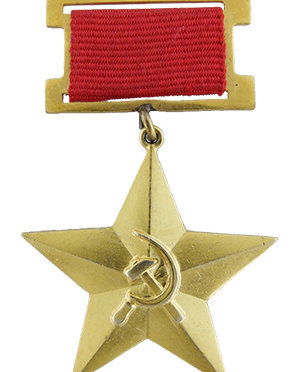
The Honorary title was designed by the artist A. Pomansky as a five-pointed star with smooth dihedral rays on the obverse. The diameter of the star was 33.5 mm. In the center of the obverse, a relief hammer and sickle respectively of 14 and 13 mm. 

The reverse was plain and was surrounded by a slightly raised rim. In the center, the relief inscription “Hero of Socialist Labor” (“Герой Социалистического Труда” in Russian) in 2mm high letters, the award serial number was inscribed just above in 1mm high numbers. The medal weighed 15.25 grams.

The insignia was secured to a standard 25 X 15mm Soviet square mount by a ring through the suspension loop. The mount was covered by a red silk moiré ribbon.

The Hero of the Soviet Union Medal

The title Hero of the Soviet Union Medal was the highest distinction in the Soviet Union. It was established on April 16, 1934.

The title Hero of the Soviet Union Medal (or Герой Советского Союза in Russian) was the highest distinction in the Soviet Union. It was established on April 16, 1934, by the Central Executive Committee of the Soviet Union and was awarded personally or collectively for heroic feats in service to the Soviet state and society.

The first recipients of the title originally received only the Order of Lenin, the highest Soviet award, along with a certificate describing the heroic deed from the Presidium of the Supreme Soviet of the USSR.

Those who received the award were entitled to special privileges, which included a pension with survivor benefits, first priority on the housing list with 50% rent reduction, tax exempt, an annual round-trip first class airline ticket, free bus transportation, and medical and entertainment benefits.

In total, during the existence of the USSR, the title of Hero of the Soviet Union was awarded to 12,777 people, including twice – 154 (9 posthumously), three times – 3 and four – 2. Ninety-five women were awarded the title. The title could also be given to foreigners. In total, forty-four foreign citizens were awarded with it.

The Hero of the Soviet Union title was also given posthumously, though often without the actual Gold Star medal given.

The Hero of the Soviet Union Medal Design

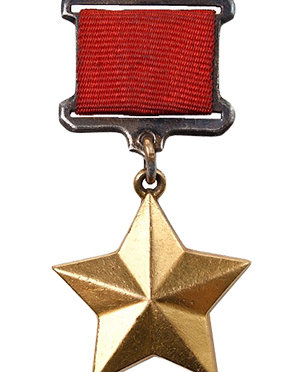
The medal is a gold star hanging from a rectangular suspension device. The medallion measures 32.5 mm in height including the eyelet, 30.3 mm in width; weighs 20.6 g not including the suspension and connecting link. The star is in 23 K gold; the suspension device is in gilded silver.  It has a ribbon in the color(s) of the issuing state (red for the USSR, white/blue/red for the Russian Federation, blue/yellow for Ukraine, red/green for Belarus).

The Hero of the Soviet Union is worn on the left side of the chest above all other orders and medals.

The Order of the Red Star

The Order of the Red Star (or Орден Краснoй Звезды in Russian) was a military decoration of the Soviet Union established on 6 April 1930.

The Order of the Red Star (or Орден Краснoй Звезды in Russian) was a military decoration of the Soviet Union established on 6 April 1930 by decree of the Presidium of the Supreme Soviet of the USSR.

It was awarded to soldiers of the Soviet Army, Navy, border and internal security forces, employees of the State Security Committee of the USSR, as well as NCOs and officers of the bodies of internal affairs; to units, warships, associations, enterprises, institutions and organizations; as well as to military personnel of foreign countries.

It was common for individuals to receive this prestigious award multiple times, with many being honored two, three, four, five, or even six times.

The Order of the Red Star Medal Criteria

The Order was awarded for personal courage and bravery in battle, successful operations of military units and formations, outstanding service in ensuring public safety and the security of the State Border of the USSR, exemplary performance of special command tasks and other outstanding deeds committed in peacetime, merit in the development of military science and technologies used in training of the Armed Forces of the USSR or merit in strengthening the defense capabilities of the socialist community.

In some cases, the Order of the Red Star was also used as a long service award (from 1944 to 1958) to mark fifteen years of service in the military, state security, or police.  Its statute was only defined on May 1930, amended on 7 May 1936, 19 June 1943, 26 February 1946, 15 October 1947, 16 December 1947 and by decree No 1803-X of 28 March 1980.

Between 1930 and 1941, the Order of Lenin was awarded approximately 22,000 times. However, during the four years of the Great Patriotic War, the number of awards surged dramatically to nearly 3,000,000. In total, from its inception in 1930 until the dissolution of the Soviet Union in 1991, the Order of Lenin was conferred around 3,870,000 times.

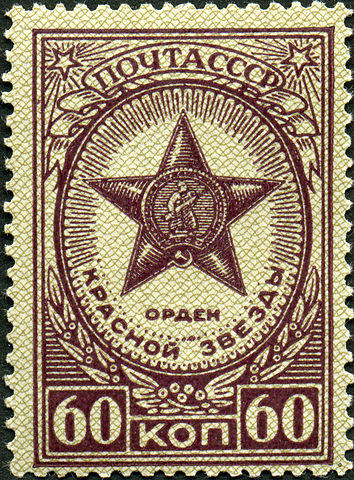
A 1946 Soviet 60 kopek stamp featuring the Order of the Red Star.
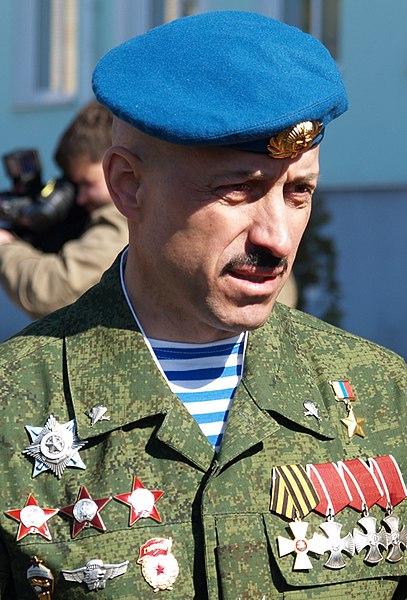
Lieutenant Colonel Anatoly Lebed, pictured wearing his three Orders of the Red Star earned during his service in Afghanistan.
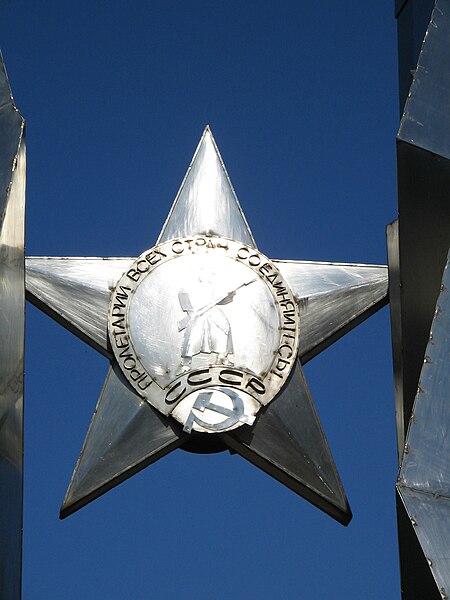
Fragment of the memorial to internationalist soldiers (Mykolaiv).

The Order of the Red Star Medal Design

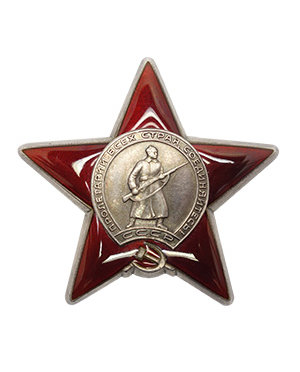
The Order of the Red Star is a red enameled 47mm to 50mm wide (depending on the variant) silver five pointed star. It was designed by artist Vasily Kupriyanov and sculptor Vladimir Golenetsky. 

In the center of the obverse is an oxidized silver shield bearing the image of a Red Army soldier wearing an overcoat and carrying a rifle, along the shield’s entire circumference, a narrow band bearing the Communist motto in relief, «Пролетарии всех стран, соединяйтесь!» Workers of the world, unite!“, the band below the soldier bore the relief inscription “USSR” («СССР»). Below the shield, the hammer and sickle also of oxidized silver.

The otherwise plain reverse bore the maker’s mark and the award serial number. The Order was attached to clothing by a threaded stud and screw attachment.

The ribbon of the Order of the red Star was a 24mm wide silk moiré dark red with a 5mm wide central silver stripe.

Find This Medal

Right Now on eBay 
Clicking a link to eBay may result in a referral commission being paid if a purchase is made.
Loading...

The Most Noble Order of the Garter

The Order of the Garter is an order of chivalry founded by Edward III in 1348 and regarded as the most prestigious British order of chivalry.

The Order of the Garter (also known as the “Most Noble Order of the Garter”) is an order of chivalry founded by Edward III in 1348 and regarded as the most prestigious British order of chivalry (though in precedence inferior to the military Victoria Cross and George Cross) in England and later the United Kingdom. It is dedicated to the image and arms of Saint George, England’s patron saint.

Membership of the Order is limited to the Sovereign, the Prince of Wales, and no more than 24 living members, or Companions. The order also includes supernumerary knights and ladies (for example, members of the British royal family and foreign monarchs). New appointments to the Order of the Garter are often announced on St George’s Day (23 April), as Saint George is the order’s patron saint.

In addition to the 25 Knights, there have been occasionally extra non-Christian Knights, such as the Sultans of Turkey or the Emperor of Japan. Emperor Hirohito was actually awarded the Garter twice: in 1922 and again in 1971 (he had forfeited the first as a result of Japan entering the Second World War in 1941). Soon after the founding of the Order, women were appointed “Ladies of the Garter“, but were not made companions. King Henry VII discontinued the practice in 1488; his mother, Margaret Beaufort, was the last Lady of the Garter before Queen Alexandra. Ladies (other than royalty) are now eligible for the Order.

All official insignia is returnable to the Central Chancery of Knighthood on the death of the holder.

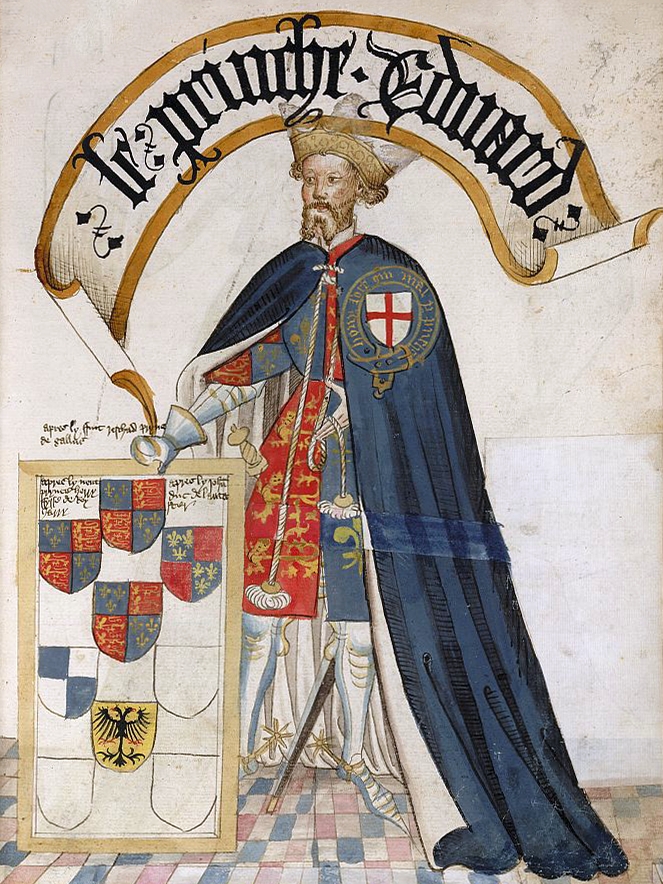
Edward, The Black Prince
Edward, The Black Prince.
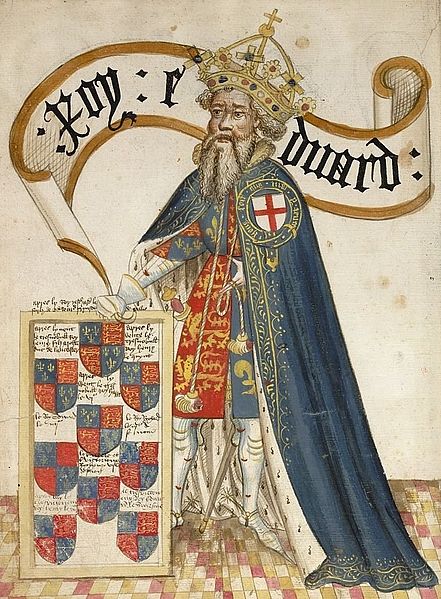
King Edward III
King Edward III.
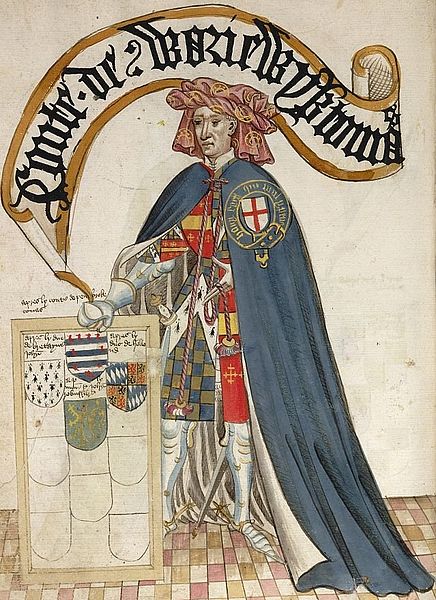
The 11th Earl of Wawick
The 11th Earl of Wawick.

The Order of the Garter Design

The Star

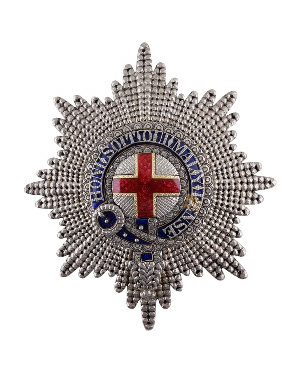
The star was originally embroidered in a metal thread and was introduced in the 17th century by King Charles I (before 1858, knights often purchased metal stars). It depicts the heraldic shield of St. George’s Cross, encircled by the Garter and the motto “HONI SOIT QUI MAL Y PENSE” (or “Evil be to who evil thinks“), which is itself encircled by an eight-point silver badge. Each point is depicted as a cluster of rays, with the four points of the cardinal directions longer than the intermediate ones. Since the Order of the Garter is the senior order of the United Kingdom, a member will wear their star above the others (up to three) that he or she holds.

The Ribbon

The ribbon measures 100 millimeters and is plain dark blue. It’s not worn in undress uniform.

The Emblem

The order’s emblem is a dark blue velvet garter with the motto “Honi soit qui mal y pense” (or “Shame on him who thinks ill of it” in Middle French) in embroidered lettering and details, or with gold lettering, buckle and tab. Members of the order wear it on ceremonial occasions. The collar chain is made of gold and consists of alternate buckled garters, each encircling a red enamelled rose. The collar badge is an enamelled three-dimensional figure of St. George the Martyr on horseback slaying a dragon.

If you want to learn more about the Order of the Garter’s mantle, hat, collar, Great George and garter, please check our sibling site Medieval Britain

More About The Order

Right Now on eBay 
Clicking a link to eBay may result in a referral commission being paid if a purchase is made.
Loading...

The Medal for the War of 1941–1945

  • Time Period: WW2
  • Year of Institution: 2 March 1946
  • Country: Greece

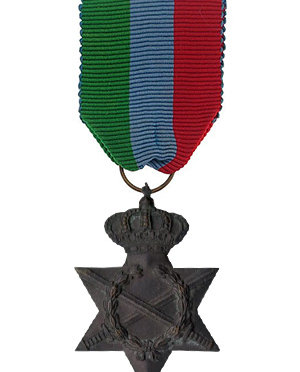
The Medal for the War of 1941–1945 was established on 2 March 1946 and awarded to members of the Royal Hellenic Armed Forces who had seen action. It was created as a star for land operations.

The medal was bestowed upon Royal Hellenic Armed Forces personnel for operational services to the Army in North Africa, the South Aegean Sea and Italy. Several thousands of Army personnel, the majority of the Fleet and the remaining airplanes escaped to Turkey or were evacuated to Egypt after the capitulation of the Continental Greece and the battle of Crete respectively. At the British controlled Middle East the Hellenic Armed Forces were reorganized and reequipped (with British assistance) while more personnel either from Greece or from the existing Greek population in Egypt joined their ranks.

Soon the Hellenic Armed Forces of the Middle East were able to form 2 Brigades, a Special Forces Unit (Sacred Band or Sacred Company in Greek) attached to 1st SAS. The Hellenic Royal Navy with 44 ships and over 8,500 men, became the second-largest Allied Navy in the Mediterranean after the RN, accounting for 80% of all non-RN operations.

The Hellenic Royal Air Force formed 3 Squadrons (the 335 and 336 Fighter Squadrons – equipped with Hurricanes and later with Spitfires – and the 13th Naval Cooperation Squadron which operated with Blenheims and later with Batimores).

The Hellenic Armed Forces participated to the Battle of El Alamein, to the Operations for Liberation of several Greek islands of the Aegean Sea after the capitulation of Italy, to the operation in Sicily and South Italy while several ships of the Hellenic Royal Navy supported the landing in Normany.

The Medal for the War of 1941–1945 Design

The ribbon shows what appears to be water / storage damage.

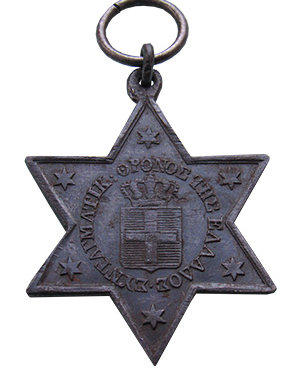
The Medal for the Proclamation of the Constitution of 1843

  • Time Period: Pre-WW1
  • Year of Institution: 1843
  • Country: Greece

The Medal for the Proclamation of the Constitution of 1843 was created on September 3, 1843 and it also known as the Cross of the Provinces.

On 3 September 1843, the military garrison of Athens, with the help of citizens, rebelled and demanded from King Otto the concession of a Constitution. The Constitution that was proclaimed in March 1844 came from the workings of the “Third of September National Assembly of the Hellenes in Athens” and was a Constitutional Pact, in other words a contract between the monarch and the Nation. This Constitution re-established the Constitutional Monarchy and was based on the French Constitution of 1830 and the Belgian Constitution of 1831.

Its main provisions were the following: It established the principle of monarchical sovereignty, as the monarch was the decisive power of the State; the legislative power was to be exercised by the King – who also had the right to ratify the laws – by the Parliament, and by the Senate. The members of the Parliament could be no less than 80 and they were elected for a three-year term by universal suffrage. The senators were appointed for life by the King and their number was set at 27, although that number could increase should the need arise and per the monarch’s will, but it could not exceed half the number of the members of Parliament.

The ministers’ responsibility for the King’s actions is established, who also appoints and removes them. Justice stems from the King and is dispensed in his name by the judges he himself appoints.

Lastly, this Assembly voted the electoral law of 18 March 1844, which was the first European law to provide, in essence, for universal suffrage (but only for men).

Despite the fact that Otto accepted the establishment of a Constitutional regime, he was not inclined to enforce it and by breaking both the spirit and the letter of the Constitution he tried to gather as much power as he possibly could. On the night of 10 October 1862 the rising wave of discontent led the people and the military to rebel and to decide Otto’s deposition.

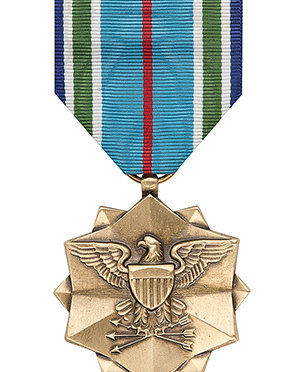
The Achievement Medal – Joint Service

The Achievement Medal is a military decoration of the Armed Forces for contributions of junior officers and enlisted personnel

The Achievement Medal is a military decoration of the United States Armed Forces. It was first proposed as a means to recognize the contributions of junior officers and enlisted personnel who were not eligible to receive the higher Commendation Medal or the Meritorious Service Medal. Award authority rests with local commanders, granting a broad discretion of when and for what action the Achievement Medal may be awarded.

Each military service issues its own version of the Achievement Medal, with a fifth version authorized by the U.S. Department of Defense for joint military activity.

The Joint Service Achievement Medal was created in 1983. This award was considered a Department of Defense decoration senior to the service department Achievement Medals.

The Achievement Medal Design

The following devices may be authorized to be worn on the following achievement medals suspension ribbon and service ribbon:

  • All Achievement Medals, “C” device, which signifies meritorious performance “under combat conditions”, after January 2016
  • Army Achievement Medal, for additional awards – oak leaf clusters
  • Air Force Achievement Medal, for additional awards – oak leaf clusters
  • Navy and Marine Corps Achievement Medal, for additional awards – 5/16 inch stars
  • Coast Guard Achievement Medal, for additional awards – 5/16 inch stars
  • Joint Service Achievement Medal (all service branches), for additional awards – oak leaf clusters
  • Coast Guard Achievement Medal – Operational Distinguishing Device (“O” device)
  • Coast Guard Achievement Medal – Combat Distinguishing Device (Combat “V”)

Find This Medal Online

Right Now on eBay 
Clicking a link to eBay may result in a referral commission being paid if a purchase is made.
Loading...