The Civil Actions Medal (South Vietnam)

The Republic of Vietnam Civil Actions Medal is a military decoration awarded by the former South Vietnamese gov. during the Vietnam War.

The Republic of Vietnam Civil Actions Medal (or Dân-Vụ Bội-Tinh in Vietnamese, also known as the Vietnam Civil Actions Medal or Civil Actions Medal) is a military decoration created on May 12, 1964 during the Vietnam War by the former South Vietnamese government.

The medal was awarded to the South Vietnamese military and its allies’ military personnel or units that performed outstanding achievements in the field of civil affairs. It was awarded in two classes, with the first class intended for commissioned officers and the second class for enlisted personnel. Individuals who were cited received the medal, ribbon, and a citation.

The Civil Actions Unit Citation Emblem was awarded to all members of a military command or unit who had participated in civic actions to such a degree as would warrant an individual Vietnam Civil Actions Medal.

The Civil Actions Medal Design

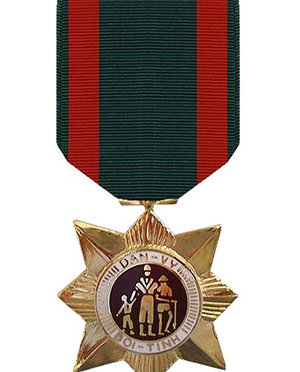
The Civil Actions Medal is a bronze eight-pointed star with alternating points of the star lined, superimposed by a disk with a figure of a soldier, a child, and a farmer with a shovel, all enclosed by a white enamel designation band inscribed Dân Vụ (Civil Action) at the top and Bội Tinh (Medal) at the bottom.

The Civil Action Medal, First and Second Class, has a suspension ribbon and service ribbon that is Bottle Green and Scarlet. The first class color is distinguished from the second class color by the first class medal having two narrow red stripes in the center of the medal’s ribbon. The Civil Actions Unit Citation Emblem is in the first class color only. The first Civil Action Medal was awarded without a ribbon device. Each additional award of the medal had one of four devices representing four levels an individual was cited from; a large palm indicated a citation from the Armed Forces level. The Republic of Vietnam made some revisions pertaining to the Civil Actions Medal in 1965 and 1967.
The National Order of Vietnam

The National Order of Vietnam was a military-civilian decoration and the highest honor that could be bestowed by the Republic of Vietnam.

The National Order of Vietnam (or Bảo-Quốc Huân-Chương in Vietnamese) was a military-civilian decoration created in 1950 and considered the highest honor that could be bestowed upon an individual by the Republic of Vietnam government.

The decoration was awarded to any person who performed “grandiose works, remarkable deeds, exhibited bravery, or for those who have honored and served the country by lofty virtues and outstanding knowledge.”

During the Vietnam War, the National Order of Vietnam was bestowed on several members of the United States military, most of whom were senior military and political advisors to the South Vietnamese government. The decoration could also be awarded posthumously.

The National Order was modeled after the French Legion of Honour, and issued in five degrees:

  • Grand Cross;
  • Grand Officer;
  • Commander;
  • Officer; and
  • Knight.

The National Order of Vietnam Design

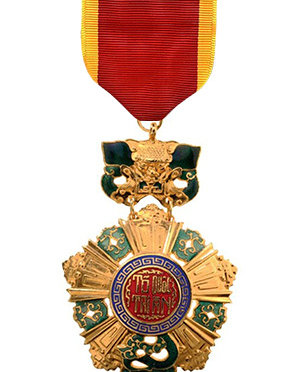
Both the badge and the star of the National Order of Vietnam have the same design. The ribbon, red with yellow borders, was in fact the ribbon of the former Order of the Dragon of Annam when awarded by the Emperor of Annam himself (when awarded by the French Government the ribbon was green with orange borders).

Since the National Order of Vietnam was both a civil and a military decoration, it was displayed above all other awards when worn on a military uniform.

The Vietnam Liberation Order

The Liberation Order Badge is a military badge given by North Vietnam during the Vietnam War and awarded for outstanding performance

The Liberation Order Badge is a military badge given by North Vietnam during the Vietnam War originally instituted on August 9, 1965 and awarded t0 groups and individuals for outstanding performance in combat, production, official-business and to families separated by the struggle in the South.

The original order was eventually replaced by an entirely different and larger (40mm) planchet and its ribbon changed. The Order was adopted as an official order of the Socialist Republic of Vietnam (SRV).

The Vietnam Liberation Order Design

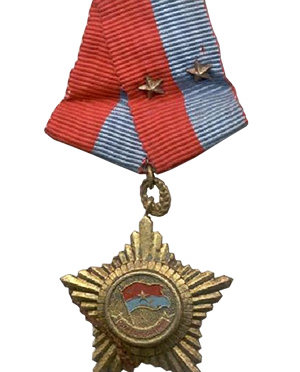
The early version of the National Liberation Front (NLF or Viet Cong) Liberation Order is a 37mm five-pointed star with seven rays between each point.

The obverse is a central disk with the NLF flag between two shocks of grain and a toothed-gear below. The inscription of the curved ribbon reads, GIAI PHONG or “Liberation”. The reverse is plain. The affiliated decoration, also an official decoration of the SRV, retains the original characteristics of the early order. The decoration is smaller (33mm) and utilizes the same blue-red-blue ribbon combination as the original version of the order.

The Republic of Vietnam Campaign Medal

The Republic of Vietnam Campaign Medal is a military decoration issued to American troops who aided South Vietnam in a conflict.

The Republic of Vietnam Campaign Medal is a military decoration issued to American troops who aided South Vietnam in a conflict. First introduced during the First Indochina War, the Republic of Vietnam Campaign medal was authorized for wear on American service members as of December 1966 for their service in Vietnam.

In order to receive this medal, military members must have served in the Republic of Vietnam for six months between March 1, 1961 and March 28, 1973 or served outside Vietnam but gave combat support for six months or served less than six months but was wounded, captured and escaped enemy forces, or was killed in action.

The Republic of Vietnam Campaign Medal Design

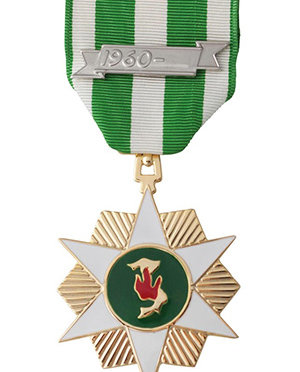
What’s unique about the medal is that it comes with a default device, known as the 1960 device. It reads, “1960-”. Because they were produced and awarded during the war, it reads the start date of the conflict, but no end date was added.

Its design helps to tell the story of the Vietnam War with the colors of the medal—green and white—to represent freedom and purity respectively. In addition, the medallion is made of a gold-colored metal in the shape of a 36 mm wide six-pointed white enamel star, six golden rays between each point in the star, and a map of Vietnam in the center of the medallion. The putative red flames on the map represent the locations of the war.

On the reverse of the medal is a circle bearing the inscription Chiến Dịch (Campaign) above and Bội Tinh (Medal) below the word VIET-NAM in the center. The suspension ribbon and service ribbon of the medal is green (to represent freedom) with three vertical white (to represent purity) stripes.

The Air Medal (USA)

The Air Medal is a decoration of the U.S. Armed Forces created in 1942 and awarded for single acts of heroism or meritorious achievement.

The Air Medal is a military decoration of the United States Armed Forces created in 1942 by Executive Order 9158, signed by Franklin D. Roosevelt. It is awarded for single acts of heroism or meritorious achievement while participating in aerial flight.

The Air Medal is awarded for a variety of accomplishments, including acts of heroism, successful completion of numerous combat missions, participation in aerial combat, or extraordinary performance of aviation duties. It recognizes the significant contributions and sacrifices made by aviators and aircrew members.

The U.S. Air Medal Criteria

The original award criteria set by an Army Policy Letter dated September 25, 1942 was for one award of the Air Medal:

  • per each naval vessel or three enemy aircraft in flight confirmed destroyed. An entire aircrew would be credited for the destruction of a ship, but only the pilot or gunner responsible would be credited for destroying an enemy aircraft.
  • per 25 operational flights during which exposure to enemy fire is expected.
  • per 100 operational flights during which exposure to enemy fire is not expected.

These criteria were altered by the commanding generals of each numbered Air Force to fit the conditions of their theater of operations and to maintain morale.

The Distinguished Flying Cross would usually be awarded for roughly twice to five times the requirements of the Air Medal. This led to automatic “score card” awards of the Air Medal and Distinguished Flying Cross for completing a set number of operational missions rather than distinguished service, meritorious action, or bravery, as had been intended. On August 5, 1943, such score card awards were officially abolished by a Headquarters Army Air Forces Awards Board memorandum due to the embarrassment when airmen received the Air Medal for “score carding” five missions or more but were later removed from flying duties for “lack of moral fibre“. Commanders could still issue the awards on those grounds, but the recipient must perform exceptional or meritorious service as well.

During World War II, the medal’s award criteria varied widely depending on the theater of operations, the aircraft flown, and the missions accomplished. The Army may award the Air Medal for peacetime service, but approval authority is by general-grade officers at the group or brigade level or higher.

The Air Medal Design

The Air Force medal design is prescribed by law. It was created by Walker Hancock, who had competed for the design as a civilian, but prior to the award of the competition had been inducted into the army.

The Air Medal is a Bronze compass rose 1​1116 inches circumscribing diameter and charged with an eagle volant carrying two lightning flashes in its talons. A fleur-de-lis at the top point holds the suspension ring. The points of the compass rose on the reverse are modeled with the central portion plain for engraving the name of the recipient.

The ribbon is 1​38 inches wide and consists of the following stripes:

  1. 18 inch Ultramarine Blue 67118;
  2. ¼ inch Golden Orange 67109;
  3. center ​58 inch Ultramarine Blue;
  4. ¼ inch Golden Orange; and
  5. 18 inch Ultramarine Blue.

Buy an Air Medal

Note: As an eBay partner, I earn from qualifying purchases. This is all done automatically when you use a link and at no extra cost to you.

Right Now on eBay 
Clicking a link to eBay may result in a referral commission being paid if a purchase is made.
Loading...

The Legion of Merit

The Legion of Merit is a military award of the United States Armed Forces for exceptionally meritorious conduct and outstanding services.

The Legion of Merit (or LOM) is a military award of the United States Armed Forces given to members of the seven uniformed services of the U.S. and  to military and political figures of foreign governments for exceptionally meritorious conduct in the performance of outstanding services and achievements. It is typically awarded to Army, Marine Corps, and Air Force general officers and colonels, and Navy and Coast Guard flag officers and captains occupying senior command or very senior staff positions. Instances for officers of lesser rank are rare.

The award was created in December 24, 1941, when the Adjutant General formally requested action be initiated to create a Meritorious Service Medal and provide designs for the decoration. These were prepared by Bailey, Banks, and Biddle and given to Assistant Chief of Staff for Personnel by the QMG on January 5, 1942. An act of Congress (Public Law 671—77th Congress) established the Legion of Merit on July 20, 1942.

The Legion of Merit is seventh in the order of precedence of all U.S. military awards and the only U.S. military decoration that may be issued in award degrees. It’s also one of only two U.S. military decorations to be issued as a neck order (the other being the Medal of Honor). It is worn after the Defense Superior Service Medal and before the Distinguished Flying Cross.

The Legion of Merit in History

During the Second World War, Brazilian Army Brigadier General Amaro Soares Bittencourt became the first person awarded the Legion of Merit (Commander) in October 1942. A week later, Lieutenant, junior grade Ann A. Bernatitus, a U.S. Navy Nurse Corps officer, became the first woman and the first member of the United States Armed Forces to receive the Legion of Merit. A year later, General Dwight D. Eisenhower was presented the Legion of Merit by President Roosevelt on November 26.

From 1942 to 1944, the Legion of Merit was awarded for a wide range of achievements, because it was the only decoration below the Silver Star, awarded for combat valor, and the Distinguished Service Medal for meritorious noncombat service. That was, until the Bronze Star Medal was established in 1944.

After World War II, the Legion of Merit was awarded almost exclusively to senior officers in the rank Lieutenant Colonel (Army, Marine Corps and Air Force) or Commander (Navy and Coast Guard) (O-5), and above. In 1969, the Meritorious Service Medal was established as a junior version of the Legion of Merit.

The Legion of Merit Classes

  1. Chief Commander: For Heads of state or government.
  2. Commander: For the equivalent of a U.S. military chief of staff or higher position.
  3. Officer: For Generals or flag officers below the equivalent of a U.S. military chief of staff; colonels or equivalent rank or military attachés.
  4. Legionnaire: For all recipients not included above.

The Legion of Merit Design

Medal Obverse

The Chief Commander Degree of the Legion of Merit Medal is, on a wreath of green laurel joined at the bottom by a gold bow-knot (rosette), a domed five-pointed white star bordered crimson, points reversed with v-shaped extremities tipped with a gold ball. In the center, a blue disk encircled by gold clouds, with 13 white stars arranged in the pattern that appears on the Great Seal of the United States. Between each point, within the wreath are crossed arrows pointing outwards. The overall width is 2 1516 inches (75 mm).[/vc_column_text][vc_column_text]

The Commander Degree of the Legion of Merit Medal has a width of 2 14 inches (57 mm). In the center, a disk for engraving the name of the recipient surrounded by the words “ANNUIT COEPTIS MDCCLXXXII.” An outer scroll contains the words “UNITED STATES OF AMERICA.”

Medal Reverse

The reverse of all of the medals has the motto taken from the Great Seal of the United States, “ANNUIT COEPTIS” (“He [God] has favored our undertakings“) and the date “MDCCLXXXII” (1782), which is the date of America’s first decoration, the Badge of Military Merit, now known as the Purple Heart. The ribbon design also follows the pattern of the Purple Heart ribbon.

Ribbon

The ribbon for all of the decorations is 1 38 inches (35 mm) wide and consists of the following stripes: 116 inch (1.6 mm) white; center 1 14 inches (32 mm) crimson; and 116 inch (1.6 mm) white.

The Chief Commander Degree, a miniature of the decoration in gold on a horizontal gold bar is worn on the service ribbon. One in silver on a horizontal silver bar is worn on the service ribbon for the Commander Degree.

Buy a Legion of Merit

Note: As an eBay partner, I earn from qualifying purchases. This is all done automatically when you use a link and at no extra cost to you.

Right Now on eBay 
Clicking a link to eBay may result in a referral commission being paid if a purchase is made.
Loading...

The Bronze Star Medal

The Bronze Star Medal (also known as Bronze Star) is a United States decoration awarded for heroic achievement or service in a combat zone. 

The Bronze Star Medal (also known as Bronze Star) is a United States decoration awarded to members of the United States Armed Forces for either heroic achievement, heroic service, meritorious achievement, or meritorious service in a combat zone. Officers from the other Uniformed Services of the United States are eligible to receive this award, as are foreign soldiers who have served with or alongside a service branch of the United States Armed Forces. Civilians serving with U.S. military forces in combat are also eligible for the award.

The Bronze Star Medal was established by Executive Order 9419, 4 February 1944 (superseded by Executive Order 11046, 24 August 1962, as amended by Executive Order 13286, 28 February 2003). Colonel Russell P. “Red” Reeder conceived the idea of the Bronze Star Medal in 1943; he believed it would aid morale if captains of companies or of batteries could award a medal to deserving people serving under them.

The Bronze Star Medal Design

The Bronze Star Medal was designed by Rudolf Freund (1878–1960) of the jewelry firm Bailey, Banks & Biddle.

The medal is a bronze star 1 12 inches (38 mm) in circumscribing diameter. In the center is a 316 inch (4.8 mm) diameter superimposed bronze star, the center line of all rays of both stars coinciding. The reverse bears the inscription HEROIC OR MERITORIOUS ACHIEVEMENT with a space for the name of the recipient to be engraved.

The star hangs from its ribbon by a rectangular metal loop with rounded corners. 

When the medal is awarded by the Army and Air Force for acts of valor in combat, the “V” Device is authorized for wear on the medal. When the medal is awarded by the Navy, Marine Corps, and Coast Guard for acts of valor or meritorious service in combat, the Combat “V” is authorized for wear on the medal.

The following ribbon devices must be specifically authorized in the award citation in order to be worn on the Bronze Star Medal, the criteria for and wear of the devices vary between the services:

  • Oak leaf cluster – In the Army and Air Force.
  • 5/16 inch star – In the Navy and Marine Corps and Coast Guard.
  • “V” device.
  • Combat “V”.

The Bronze Star During WW2

Here are some examples of individuals receiving the Bronze Star Medal for their actions during World War II:

  • General Dwight D. Eisenhower: General Eisenhower, the Supreme Commander of the Allied Expeditionary Forces in Europe, was awarded the Bronze Star Medal for his leadership during the planning and execution of the D-Day invasion on June 6, 1944.

  • Sergeant Audie Murphy: Audie Murphy, a highly decorated soldier and later a famous actor, received the Bronze Star Medal for his valorous actions in combat. Murphy demonstrated extraordinary courage and leadership in various engagements throughout the war, including his single-handed stand against German forces in the Battle of Holtzwihr.

  • Lieutenant Colonel James H. Doolittle: Lieutenant Colonel Doolittle, an aviation pioneer, was honored with the Bronze Star Medal for leading the daring Doolittle Raid, the first U.S. air raid on the Japanese mainland. Despite challenging circumstances, his leadership and audacity boosted American morale and dealt a blow to Japan’s strategic capabilities.

  • Private First Class Desmond Doss: Desmond Doss, a conscientious objector and combat medic, was awarded the Bronze Star Medal for his selfless actions during the Battle of Okinawa. Despite being under heavy enemy fire, Doss repeatedly braved danger to rescue and treat wounded soldiers, saving numerous lives.

  • Lieutenant Colonel Benjamin O. Davis Jr.: Lieutenant Colonel Davis, an officer in the Tuskegee Airmen, received the Bronze Star Medal for his exceptional achievements as a fighter pilot. He overcame significant adversity and discrimination to become one of the most respected and highly decorated African American officers of World War II.
Right Now on eBay 
Clicking a link to eBay may result in a referral commission being paid if a purchase is made.
Loading...

The Order of St. Sava

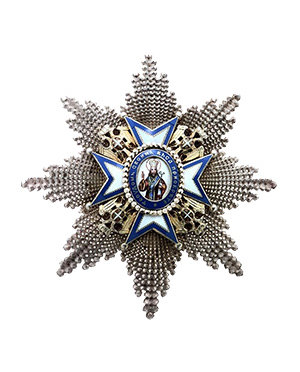
The Order of St. Sava was a decoration of merits established originally to recognize civilians for meritorious achievements to the Church, to arts and sciences, the royal house and the state and awarded by the Kingdom of Serbia, the Kingdom of Serbs, Croats and Slovenes and the Kingdom of Yugoslavia from 1883 to 1945.

The Order of St Sava was then awarded by the king of Yugoslavia until the abolishment of the monarchy in 1945.

Since 1985, the Order has been awarded on the occasion of the 800th anniversary of St. Sava. This order is dedicated to ecclesiastic and secular persons, who have special merits for the Serbian Orthodox Church. According to the ordinance of the church, each person who received a medal of third grade, may receive the medal of the higher grade as well as the first grade for future merits, provided that three years have passed at least since the previous award.

The Order of St. Sava Design

Five grades were awarded: Grand Cross, Grand Officer, Commander, Officer and Knight.

The first grade was a medal, worn with a sash over a shoulder and additionally with a breast star. The second and third grade laureates wore the Order with a neckband. The fourth grade with a triangular suspension, a rosette was attached to the ribbon above the medal. The fifth grade had a triangular suspension without a rosette. The medals of the fourth and fifth grades were worn on the breast. All white ribbons had two light blue stripes.

The order is determined in three grades: the first one is white, the second red and the third blue colored.

The Star for Naval Merit (Mexico)

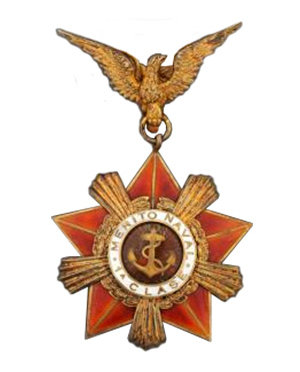
The Star for Military Merit was a medal issued during the twentieth century for the suppression of revolts and for general military service as the Mexican army put down rebellions by Mayan Indians.

In Spanish colonial times, the Yucatán (like most of New Spain) population operated under a legal caste system: peninsulares (officials born in Spain) were at the top, the criollos of Spanish descent in the next level, followed by the mestizo population (of mixed European-Amerindian descent), then descendants of the natives who had collaborated with the Spanish conquest of Yucatán, and at the bottom were the other native indios.

The Caste War of Yucatán (1847–1901) began with the revolt of native Maya people of Yucatán, Mexico against the European-descended population, called Yucatecos. The latter had long held political and economic control of the region. A lengthy war ensued between the Yucateco forces in the north-west of the Yucatán and the independent Maya in the south-east.

The war officially ended in 1901 when the Mexican army occupied the Maya capital of Chan Santa Cruz and subdued neighboring areas. Another formal end was made in 1915, when a Mexican general was sent to subdue the territory. However, skirmishes with small settlements that refused to acknowledge Mexican control continued until 1933.

The Star for Military Merit (Mexico)

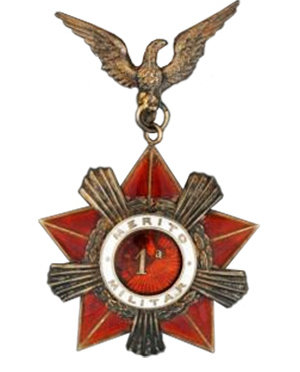
The Star for Military Merit was a medal issued during the twentieth century for the suppression of revolts and for general military service as the Mexican army put down rebellions by Mayan Indians.

In Spanish colonial times, the Yucatán (like most of New Spain) population operated under a legal caste system: peninsulares (officials born in Spain) were at the top, the criollos of Spanish descent in the next level, followed by the mestizo population (of mixed European-Amerindian descent), then descendants of the natives who had collaborated with the Spanish conquest of Yucatán, and at the bottom were the other native indios.

The Caste War of Yucatán (1847–1901) began with the revolt of native Maya people of Yucatán, Mexico against the European-descended population, called Yucatecos. The latter had long held political and economic control of the region. A lengthy war ensued between the Yucateco forces in the north-west of the Yucatán and the independent Maya in the south-east.

The war officially ended in 1901 when the Mexican army occupied the Maya capital of Chan Santa Cruz and subdued neighboring areas. Another formal end was made in 1915, when a Mexican general was sent to subdue the territory. However, skirmishes with small settlements that refused to acknowledge Mexican control continued until 1933.