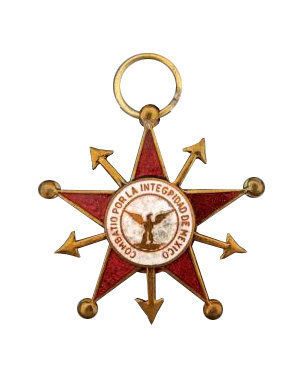
The Star for Bejar and El Salado (1842)

This set of medals were issued during the period 1835-1841 of armed conflict between settlers and the Mexican army that began in late 1835.

As the number of American settlers in the Mexican state of Texas kept growing, the Mexican government made the decision in 1830 to close the border to all immigration, imposing as well numerous restrictions like the abolition of slavery.

The Mexican government believed the United States had instigated the Texas insurrection (October 2, 1835 – April 21, 1836) with the goal of annexation. The Mexican Congress passed the Tornel Decree, declaring that any foreigners fighting against Mexican troops “will be deemed pirates and dealt with as such, being citizens of no nation presently at war with the Republic and fighting under no recognized flag.”

The revolution began in October 1835, after a decade of political and cultural clashes between the Mexican government and the increasingly large population of American settlers in Texas. Colonists and Tejanos disagreed on whether the ultimate goal was independence or a return to the Mexican Constitution of 1824. In March 1836, a second political convention declared independence and appointed leadership for the new Republic of Texas.

Determined to avenge Mexico’s honor, Santa Anna vowed to personally retake Texas. His Army of Operations entered Texas in mid-February 1836 and found the Texians completely unprepared. Mexican General José de Urrea led a contingent of troops on the Goliad Campaign up the Texas coast, defeating all Texian troops in his path and executing most of those who surrendered. Santa Anna led a larger force to San Antonio de Béxar (or Béxar), where his troops defeated the Texian garrison in the Battle of the Alamo, killing almost all of the defenders.

After the Texans’ defeat in April 1836 of General Santa Anna, Mexico made no further attempt to reconquer the territory, although it refused to recognize its independence. The annexation of Texas as the 28th state of the United States, in 1845, led directly to the Mexican–American War. By the terms of the Treaty of Guadalupe Hildago, signed in 1848, Mexico ceded almost half its national territory to the United States.
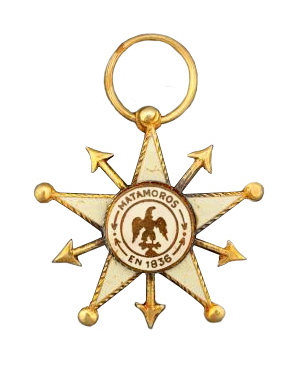
The Star for the Defense of Matamoros (1836)

This set of medals were issued during the period 1835-1841 of armed conflict between settlers and the Mexican army that began in late 1835.

As the number of American settlers in the Mexican state of Texas kept growing, the Mexican government made the decision in 1830 to close the border to all immigration, imposing as well numerous restrictions like the abolition of slavery.

The Mexican government believed the United States had instigated the Texas insurrection (October 2, 1835 – April 21, 1836) with the goal of annexation. The Mexican Congress passed the Tornel Decree, declaring that any foreigners fighting against Mexican troops “will be deemed pirates and dealt with as such, being citizens of no nation presently at war with the Republic and fighting under no recognized flag.”

The revolution began in October 1835, after a decade of political and cultural clashes between the Mexican government and the increasingly large population of American settlers in Texas. Colonists and Tejanos disagreed on whether the ultimate goal was independence or a return to the Mexican Constitution of 1824. In March 1836, a second political convention declared independence and appointed leadership for the new Republic of Texas.

Determined to avenge Mexico’s honor, Santa Anna vowed to personally retake Texas. His Army of Operations entered Texas in mid-February 1836 and found the Texians completely unprepared. Mexican General José de Urrea led a contingent of troops on the Goliad Campaign up the Texas coast, defeating all Texian troops in his path and executing most of those who surrendered. Santa Anna led a larger force to San Antonio de Béxar (or Béxar), where his troops defeated the Texian garrison in the Battle of the Alamo, killing almost all of the defenders.

After the Texans’ defeat in April 1836 of General Santa Anna, Mexico made no further attempt to reconquer the territory, although it refused to recognize its independence. The annexation of Texas as the 28th state of the United States, in 1845, led directly to the Mexican–American War. By the terms of the Treaty of Guadalupe Hildago, signed in 1848, Mexico ceded almost half its national territory to the United States.

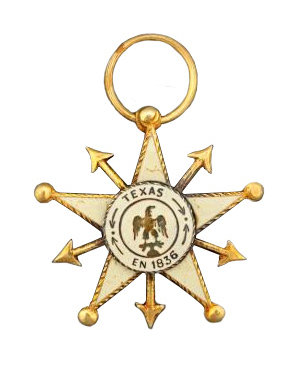
The Star for the Defense of Texas (1836)

This set of medals were issued during the period 1835-1841 of armed conflict between settlers and the Mexican army that began in late 1835.

As the number of American settlers in the Mexican state of Texas kept growing, the Mexican government made the decision in 1830 to close the border to all immigration, imposing as well numerous restrictions like the abolition of slavery.

The Mexican government believed the United States had instigated the Texas insurrection (October 2, 1835 – April 21, 1836) with the goal of annexation. The Mexican Congress passed the Tornel Decree, declaring that any foreigners fighting against Mexican troops “will be deemed pirates and dealt with as such, being citizens of no nation presently at war with the Republic and fighting under no recognized flag.”

The revolution began in October 1835, after a decade of political and cultural clashes between the Mexican government and the increasingly large population of American settlers in Texas. Colonists and Tejanos disagreed on whether the ultimate goal was independence or a return to the Mexican Constitution of 1824. In March 1836, a second political convention declared independence and appointed leadership for the new Republic of Texas.

Determined to avenge Mexico’s honor, Santa Anna vowed to personally retake Texas. His Army of Operations entered Texas in mid-February 1836 and found the Texians completely unprepared. Mexican General José de Urrea led a contingent of troops on the Goliad Campaign up the Texas coast, defeating all Texian troops in his path and executing most of those who surrendered. Santa Anna led a larger force to San Antonio de Béxar (or Béxar), where his troops defeated the Texian garrison in the Battle of the Alamo, killing almost all of the defenders.

After the Texans’ defeat in April 1836 of General Santa Anna, Mexico made no further attempt to reconquer the territory, although it refused to recognize its independence. The annexation of Texas as the 28th state of the United States, in 1845, led directly to the Mexican–American War. By the terms of the Treaty of Guadalupe Hildago, signed in 1848, Mexico ceded almost half its national territory to the United States.

The Presidential Medal of Freedom

The Presidential Medal of Freedom is an award bestowed by the President of the United States. It is the highest civilian award of the USA.

The Presidential Medal of Freedom is an award bestowed by the President of the United States and is—along with the Congressional Gold Medal—the highest civilian award of the United States.

The medal recognizes those people who have made “an especially meritorious contribution to the security or national interests of the United States, world peace, cultural or other significant public or private endeavors”. The award is not limited to U.S. citizens and, while it is a civilian award, it can also be awarded to military personnel and worn on the uniform.

President John F. Kennedy established the current decoration in 1963 through Executive Order 11085, with unique and distinctive insignia, vastly expanded purpose, and far higher prestige. It was the first U.S. civilian neck decoration and, in the grade of Awarded With Distinction, is the only U.S. sash and star decoration.

The Executive Order calls for the medal to be awarded annually on or around July 4, and at other convenient times as chosen by the president, but it has not been awarded every year (e.g., 2001, 2010). Recipients are selected by the president, either on the president’s own initiative or based on recommendations.

The medal may be awarded to an individual more than once.

The Presidential Medal of Freedom Design

The badge of the Presidential Medal of Freedom is in the form of a golden star with white enamel, with a red enamel pentagon behind it; the central disc bears thirteen gold stars on a blue enamel background (taken from the Great Seal of the United States) within a golden ring. Golden North American bald eagles with spread wings stand between the points of the star. It is worn around the neck on a blue ribbon with white edge stripes.

A special rarely given grade of the medal, known as the Presidential Medal of Freedom with Distinction, has a larger execution of the same medal design worn as a star on the left chest along with a sash over the right shoulder, with its rosette resting on the left hip.

Both medals may also be worn in miniature form on a ribbon on the left chest, with a silver North American bald eagle with spread wings on the ribbon, or a golden North American bald eagle for a medal awarded With Distinction.

In addition, the medal is accompanied by a service ribbon for wear on military service uniform, a miniature medal pendant for wear on mess dress or civilian formal wear, and a lapel badge for wear on civilian clothes (all shown in the accompanying photograph of the full presentation set).

Find This Medal Online

Right Now on eBay 
Clicking a link to eBay may result in a referral commission being paid if a purchase is made.
Loading...

The Medal for the War Wounded

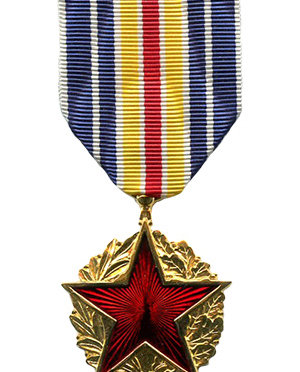
The Medal for the War Wounded (Médaille des blessés de guerre) was a ribbon insignia awarded for wounds received in the line of duty.

The Medal for the War Wounded (or Médaille des blessés de guerre) was originally a mere insignia in the form of a ribbon awarded for wounds received in the line of duty while facing an enemy.

The insignia was established by the law of 11 December 1916, based on an idea by the nationalist writer Maurice Barrès. Although originally established as a temporary measure, the insignia survived for a century in some form or another. It could be awarded to wounded soldiers, prisoners of war, to World War II deportees and internees from the French resistance and to soldiers wounded in more recent conflicts.

A variety of unofficial medals in the form of a red enameled star suspended by the same ribbon appeared very early on and although tolerated for wear by the authorities, were not official until recently.

The Medal for the War Wounded can be worn by:

  • Military personnel suffering from a physical or mental war wound, ascertained by the army health service and approved by the Minister of Defence;
  • Prisoners of war, physically or psychologically wounded during their detention.

The Medal for the War Wounded Design

The Medal for the War Wounded is made of gilded bronze with a 30 mm diameter. It is mainly composed of a large bright red enameled five-pointed star atop a crown of half laurels (left) and half oak leaves (right).

The medal is suspended by a ring from a 35 mm wide silk moiré ribbon composed of vertical stripes in the following colors: white 1 mm – blue 5 mm – white 1 mm – blue 4 mm – white 1 mm – yellow 3 mm – white 1 mm – beginning ou the outer edge on both sides of a 3 mm wide central red stripe.

Small enamel red five pointed stars are added to the medal ribbon and undress ribbon for each additional wound.

The Insignia for Wounded Civilians

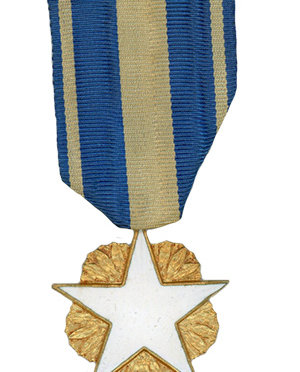
The Insignia for wounded civilians (Insigne des blessés civils) is a French distinction for civilians injured or maimed as a result of war.

The Insignia for wounded civilians (or Insigne des blessés civils) is a French distinction for civilians, irrespective of age or sex, who have been injured or maimed as a result of war.

It was Maurice Barres, defender of the National Federation of the Disabled and President of the League of Patriots, to whom the idea of the creation of the Badge Wounded. In 1915, he launched a first call in the columns of the newspaper “L’Echo de Paris” on 28 March and another in the issue of June 10, for the creation of this distinctive insignia to designate the eyes of all “un homme dont les blessures, l’infirmité, la maladie proviennent d’un fait de guerre” (“a man whose injury, disability, illness comes from an act of war”).

On July 18, 1918, a decree made at the initiative of Minister of the Interior, which instituted a lapel pin for civilian victims of war. This award is presented:

  • for World War I 1914-1918, by order of the Minister of Interior after consulting a board meeting at Head of the department of residence of the candidate.
  • for World War II 1939-1945, by the Minister of Veterans and War Victims, the candidate must be a pensioner or civilian casualties of war.

La Grande Chancellerie de la Légion d’honneur does not recognize this medal, or the military version, as an official decoration, therefore it is not mentioned on any order of precedence list. However, in view of the importance it can have many of its owners, it is widely worn.

The Insignia or Wounded Civilians Design

Currently, the most commonly worn medal is uniface of gilt bronze, 30 mm in diameter and consists of a white enamel star encircled by a wreath of oak and laurel leaves.

The medal hangs from a ribbon of blue and yellow. When the ribbon bar is worn alone it containts a white star clasp.

The Order of the Dragon of Annam

The Imperial Order of the Dragon of Annam (Ordre impérial du Dragon d’Annam) was created in 1886 in the ancient Vietnamese city of Huế.

The Imperial Order of the Dragon of Annam (or Ordre impérial du Dragon d’Annam) was created on March 14, 1886, in the ancient Vietnamese city of Huế, by Emperor Đồng Khánh of the Imperial House of Annam, upon the “recommendation” of the President of France as a jointly awarded French colonial order.

The Order was designed as a reward for services to the state, the French colonial government, or the emperor.

When French colonial rule over Indochina ended, the Order of the Dragon of Annam was abolished and replaced by the National Order of Vietnam which was later retained and revised by the Republic of Vietnam (South Vietnam). The ribbon of the Dragon of Annam was retained for this award, but it was (belatedly) recognized that a colonial order had no place in the new regime as the order was always historically associated with the period of French rule. Even the name of “Annam” in the title of the order was a point of dishonor as the name comes from the old Chinese term for Vietnam, which means “the pacified south”.

In its classes and insignia, the Order was modeled on the French Légion d’honneur and the other French colonial orders:

  • Grand Cordon
  • Grand Officer
  • Commander
  • Officer
  • Knight

The Order of the Dragon of Annam Design

The badge was an eight-pointed star charged with a central medallion of blue bearing the legend “Hoàng đế Đồng Khánh” (‘Emperor Đồng Khánh’; in stylized Chinese characters) with four radiant suns surrounded by a red band, all suspended from an imperial crown surmounted by a green dragon.

The star for Grand Officers and Grand Cross holders was charged with a green dragon holding the same blue medallion as featured on the badge. There were two ribbons, red with gold border stripes for awards by the Emperor and green with gold border stripes for the President’s version.

The Order of Nichan El-Anouar (Order of the Light)

The Order of Nichan El-Anouar (or “Order of the Light”) was established in 1887 as a colonial order of merit of the Tajurah sultanate in French Somaliland.

The order has five degrees:

  • Grand-croix (grand cross)
  • Grand officier (grand officer)
  • Commandeur (commander)
  • Officier (officer)
  • Chevalier (knight)

The Order was deprecated on 3 December 1963 by the Ordre National du Mérite.

The Order of the Star of Anjouan

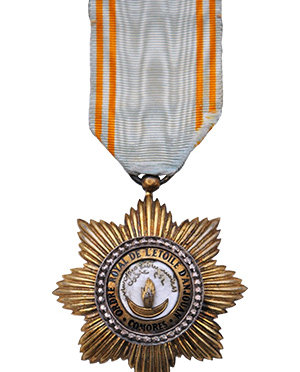
The Ordre de l’Étoile d’Anjouan (or “Order of the Star of Anjouan”) was a French colonial order of knighthood founded in 1874.

  • Time Period: Pre-WW1
  • Institution: 1 December 1889
  • Country: France

The Ordre de l’Étoile d’Anjouan (or “Order of the Star of Anjouan”) was a French colonial order of knighthood founded in 1874.

It was established in 1874 by sultan Mohamed-Saïd-Omar of the Comoros island of Anjouan, reorganized on 18 June 1892 and authorized and recognized by the French government on 12 September 1896. It was made a French Overseas Order in 1950.

In this case a local order was adopted by the French, although they reorganized and redesigned it. Another Anjouan orde, the Star of Said Ali was not adopted.

The Ordre de l’Étoile d’Anjouan has five classes:

  • Grand-croix
  • Grand-officier
  • Commandeur
  • Officier
  • Chevalier

The Order of the Black Star

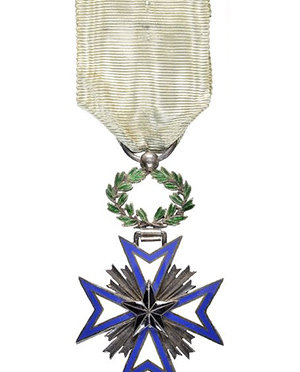
The Order of the Black Star (Ordre de l’Étoile Noire) was an order of knighthood established by Toffa, future king of Dahomey, today Benin.

The Order of the Black Star (or “Ordre de l’Étoile Noire”) was an order of knighthood established on 1 December 1889 at Porto-Novo by Toffa, future king of Dahomey (today the Republic of Benin).

Approved and recognized by the French government on 30 July 1894, after the establishment of the new statutes of 30 August 1892, according this distinction to all those who worked to develop French influence on the west coast of Africa.

The order has five classes:

  • Grand-croix (grand cross)
  • Commandeur avec plaque (commander with plaque)
  • Commandeur (commander)
  • Officier (officer)
  • Chevalier (knight)

The order was deprecated by decree on 3 December 1963, and superseded by the Ordre National du Mérite. Extant members of the order are permitted to wear their original decorations.