The Indochinese Order of Merit

The Indochinese Order of Merit (or “Ordre du Mérite indochinois”) was a regional award of France awarded by the Governor-General of Indochina for the local population of French Indochina.

Established April 30, 1900 by Governor-General of French Indochina Paul Doumer the order was to reward the local population of Indo-China for services to agriculture, commerce, industry and art.

This award had no status as an official French colonial award but was a local only award for the population of Laos, Cambodia, Tonkin, Cochin China, and Annam.

Governed by an Order Council, it was divided into three classes with limit on the number of members for each class. The 3rd class, was limited to 500 members. The 2nd Class, was limited to 100 members. The 1st class, was limited to 15 members.

The Indochinese Order of Merit Design

The badge of the order is a ball tipped six-pointed star with concave sides. In the center of the star is a round rimmed medallion. In the center of the medallion is the inscription in Annamese ideographic writing “It is worthy to develop knowledge“.

On the rim is the inscription INDOCHINE FRANCAISE (French Indochina). Attached to the ball of the top most arm of the star are two laurel branches, which act as a ring to attach the star to its ribbon.

The ribbon of the order is yellow Moire silk. The Order was presented in the 1st degree in gold, 2nd degree silver, and third degree bronze.
The Order of Agricultural Merit

The Order of Agricultural Merit is an order of merit by the French Republic for outstanding contributions to agriculture.

The Order of Agricultural Merit (or Ordre du Mérite agricole) is an order of merit bestowed by the French Republic for outstanding contributions to agriculture.

When it was created in 1883, it was second in importance only to the Legion of Honour within the French order of precedence. The order was established on 7 July 1883, based on the proposition of the then Minister of Agriculture Jules Méline, in an effort to adequately reward services to agriculture in view of the maximum number of the Legion of Honour that could be awarded yearly. Labour was intensive and never-ending, devotion was commonplace but the rewards were rare.

The Order comprises approximately 340,000 recipients to date, of which approximately 23,000 are alive at any given time, including all living former ministers of agriculture. Officers number approximately 60,000 to date with approximately 5,000 living, and approximately 4800 were made commanders to date, with approximately 400 living at any given time.

Award prerequisites are as follows:

  • Knight: be at least thirty years of age with fifteen years of service/work;
  • Officer: at least five years as a Member of the order;
  • Commander: at least five years as an Officer of the order.

Conditions of age and of seniority may be lowered for candidates who have outstanding qualifications.

The Order of Agricultural Merit Design

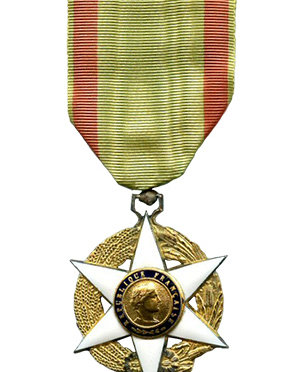
The Order of Agricultural Merit is in the form of a 40mm (35mm for pre-November 1999) wide star, 60mm for the commander’s insignia, with six white enameled arms, the arms resting on a gilt wreath of wheat on the right and of corn on the left.

On the obverse at its center, a gilt medallion bearing the effigy of the republic in the form of the relief right profile of a woman’s head, the medallion is surrounded by a narrow blue enameled band bearing the golden semi-circular inscription “RÉPUBLIQUE FRANÇAISE” (“FRENCH REPUBLIC”).

On the reverse, the gilt medallion bears the relief inscription on three lines “MÉRITE” “AGRICOLE” “1883” (“AGRICULTURAL MERIT 1883”), it is surrounded by a plain blue enameled band.

The officers’ and commanders’ badges also bear a gilt wreath, half vine and half olive branch, between the insignia and the ribbon suspension ring. The knight’s insignia is made of silver, the officer’s is made of silver-gilt, the commander’s is made of silver-gilt or gold.

The order hangs from a 37mm wide silk moiré green ribbon with 5mm amaranth vertical stripes located 1mm from the edges. The commander’s insignia is worn on a cravat around the neck.

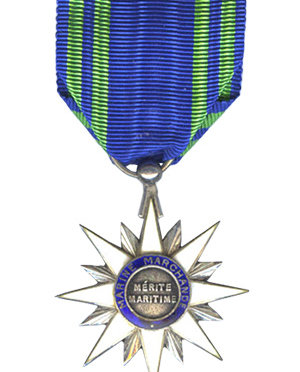
The Order of Maritime Merit

The Ordre du Mérite Maritime (or Order of Maritime Merit in French) is a French order established on 9 February 1930 for services rendered by the seafarers to distinguish the risks involved and the services rendered by seamen.

Stressed over the importance of the economic role of the Merchant Navy to the country. The order was reorganized in 1948, and again by decree on 17 January 2002.

The order can be awarded to merchant marine crew, civilian administrators, and the crews of lifeboats and rescues, naval military personnel and individuals who have distinguished themselves in maritime field.

The Order of Merit has 3 degrees:

  • Commandeur (commander)
  • Officier (officer)
  • Chevalier (knight)

The Order of the Gold Lion of the House of Nassau

The Order of the Gold Lion of the House of Nassau is a chivalric order shared by the two branches of the House of Nassau.

The Order of the Gold Lion of the House of Nassau (or Huisorde van de Gouden Leeuw van Nassau in Dutch) is a chivalric order shared by the two branches of the House of Nassau (the Ottonian and Walramian lines). The order may be awarded to sovereigns, princes of sovereign houses and heads of state for meritorious service to Luxembourg and the Grand Duke.

In the context of the younger Ottonian line, this order is a house order of the Dutch Royal House of Orange-Nassau and is awarded as a personal gift by the King of the Netherlands on a person who has rendered special service to the Royal House.

The order was founded by royal grand-ducal decree on 31 March 1858 by King-Grand Duke William III. The order originally included only one grade (i.e. “Knight”), but this was increased to four by William III in 1873:

  1. Grand Cross
  2. Grand Officer
  3. Officer
  4. Knight

The further rank of Commander was introduced in 1882. Nowadays, the order is conferred only on rare occasions in the Netherlands or Luxembourg.

Princes who are sons or brothers of the heads of the two lines of the House of Nassau are born knights of the order. In 1984, Queen Beatrix and Grand Duke Jean made an agreement that princesses (daughters of the heads of the two lines of the House of Nassau) may be admitted when they reach the age of majority (18).

The Order of the Gold Lion o the House of Nassau Design

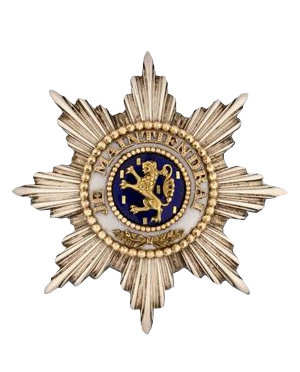
The badge of the order is a white-enameled golden Maltese Cross, with the golden monogram “N” between the arms of the cross. The obverse central disc is in blue enamel, bearing the Gold Lion of the House of Nassau. The reverse central disc is also blue enameled, with the motto Je maintiendrai (“I will maintain”) in gold.

The plaque is an 8-pointed star with straight silver rays; the same obverse of the badge of the order appears at its centre, surrounded by the motto Je maintiendrai in gold letters on white enamel. The ribbon of the sash of the order is yellow-orange moiré with a small blue stripe at each edge.

A knight wears the order’s badge on a sash on the right shoulder, and the plaque (breast star) of the order on the left chest.

The Order of Saint Hubert

The Royal Order of Saint Hubert is a Roman Catholic dynastic order of knighthood founded in 1444 or 1445 by Gerhard VII.

The Royal Order of Saint Hubert is a Roman Catholic dynastic order of knighthood founded in 1444 or 1445 by Gerhard VII, Duke of Jülich-Berg to commemorate his victory over the House of Egmond at the Battle of Linnich on 3 November (Saint Hubert‘s day, which commemorates the conversion of Saint Hubert and his standing as the patron saint of hunters and knights).

The establishment of the Order occurred during a long-term, intermittent territorial dispute that began in the 1430s between the Dukes of Jülich and the Guelders. the Order of Saint Hubert honors a military victory of the Duke of Jülich, on Saint Hubert’s day, 3 November 1444.

Initially, the order was open to men and women, although the number of male companions was limited to sixty. Over time, the award had other uses as a reward for loyalty to the monarch and service to the princely state.

The Order of Saint Hubert Design

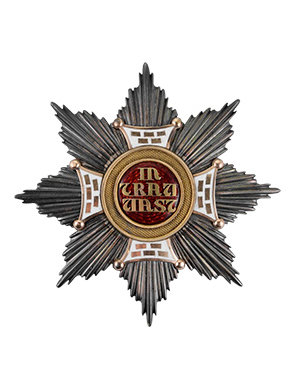
The insignia is a gold-enameled cross lying in a white field and surmounted by a crown.

On the obverse is represented the conversion of Saint Hubert, with the legend In trau vast (“Firm in fidelity”) in Gothic letters. On the reverse lies the imperial orb and the Latin inscription In memoriam recuperatæ dignitatis a vitæ 1708 (“In remembrance of the restoration of the original dignity, 1708″).

Originally, the order consisted of a collar (of stylized horns, six for men and four for women) and a pendant jewel (depicting the conversion of Saint Hubert). The great cross was only worn on special days.

The collar of the Order under the Wittelsbach dynasty consisted of forty-four gold links, twenty-two of which consisted of a rectangular representation of the conversion of Saint Hubert in open relief surrounded by a gold and white enamel frame.

The sash of the Order was poppy red moire with narrow green borders, but under the knot, at the ends of this sash, these green borders as well as the ends of the sash were covered with gold metallic ribbon.

The Queen’s Mediterranean Medal

The Queen’s Mediterranean Medal was awarded to troops who had replaced their regular Army counterparts in garrisons across the Mediterranean.

The Queen’s Mediterranean Medal was awarded to Militia troops who had replaced their regular Army counterparts in the various military garrisons across the Mediterranean, in Gibraltar, Malta and Egypt. The medal was authorized by King Edward VII and This allowed regular troops to be available for the Second Boer War.

Troops on the island of St. Helena who were guarding Boer prisoners of war in the POW camp were awarded the Queen’s South Africa Medal without clasp.

The Queen’s Mediterranean Medal Design

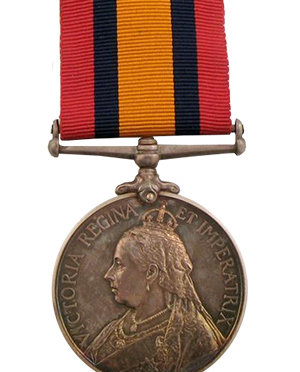
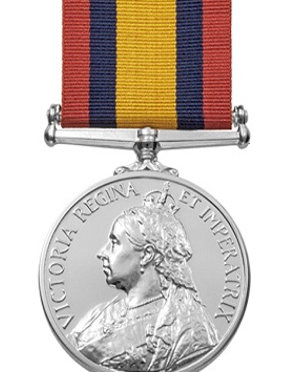
The Queen’s Mediterranean Medal and ribbon are identical to the Queen’s South Africa Medal 1899-1902, except the inscription ‘SOUTH AFRICA’ has been replaced by the word ‘MEDITERRANEAN’ on the reverse of the medal.

No clasps were awarded with this medal.

The Queen’s South Africa Medal

The Queen’s South Africa Medal is a military decoration established in 1900 and presented to military personnel in the Boer War.

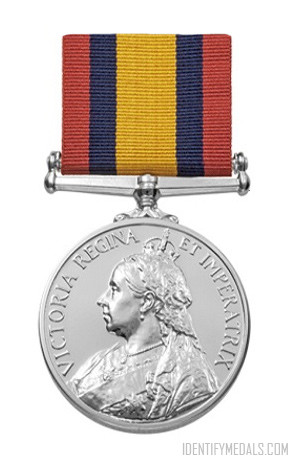
The Queen’s South Africa Medal is a military decoration of South Africa that was established in 1900. It was first presented to military personnel who fought in the Boer War from the 11th of October 1899 to 31st May 1902 and awarded to the British forces, the Royal Navy, the colonial forces; mainly from Canada, Australia, India, New Zealand, South Africa and civilians employed in official positions by the military.

The medal (without bar) was also presented to soldiers who guarded the prisoners captured in the Boer War at POW camp in St Helena. Those in the Mediterranean islands received the Queen’s Mediterranean Medal, and some troops on the ships received the Transport Medal.

Establishment:

The QSA was instituted by Queen Victoria in 1900 to honor soldiers and civilians who served in South Africa’s Boer War.

There are three known versions of the medal. Since it was expected the war would only last a short duration and conclude by 1900, the original medals were struck years 1899 to 1900 on the back.

Fifty medals were presented before it became apparent the war was not going to end any time soon. And so the remaining medals had the impressed years scrapped off. The third version of the QSA medal didn’t have the labeling of the years.

The soldiers who received this medal deserved it because they faced difficulties during the war. For instance, they fought against an enemy who was well prepared in terms of marksmanship and movement. The enemy was good at navigation and used horses to move around.

These combatants survived devoid of the basic necessities like food and water, while thousands perished from enteric fever. Casualties reached 50,000 during the war, but recent studies put the number at approximately 97,000.

A majority of those who were awarded this medal took part in the scorched earth policy during the last stage of the war that lasted twenty months. They adopted this strategy when it became clear the conventional way of fighting the enemy wasn’t working.

The Queen’s South Africa Medal Design

The QSA medal is made of silver and is about 1.5 inches in diameter. But there were versions made of bronze, which were issued to Indian non-combatants and other non-combatant groups who were in the military payroll. The silver medal was mainly awarded to the native soldiers.

Forward-face:

The front part shows a crowned and disguised model of Queen Victoria, facing the left.

Back side:

The back side was designed by G.W. de Saulles. It shows Britannia clutching at the Union Flag in the left hand and a laurel wreath on the right. In the background, soldiers can be seen marching from the coat towards the inland.

Towards the background in the left, you’ll notice two men-of-war and Britannia’s shield and Neptune’s Trident on the ground. In the top perimeter the words ‘South Africa’ is engraved.

Three versions of the back side exist;

  1. The first version is dated 1899 and 1900, with the wreath close to touching the letter ‘R’ in Africa.
  2. The years were later scrapped off both the dies and the remaining medals were still somehow visible.
  3. Minting was subsequently done with new dies, without the years and the wreath almost touching letter ‘F’ of AFRICA. This is the reverse adopted for the King’s South Africa Medal.

The Ribbons:

The Queens South Africa Medal is worn from its specific ribbon, which was first made from silk but after the 19th-century advancements, changed to cotton.

Furthermore, their colors are symbolic; the equal stripes of 1939 -1945 star are dark blue, signifying the service of the Merchant and Royal Navies, whereas red is for the Armies, and light blue for the Air Force.

The ribbon’s width varies but in general, it’s about 32mm wide. It has five stripes, each around 5 mm wide; red, dark blue, orange at the center, blue and red.

Eligibility:

Recipients of this medal are those who served from 11th October 1899 to 31st May 1902, after the British declared war against the German Empire and the armistice of 11th November 1918. Furthermore, this award was issued to the recipients of the 1914 0r 1914-15 star or those who received the British War Medal.

Clasps:

Also known as bars, clasps are common but not restricted. They are single-faced bars carried on ribbons and attached to the medal. They signify the service during particular battles.

They also have side flanges which makes it easy to attach to the medal and is riveted together to allow a new one to be added as earned.

Typically, the first clasp earned should be attached near the medal, whereas the last one earned attached at the top, but people wear them in the wrong order.

Naming:

The recipient’s details were impressed on the medal’s rim, and some officer’s medals had their details engraved.

Since its institution the Queen’s South Africa model has been awarded to more than 178,000 individuals.

More Union of South Africa Medals

The East and Central Africa Medal

The East and Central Africa Medal is a British campaign medal awarded for military operations in the Uganda Protectorate and Southern Sudan.

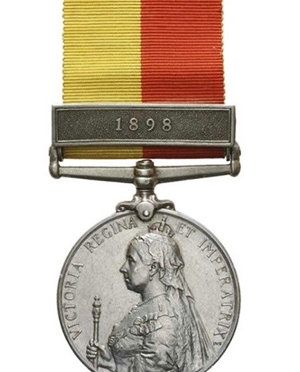
The East and Central Africa Medal is a British campaign medal established in February 1899 and awarded for minor military operations in the Uganda Protectorate and Southern Sudan between 1897 and 1899. Four separate clasps were issued.

Most medals were awarded to British-led local forces or units of the Indian Army. No British Army units were present, although a number of British officers and non commissioned officers received the medal while seconded to local units. The recipients of the Lubwa’s and Uganda 1897-98 clasps included several women who nursed the sick.

Most medals were awarded with a clasp, and there were a total of four authorized:

  • Lubwa’s: Operation against mutinous Sudanese soldiers stationed in Uganda who held Fort Lubwa’s on Lake Victoria, 23 September 1897 – 24 February 1898.
  • Uganda 1897-98: An expedition into the Teita country of Uganda, 20 July 1897 – 19 March 1898.
  • 1898: For service in quelling a rebellion by the Ogaden Somalis led by Sultan Ahmed bin Marghan, 12 April – 3 October 1898.

The East and Central Africa Medal Design

The East and Central Africa medal measures 36 millimeters (1.4 in) in diameter. It was issued in silver to all recipients, except for native porters and other authorized camp followers, who received the medal in bronze.

The obverse shows a left facing half-length figure of Queen Victoria holding the Royal Sceptre and the inscription “VICTORIA REGINA ET IMPERATRIX”. The reverse, designed by G. W. de Saulles, has an image of Britannia standing and facing right, holding a trident and palm branch, while behind is a lion and the rising sun. Below is the inscription “EAST & CENTRAL AFRICA”.

The ribbon measures 31.7 millimeters (1.25 in) wide and is half yellow and half red, with the yellow to the left when facing the wearer.

The Queen’s Sudan Medal

The Queen’s Sudan Medal was awarded to British and Egyptian forces which had taken part in the Sudan campaign between 1896 and 1898.

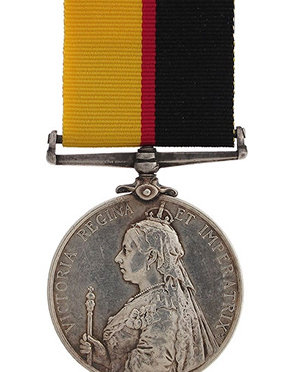
The Queen’s Sudan Medal was awarded to British and Egyptian forces which had taken part in the Sudan campaign between June 1896 and September 1898, and authorized in March 1899.

The campaign reflected the British desire to reverse the defeats of the Mahdist War in the 1880’s, as well as concern that France and other European powers would take advantage of Sudan’s instability to acquire parts of its territory.

Initially only the Egyptian Army was engaged. British Army units joined from early 1898, with two British brigades being present at the decisive victory at Omdurman on 2 September 1898.

The Queen’s Sudan Medal Design

The Queen’s Sudan medal is circular and measures 36.5 millimeters (1.44 in) in diameter. It was awarded in silver to soldiers of the British and Egyptian armies, and in bronze to a small number of non-combatants, mainly officers’ servants, and grooms from the Indian Army.

The obverse shows a half length crowned figure of Queen Victoria and has the legend VICTORIA REGINA ET IMPERATRIX. The reverse displays a plinth inscribed SUDAN supported by Nile lilies, where a figure of victory sits holding a laurel wreath and a palm branch. Behind her are the British and Egyptian flags.

The ribbon measures 31.7 millimeters (1.25 in) wide ribbon is half yellow, half black with a thin dividing red stripe. No clasps were awarded for this medal.

The Ashanti Star

The Ashanti Star was a British medal awarded to members of the expedition against the Ashanti King Prempeh, in the Fourth Anglo-Ashanti War.

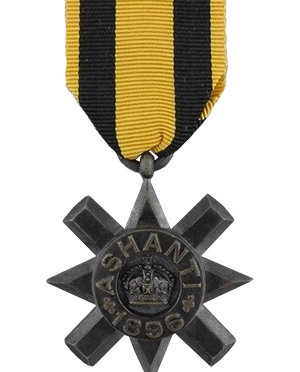
The Ashanti Star was a British medal awarded to members of the expedition against the Ashanti King Prempeh, in the Fourth Anglo-Ashanti War that lasted from December 1895 to February 1896. The medal was established in 1896.

The forces who qualified for the medal included the second Battalion of the West Yorkshire Regiment and a composite battalion consisting of between 16 and 26 men from each of the three regiments of Foot Guards and from eight infantry regiments. About half the troops deployed were locally recruited Hausa forces. Three Nursing Sisters were also present and received the medal.

The Ashanti Medal Design

The design of the Ashanti medal is attributed to Princess Beatrice, Queen Victoria’s youngest daughter (whose husband, Prince Henry of Battenberg, died of malaria during the campaign).

The medal measures 38mm wide, it’s suspended by a loop and ring, and is a bronze four pointed star superimposed on a saltire cross.

The obverse shows a central medallion with a circlet inscribed “Ashanti 1896”, surrounding an imperial crown. The reverse displays within a circular central recess the inscription “From the Queen”, the rest of the reverse surface is plain.

The ribbon measures 31 millimeters (1.2 in) wide, yellow with two black stripes. The medal was awarded unnamed, except to members of the West Yorkshire Regiment, whose colonel had the medals engraved at his own expense.