The Medal for the Liberation of Kuwait (Egypt)

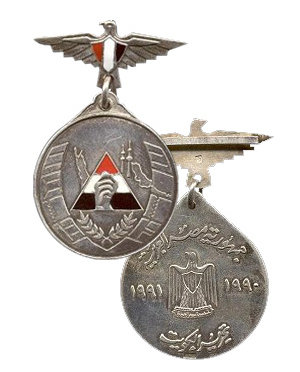
The Medal for the Liberation of Kuwait (Egypt) was instituted in 1991 and awarded to armed forces personnel who served in the Gulf War.

The Medal for the Liberation of Kuwait (Egyptian version) was instituted in 1991 and awarded to armed forces personnel who served in the Gulf War during the months of August 1990 – March 1991.

The Medal for the Liberation of Kuwait (Egypt Version) Design

The Egyptian version of the medal is silver and round. The ribbon has nine equal stripes: red, white, black, red, white, green, red, white and black.

The Medal for the Liberation of Kuwait (Saudi Arabia)

The Medal for the Liberation of Kuwait was instituted by King Fahd ibn Abdulaziz of Saudi Arabia for service during the Gulf War.

The Medal for the Liberation of Kuwait (or Naut Tahrir al-Kuwait نوط تحرير الكويت‎ in Arabic) was instituted by King Fahd ibn Abdulaziz of Saudi Arabia for service during the Liberation of Kuwait campaign.

The Saudi Arabian version of the medal was awarded to members of the Coalition Forces who participated in Operation Desert Storm and the liberation of Kuwait between the dates of January 17, 1991 and February 28, 1991. Unlike other medals, it recognizes service in a relatively short period of time whereas the Kuwaiti version of the medal is granted for service over three years. The Saudi Arabian version is also senior in U.S. precedence, owing to its having been authorized for several years before the Kuwaiti version was offered.

The Medal for the Liberation of Kuwait Design

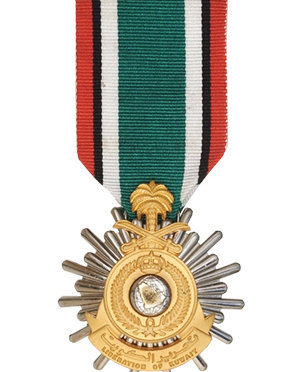
The Saudi version of the Kuwait Liberation Medal consists of a silver star of fifteen rounded points (with shorter rounded points between them) surmounted by a gilt medallion which contains a wreath tied at its based and a crown at its top. In the center of the gilt medallion is a silver representation of the Earth, over which is superimposed a gilt representation of the Kingdom of Saudi Arabia.

Above the gilt medallion are the crossed swords and palm tree taken from the Royal Cypher. Beneath the gilt medallion is a swallow-tailed scroll with its ends folded back and point upward so they follow the contour of the gilt medallion. On the scroll are the words, LIBERATION OF KUWAIT in English, and the same inscription above it in Arabic.

Buy a Medal for the Liberation of Kuwait

Note: As an eBay partner, I earn from qualifying purchases. This is all done automatically when you use a link and at no extra cost to you.

Right Now on eBay 
Clicking a link to eBay may result in a referral commission being paid if a purchase is made.
Loading...

The Medal for Defense Service Abroad (Norway)

The Medal for Defence Service Abroad is a Norwegian military medal originally awarded for service during military operations in the 1990s.

The Medal for Defence Service Abroad (or Forsvarets Innsatsmedalje in Norwegian) is a military medal established 1 January 1993 in Norway and originally awarded for service during military operations that took place in the 1990s. The later establishment of the Medal for Defence Operations Abroad rendered the first obsolete, however in 2009 it was reintroduced as an achievement medal.

It was awarded for distinguished bravery and courage, beyond what is normally required during combat operations. The medal’s color was changed from bronze to gold, and the ribbons of the medal would vary, depending on the area of operations.

The Medal for Defense Service Abroad Design

The medal is round, embossed in gold colored metal. On the obverse is a sword pointing up, with an oak branch on either side. On the reverse are the words FOR DIN INNSATS with oak branches above and below.

The award is suspended from a ribbon in the colors of the Flag of Norway and the Norwegian Armed Forces’ colors. The ribbon is blue with red edges, the red edges are bordered in the inside by a thin white stripe. In the center is a stripe of light blue.

During the first period of its existence, the medal was always awarded with a rosette. Finally, in 2012 the medal was further changed to a single ribbon design for all awards. The medal may be awarded with rosette for particularly meritorious distinction.

The Commemorative Cross for the Operations in the Persian Gulf

The Commemorative Cross for the Operations in the Persian Gulf is an Italian award for participation in Operazione Locusta.

The Commemorative Cross for the Operations in the Persian Gulf is an Italian award created to commemorate Italy’s participation in the Gulf War (1990-1991). Italy has been a part, in accordance to its long history of peacekeeping activities, of numerous UN missions and sub-regional peacekeeping efforts in Somalia, the Balkans, Afghanistan and Iraq. Some of these missions were accompanied by a series of crosses and distinct ribbon combinations.

The code name given to the contribution of the Italian Air Force in the Gulf War was Operazione Locusta. Following the invasion and annexation of Kuwait by Iraq (September 25, 1990) the Italian Government sent eight multi-role fighter bombers Tornado IDS to the Persian gulf. The bombers belonged to the 6º, 36º and 50º Stormo, which were deployed at the Al Dhafra Air Base, in United Arab Emirates. The deployment of Italian aircraft was part of the international security system implemented by UN Security Council Resolution 678.

The use of Italian aircraft as part of the Desert Storm operation represented the first operational employment in combat missions of Italian Air Force aircraft after the end of World War II. The RF104-G returned to Italy on March 11, 1991.

The Cross for the Operations in the Persian Gulf Design

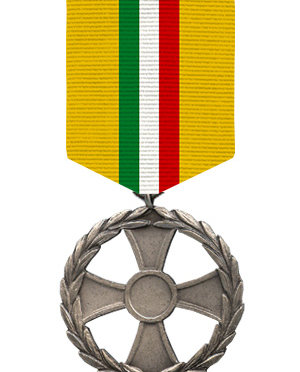
The medal is a silver cross. The ribbon is yellow with a central green, white and red stripe.

In some cases the mission medals were issued with bronze (silver in the case of Afghanistan) bars to denote the specific mission. For earlier missions, the planchet was engraved with the name of the mission.

Find This Medal

Right Now on eBay 
Clicking a link to eBay may result in a referral commission being paid if a purchase is made.
Loading...

The Southwest Asia Service Medal

The Southwest Asia Service Medal (SASM or SWASM) is a military award of the US Armed Forces to recognize duty during the Persian Gulf War.

The Southwest Asia Service Medal (also known as SASM or SWASM) is a military award of the United States Armed Forces created by order of President George H.W. Bush to recognize those military service members who performed duty during the years of the Persian Gulf War between August 2, 1990, and November 30, 1995.

Individuals awarded the Southwest Asia Service Medal must have participated in or supported military operations in Southwest Asia, including participation in Operations Desert Shield or Desert Storm. To receive the award, a service member had to be attached to or regularly serving for one or more days with an organization participating in ground/shore military operations; aboard a naval vessel directly supporting military operations; participating as a crew member in one or more aerial flights or serving on temporary duty for 30 consecutive days or 60 nonconsecutive days.

The award is not authorized for those who performed support of the Persian Gulf War from European or Pacific bases, or for service members who performed “home service” during the Persian Gulf War.

The Southwest Asia Service Medal Design

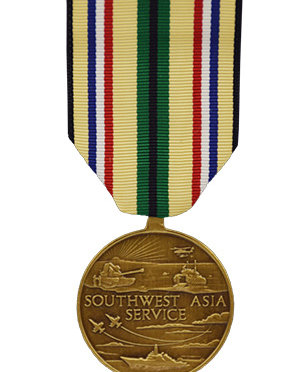
The medal was designed by Nadine Russell of the Army’s Institute of Heraldry. The colors of the ribbon are tan, representing sand, with the black, white, red, blue, and green colors symbolizing the colors of coalition countries’ national flags. The maximum number of bronze service stars that are authorized to be worn for the Southwest Asia Service Medal’s ribbon or streamer is three.

Ribbon devices:
  • Bronze service star: for participation in each designated campaign. Each recipient of the medal should wear at least one campaign star.
  • Fleet Marine Force Combat Operation Insignia: for naval personnel on duty with and attached to a Marine Corps unit that participated in combat.

Designated campaigns:

  • Defense of Saudi Arabia. From August 2, 1990 to January 16, 1991.
  • Liberation and Defense of Kuwait. January 17, 1991 to April 11, 1991.
  • Southwest Asia Cease-Fire. April 12, 1991 to November 30, 1995.

In April 2016, the appearance of the suspension and service ribbon of the SASM was slightly modified. The DLA made the two vertical green bars and one vertical black bar in the middle wider than in the original 1991 version.

Find This Medal Online

Right Now on eBay 
Clicking a link to eBay may result in a referral commission being paid if a purchase is made.
Loading...

The Air Force Cross and Medal (United Kingdom)

The Air Force Cross is a British military decoration awarded to officers for “acts of exemplary gallantry while flying against the enemy”

Time Period: WW1 The Great War
Year of Institution: 3 June 1918
Country: Great Britain

The Air Force Cross (or AFC) is a military decoration awarded to officers for “an act or acts of exemplary gallantry while flying, though not in active operations against the enemy“. Since 1993 it’s also given to other ranks, of the United Kingdom Armed Forces, and formerly also to officers of the other Commonwealth countries.

The award was established on 3 June 1918, shortly after the formation of the Royal Air Force (RAF). It was originally awarded to RAF commissioned officers and Warrant Officers, but was later expanded to include Royal Navy and army aviation officers. Recipients of the Air Force Cross are entitled to use the post-nominal letters “AFC”.

Between 1919 and 1932 the AFC was also awarded to civilians, on the same basis as for RAF personnel. The AFC had also been awarded by Commonwealth countries but by 1990’s most, including Canada, Australia, and New Zealand, had established their own honors systems and no longer recommended British honors.

The Air Force Cross and Medal Design

The Cross

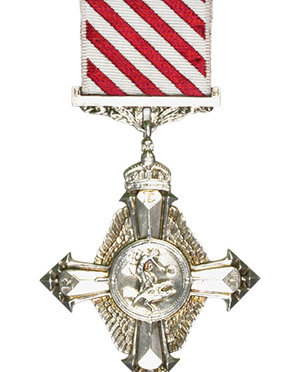
The Air Force Cross is a silver cross measuring 60 millimeters (2.4 in) in height and 54 millimeters (2.1 in) in width, representing aircraft propeller blades, with wings between the arms. It was design by Edward Carter Preston.

The obverse depicts Hermes, riding on the wings of a hawk holding a laurel wreath. At the top of the upper arm is the royal crown, while the other three arms bear the royal cipher of the reigning monarch at the time of issue. The reverse is plain, except for a central roundel bearing the reigning monarch’s cipher and the date ‘1918’. Originally awarded unnamed, from 1939 the year of issue was engraved on the reverse lower limb of cross, and since 1984 it has been awarded named to the recipient.

The suspender is straight and decorated with laurel wreaths. The ribbon bar denoting a further award is silver, with the Royal Air Force eagle in its centre. Bars awarded during World War II have the year of award engraved on the reverse. The 32 mm (1.25 inch) ribbon was originally white with red broad horizontal stripes, but changed in July 1919 to the current white with red broad diagonal stripes at a 45-degree angle.

The Medal

The Air Force Medal is an oval struck in silver and measures 42 mm tall and 32 mm wide. It has a laurel border and features, on the obverse, the sovereign’s effigy. The reverse Hermes mounted on a hawk bestowing a laurel wreath.

The medal is suspended by a pair of wings from a straight bar. The ribbon, originally with horizontal narrow stripes or white and crimson, changed in 1919 to diagonal ones of the same colors.

The National Defense Service Medal

The National Defense Service Medal (NDSM) is a service medal of the United States Armed Forces created by President Eisenhower in 1953. 

The National Defense Service Medal (or NDSM) is a service medal of the United States Armed Forces established by President Dwight D. Eisenhower in 1953. Currently, the National Defense Service Medal is the oldest service medal (as opposed to decorations for particular achievements) currently awarded by all branches of the United States Armed Forces.

It was first intended to be a “blanket campaign medal” awarded to service members who served honorably during a designated time period of which a “national emergency” had been declared during a time of war or conflict. It may also be issued to active military members for any other period that the Secretary of Defense designates. While no document is known which explains the rationale for the award, it was apparently established to recognize all service members who served during the Korean War to include those who did not serve in the war zone.

To date, the NDSM has been awarded for four specific time periods, which roughly correspond to the Korean, Vietnam and Gulf War eras as well as the Global War on Terrorism. As the NDSM has been awarded to all military personnel during four wartime periods, it has millions of recipients and is probably the most widely awarded medal in the history of the United States military, with the possible exception of World War II Victory Medal.

The National Defense Service Medal Design

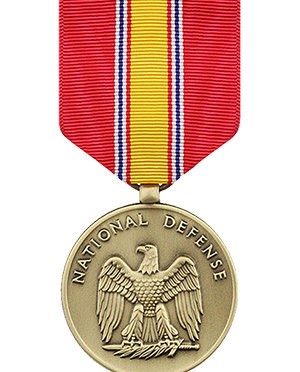
The obverse of the medal shows a North American bald eagle, perched on a sword and palm. Above this, in a semicircle, is the inscription “National Defense“. The reverse shows a shield, taken from the coat of arms of the United States; it is half encircled below with an open wreath, the right side of oak leaves and laurel leaves the left.

The ribbon has a wide yellow stripe in the center, flanked by narrow stripes of red, white, blue, white and wide red stripes.

How Do You Request a National Defense Service Medal?

If you are eligible for the National Defense Service Medal (NDSM) and need to request a replacement or a new one, you can typically do so through the appropriate military branch’s records office or the National Personnel Records Center (NPRC).

You can submit your request through various means, including mail, fax, email, or online, depending on the specific requirements of the records office you are dealing with.

Buy a National Defense Service Medal

Right Now on eBay 
Clicking a link to eBay may result in a referral commission being paid if a purchase is made.
Loading...

Other Service Medals

A service medal is a type of military decoration awarded to members of the armed forces, government employees, and, in some cases, civilians in recognition of their service, participation in specific military campaigns, or the fulfillment of certain criteria. Here are related to this one:

The Conspicuous Gallantry Cross and Medal

The Conspicuous Gallantry Cross (CGC) is a second level military decoration of the British Armed Forces created in 1993.

The Conspicuous Gallantry Cross (also known as CGC) is a second level military decoration of the British Armed Forces created in 1993 after a review of the British honors system as part of the drive to remove distinctions of rank in awards for bravery.

The CGC now serves as the second level award for gallantry for all ranks across the whole armed forces. The CGC may be awarded posthumously, “in recognition of an act or acts of conspicuous gallantry during active operations against the enemy“.

All ranks of the Royal Navy, Royal Marines, British Army, and Royal Air Force may be awarded the CGC in recognition of qualifying acts of gallantry. Recipients are entitled to the postnominal letters CGC

The Conspicuous Gallantry Cross and Medal Design

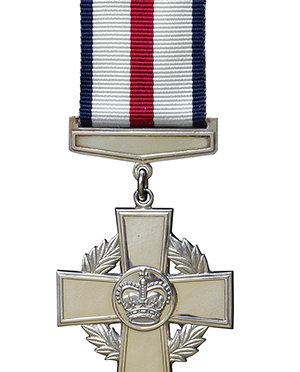
The medal is in the shape of a cross pattée and truck in silver. Arranged behind the cross, visible between the arms is a laurel wreath.

On the obverse, the circular medallion in the center depicts St. Edward’s crown. The reverse is plain which allows room for the engraving of the rank, name, and unit of its recipient.

The award date is also engraved on the reverse of the medal. The medal is suspended by a white ribbon with two narrow dark blue stripes at the edge and one center stripe in crimson.

The Distinguished Service Order

The Distinguished Service Order (DSO) is a United Kingdom military decoration awarded for distinguished service during wartime.

The Distinguished Service Order (DSO) is one of the highest military decorations awarded by the United Kingdom, primarily for acts of meritorious or distinguished service by officers of the armed forces during wartime.

Instituted in 1886 by Queen Victoria and typically awarded to officers ranked major, the first DSOs awarded were dated 25 November 1886. Recipients of the order are officially known as Companions of the Distinguished Service Order and are entitled to use the post-nominal letters “DSO”.

The DSO is typically awarded to officers ranked Major and above for meritorious or distinguished service in combat or other significant contributions to military operations. It is often awarded for leadership, courage, and exceptional service under fire.

 Over the years, the DSO has been awarded to numerous officers for their outstanding leadership, gallantry, and devotion to duty in various conflicts, including World War I, World War II, and subsequent military operations. During the First World War, 8,981 DSOs were awarded, each award being announced in The London Gazette.

The Distinguished Service Order Precedence and Clasps

The DSO ranks below only the Victoria Cross (VC) and the George Cross (GC) in the order of precedence for British military decorations. It is considered a prestigious honor and is highly respected within the military community.

In addition to the standard DSO, there are several variants and clasps that may be awarded in recognition of additional acts of distinguished service or multiple awards.

The Distinguished Service Order Design

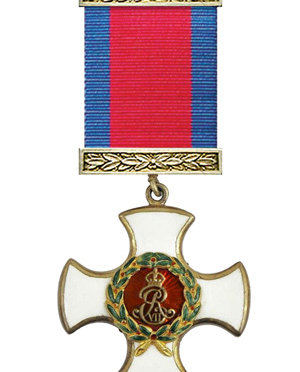
The DSO is a cross patonce, which means it has arms that narrow towards the center and end in a floriated decoration. It is crafted from silver gilt, enameled white and edged in gold.

In the obverse and the center, within a wreath of green laurel, is the imperial crown in gold upon a red enameled background. The reverse shows the royal cypher in gold upon a red enameled ground, within a wreath of laurel, enameled green. 

The ribbon of the DSO is crimson with narrow dark blue edges.

The Military Cross

The Military Cross (MC) is the third-level military decoration awarded for acts of exemplary gallantry during active operations.

The Military Cross (MC) is a prestigious third-level military decoration awarded in recognition of “an act or acts of exemplary gallantry during active operations against the enemy on land to all members, of any rank in Our Armed Forces.”

It is awarded to officers of the British Armed Forces and Commonwealth forces for acts of exemplary gallantry and leadership in combat and it’s one of the highest awards for bravery and valor that an officer can receive. The Military Cross is also open to officers of all ranks, including commissioned officers, non-commissioned officers, and warrant officers.

The award was created on 28 December 1914 for commissioned officers of the substantive rank of Captain or below and for Warrant Officers. In August 1916, Bars were awarded to the MC in recognition of the performance of further acts of gallantry meriting the award and recipients of a bar continue to use postnominal letters MC. In 1931 the award was extended to Majors and also to members of the Royal Air Force for actions on the ground.

Military Cross Awardees

During World War I, Acting Captain Francis Wallington of the Royal Field Artillery was the first person to be awarded the MC. Throughout its history, though, the Military Cross has been awarded in various conflicts, including both World Wars and more recent military operations. Recipients of the Military Cross are recognized for their exceptional bravery and leadership in the service of their country.

Here are five individuals who have received the Military Cross:

  1. Captain Charles Upham – He was a New Zealand soldier who received the Military Cross twice during World War II for his bravery and leadership in the Battle of Crete and the North African campaign.

  2. Captain Tom Moore – Captain Tom Moore, a British Army officer, was awarded the Military Cross during World War II for his outstanding courage and service in the Burma Campaign.

  3. Lieutenant Colonel Herbert “H” Jones – He received the Military Cross posthumously during the Falklands War in 1982 for his exceptional leadership and bravery during the Battle of Goose Green.

  4. Captain Guy Gibson – Captain Gibson was a British Royal Air Force pilot who was awarded the Military Cross for his leadership in the famous “Dambusters” raid during World War II.

  5. Major Charles Whittlesey – An American officer, Major Whittlesey was awarded the Military Cross for his valor during the Meuse-Argonne Offensive in World War I.

The Military Cross Design

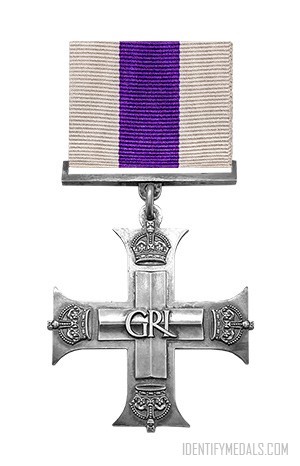
The Military Cross measures 46 mm max height and 44 mm max width, and shows an ornamental silver cross with straight arms terminating in broad finials.

The obverse is decorated with imperial crowns and the Royal Cypher in the center. The reverse is plain, but from 1938 the name of the recipient and year of issue has been engraved on the lower limb of the cross.

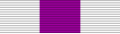
The ribbon for the Military Cross is 32 mm wide and shows three vertical moire stripes of white, purple, and white, all of the same width.

  • Military Cross Without Bar
  • Military Cross With One Bar
  • Military Cross With Two Bars

Find This Medal

Right Now on eBay 
Clicking a link to eBay may result in a referral commission being paid if a purchase is made.
Loading...