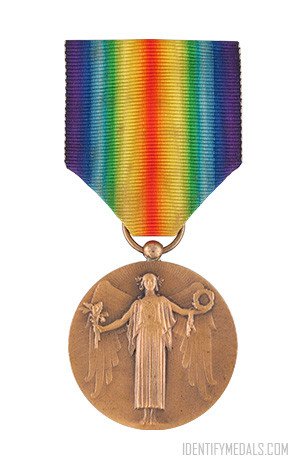
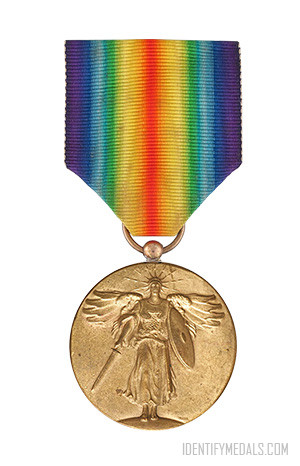
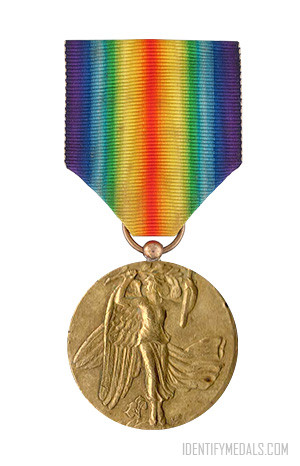
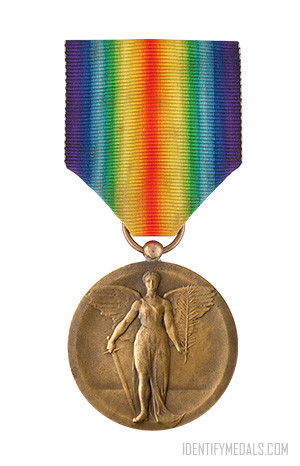

The Inter Allied Victory Medal (Cuba)

The Cuban Victory Medal was awarded to all military personnel or civilians who have been employed in war service between 1917 and 1919.

The Allied Victory Medal was recommended by an inter-allied committee in March 1919. Fourteen victorious countries finally awarded the medal after World War I, and each allied nation would design a ‘Victory Medal’ for award to their own nationals. Certain features were to be shared: a winged figure of Victory on the obverse and the same ribbon.

The President of the United States of Brazil, adopted the proposal of Marshal Foch in January 24, 1919 so that all the fighters of the Great War received a commemorative medal.

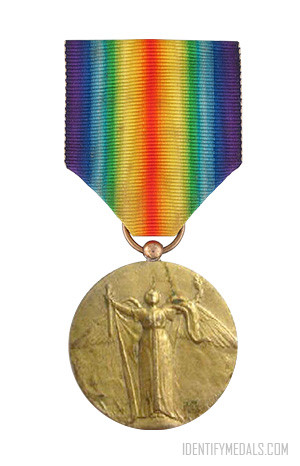
The Cuba Inter-Allied Victory Medal Design

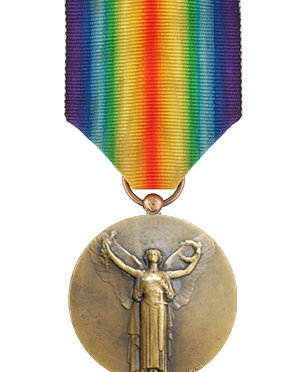
The Victory Medal measures 36 millimetres (1.4 in) in diameter and was designed by William McMillan. The design and ribbon was also adopted by Belgium, Brazil, Cuba, Czechoslovakia, France, Greece, Italy, Japan, Portugal, Romania, Siam, Union of South Africa and the USA. Each allied nation would design a ‘Victory Medal’ for award to their own nationals, all issues having certain common features, including a winged figure of victory on the obverse and the same ribbon.

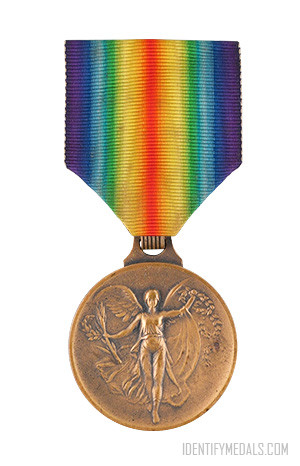
The obverse of the Cuban Victory Medal featured a symbolic figure of Victoria with her hands up on a plain background.

The reverse shows the words ‘THE GREAT / WAR FOR / CIVILISATION / 1914-1919’ surrounded by a laurel wreath.

The 39 millimeters (1.5 in) wide watered ribbon has an iridescent color scheme, with the violet moving through to a central red stripe where both schemes meet. It attaches to the medal through a ring suspender. The recipient’s name, rank, service number and unit were impressed on the edge of the medal. The name of the regiment or corps was omitted on medals awarded to Army officers.

All the Inter-Allied Victory Medal Variations

Although each country designed its own version of the Inter-Allied Victory Medal, all of them shared some common elements, such as a winged victory figure on the obverse and a similar ribbon with rainbow colors symbolizing unity among the Allies. Here are the versions for all countries:

Find an Inter-Allied Victory Medal Online

Right Now on eBay 
Clicking a link to eBay may result in a referral commission being paid if a purchase is made.
Loading...

The Inter Allied Victory Medal (France)

The French Victory Medal was established on 20 July 1922 and awarded to all soldiers who served three months between 1914 and 1918.

The Allied Victory Medal was recommended by an inter-allied committee in March 1919. Fourteen victorious countries were finally awarded the medal after World War I, and each allied nation would design a ‘Victory Medal’ for award to their own nationals. Certain features were to be shared: a winged figure of Victory on the obverse and the same ribbon.

The French Victory Medal was established on 20 July 1922 and awarded to all soldiers who served three months between 2 August 1914 and 11 November 1918, as well as to civilian nurses, aliens who served directly under French command, Marshals and generals who had a command for at least three months, and prisoners of war from Alsace and Lorraine who then served in the French forces.

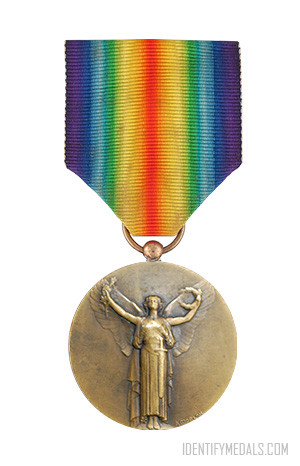
The France Inter-Allied Victory Medal Design

The Victory Medal measures 36 millimetres (1.4 in) in diameter and was designed by William McMillan. The design and ribbon was also adopted by Belgium, Brazil, Cuba, Czechoslovakia, France, Greece, Italy, Japan, Portugal, Romania, Siam, Union of South Africa and the USA. Each allied nation would design a ‘Victory Medal’ for award to their own nationals, all issues having certain common features, including a winged figure of victory on the obverse and the same ribbon.

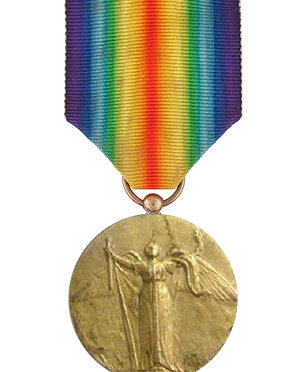
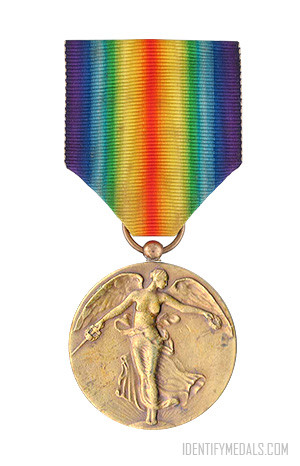
The obverse of the medal bears the winged, full-length and full-front figure of Victoria and the designer’s signature “A. Morlon”. The reverse reads “LA GRANDE GVERRE POUR CIVILISATION 1914-1919” and a Phrygian cap between the letters R. F.

The 39 millimeters (1.5 in) wide watered ribbon has an iridescent color scheme, with the violet moving through to a central red stripe where both schemes meet. It attaches to the medal through a ring suspender. The recipient’s name, rank, service number and unit were impressed on the edge of the medal. The name of the regiment or corps was omitted on medals awarded to Army officers.

All the Inter-Allied Victory Medal Variations

Although each country designed its own version of the Inter-Allied Victory Medal, all of them shared some common elements, such as a winged victory figure on the obverse and a similar ribbon with rainbow colors symbolizing unity among the Allies. Here are the versions for all countries:

Find an Inter-Allied Victory Medal Online

Right Now on eBay 
Clicking a link to eBay may result in a referral commission being paid if a purchase is made.
Loading...

The Allied Victory Medal (Italy)

The Allied Victory Medal (Medaglia interalleata della vittoria) was the Italian variant of the Victory Medal of other nations.

The Allied Victory Medal (or Medaglia interalleata della vittoria, or Medaglia della vittoria commemorativa della grande guerra per la civiltà in Italian) was the Italian variant of the Victory Medal of other nations.

The Allied Victory Medal was established by royal decree number 1918 on 16 December 1920, and was awarded to all who had been given the “fatiche di guerra” distinction before, on 21 May 1916. It was also given to those who had served for four months in an area under the jurisdiction of the armed forces and who had been mobilized and directly worked with the operational army.

The Italy Inter-Allied Victory Medal Design

The Victory Medal measures 36 millimeters (1.4 in) in diameter and its obverse was designed by William McMillan. The design and ribbon was adopted by Great Britain, Belgium, Brazil, Cuba, Czechoslovakia, France, Greece, Italy, Japan, Portugal, Romania, Siam, Union of South Africa and the USA.

Each allied nation would design a ‘Victory Medal’ for award to their own nationals, all issues having certain common features, including a winged figure of victory on the obverse and the same ribbon.

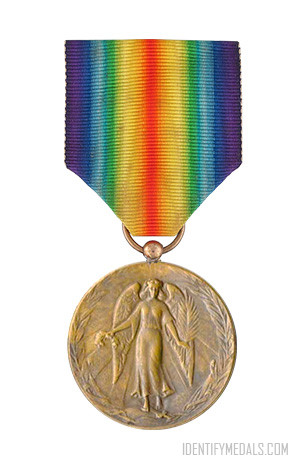
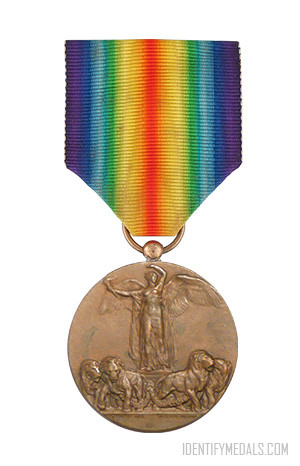
The Italian medal’s design was done via public competition, which was won by Gaetano Orsolini. His design features the ‘Victory on a triumphal chariot, with the torch of liberty, drawn by four yoked lions’.

The obverse of the medal shows the winged, full-length, full-front, figure of ‘Victory‘ with her left arm extended and holding a palm branch in her right hand.

The 39 millimeters (1.5 in) wide watered ribbon has an iridescent color scheme, with the violet moving through to a central red stripe where both schemes meet. It attaches to the medal through a ring suspender. The recipient’s name, rank, service number and unit were impressed on the edge of the medal. The name of the regiment or corps was omitted on medals awarded to Army officers.

All the Inter-Allied Victory Medal Variations

Although each country designed its own version of the Inter-Allied Victory Medal, all of them shared some common elements, such as a winged victory figure on the obverse and a similar ribbon with rainbow colors symbolizing unity among the Allies. Here are the versions for all countries:

Find an Inter-Allied Victory Medal Online

Right Now on eBay 
Clicking a link to eBay may result in a referral commission being paid if a purchase is made.
Loading...

The Inter Allied Victory Medal (Great Britain)

The Victory Medal (also known as Inter-Allied Victory Medal) is a United Kingdom and British Empire First World War campaign medal.
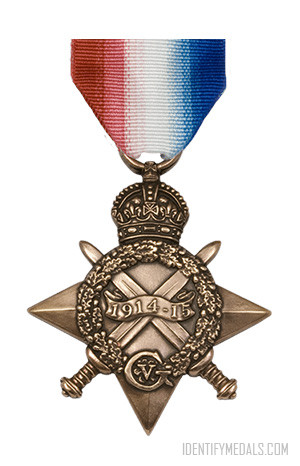
The Victory Medal (also known as Inter-Allied Victory Medal) is a United Kingdom and British Empire First World War campaign medal. The medal was not awarded single, but to all those who received the 1914 Star or the 1914–15 Star, and to most of those who were awarded the British War Medal.

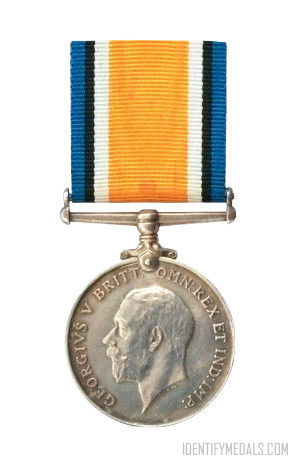
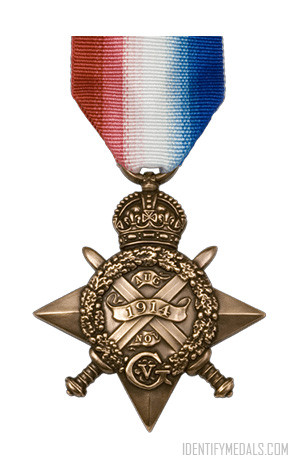
The three First World War medals, either one of the 1914 Star or the 1914-15 Star, the British War Medal and the Victory Medal, were collectively irreverently referred to as Pip, Squeak and Wilfred, after three comic strip characters, a dog, a penguin and a rabbit, which were popular in the immediate post-war era.

Recipients had to be mobilized for war service in the United Kingdom or the British Empire, in any service, and to have entered a theatre of war between 5 August 1914 and 11 November 1918 to qualify for the Victory Medal. Women qualified for service in nursing homes and other auxiliary forces. It was also awarded to members of the British Naval mission to Russia 1919 – 1920, and for mine clearance in the North Sea between 11 November 1918 and 30 November 1919.

The Victory Medal issued within the British Empire was a result of an international agreement at the Inter-allied Peace Conference preceding the Treaty of Versailles. Some 6,334,522+ medals were awarded in Great Britain.

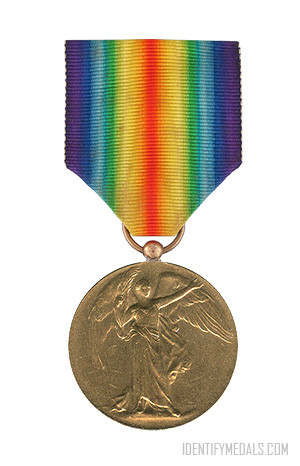
The UK Inter-Allied Victory Medal Design

The Victory Medal measures 36 millimeters (1.4 in) in diameter and was designed by William McMillan. The design and ribbon was also adopted by Belgium, Brazil, Cuba, Czechoslovakia, France, Greece, Italy, Japan, Portugal, Romania, Siam, Union of South Africa and the USA. Each allied nation would design a ‘Victory Medal’ for award to their own nationals, all issues having certain common features, including a winged figure of victory on the obverse and the same ribbon.

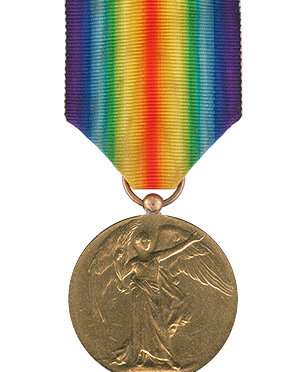
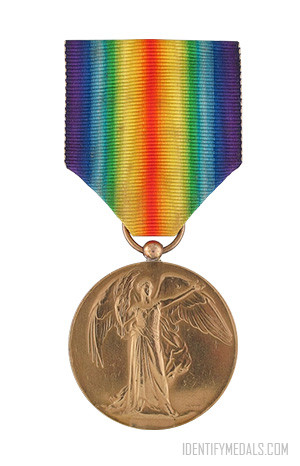
The obverse of the medal shows the winged, full-length, full-front, figure of ‘Victory‘ with her left arm extended and holding a palm branch in her right hand. The reverse shows the words ‘THE GREAT / WAR FOR / CIVILISATION / 1914-1919‘  surrounded by a laurel wreath.

The 39 millimeters (1.5 in) wide watered ribbon has an iridescent color scheme, with the violet moving through to a central red stripe where both schemes meet. It attaches to the medal through a ring suspender. The recipient’s name, rank, service number and unit were impressed on the edge of the medal. The name of the regiment or corps was omitted on medals awarded to Army officers.

Related Medals

The ‘Pip’, ‘Squeak’, and ‘Wilfred’ medals were British military decorations established during World War I. The Pip Squeak was the 1914 Star, the Wilfred was the British War Medal, and the Pip was the Victory Medal. 

WW1 Medals and Awards: The 1914-15 Star

The 1914-15 Star

The 1914–15 Star is a British Empire campaign medal awarded to officers and men of British and Imperial forces during the First World War.
Read More »
WW1 Medals and Awards: The 1914 Star

The 1914 Star

The 1914 Star, ‘Mons’ Star or ‘Pip’ is a British Empire campaign medal instituted in 1917 and presented for service during World War I.
Read More »

All the Inter-Allied Victory Medal Variations

Although each country designed its own version of the Inter-Allied Victory Medal, all of them shared some common elements, such as a winged victory figure on the obverse and a similar ribbon with rainbow colors symbolizing unity among the Allies. Here are the versions for all countries:

Find an Inter-Allied Victory Medal Online

Right Now on eBay 
Clicking a link to eBay may result in a referral commission being paid if a purchase is made.
Loading...