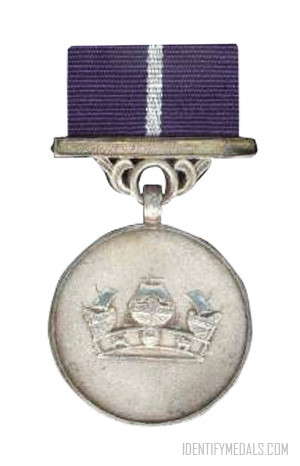
The Uttam Yudh Seva Medal

  • Time Period: Post-WW2
  • Institution: 26 June 1980
  • Country: India

The Uttam Yudh Seva Medal is one of India’s military decorations for Wartime Distinguished Service in an operational context (times of war, conflict, or hostilities).

The Uttam Yudh Seva Design

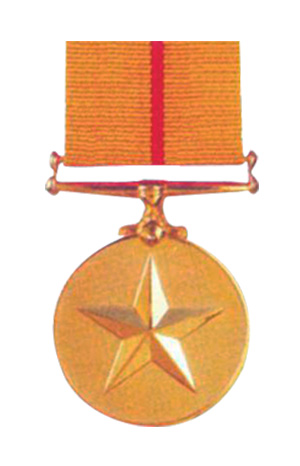
The medal is struck in gold gilt, circular and measures 35 mm in diameter. It’s fitted to a plain horizontal bar with standard fittings.

The obverse bears the State Emblem and the inscription “UTTAM YUDH SEVA MEDAL“. On its reverse, it has a five pointed star.

The ribbon is golden color with two red vertical stripes.

The Sarvottam Yudh Seva Medal

  • Time Period: Post-WW2
  • Institution: 26 June 1980
  • Country: India

The Sarvottam Yudh Seva Medal is India’s highest wartime distinguished service decoration. It is awarded in an operational context such as during times of war, conflict, or hostilities. It is the military equivalent of the Param Vishisht Seva Medal.

The Sarvottam Yudh Seva Medal may be awarded to all ranks of the Army, the Navy and the Air Force including those of Territorial Army Units, Auxiliary and Reserve Forces and other lawfully constituted Armed Forces. The medal can be awarded posthumously.

The Sarvottam Yudh Seva Medal has only been awarded three times in history: To Lieutenant General A.S. Kalkat, the overall commander of the Indian Peacekeeping Force (IPKF) in Sri Lanka. To Air Marshal Vinod Patney was the Western Air Commander and to Lieutenant General H.M. Khanna was the Northern Army Commander during the Kargil War.

The Sarvottam Yudh Seva Design

The medal is struck in gold gilt, circular and measures 35 mm in diameter. It’s fitted to a plain horizontal bar with standard fittings.

The obverse bears the State Emblem and the inscription “SARVOTTAM YUDH SEVA MEDAL“. On its reverse, it has a five pointed star.

The ribbon is golden color with one red vertical stripe in the center, which divides it into two equal parts. If a recipient of the medal is subsequently awarded the medal again, every such further award shall be recognized by a bar to be attached to the riband by which the medal is suspended. 

Collecting WW2 Medals, Awards & Badges: Where to Start, What to Collect

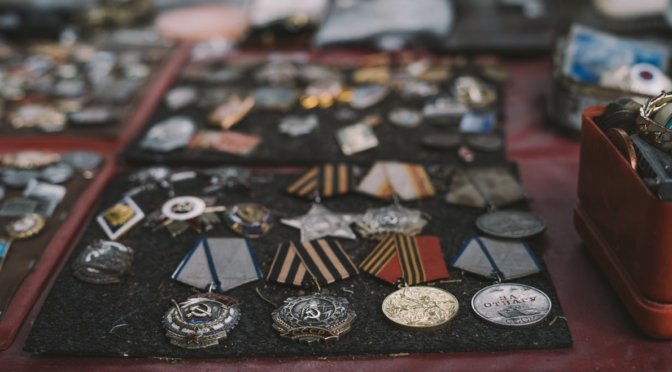
Many people choose to collect a particular set of military medals and awards. Amongst the most popular choices is medals from the Second World War (WW2). The reasons vary. Many have relatives that fought in the war. Others value the stories of heroism behind the medals.

Whatever the case, a lot of World War II medals are remade in large numbers, which makes them easier to find today. If you’re thinking of starting a WW2 medals and award collection, we have gathered some information that might come useful. 

What are the Most Popular WW2 Campaign Medals?

There are several medals from the World War II period that are particularly popular with collectors. For those new to the hobby, campaign medals are preferred, because of their larger numbers.

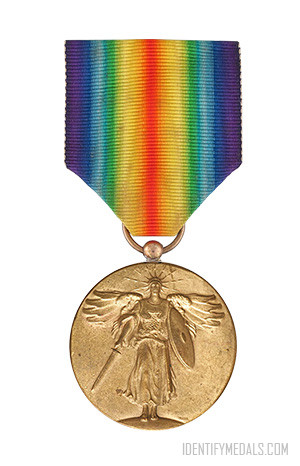
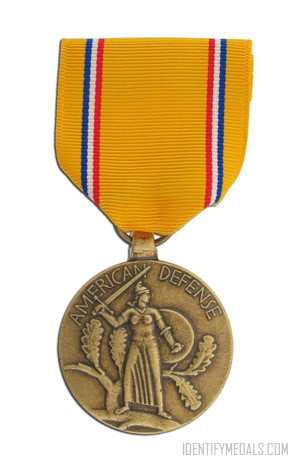
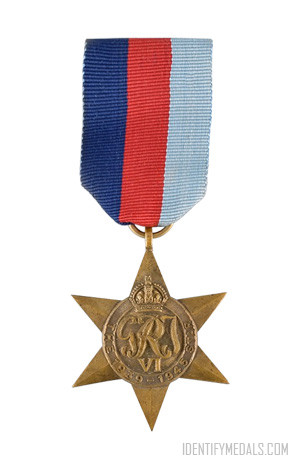
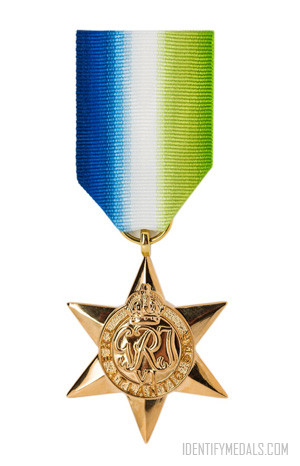
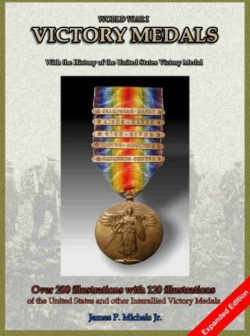
The most popular British WW2 medals include the 1939–1945 Star, the Atlantic Star, and the Defence Medal. From the United States, the American Defense Service Medal, Asiatic-Pacific Campaign Medal, and the World War I Victory Medal, among others.

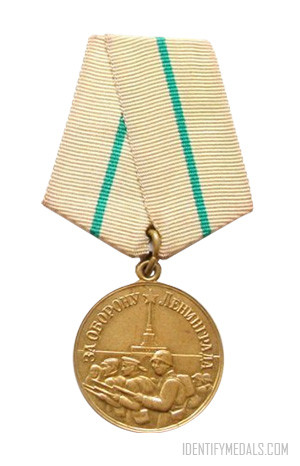
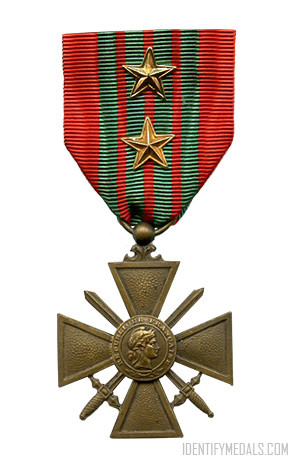
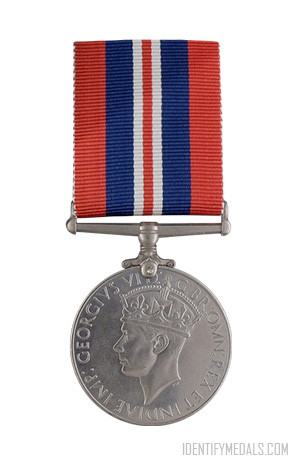
Other collectable allied medals include the Russian/USSR Medal for the Capture of Berlin, Medal for the Defence of Leningrad, or the French 1939–1945 Commemorative War Medal. In general, medals such as the 1939-1945 Star and the War Medal were issued to a huge number of servicemen and are therefore not hugely valuable in terms of money. That doesn’t mean, however, that they are not sought after. Because of their lower price and larger numbers, they are the perfect starting point for a new collector.

Campaign Medals of the Allies

Popular Collections: British Campaign Stars

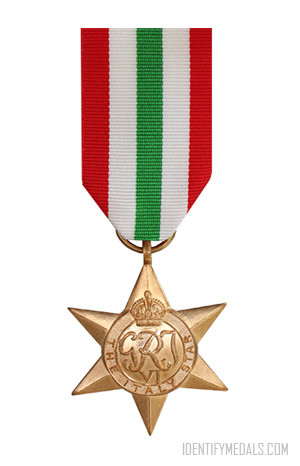
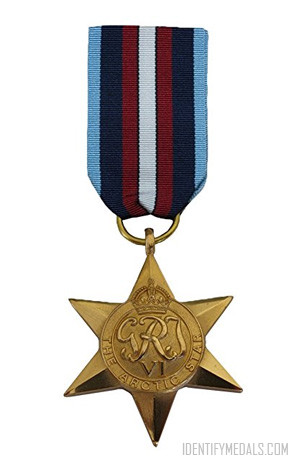
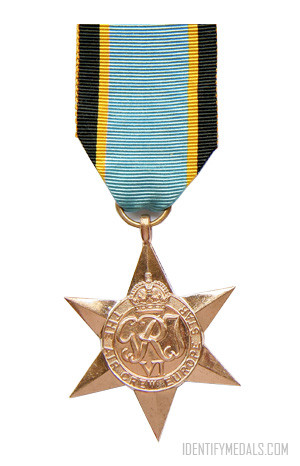
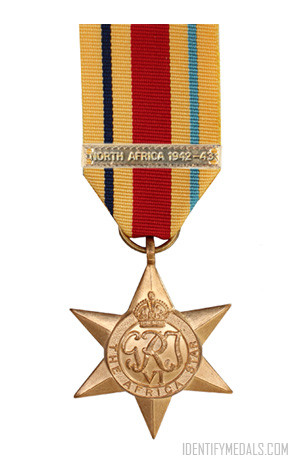
The British Government issued eleven campaign medals for participation in WW2, nine of which are campaign stars. These stars constitute a great collection, because these medals are relatively easy to find.

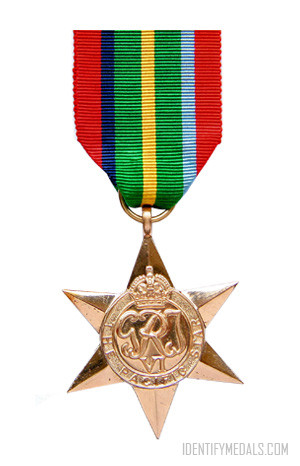
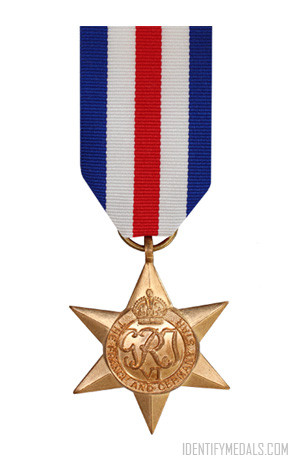
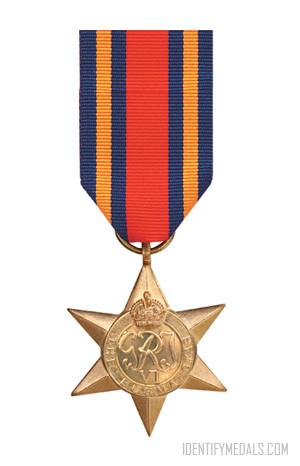
The British Campaign Stars were issued between 1939 and 1945 and were awarded for participation in the war. For example, the Air Crew Europe Star was awarded for two months of operational flying. The Artic Star commemorates the Arctic convoys to northern Russia. The Burma Star was awarded for one day or more of operational service during the Burma campaign. And the France and Germany Star was given for operational service in France,, Holland, Belgium, Luxembourg or Germany between D-Day and the surrender of Germany.

German Medals & Militaria Collections

German medals (from the Interwar and WW2 period) are usually more pricey and difficult to find than American, French, or British medals. The price of German World War II medals can range from $30 to $200,000, depending on the condition and the importance of the individual who owned the item originally. Contrary to non-collectors’ assumptions, the buyers of these objects include university professors, museums, and people who want to preserve this kind of material for future generations and to learn from it. One problem to keep in mind when choosing to collect German medals and awards is that there are a lot of reproductions and fake insignia. Trustworthy information on the authenticity of army paraphernalia can be found on this website.

The Long Service Decoration (Bourbon-Parma Lucca)

The Long Service Decoration (Bourbon-Parma Lucca) is a medal instituted in 1833 and awarded to NCO’s and Enlisted Men for ten years’ service.

The Long Service Decoration (or Decorazioni di servizio per gli ufficiali e sottufficiali in Italian, also Medaglia di Anzianitá) is a medal instituted in 1833 and awarded to NCO’s and Enlisted Men who had served at least ten (round medal) or thirty years (cross).

The medal was created during the period of the House of Bourbon-Parma, a cadet branch of the Spanish royal family. Their members once ruled as Duke of Parma and Piacenza, Guastalla, and Lucca.

The Long Service Decoration Design

The medal is round, struck in bronze gilt and measures 33 mm (wide) x 37.7 mm (hight) inclusive of its laterally-pierced ball suspension.

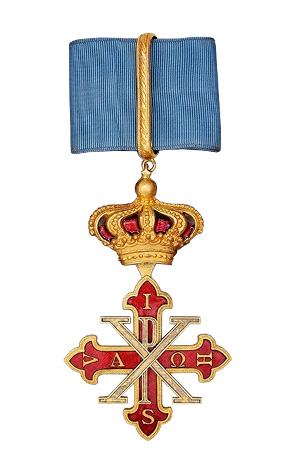
The Constantinian Order of St. George (Parma)

The Constantinian Order of St. George, or Order of St. Angelus / Order of the Golden Chevaliers is a dynastic order of knighthood.

The Sacred Military Constantinian Order of Saint George, also known as the Imperial Constantinian Order of Saint George and the Order of the Constantinian Angelic Knights of Saint George, is a dynastic order of knighthood of the House of Bourbon-Two Sicilies.

The order is allegedly founded in its original form by Constantine the Great and restored under later Byzantine emperors. However, the actual origin of the order can be traced to the 16th century, when it was founded by an Albanian family by the name Angelo Flavio Comneno. Chivalric orders were completely unknown in the Byzantine world, so it’s believed the story of the links between the Comneno family and their claim to be connected to the Byzantine Komnenos and Angelos dynasties was invented much later.

The Order is best recognized for its Parma iteration. Duke Francesco Farnese of Parma made several amendments to the Order statutes in 1705. These changes were  recognized by Pope Clement XI in 1706 and finalized as a dynastic Order of the Duchy of Parma by a Papul Bull in 1718. In 1731, the Order became a dynastic Order of the Kingdom of the Two Sicilies. When Marie Louise ascended to the throne of the Duchy of Parma, Piacenza and Guastalla she restored it as a dynastic Order of the Duchy of Parma, resulting in the creation of two Order branches.

The motto of the Order is “In hoc signo vinces,” or “In this sign you will conquer.

The Constantinian Order of Saint George Design

There are several insignia for this order. The medal is a bronze, silver, or gold cross with a collar, sash or ribbon. 

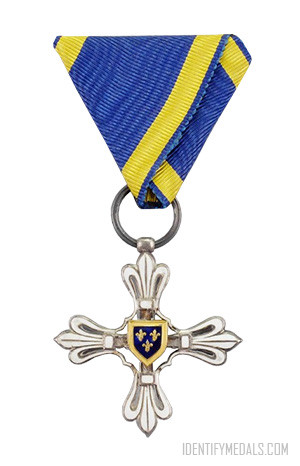
The Civil Merit Order Of St. Louis (Parma)

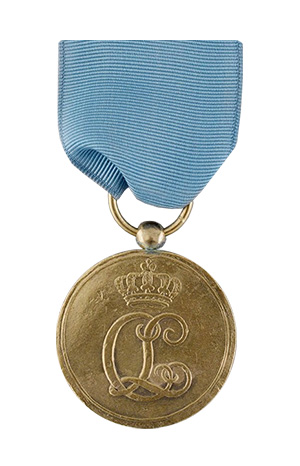
The Civil Merit Order Of St. Louis is an order of the Duchy of Parma (today Italy). The Order was established in c. 1860.

The Civil Merit Order Of St. Louis is an order of the Duchy of Parma (today Italy) awarded for extraordinary merit within civil services. It has five grades and the Grand Master of the Order was always the Duke of Parma

The Order of St. Louis was initially founded in the Duchy of Lucca in 1836 by Charles Louise (also known as Charles II). His son, Charles III Duke of Parma, revived the Order at Parma, on August 11, 1849, as an award of merit. Membership to the Order was primarily restricted to noble Catholics. When a non-noble became the recipient of the Grand Cross or Commander grades they were bestowed with hereditary nobility.

The Order of St. Louis Design

The insignia for this order is a silver 4 multifaceted armed star, measuring 45 mm (w) x 46.8 mm, with a central gold crest on both the obverse and the reverse. The medal also has finely detailed red, blue, white enameled centers. The suspension is a French style ring with right facing eagles head.

Cigarette Cards: All Military Medals Collections and Where to Find Them

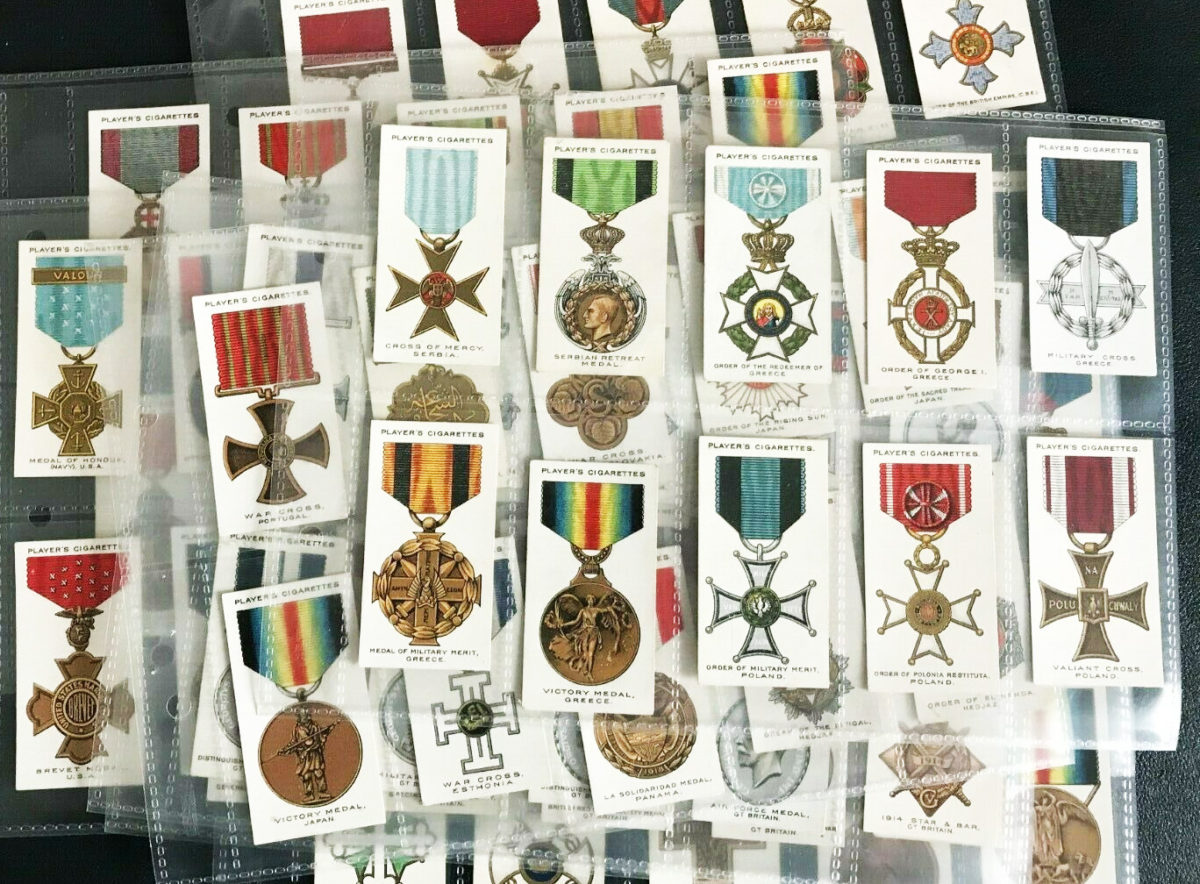
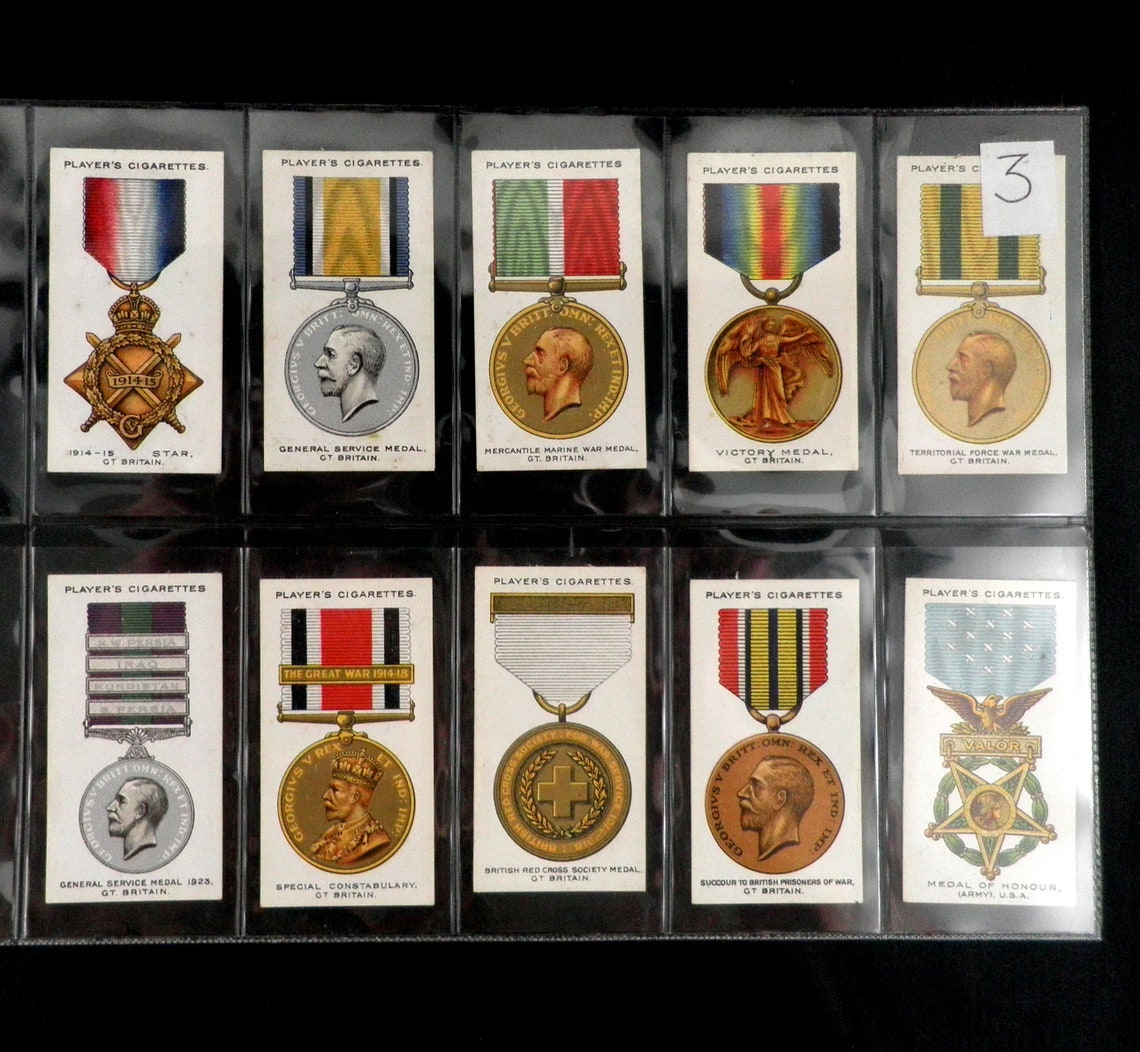
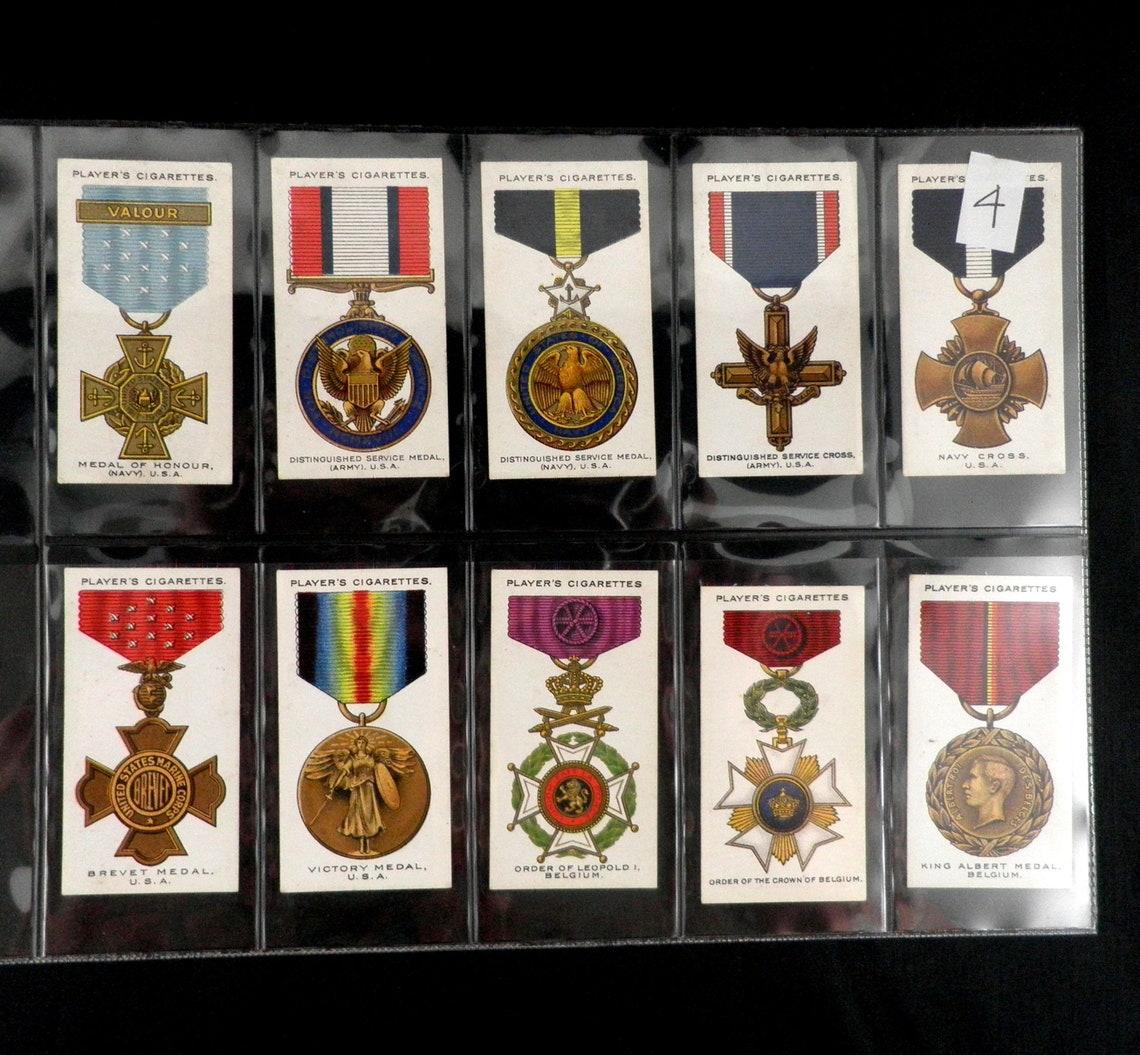
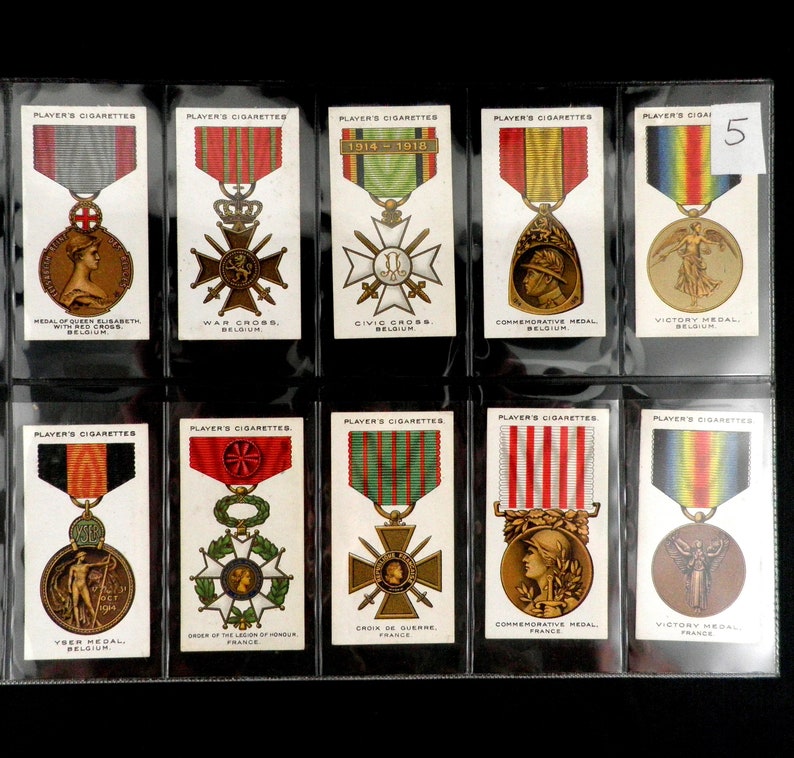
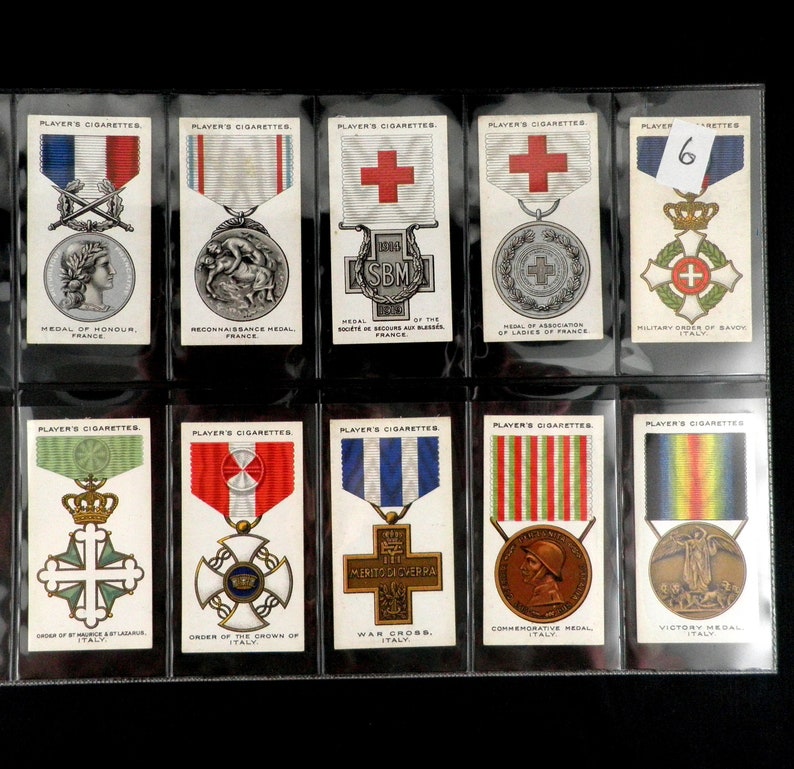
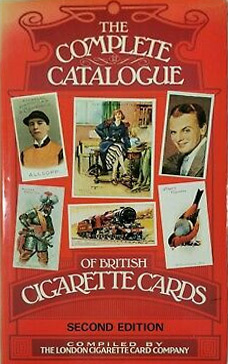
Several cigarettes companies produced collectible cards. We have compiled all the ones based on Military Medals and Decorations here. Amongst the most popular ones are the John Player set of 90 War Decorations and medals issued in 1927 by John Player & Sons. Other collections include 1971s Tommy Gunn set of 50 military medals.

What are Cigarette Collectible Cards?

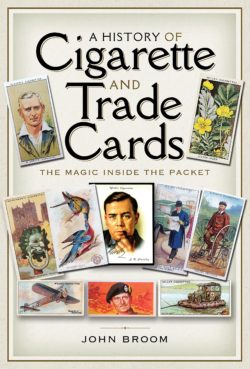
Cigarette cards were trading cards issued by tobacco manufacturers. They were included in cigarette packs, primarily between 1875 and the 1940s, and depicted the period’s costumes, actresses, national flags, wild animals, sports, and cultural norms. In the UK, the first company to produce a popular general interest set was John Player & Sons, who launched their “Castles and Abbeys” collection in 1893. Thomas Ogden followed in 1894 and Wills in 1895, with their famous set “Ships and Sailors“. 

Each cigarette card set consisted of 25 to 50 unique subjects – although some series reached 100 cards. Some early ones were printed on silk attached to a paper backing. However, these were discontinued during World War II and never reintroduced again.

Are Cigarette Cards Expensive?

The most valuable cigarette card in the world set a record when it sold for $3,120,000 in 2016. It was that of the baseball star Honus Wagner, an American baseball shortstop who played 21 seasons from 1897 to 1917. Although an exception, this is not the only card that can fetch big prices. Some cards are extremely rare, with only a few copies known, and generate a lot of interest when they go on auction. 

All the Cigarette Cards based on Decorations and Medals

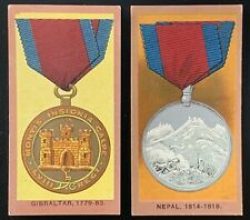
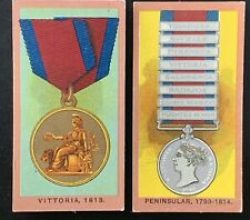
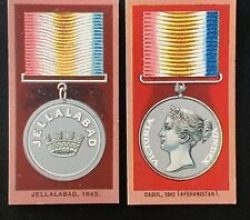
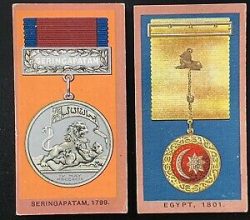
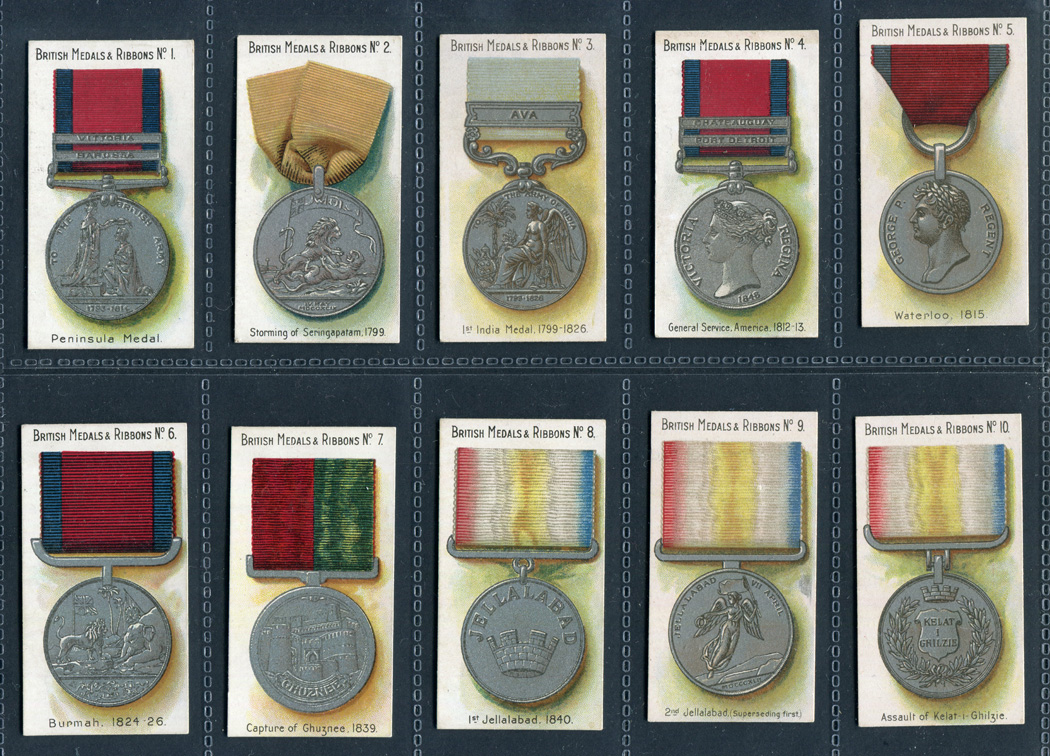
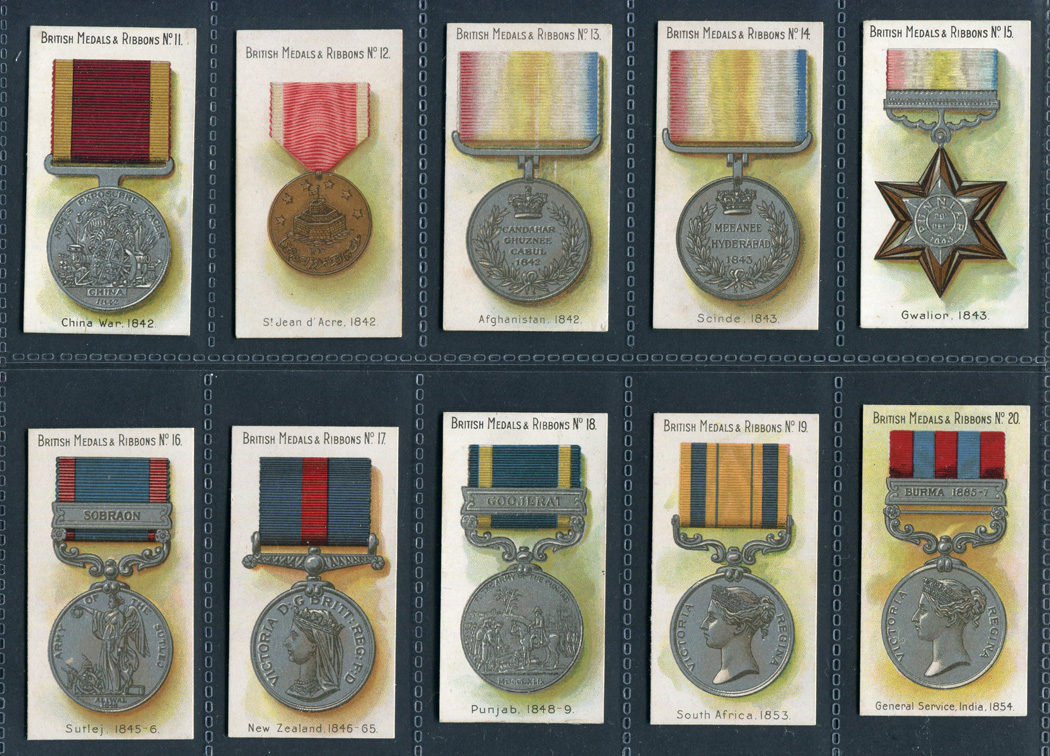
WD & WO Wills - Military Campaign Medals - 1906

This series of “Military Campaign Medals” cards by WD & WO Wills was created in 1906. The set contained 50 original cards.

Wills - Medals - 1906 1
Wills - Medals - 1906 2
Wills - Medals - 1906 3
Wills - Medals - 1906 4

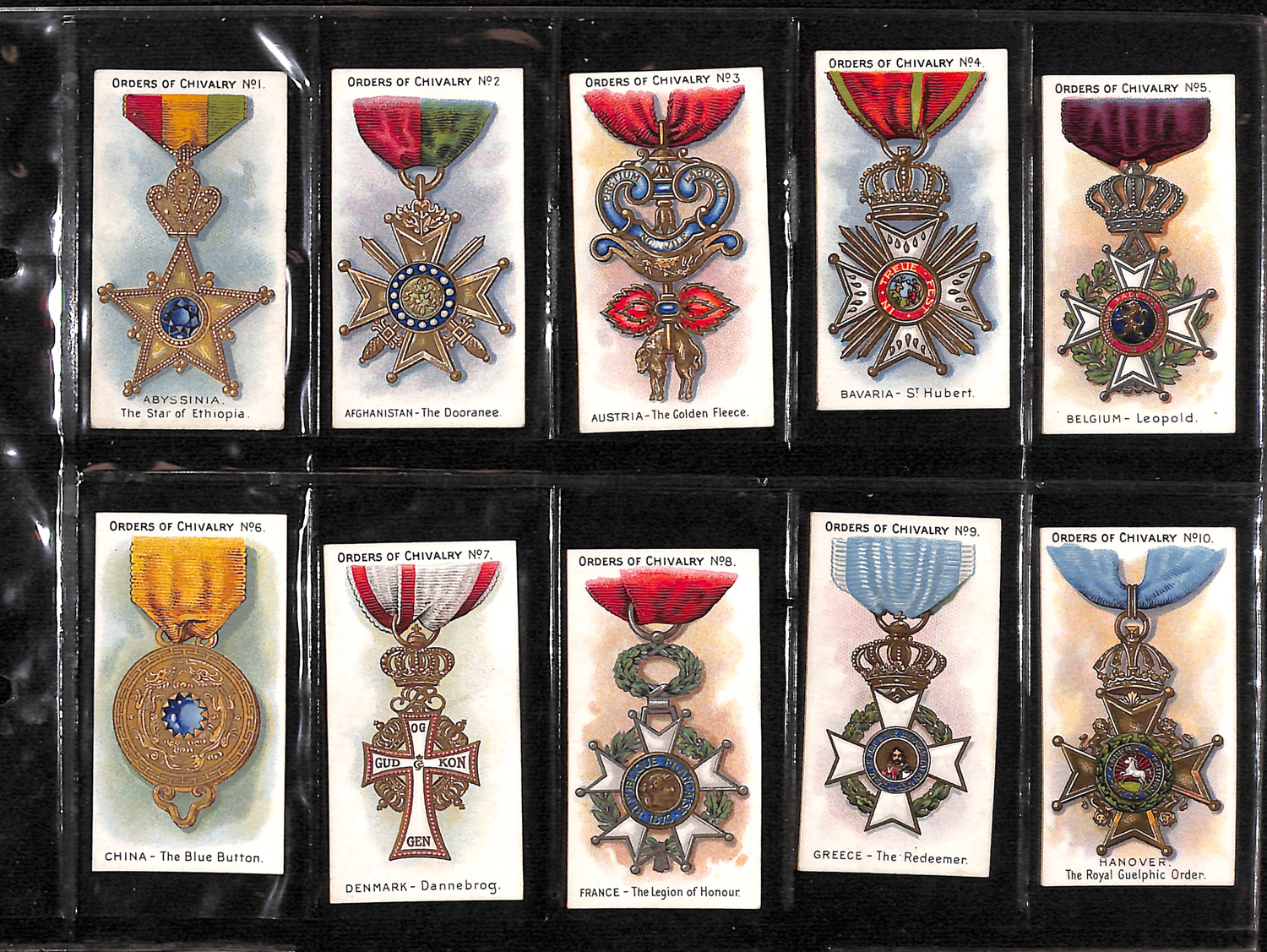
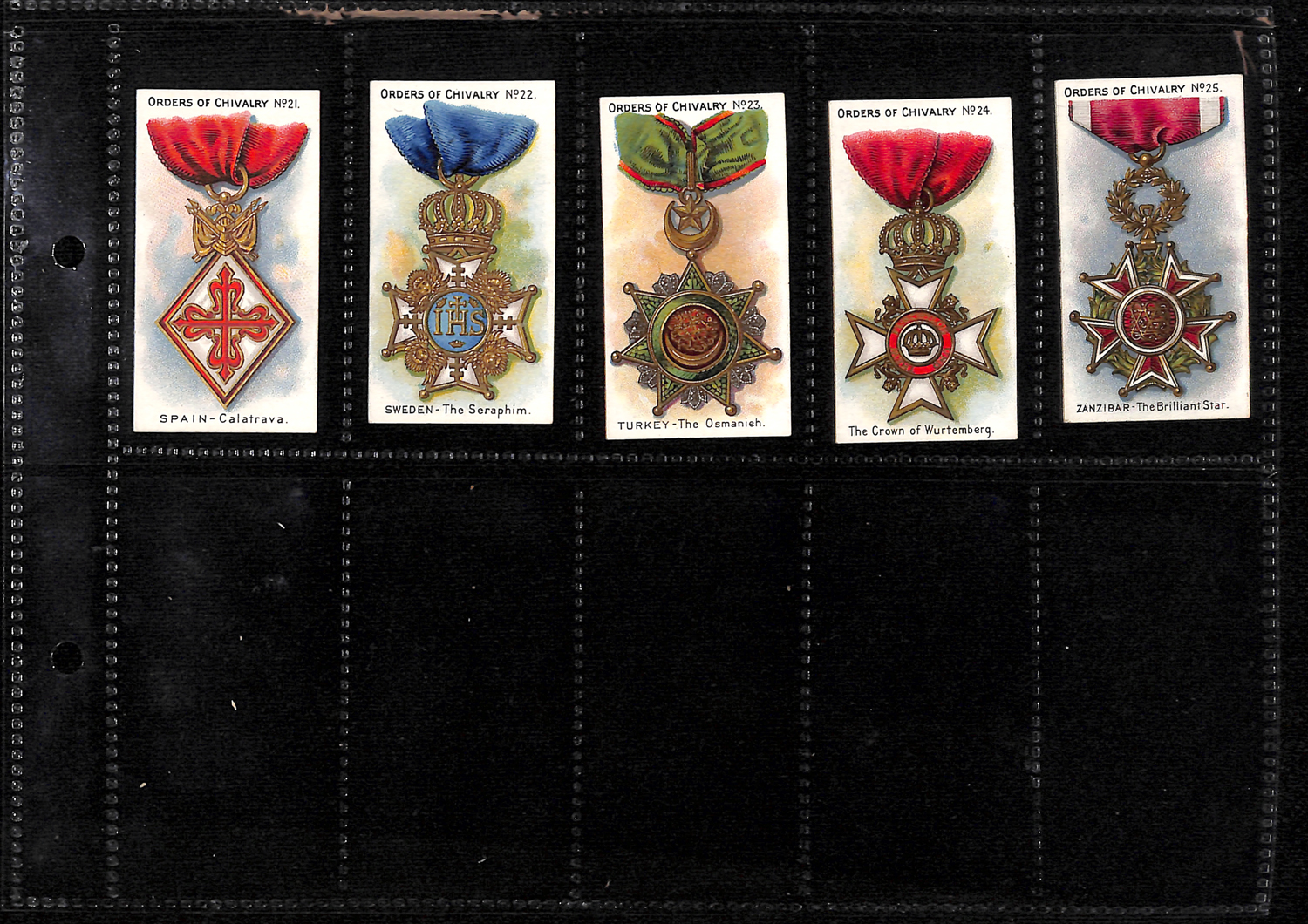
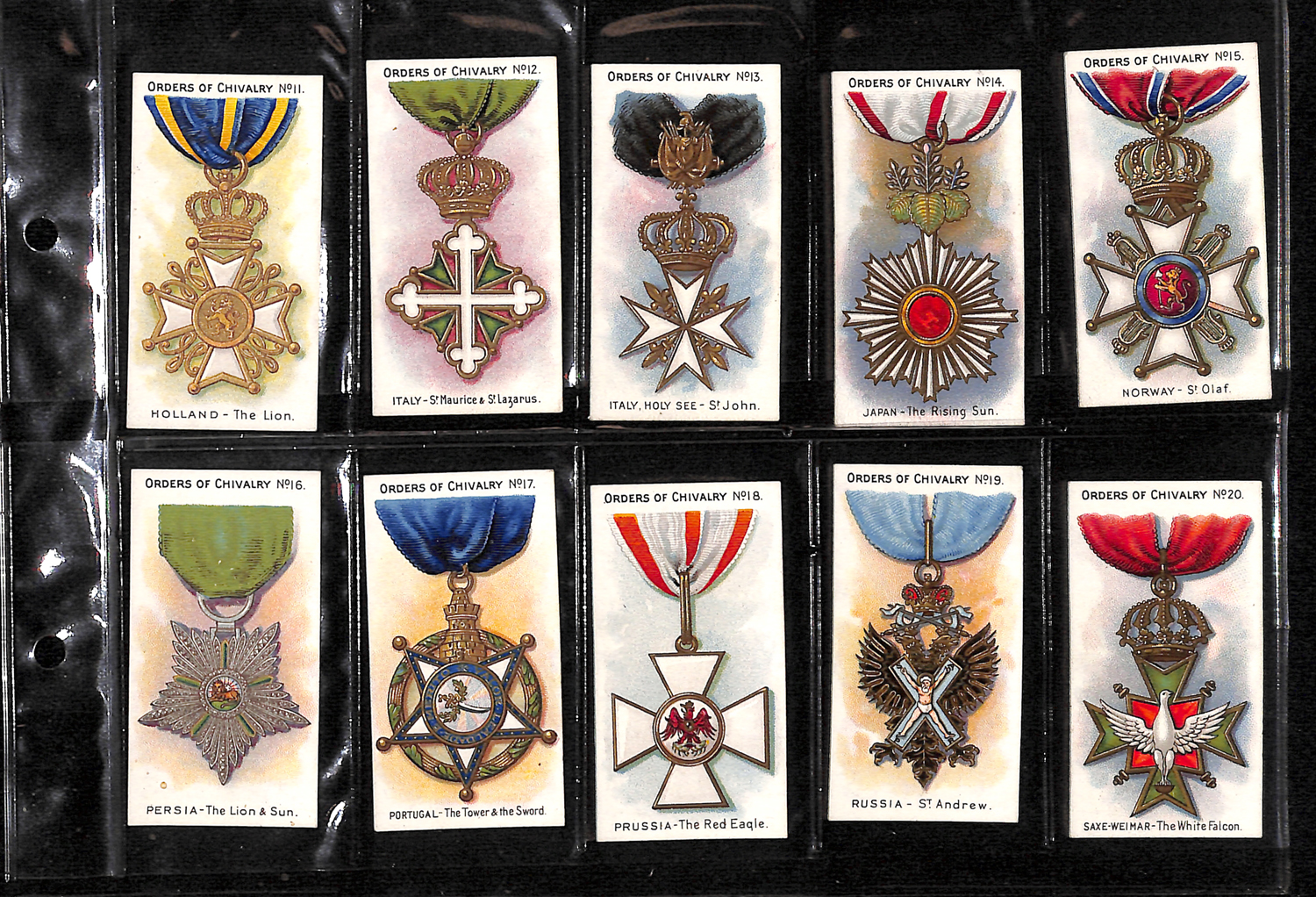
Taddy - Orders of Chivalry - 1911

This series of “Orders of Chivalry” cards by Taddy was issued in 1911. The set contained 25 original cards with orders from several countries.

Taddy - British Medals & Decorations - 1912

This series of 50 “British Medals & Decorations” cards by Taddy was issued in 1912. 

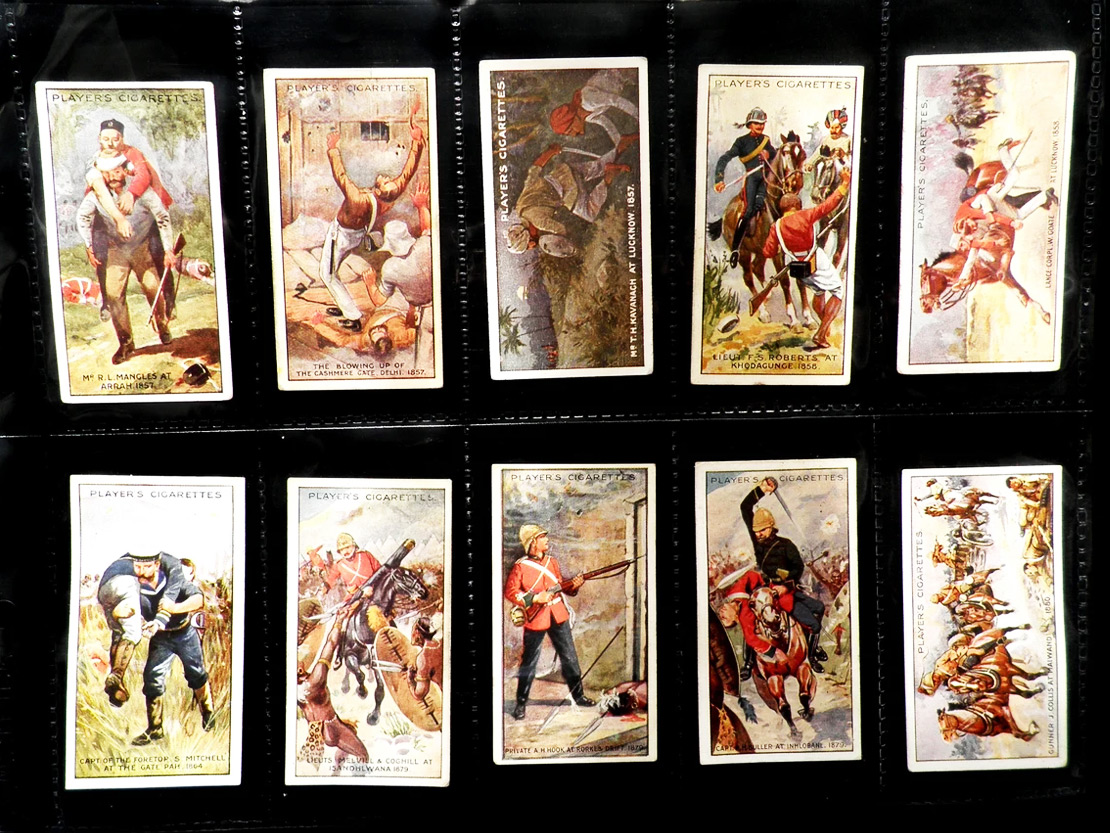
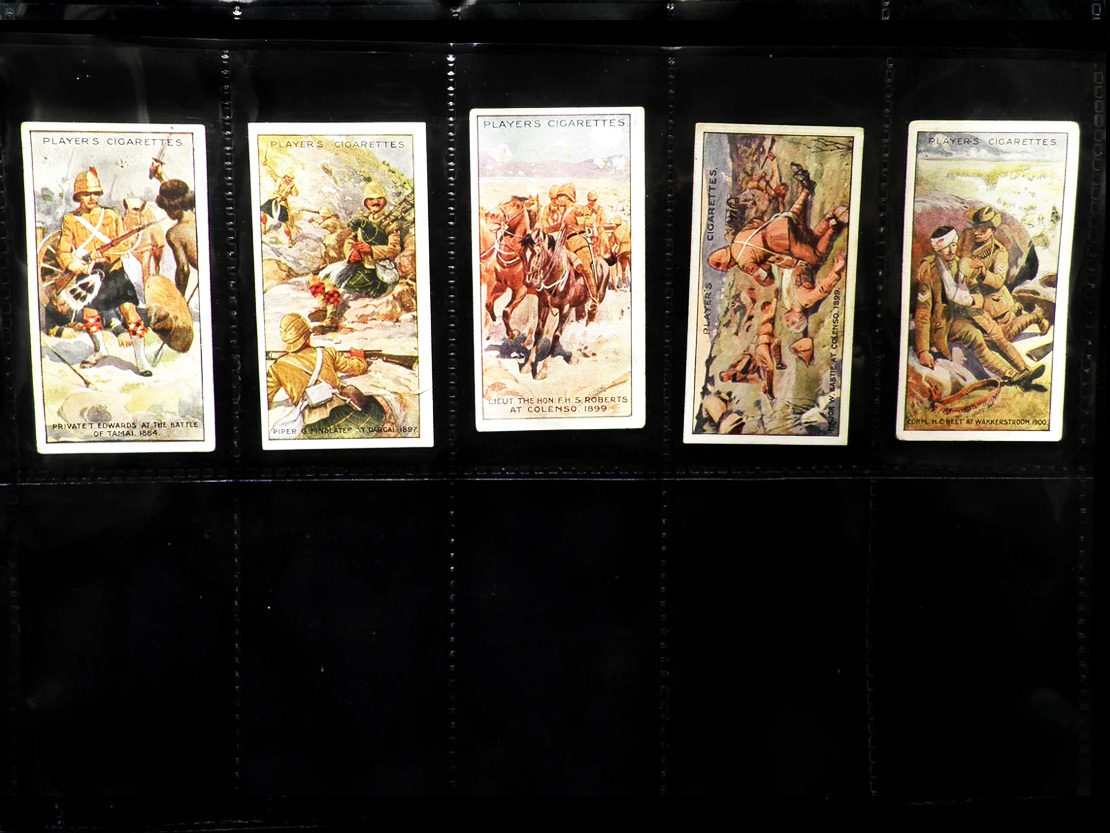
John Player & Sons - Victoria Cross Set - 1914

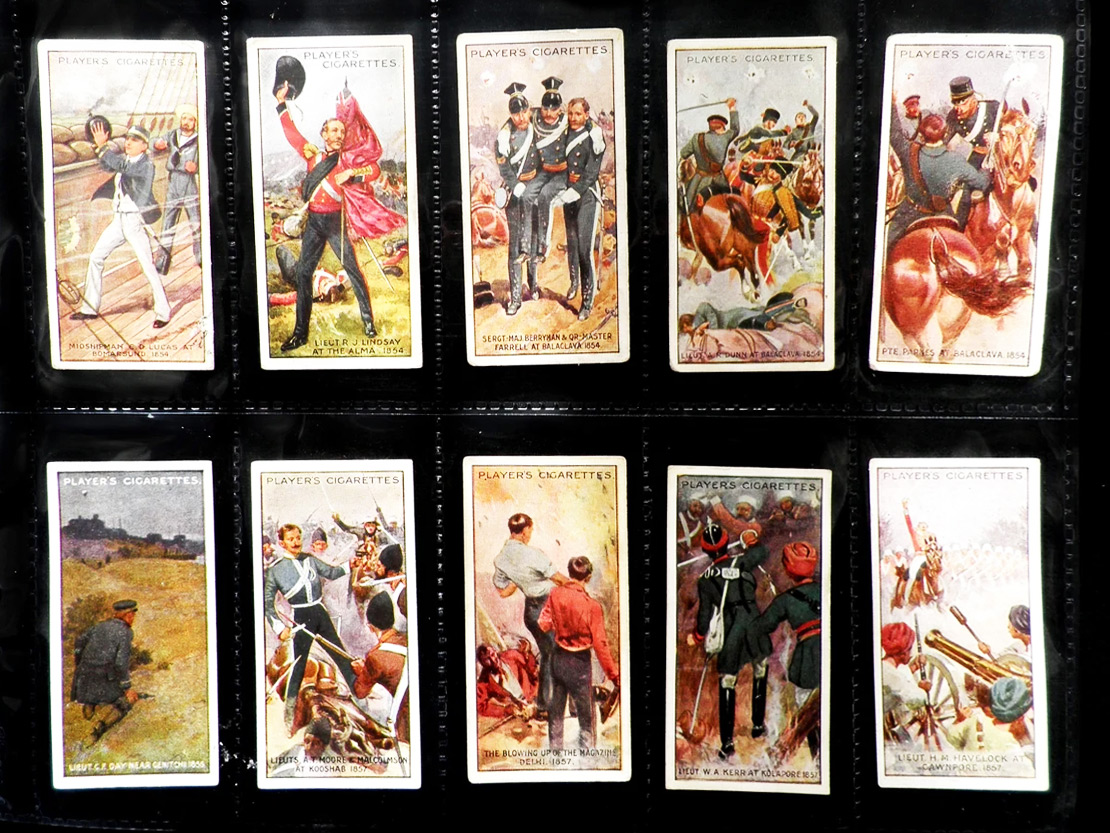
This series of 25 “Victoria Cross” cards by John Player & Sons was issued in 1914. The collection features fascinating stories about the winners of the Victoria Cross award for gallantry: Pvt AH Hook, Rorkes Drift, Gunner J Collis, Afghanistan, Pvt T Edwards, Soudan, Pvt S Parkes Balaclava, Lieut GF Day Crimea, Lieut AT Moore Persis, and many more.

The cigarette cards in this set are: 1 Midshipman RD Lucas (Bomarsund, 1854) 2 Lieut RJ Lindsay (Alma, 1854) 3 Sergt-Major Berryman & Quartermaster J Farrell (Balaclava, 1854) 4 Lieut AR Dunn (Balaclava, 1854) 5 Private S Parkes (Balaclava, 1854) 6 Lieut GF Day (Genitchi, Crimea, 1855) 7 Lieut AT Moore & Lieut Malcolmson (Kooshab, Persia, 1857) 8 The Blowing up of the Magazine (Delhi, 1857) 9 Lieut WA Kerr (Kolapore, 1857) 10 Lieut HM Havelock (Cawnpore, 1857) 11 MR RL Mangles (Arrah, India, 1857) 12 The Blowing up of the Cashmere Gate (Delhi, 1857) 13 Mr TH Cavanagh (Lucknow, 1857) 14 Lieut FS Roberts (Khodagunge, India, 1858) 15 Lance-Corp W Goate (Lucknow, 1858) 16 Capt of the Foretop S Mitchell (Gate Pah, NZ, 1864) 17 Lieut T Melville & NJA Coghill (Isandhlwana, 1879) 18 Private AH Hook (Rorke’s Drift, 1879) 19 Capt RH Buller (Inhlobane Mount, Zululand, 1879) 20 Gunner J Collis (Maiwand, Afghanistan, 1880) 21 Private T Edwards (Tamai, Soudan, 1884) 22 Piper G Findlater (Dargai, India, 1879) 23 Lieut, The Hon FHS Roberts (Colenso, 1899) 24 Major W Babtie (Colenso) 25 Corpl HC Beet (Wakkenstroom, S Africa, 1900)

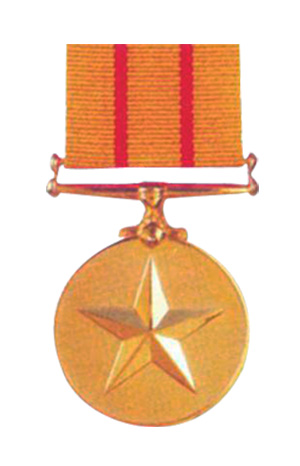
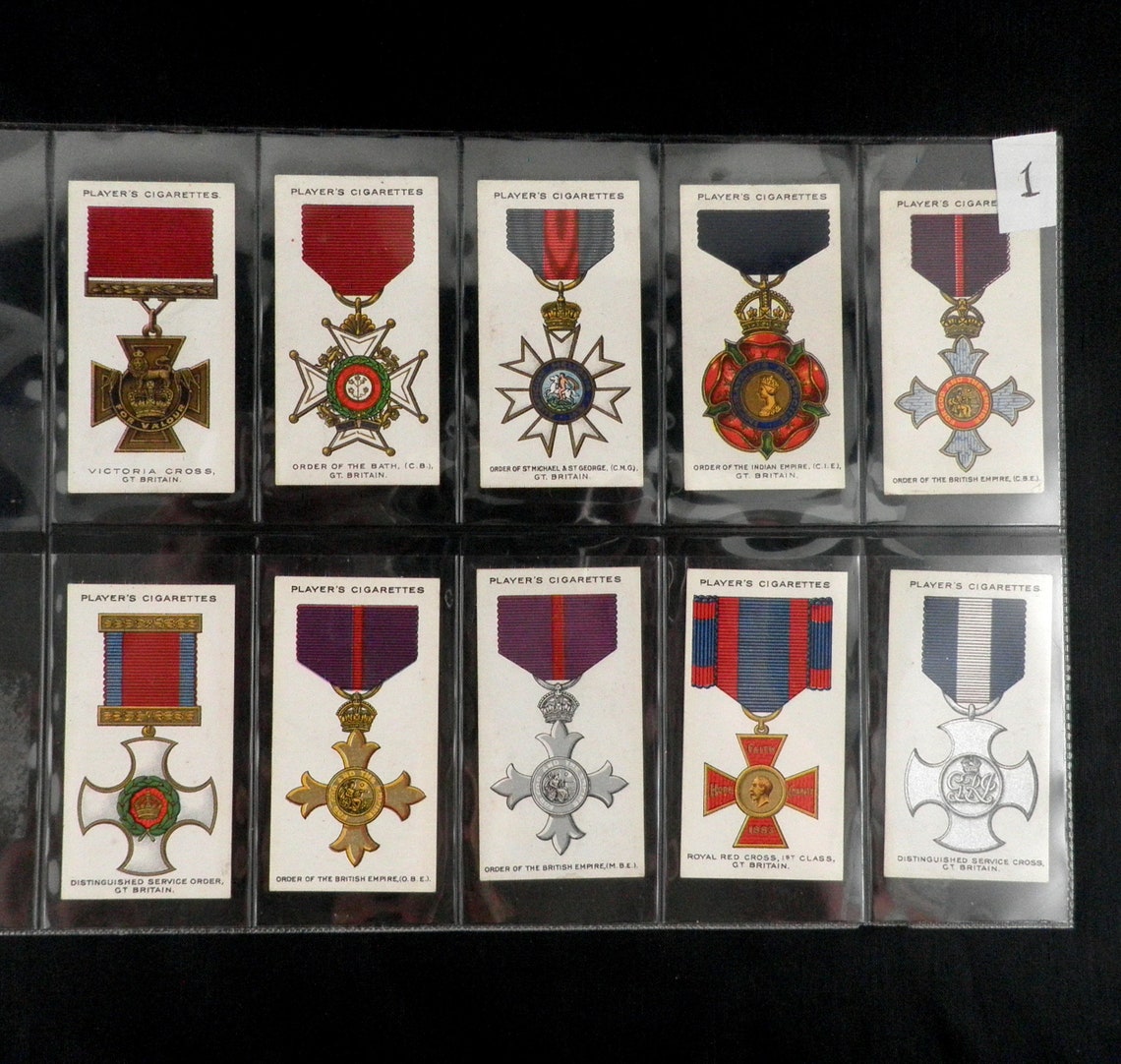
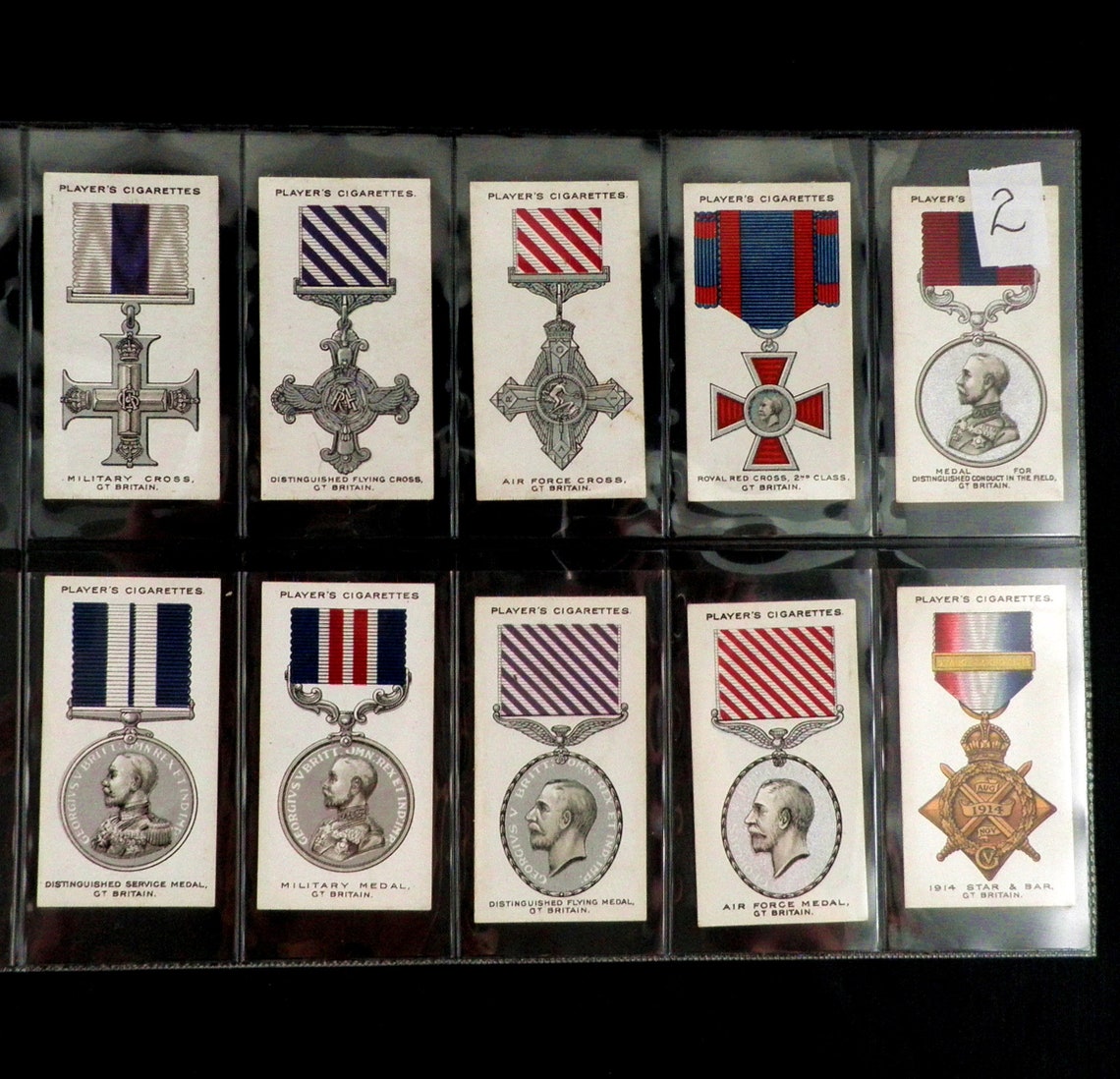
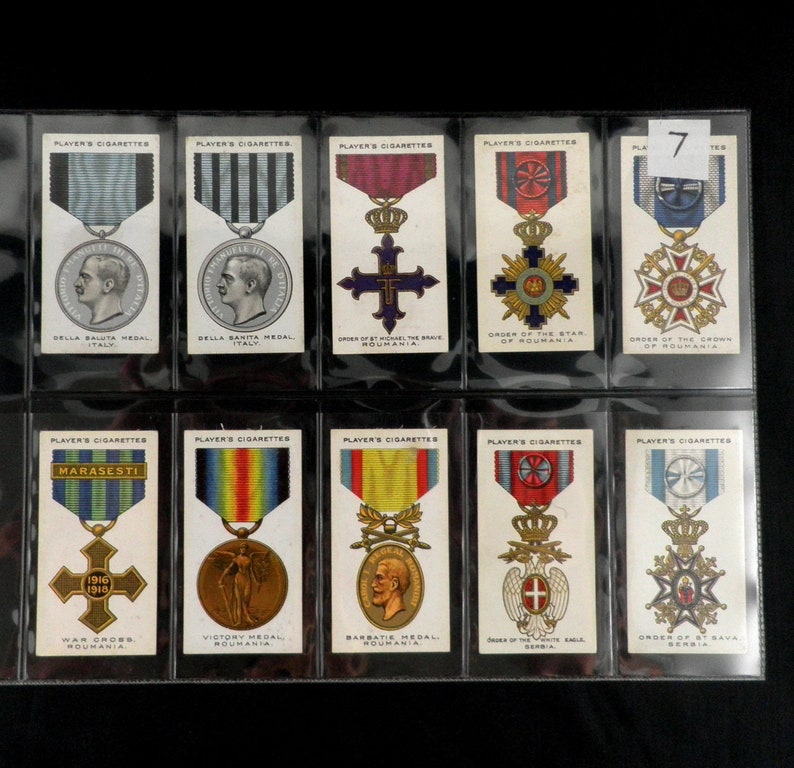
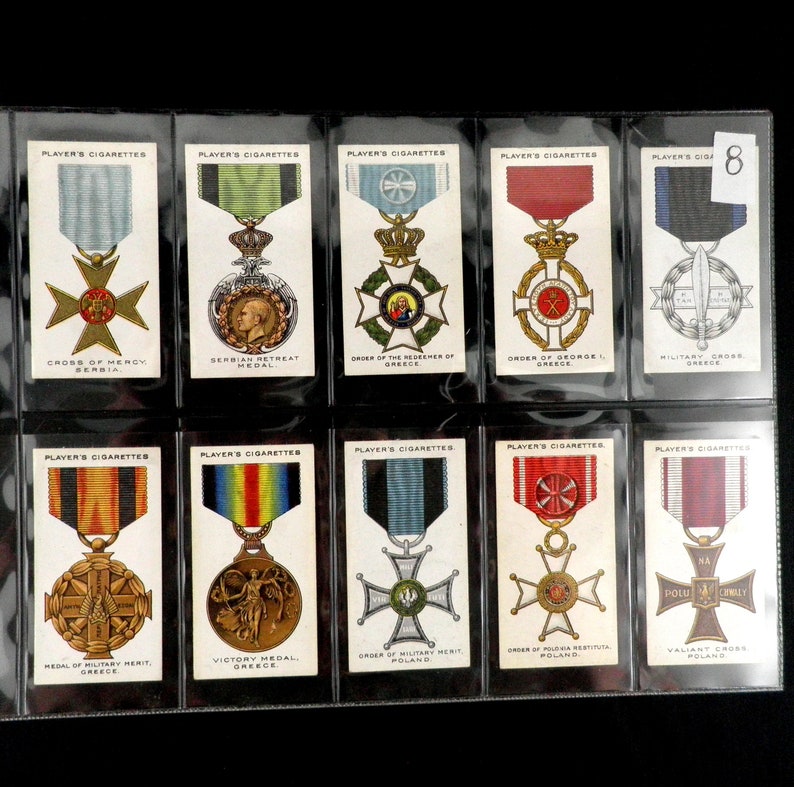
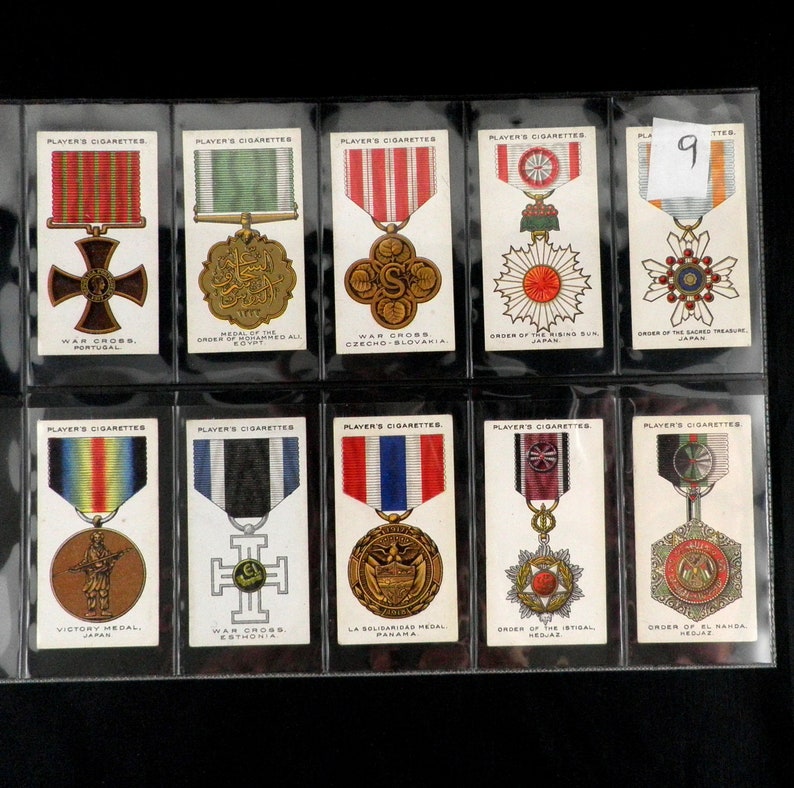
John Player & Sons - War Decorations and Medals Set - 1927

This series of 90 “War Decorations and Medals” cards by John Player & Sons was issued in 1927. The collection features the medals issued to the heroes of war and includes some information about each one on the reverse. 

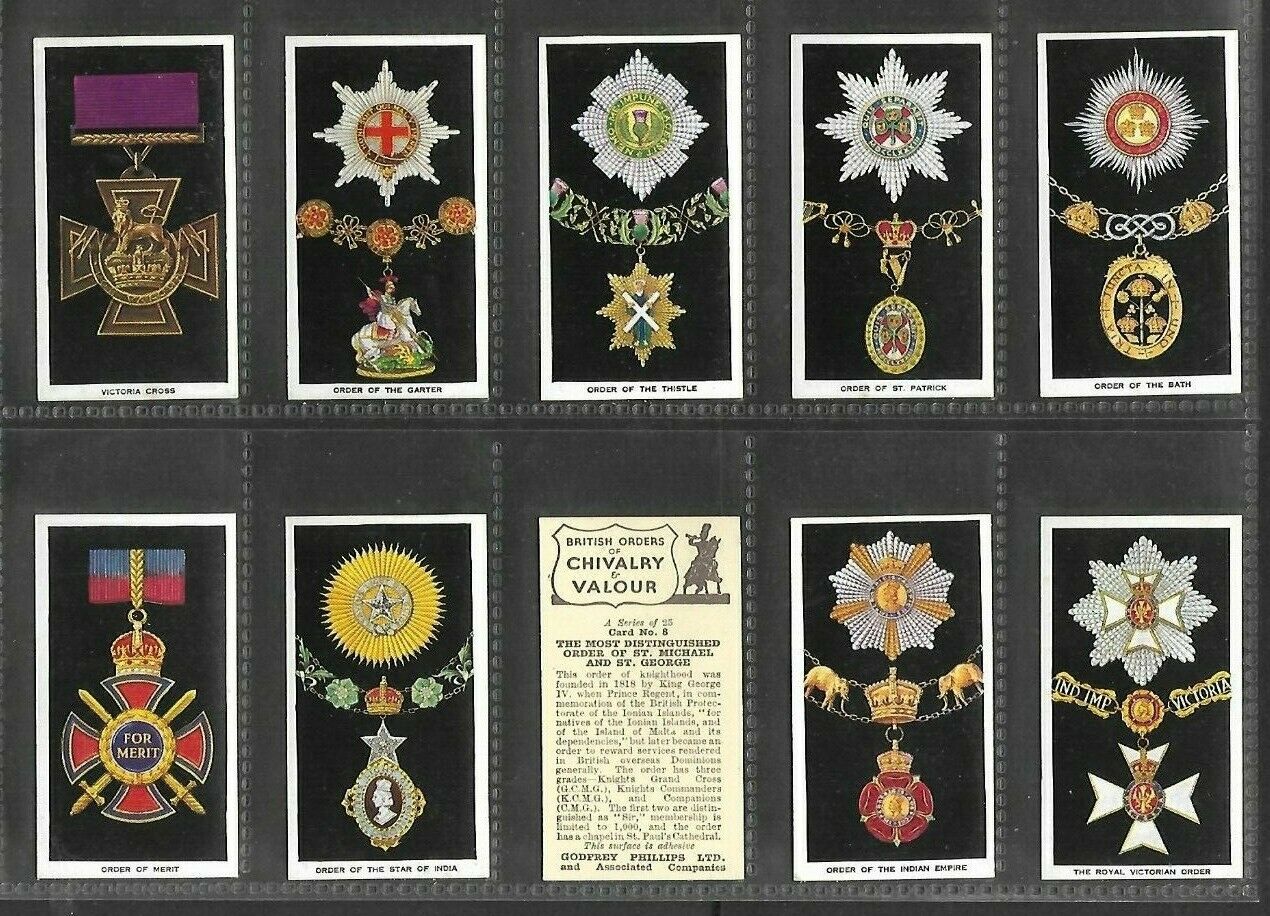
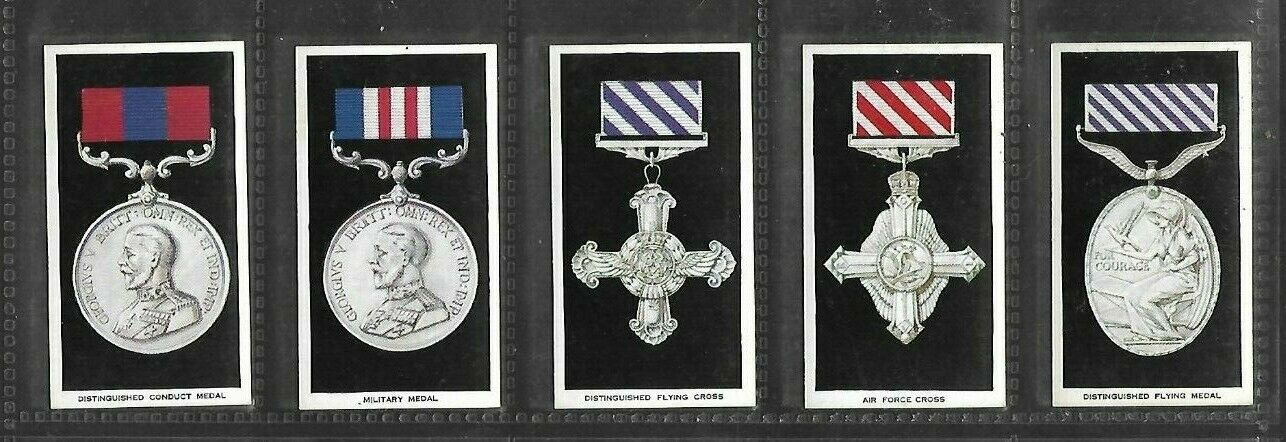
Godfrey Phillips - British Orders of Chivalry & Valour Set - 1936

This series of 25 “British Orders of Chivalry & Valour” cards by Godfrey Phillips was created in 1936. 

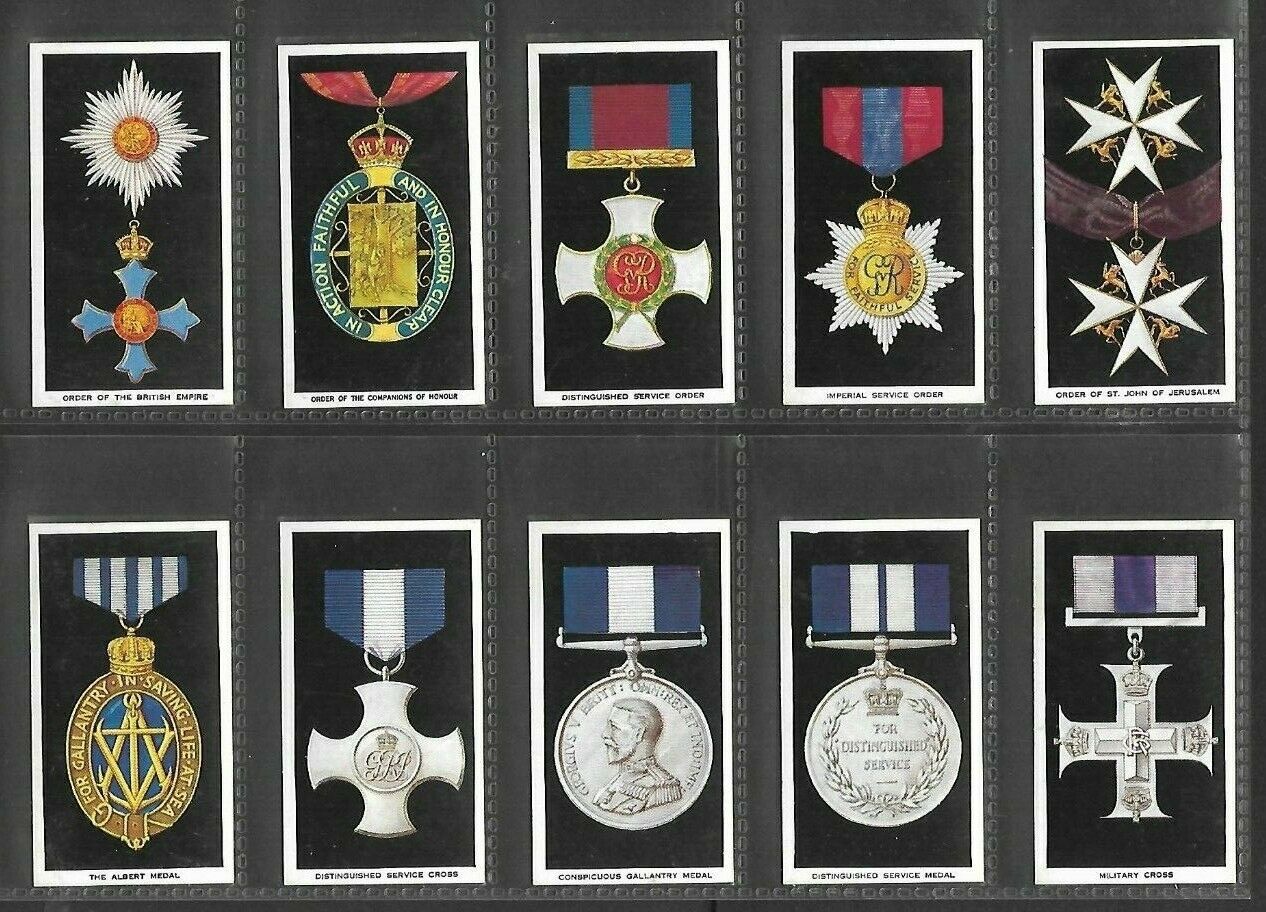
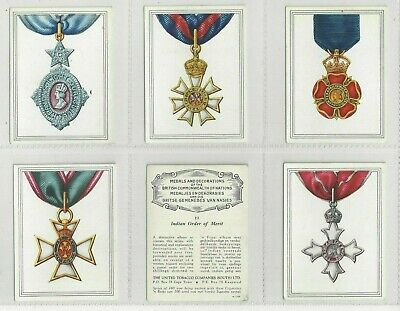
United Tob Cigarettes - "Medals & Decorations of the British Commonwealth of Nations" - 1941

This series of 100 cards is called “Medals & Decorations of the British Commonwealth of Nations” and was created by United Tob Cigarettes in 1941. 

Glengettie - Medals of the World - 1959

This series of 25 cards is called “Medals of the World” and was made by Glengettie in 1959.

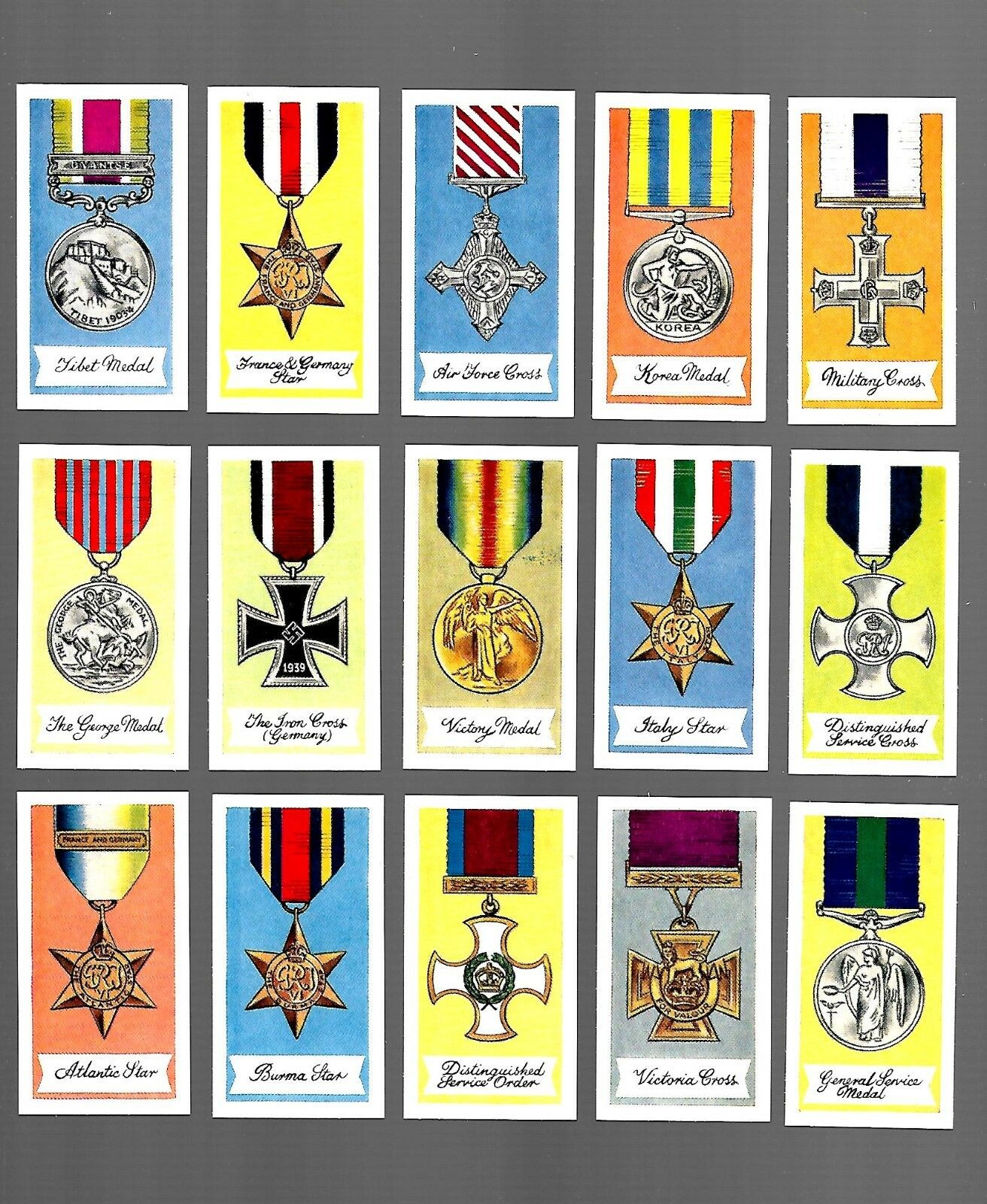
Tommy Gunn - 1971

This series of 50 cards is called “Medals” and was issued by Tommy Gunn in 1971. The cards have a plain back.

The History of Military Medals. Origins, The Wars, and Today

The tradition of awarding medals and decorations can be traced hundreds of years into the past. Most medals were a piece of metal, struck in gold, silver, bronze or lead, with an embossed design that commemorated a person, a place or an event. Some took the shape of small medallions and others were as big as large plaques or plaquettes.

How were Medals Constructed?

The process of creating medals could use a variety of techniques. Some were struck from a die engraved in intaglio – the design was then applied on the metal by pressure. Others were cast from models of wax, wood, or stone. A few were produced by repoussé, using two interlocking molds.

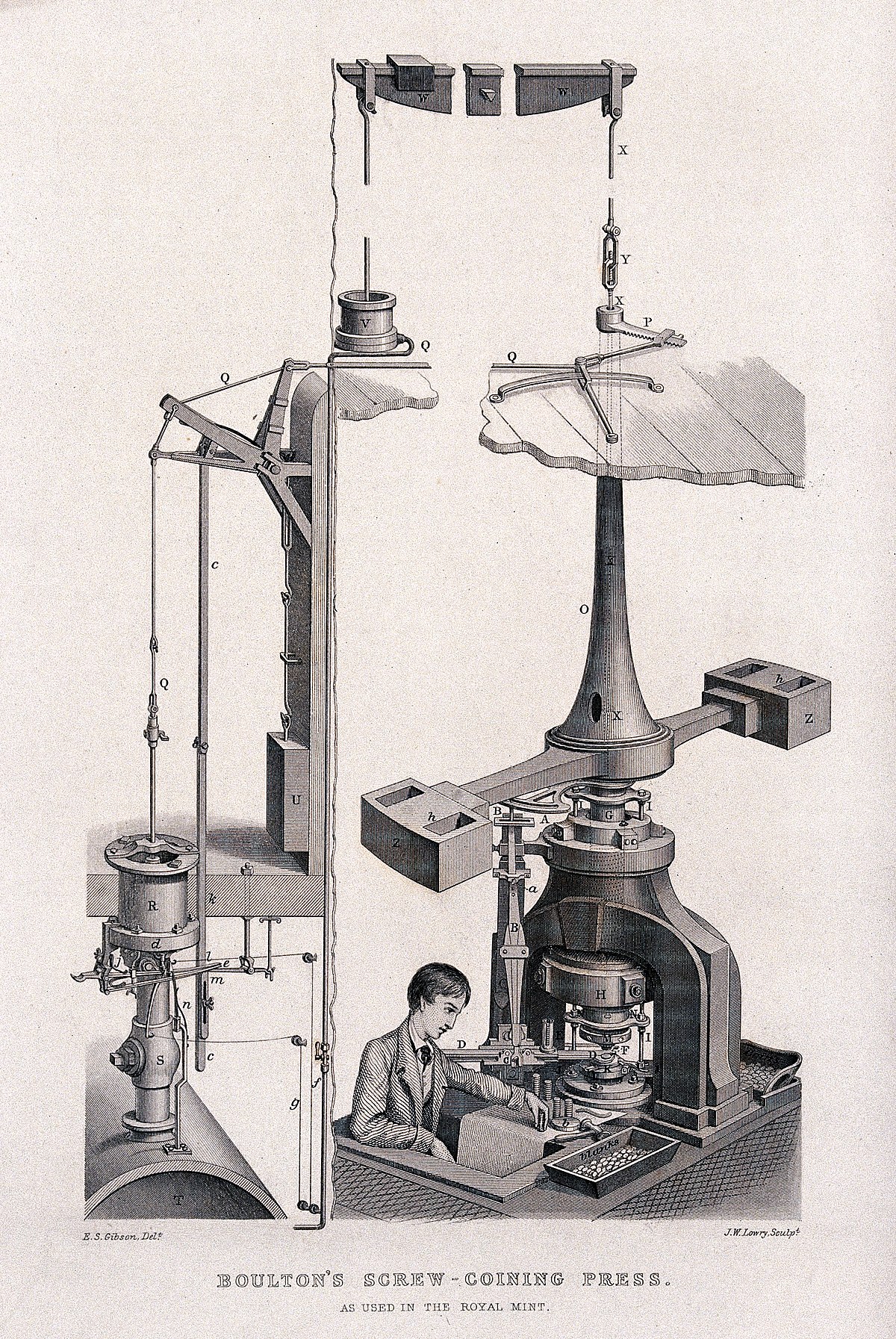
In 1786, the English engineer Matthew Boulton introduced steam-powered presses for coin and medal making, as well as the use of the reducing machine, which could turn a sculptor’s large-scale relief into a working die. It wasn’t until the 19th century, however, that machine cutters were introduced. These machines were able to copy a design mechanically, eliminating hand cutting.

What was the First Medal?

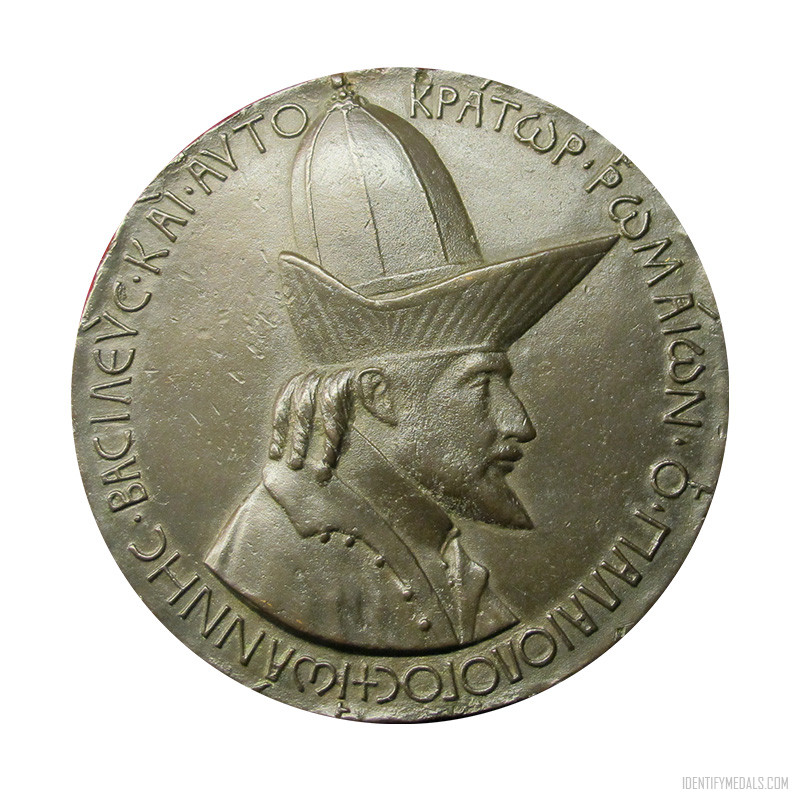
Medal of the Emperor John VIII Palaiologos made by Pisanello in 1438.

Most experts agree that the first medal ever created was made by Antonio Pisano (or “Pisanello“), an Italian painter that lived from 1395 to 1455. 

The medal, made in 1438, portrays John VIII Palaeologus – the penultimate Byzantine emperor. Several painters have also famously depicted John VIII Palaiologos on the occasion of his visit to Italy. For example, Benozzo Gozzoli painted him portrait on the southern wall of the Magi Chapel, at the Medici-Riccardi Palace in Florence.

You can read more about this medal in the article: The First Ever Military Medal: Who Created it and Why.

Early European Medals

Pisanello is universally considered the father of commemorative portrait medalists. He was the first artist to melt his, a process closer to the creation of bronze low-relief. However, other European countries would soon begin to try their own medals. 

In France, for example, the first commemorative medals were produced in the 15th century. For example, in 1455, a few heraldic pieces were struck in gold and silver to commemorate the expulsion of the English. And The first medal portrait produced in France was that of Charles VIII and Anne of Brittany, who visited Lyon in 1494. 

The most popular northern Renaissance medal, however, is the Medal of Erasmus, made in 1519 in Antwerp by Quentin Massys. Medal production in the Netherlands was particularly stimulated by the need for propaganda medals during the war with Spain (1568–1648). 

Coinage: elevation of a coin press. Engraving by J. W. Lowry after E. S. Gibson.
Coinage: elevation of a coin press. Engraving by J. W. Lowry after E. S. Gibson. Image courtesy of Wellcome Images.

Medals in the Baroque Period

The 17th Century was the time of large struck propaganda. The Thirty-Years War and the Dutch Wars with France and England were in part responsible for this. Saxony, Poland, Sweden and the Holy Roman Empire hired Sebastian Dadler (1586–1657) to produce large struck medals that displayed the political events. In Stockhold, Johann Carl Hedlinger (1691–1771), a Swiss trained in Paris, became court medalist. 
The style that dominated in the 17th Century was that of Versailles – while the Mint of Paris was widely admired and respected. For example, the series Histoire métalliquea series of large medals struck to commemorate Louis XIV, was imitated all around Europe. In England, the fist Baroque medal was that of King Charles II in 1660 – made by the Paris-trained medalist John Roettier in the French court style. Also in England, Thomas and Abraham Simon produced refined cast portrait medals, while the Napoleonic regime ordered an elaborate Histoire métallique. 

The Oldest Medal Still in Use

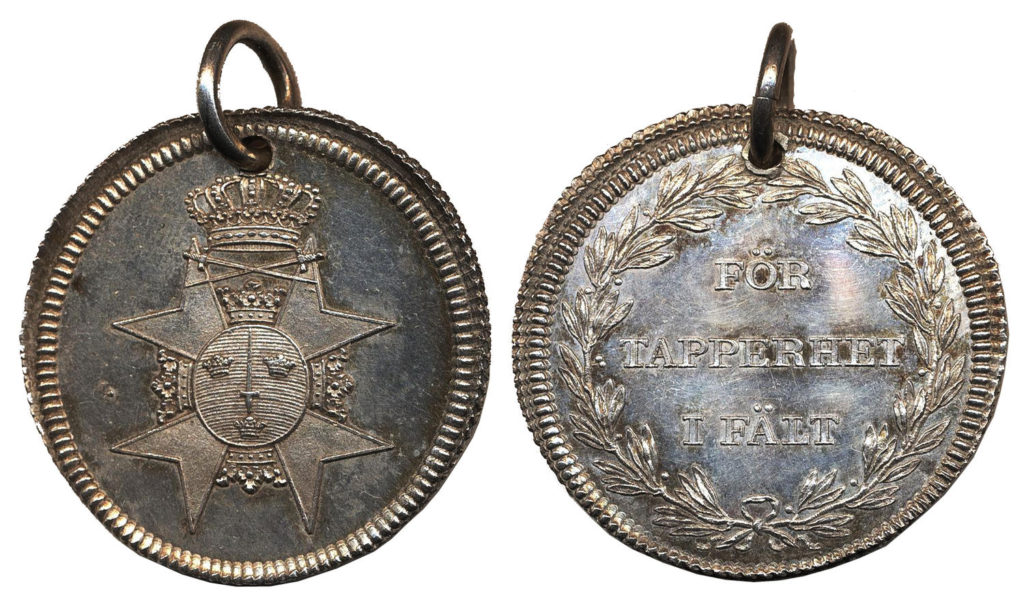
The För tapperhet i fält Medal

The oldest military decoration still in use the Sweddish För tapperhet i fält (“For Valor in the Field” medal) and the För tapperhet till sjöss (“For Valor at Sea” medal). These decorations were awarded for valor in the field or at sea in wartime. They were instituted by Swedish king Gustav III on 28 May 1789, during his war against Russia. 

The New Parisian and Art Noveau Schools

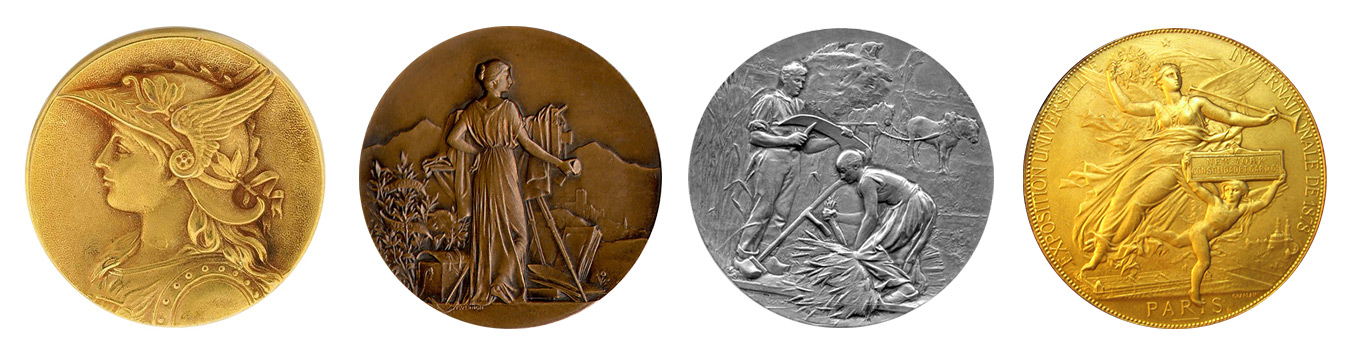
The invention of the reducing machine and the wider use of steam-powered presses were crucial to the development of the new Parisian school of the Art Nouveau, which was founded by Jules-Clément Chaplain (1839–1909) and Louis Oscar Roty (1846–1911). Rival schools were erected in Vienna, Hungary, and Bohemia. In England, a few sculptors took up medal making. And in Germany, reacting the new Parisian school, a school of expressionist medalists flourished. 

Art Noveau medals
Art Noveau Medals: 1. Art Nouveau Gold Medal Jewel – Possibly Depicting Brunhilde. 2. Frédéric Vernon: French Bronze Art-Nouveau medal. 3. Adolphe Rivet: Agriculture. 4. The Universal Exposition, Paris, Gold Medal, 1878, signed by J C Chaplain.

Medals and the American Revolutionary War

In 1787, Col. David Humphreys, an American Revolutionary War colonel and aide de camp to George Washington, wrote: “Few inventions could be more happily calculated to diffuse the knowledge and preserve the memory of illustrious characters and splendid events, than medals.” From the outset, Congress was imbued with the conviction that only the highest achievement would be entitled to such a distinction. 

Following a long-standing practice, the American Congress commissioned a series of gold medals that represented the most distinguished achievements. Other awards included silver and bronze medals, and ceremonial swords. Following the ratification of the Constitution, the first gold medal was given to Captain Thomas Truxtun in 1800. Subsequently, Congress commissioned 27 gold medals for notable victories and achievements. The gold medal continues to be awarded to the present day.

Click here to explore all American medals >

Medals and the Great War

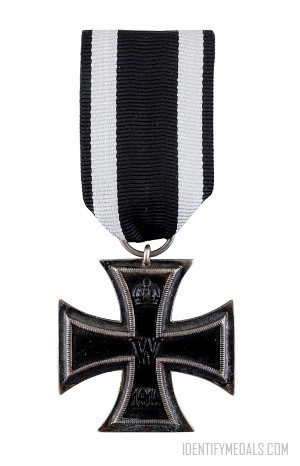
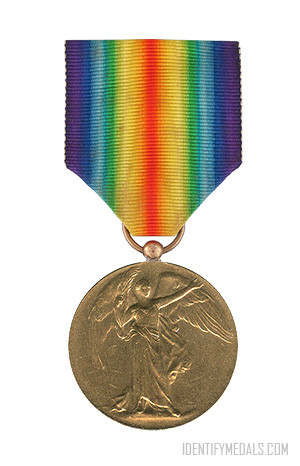
A significant number of medals and awards were given for gallantry or meritorious service for those who fought during the Great War. Some of the most popular include Pip, Squeak and Wilfred (the affectionate names given to the three WW1 campaign medals from the United Kingdom: The 1914 Star or 1914-15 Star, the British War Medal and the Victory Medal), the French War Cross and Belgian War Cross, and the German Iron CrossWound Badge and the Hindenburg Cross.

Medals and the Second world War

During and after the Second World War, which lasted from 1939 to 1945, numerous campaign medals and awards were instituted in recognition of service. Some medals denote extraordinary service in ground operations, aerial flight, or Sea Services. 

Medals Today

Medals and decorations continue to be awarded today for a variety of achievements. These include campaign medals for acts of bravery, awards for cultural and scientific advances, and commemorative medals and coins. 

The Vayu Sena Medal

The Vayu Sena Medal is a gallantry award for servicemen in the Indian Air Force. It was instituted in 1960 and usually awarded in peacetime.

  • Time Period: Post-WW2
  • Institution: 17 June 1960
  • Country: India

The Vayu Sena Medal is a gallantry award for servicemen in the Indian Air Force. It was instituted on 17 June 1960 by the President of India and is usually awarded in peacetime. However, it has been granted during times of conflict for acts of gallantry in the face of enemy (although not as many times as the Vir Chakra Decoration).

It is possible to receive the Vayu Sena Medal posthumously. 

The Vayu Sena Medal Design

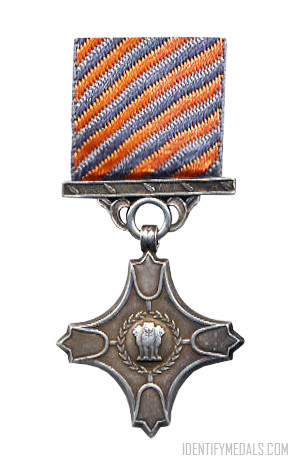
The medal is a four-armed silver star with the ends shaped like lotus flower blooms. 

The obverse bears the national emblem of India. The reverse shows a Himalayan Eagle with wings spread, and the legend, above and below, in Hindi “Vayu Sena Medal” or “Air Force Medal“. 

The ribbon measure 30 mm wide and alternates 2mm diagonal stripes in grey and orange-saffron. 

The Nau Sena Medal

  • Time Period: Post-WW2
  • Institution: 17 June 1960
  • Country: India

The Nau Sena Medal is a gallantry award for servicemen in the Indian Navy instituted on 17 June 1960 for individual acts of exceptional devotion to duty or courage as have special significance for the Navy.

The Nao Sena Medal was instituted by the Government of India, with the approval of the President of India.

The Nau Sena Medal Design

The medal is pentangular in shape, struck in silver and has curved sides. 

The obverse bears an embossed Naval Crest. The reverse shows a trident within a circle and rope. There’s also an inscription reading “Nau Sena Medal” in Hindi embossed along the upper rim.

The ribbon is navy blue with a single central white line and measures 32 mms wide.