The Bharat Ratna Award

The Bharat Ratna Award is the highest civilian award of the Republic of India, given for exceptional service. It was established in 1954.

The Bharat Ratna Award is the highest civilian award of the Republic of India. It was established on 2 January 1954 and it is awarded for exceptional service or performance of the highest order.

Although the honor was originally limited to achievements in the arts, literature, science, and public services, in 2011 the Indian government expanded the criteria to include “any field of human endeavor“. People of any race, occupation, position, or sex can receive this award.

The recommendations for the Bharat Ratna award are made by the Prime Minister to the President. There’s a maximum of three nominees awarded per year. Several bestowals of the award, such as that of K. Kamaraj (1976) and M. G. Ramachandran (1988) have met with criticism.

The Bharat Ratna Design

The original award (1954) was specified as a circle measuring 35 mm (1 38 inches) in diameter and made of gold.

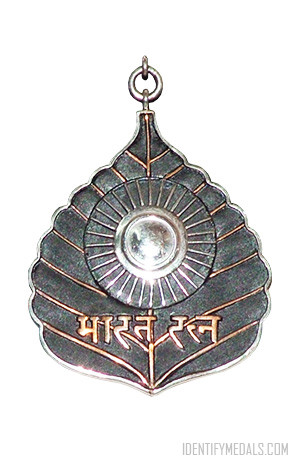
The obverse has a sun burst design, the text “Bharat Ratna“, in Devanagari Script inscribed on the upper edge in silver gilt, and a wreath set along on the lower edge. The reverse bears the platinum State Emblem of India in the center as well as the national motto, “Satyameva Jayate” in Devanagari Script (सत्यमेव जयते in Sanscrit; lit. “Truth alone triumphs“) inscribed in silver-gilt on the lower edge.

This design was modified in 1955. The current medals has the shape of a peepal leaf, measures approximately 59 mm (2 516 inches) long, 48 mm (1 78 inches) wide and 3.2 mm (18 inches) thick and it’s rimmed in platinum. 

The obverse has an embossed sun burst design made of platinum, with rays spreading out, and the words “Bharat Ratna”. The reverse bears the sane design as the 1954 version and the inscription “Satyameva Jayate”.

The ribbon is white.
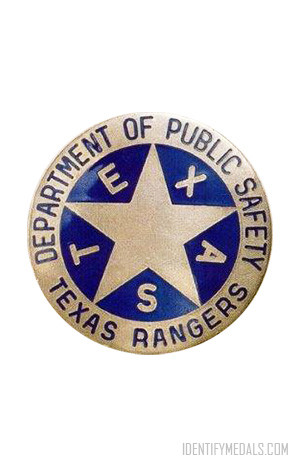
The 1957 Texas Rangers “Blue Bottle Cap” Badge

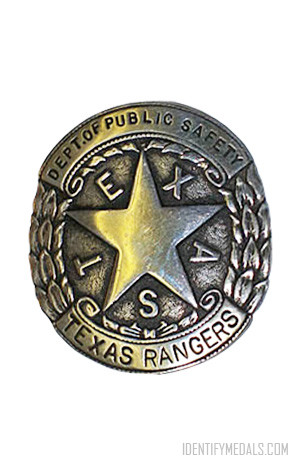
The 1957 Texas Rangers “Blue Bottle Cap” Badge was issued to the Rangers and featured blue enamel paint on polished metal.

The 1957 Texas Rangers “Blue Bottle Cap” Badge was issued to the Rangers and featured blue enamel paint on polished metal. The badge was created by the Texas Department of Public Safety. 

It’s said that most Rangers were not happy with the result because it was too severe a break from the traditional frontier designs. That’s probably why it was soon replaced by the 1962 Texas Rangers badge, which is actually based on a Cinco Peso Mexican silver coin. 

Other Texas Rangers Badges

Find Texas Rangers Badges Online

Right Now on eBay 
Clicking a link to eBay may result in a referral commission being paid if a purchase is made.
Loading...

Further Reading About the Texas Rangers

The 1962 Texas Rangers Badge

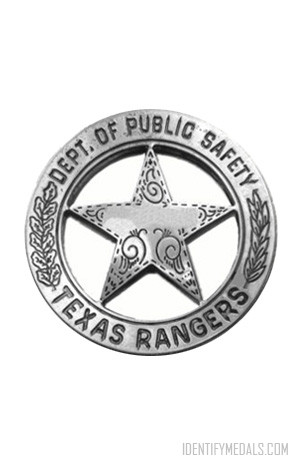
The 1962 Texas Rangers Badge was designed in 1961-62 and is a five-pointed star symbolizing the “Lone Star” of Texas.

The 1962 Texas Rangers Badge was designed in 1961-62 and is a five-pointed star symbolizing the “Lone Star” of Texas. The badge was created by Ranger Hardy L. Purvis in honor of his late father, Ranger Captain Hardy B. Purvis, and his mother. When Purvis presented the badge to the Texas Department of Public Safety, he also gave the Dept enough Cinco Peso Mexican silver coins for the sixty-two rangers at the time. 

Colonel Homer Garrison, Jr., Director of the Texas Department of Public Safety and Chief of the Texas Rangers, announced in October 1962, that the Texas Rangers are going back to the tradition steeped in history of a Mexican silver badge worn by their predecessors during frontier days. The new official Ranger badge, issued to each of the 62 members of the Force, is a replica of the historic original badge which old-time Rangers carved out of a Mexican five-peso silver dollar.

Modern Texas Rangers receive two badges when they are promoted to the Ranger Service. The first is the silver badge made from a Mexican Cinco peso coin. The second a bronze, silver-plated badge to carry in their identification case. 

Other Texas Rangers Badges

Find Texas Rangers Badges Online

Further Reading About the Texas Rangers

The 1935 Texas Rangers Badge

The 1935 Texas Rangers Badge is a shield overlaid with a circle star. It was the first official badge by the Texas Dept. of Public Safety.

The 1935 Texas Rangers Badge is a shield overlaid with a circle star. It was the first official badge by the Texas Department of Public Safety.

Other Texas Rangers Badges

Find Texas Rangers Badges Online

Right Now on eBay 
Clicking a link to eBay may result in a referral commission being paid if a purchase is made.
Loading...

Further Reading About the Texas Rangers

The Texas Rangers Ira Aten Badge

The Texas Rangers Ira Aten Badge dates to the 1880s. It is the earliest surviving Texas Rangers badge known and belonged to Ira Aten.

The Texas Rangers Ira Aten Badge dates to the 1880s. It is the earliest surviving Texas Rangers badge known and belonged to Ira Aten. 

Ira Aten (September 3, 1862 – August 5, 1953) was a Texas Ranger born in Cairo, Illinois. Aten was assigned to the counties bordering the Rio Grande, and due to the rough nature of this area, he became involved in numerous dangerous encounters. He was inducted into the Texas Rangers Hall of Fame.

Other Texas Rangers Badges

Find Texas Rangers Badges Online

Right Now on eBay 
Clicking a link to eBay may result in a referral commission being paid if a purchase is made.
Loading...

Further Reading About the Texas Rangers

All the Texas Rangers Badges and Their Unique Designs

The Texas Rangers were in charge of protecting the state from Indian and bandit raids. The rangers were originally organized in two groups, which had been formed after the Civil War Reconstruction. 

T he first was the Frontier Battalion, which operated state-side. The second was the Special Forces, which were stationed in the area between the Nueces River and the Rio Grande. Both groups were under the command of the Texas Adjutant General.

Why Did Texas Rangers Wear Badges?

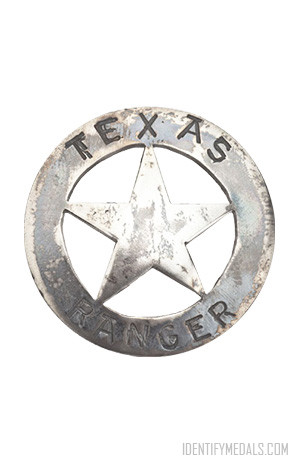
From the 1880s on, Texas Rangers carried a Warrant of Authority and a physical descriptive list that served as proof of the Ranger’s identity and authority. Contrary to what you might believe, the state of Texas did not supply rangers with badges! The rangers would choose their badges based on taste and availability 0 so there was a large variety of designs. 

The first Rangers to wear official badges were those working from 1935 on, when the Texas Rangers were reorganized as a division of the Texas Department of Public Safety. Since then, there has been three official designs: A shield overlaid with a circle star (1935), a blue enameled circle star (1957) and a badge decorated with wreaths of olive and live oaks (1962).

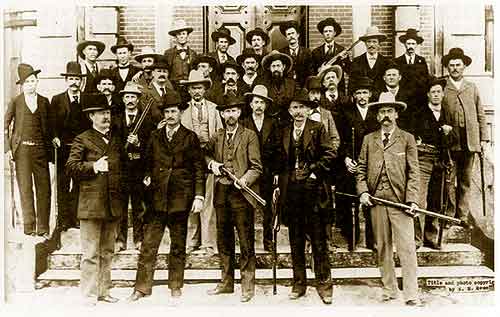
Texas Rangers gathered at El Paso to stop the illegal Maher–Fitzsimmons fight, 1896.
Texas Rangers gathered at El Paso to stop the illegal Maher–Fitzsimmons fight, 1896. Image courtesy of Wikipeda.
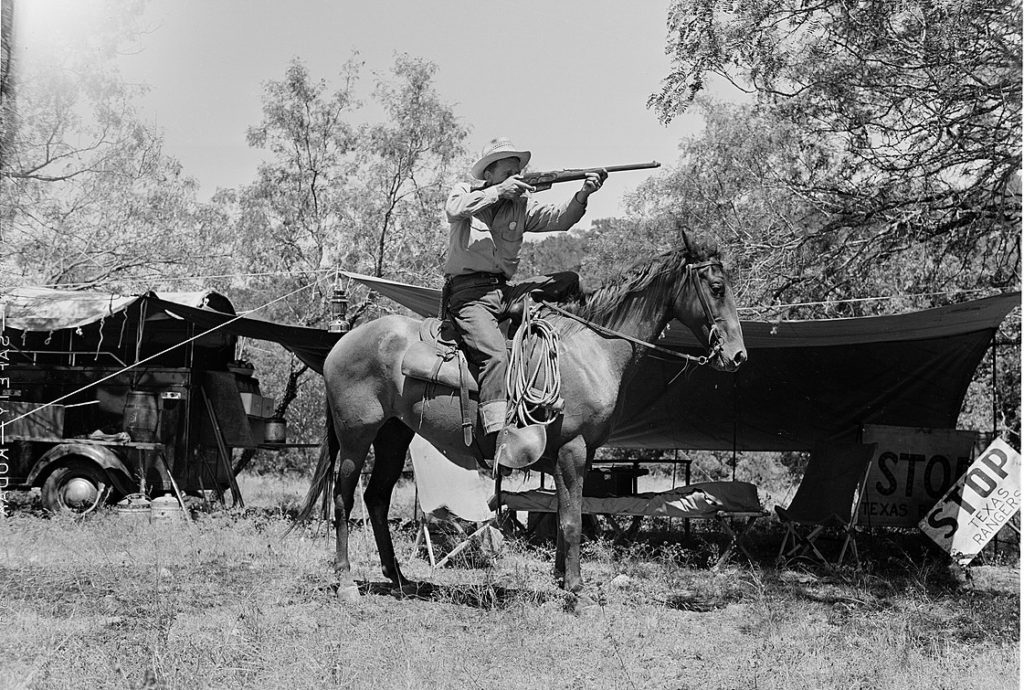
A Texas Ranger. Image courtesy of Texas Department of Public Safety photograph collection.

Historical Texas Rangers Badges

The newly formed Republic of Texas could hardly afford to pay the frontier force – in fact, the Rangers didn’t even have uniforms. Also, the Rangers didn’t necessarily want to be identified. Their ability to blend into the populace were a valuable one in an out-manned scenario. Not to mention that a badge would be of little consequence to the bandits. 

The earliest surviving Texas Ranger badge that we can track to this day belonged to Ira Aten. It’s believed that the badge was created by a local silversmith – or Aten himself. The starting point for this badge was a Mexican Ocho Peso coin. Aten’s badge was not the first badge made. In 1875 Ranger Leander McNelly had been gifted one from local ranchers – but unfortunately it hasn’t survived. 

Why a star for the Rangers? In 1836, when George Childress signed the Texas Declaration of Independence, he introduced a resolution at the general convention that “a single star of five points” be recognized as the emblem of the new republic. He also requested that all army and members of this convention, as well as any friends of Texas, wore it on their hats or bosoms.

Official Texas Rangers Badges 1935-1962

Find Texas Rangers Badges Online

Right Now on eBay 
Clicking a link to eBay may result in a referral commission being paid if a purchase is made.
Loading...

The WW1 Royal Tank Corps Cap Badge

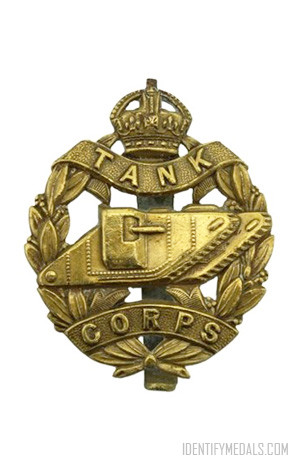
The Royal Tank Corps Cap Badge is a First World War brass King’s crown cap badge for members of the Tank Corps.

The Royal Tank Corps Cap Badge is a First World War brass King’s crown cap badge for members of the Tank Corps.

The Royal Tank Regiment (RTR) is a division of the British Army specializing in armored warfare. Previously referred to as the Tank Corps and the Royal Tank Corps, it operates under the Royal Armoured Corps. On July 5, 2012, plans were announced to merge the operational regiments—1st Royal Tank Regiment (1RTR) and 2nd Royal Tank Regiment (2RTR)—into a unified regiment named The Royal Tank Regiment, effective 2014.

Tanks made their debut at the Battle of Flers-Courcelette in September 1916, part of the larger Battle of the Somme in World War I. During this period, the six tank companies were organized under the Heavy Section of the Machine Gun Corps (MGC).

The Royal Tank Corps Cap Badge Design

The cap badge measures 48 millimeters by 40 millimeters and is stuck in brass. The obverse features a Mark I tank and the words “Tank” and “Corps”. The reverse has a slider.

The Royal Tank Regiment Cap Badge

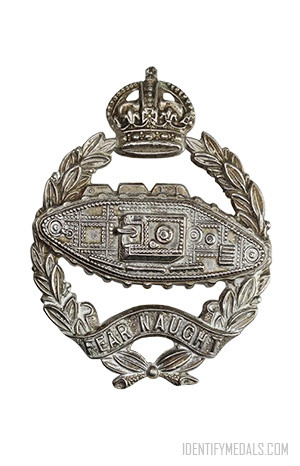
The Royal Tank Regiment Cap Badge is a WW2 badge given to members of the Royal Tank Regiment (previously known as Tank Corps).

The Royal Tank Regiment Cap Badge is a WW2 badge given to members of the Royal Tank Regiment (previously known as Tank Corps).

The badge is struck in white metal and depicts a WW1 tank in the center, surrounded by a laurel wreath and surmounted by a King George V crown. Under the tank is the inscription “Fear Naught”.

The badge measures 3.5 centimeters by 4.5 centimeters.

The Tank Corps and Royal Tank Regiment: Their Medals and History WW1, WW2

The Tank Corps was created in 1917 from the Heavy Branch Machine Gun Corps. Learn more about the Royal Tank Regiment and their medals.

The Tank Corps was created in 1917 from the Heavy Branch Machine Gun Corps and received its “Royal” prefix in 1923. In 1939 it became the Royal Tank Regiment. In this article we will go through the history of the Tank Corps, their participation during The Great War and thr Second World War, and the medals that their members were awarded. 

The Formation of the Tank Corps

The birth of the Royal Tank Regiment is directly linked to the invention of the tank itself. Tanks were used for the first time during the Battle of Flers-Courcelette (the Somme) in September 1916. Six companies constituted then the Heavy Section of the Machine Gun Corps (MGC). By November 2016, this number had increased to eight – each company expanded to form battalions named A to H, and by January 1918 seven more had been created (using the letters I to O, although it soon changed into numbered units).

In July 1917, the Heavy Branch was separated to form the Tank Corps. By December 1918, 25 battalions were equipped with tanks. 

The Tank Corps First Commander: Hugh Elles

The first commander of the Tank Corps was Hugh Elles. Born in India in 1880, Huge Jamieson Elles was the younger son of Sir Edmon Alles, a British Army officer who had served in Egypt and India. 

On the outbreak of WW1, Hugh Elles was posted to the 4th Division and sent to France. He served at Le Cateau, the Retreat to the Seine and the Battle of the Aisne. As part of the British Expeditionary Force, he took part in the Battle of Armentières. After being wounded during the 10th Brigade’s counterattack, on 25 April 1915, he was especially selected by General Sir William Robertson to liaise with troops at the front.

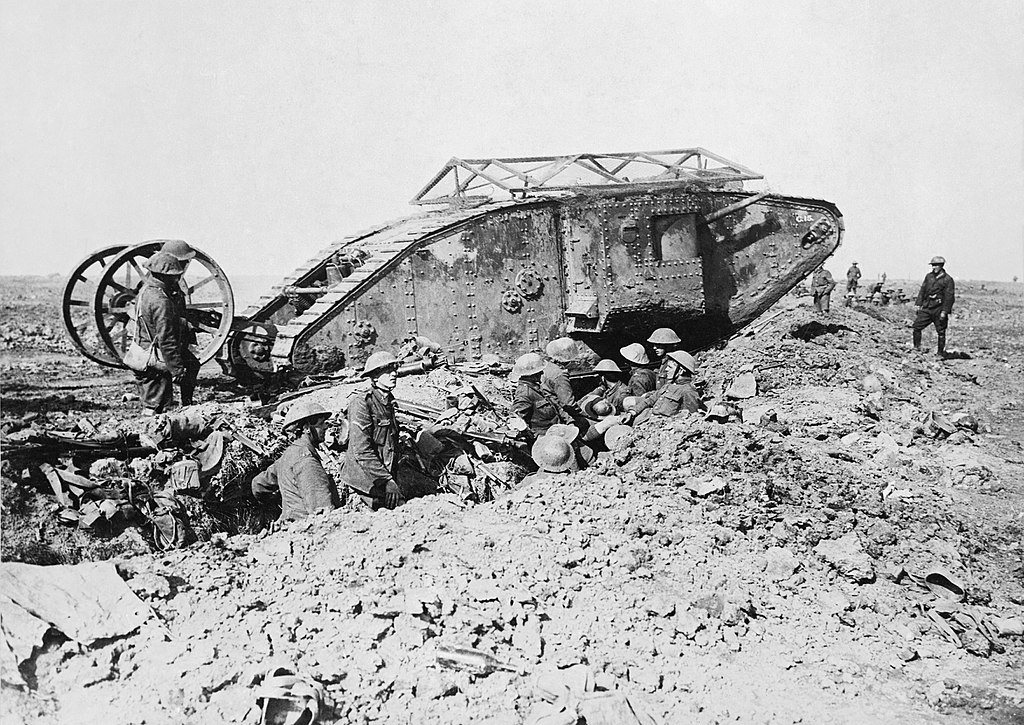
An early model British Mark I "male" tank, named C-15, near Thiepval, 25 September 1916.
An early model British Mark I "male" tank, named C-15, near Thiepval, 25 September 1916. Image courtesy of Wikipedia.

In January 1916, Elles was sent to investigate the first tanks that were being built in England. He was present during the first trials of “Mother”, a prototype tank with a mounted 6-pounder cannon and a Hotchkiss machine gun at each side. 

Elles reported the success of the prototype back to Haig, and in the summer of 1916 he was tasked to inform from the Somme – the place where the tank was first used. Elles was promoted to the temporary rank of Colonel and appointed the head of the Heavy Branch of the Machine Gun Corps, the first tank unit. 

Because the exceptionally wet ground conditions during the Battle of Passchendaele, Elles suggested to Haig they used the massed tanks at Cambrai. On 20 November 1917, Elles personally led 350 tanks in a Mark IV tank called “Hilda”.

Tanks in Action: The Battle of Cambrai and the Great War

The first tanks (or armored vehicles) had been created in the autumn of 1914, with the first experimental machine completed in December 1915. The “Mechanical Warfare Supply Department” of the Ministry of Munitions was in charge of supplying the machines. 

The first tanks, Mark 1, were built in two types: “Male” (carrying two Hotchkiss 6-pounder guns and 4 machine guns) and “Female” (carrying 5 machineguns). Turning was a especially complex maneuver, requiring these “caterpillars” to halt – and making them an easy target.

Men driving these first WW1 tanks (usually a Subaltern, 3 Drivers and 4 Gunners) would often become sick due to the heat, noise, and engine exhaust. The tanks would make violent movements and were also mechanically unreliable. However, they still managed to surprise and alarm the German army – which quickly began to develop their own. 

A significant improvement came with the Mark VIs, which had more armor, an external tank and carries fascines, or bundles of wood that could be dropped to bridge trenches and ditches. A lighter tank called Whippet came into service in early 1918. Although it lightly armored, it was an effective variant that had much better control mechanisms and required less crew. 

There are several notable stories of tanks sent in action ahead of the infantry. The tanks had one big advantage: They could draw enemy fire. Although some had to be ditched or broke down, the surprise of the tanks helped the attacks. 

Although several attempts were challenging due to mud and deep trenches and shell holes, on 20 November 1917, 378 Mark VI tanks smashed through the Hindenburg Line and created a temporary rupture that would have allowed a unique advantage (which, although wasn’t used, proved the strategic value of tanks).

The Tank Corps and Royal Tank Regiment
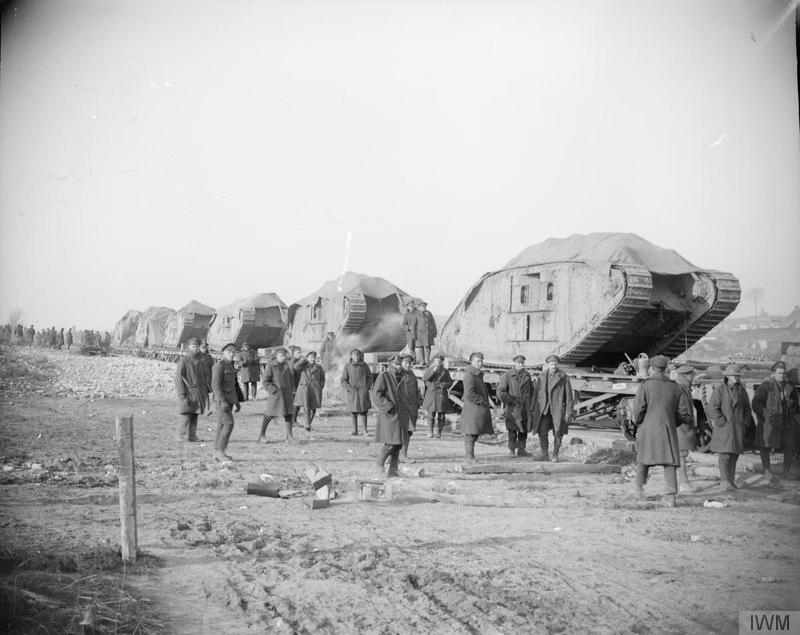
Tanks of the 2nd Brigade on railway trucks at the railhead returning from the Battle of Cambrai on 6 December 1917. Image courtesy of Wikimedia Commons.

The Second World War and the Royal Tank Regiment

On April 1939, the Royal Tank Corps was renamed to the Royal Tank Regiment. At the outbreak of war, the regiment had 20 battalions (8 regular and 12 territorial). There were also four “hostilities only” battalions (9th, 10th1, 1th and 12th).

Numerous tanks took place in the battles of World War II. They were present during the  Battle of DunkirkEl AlameinItalian Campaign, Burma Campaign and D-Day landings.

Medals and Badges of the Tank Corps and Royal Tank Regiment

There are two awards linked to the Tank Corps. These are the WW1 Royal Tank Corps cap badge, and the Royal Tank Regiment cap badge. You can click on the images below to find out more about the two.

The Civil Merit Medal (Austria-Hungary)

The Civil Merit Medal (Austria-Hungary) is a medal established by Emperor Karl I in 1918 to recognize extraordinary service in war or peace.

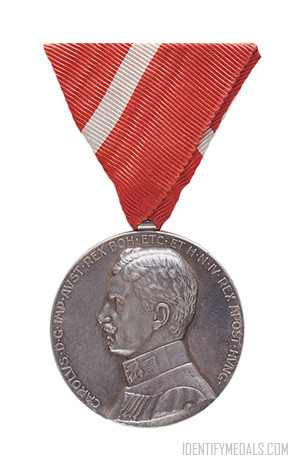
The Civil Merit Medal is an Austro-Hungarian medal established by Emperor Karl I in 1918 to recognize extraordinary service in time of war or outstanding service in peace time by civil servants of all ranks or other civilians in support of the empire or the emperor. The medal could be awarded retroactively.

There are two classes of this award:

  • Gold Civil Merit Medal
  • Silver Civil Merit Medal

The Civil Merit Medal Design

The medal is round with an attached wedge shaped suspension eye. It measures 42 mm in diameter and is struck in silver gilt bronze and gold gilt bronze.

The obverse features the image of Emperor Karl in a Field Marshal’s uniform with decorations facing to the viewers left. Surrounding the image is the inscription: “CAROLVS D G IMP AVST RX BOH ETC ET H N IV APOST HVNG”. The reverse is a laurel on the left and an oak bough on the right within which is the inscription “SIGNVM LAVDIS” (“A token of esteem”) in two lines.

The ribbon is red with a white center stripe and measures 38-40 mm wide.