The South Atlantic Medal

The South Atlantic Medal is a British campaign medal awarded to civilians and military personnel for service in the Falklands War of 1982.

The South Atlantic Medal is a British campaign medal awarded to British civilians as well as military personnel for service in the Falklands War of 1982. Over 33,000 medals have been awarded. The South Atlantic Medal Association was formed in 1997 for recipients of the South Atlantic Medal.

Initially, about 29,700 people were awarded the South Atlantic medal, including Prince Andrew. Civil servants serving in Accession Island, NAAFI staff, war artist Linda Kitson and journalists attached to the armed forces, including Michael Nicholson, have also received this medal.

Since 2014 an additional 3,626 South Atlantic medals have been awarded without rosette, in response to the extension of the qualifying period to 21 October 1982.

The South Atlantic Medal Design

The South Atlantic Medal is made of cupronickel, and measures 36 mm in diameter. It was struck by the Royal Mint and issued by the Army Medal Office, Droitwich. The design, attributed to HM the Queen, was based on the ribbon for the 1939-45 Atlantic Star.

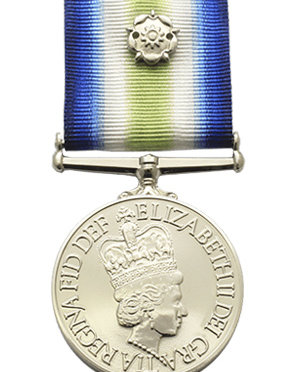
The obverse shows a crowned effigy of The Queen facing right, with the inscription ELIZABETH II DEI GRATIA REGINA FID:DEF (“Elizabeth II, by the grace of God, Queen and Defender of the Faith”). The reverse displays the Falkland Islands’ coat of arms, bearing the words “DESIRE THE RIGHT” (an allusion to English explorer John Davis’ ship, “Desire”). The border is made up of a laurel wreath below and the words “SOUTH ATLANTIC MEDAL” above.

The initials and surname, rank or rating, service number and unit of the recipient are diamond engraved on the edge of the medal, but the Royal Navy officers (as was the tradition) don’t include the service number.

The 32 mm ribbon has a central stripe of “sea green” flanked on each side by stripes of white and “empire blue” symbolizing the Atlantic Ocean.

Find This Medal

Right Now on eBay 
Clicking a link to eBay may result in a referral commission being paid if a purchase is made.
Loading...

The General Service Medal (1962)

The General Service Medal 1962 (or 1962 GSM) is a campaign medal of the United Kingdom awarded for what were often arduous campaigns.

The General Service Medal 1962 (or 1962 GSM) is a campaign medal of the United Kingdom awarded for what were often arduous campaigns and well fought operations and introduced in 1962 to combine the General Service Medal (1918), which was awarded to the Army and RAF, and the Naval General Service Medal (1915). The 1962 General Service Medal was awarded until 2007.

The General Service Medal 1962 Design

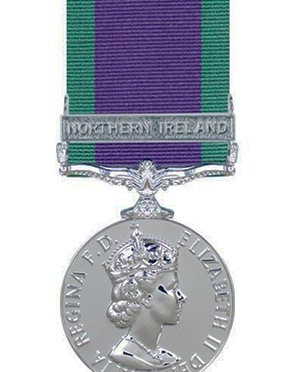
The 1962 GSM is a circular silver medal measuring 36 mm in diameter. The obverse bears the crowned effigy of Queen Elizabeth II with the inscription ELIZABETH II DEI GRATIA REGINA F.D. The reverse shows the words ‘FOR CAMPAIGN SERVICE‘ under a crown, all surrounded by a wreath of oak leaves. The name, rank, service number and regiment or corps of the awardee are annotated on the rim of the medal.

The ribbon is 32 mm wide, purple with two outer stripes of dark green. In different proportions, these are the same colours as the GSM 1918–62.

Those mentioned in despatches during a campaign qualifying for the 1962 GSM wear a bronze oak leaf on the medal ribbon.

Fourteen clasps were awarded, and the medal always had one of them. The maximum appears to have been six, which were worn in the order that the recipient qualified for them and not the date of the relevant Army Order. There was no minimum qualifying period for each clasp for those killed, wounded or disabled during operations.

The clasps were: Cyprus 1963-64, Borneo, Radfan, South Arabia, Malay Peninsula, South Vietnam, Northern Ireland, Dhofar, Lebanon, Gulf of Suez, Gulf, Kuwait, North Irak and Turkey and Air Operations Irak.

Find This Medal

Right Now on eBay 
Clicking a link to eBay may result in a referral commission being paid if a purchase is made.
Loading...

The Korea Medal

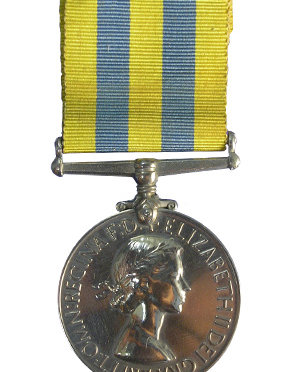
The Korea Medal (or Médaille de Corée in French), also known as the Queen’s Korea Medal, was a campaign medal created in 1951 to recognize troops from Australia, Canada, New Zealand, and the United Kingdom who had given 28 days service offshore during the Korean War, or at least one day’s service in an air sortie over Korea.

The Korean War was the first event in which United Nations (UN) armed forces took on a combat role in a multinational effort to stop the North Korean takeover of the Republic of Korea. It involved the participation of 20 UN member states, the Republic of Korea and Italy.

Except for Canada, the medal was identical in all countries where it was awarded, and holds a different place in each country’s order of precedence for honors.

The Korean War Medal Design

Designed by Edward Carter Preston, a Liverpool artist, sculptor and medallist, the Korea Medal measures 36 millimetres (1.4 in) and is a disc. All medals were made of cupro-nickel, except for the Canadian version that was made of silver.

On the Korean War medal obverse is an effigy of Queen Elizabeth II, surrounded by an inscription that symbolizes her roles as both fount of honour and Commander-in-Chief of her various forces. At the time of the medal’s creation, King George VI was monarch. However, he died on 6 February 1952 and so the image of his daughter was placed on the obverse of the medal, uncrowned.

There are three versions of the inscription surrounding the Queen’s head:

  • ELIZABETH II DEI GRA. BRITT. OMN. REGINA F.D. (Elizabeth II, by the Grace of God Queen of all the Britons, Defender of the Faith).
  • ELIZABETH II DEI GRATIA REGINA F.D. (Elizabeth II, by the Grace of God Queen, Defender of the Faith), later awards omitting BRITT. OMN..
  • ELIZABETH II DEI GRATIA REGINA CANADA (Elizabeth II, by the Grace of God Queen of Canada), awarded to Canadian participants.

On the reverse is a depiction of Hercules wrestling the Hydra—a symbolic representation of communism—with the word KOREA below.

The recipient’s name, rank and regimental number is impressed on the medal’s rim.

The German Cross (Post-WW2 Version)

The German Cross (or Deutsches Kreuz in German) was instituted by Adolf Hitler on 28 September 1941 and awarded in gold and silver.

The German Cross (also known as The War Order of the German Cross, or Der Kriegsorden Deutsches Kreuz in German) was instituted by Adolf Hitler on 28 September 1941 and awarded in gold and silver, depending on the division.

The German Cross in Gold (ranked higher than the Iron Cross First Class but below the Knight’s Cross of the Iron Cross) was awarded for repeated acts of bravery or achievement in combat. The German Cross in Silver, on the other hand (which ranked higher than the War Merit Cross First Class with Swords but below the Knight’s Cross of the War Merit Cross with Swords) was awarded for distinguished non-combat war service.

The German Cross Eligibility

In order to qualify for the German Cross, the recipient had to be a holder of the Iron Cross or the War Merit Cross.

Civilians were not eligible for this medal, although awards could be made to specific members of uniformed formations, such as railway workers or the police. In 1942, eligibility for the German Cross in Gold was also extended to the armed forces of allied countries.

The German Cross Design

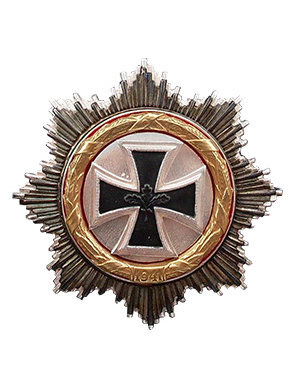
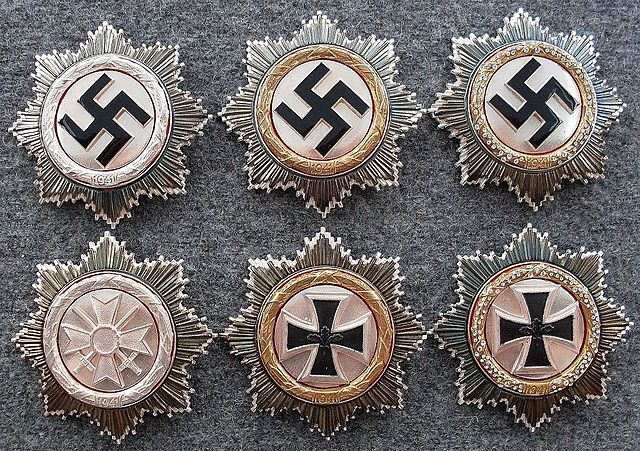
The original order consisted of a star badge with a swastika (in German a Hakenkreuz or “hooked cross”, hence the medal’s name). In 1957, however, alternative de-nazified replacement versions of the German Cross were authorized for wear by the Federal Republic of Germany. These medals replaced the swastika with a representation of the Iron Cross for the gold division, and the War Merit Cross with Swords for the silver division.

The German Cross has a diameter of 6.5 cm and was worn on the right-hand side of the tunic. If a recipient had been awarded both the silver and gold divisions, the gold division should be worn only.

German Cross in Silver, Gold, and with Diamonds. Post-war denazified versions shown below.

Find a German Cross 

Right Now on eBay 
Clicking a link to eBay may result in a referral commission being paid if a purchase is made.
Loading...

The Order of Merit of the Federal Republic of Germany

The Order of Merit of the Federal Republic of Germany was created by the first President of the Federal Republic of Germany in 1951.

The Order of Merit of the Federal Republic of Germany (or Verdienstorden der Bundesrepublik Deutschland ni German) was created by the first President of the Federal Republic of Germany, Theodor Heuss, on 7 September 1951, and has been awarded to over 200,000 individuals in total, both Germans and foreigners. It’s the only federal decoration of Germany.

The creation decree, which was co-signed by the President Heuss and Chancellor Konrad Adenauer as well as the Minister of the Interior, Robert Lehr, signed, states: “Desiring to visibly express recognition and gratitude to deserving men and women of the German people and of foreign countries, on the second Anniversary of the Federal Republic of Germany, I establish the Order of Merit of the Federal Republic of Germany. It is awarded for achievements that served the rebuilding of the country in the fields of political, socio-economic and intellectual activity, and is intended to mean an award of all those whose work contributes to the peaceful rise of the Federal Republic of Germany.”

The Order of Merit of the Federal Republic of Germany Design

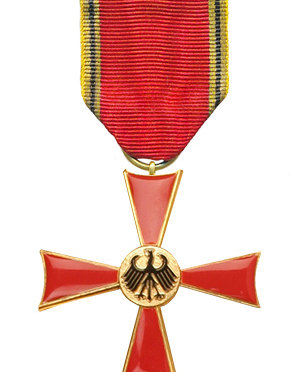
Except for the lowest class, the badge is the same for all classes, with slightly different versions for men and women (the badge and ribbon are smaller for women): The badge’s obverse is a golden cross enameled in red, with a central disc bearing a black eagle. The star is a golden star with straight rays, its size and points vary according to class, with the badge superimposed upon it.

The National Order of Merit (France)

The National Order of Merit (or Ordre national du Mérite in French) is an order of merit with membership established to replace the large number of ministerial orders previously awarded by the ministries and to create an award that can be given at a lower level than the Legion of Honour, which is generally reserved for French citizens.

The National Order of Merit was awarded by the President of the French Republic, founded on 3 December 1963 by President Charles de Gaulle. It comprises about 187,000 members worldwide. The President of the French Republic is the Grand Master of the order and appoints all its members by convention on the advice of the Government of France.

The order has a common Chancellor and Chancery with the Legion of Honour. Every Prime Minister of France is made a Grand cross of the order after 24 months of service.

The National Order of Merit Design

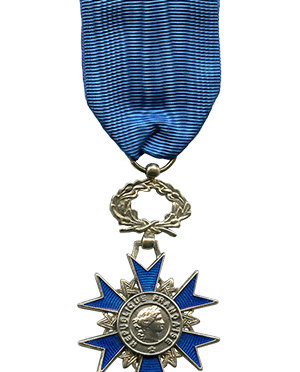
The medal of the order is a six-armed Maltese asterisk in gilt enamelled blue, with laurel leaves between the arms.

The obverse central disc of the National Order of Merit medal features the head of Marianne, surrounded by the legend République française (French Republic). The reverse central disc has a set of crossed tricolores, surrounded by the name of the order and its foundation date. The badge is suspended by a laurel wreath.

The Order has five classes:

  • Three ranks:
    • Knight (Chevalier): to be of a minimum age of 35, minimum of 10 years of public service and “distinguished merits”;
    • Officer (Officier): minimum of 5 years in the rank of Knight;
    • Commander (Commandeur): minimum of 5 years in the rank of Officer;
  • Two dignities:
    • Grand Officer (Grand Officier): minimum 3 years in the rank of Commander; and
    • Grand Cross (Grand-Croix): minimum 3 years in the rank of Grand Officer.

The Medal of Aeronautic Valor (Post WW2)

The Medal of Aeronautic Valor is a medal awarded for acts and enterprises of singular courage and skill aboard an aircraft in flight.

The Medal of Aeronautic Valor (or Medaglia al valore aeronautico in Italian) is a medal awarded “for acts and enterprises of singular courage and skill aboard an aircraft in flight.

Proposals for a medal awarded to aviators had begun as early as 1913 but were put on hold with the outbreak of World War I. The medal was finally instituted by Victor Emmanuel III of Italy‘s decree of 27 November 1927. The criteria for conferral remained virtually unchanged until 1939, when a decree restricted its award solely to members of the Italian military. In 2010, the medal was absorbed into the Italian Military Code. The principal change was the restoration of eligibility to civilians.

Prior to the outbreak of World War II, the recipients were primarily those who had distinguished themselves in air races or had set speed and distance records. However, the medal was also awarded for participation in daring air rescues.

The Medal of Aeronautic Valor Design

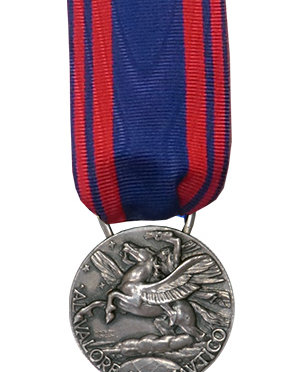
From 1927 to 1945 the Obverse of the medal shows a winged horse surrounded by the words “Al Valore Aeronautico”.

The Reverse shows two oak branches with the name of the recipient and the place and date of the award engraved between them.