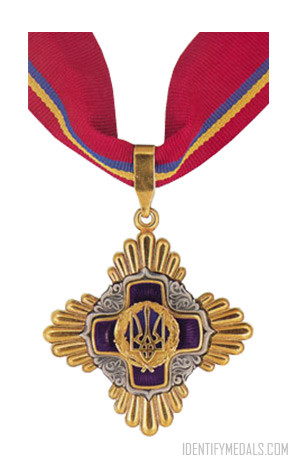
The Order of the Heavenly Hundred Heroes

The Order of the Heavenly Hundred Heroes (Орден Героїв Небесної Сотні) is awarded for civil courage, patriotism and the defense of democracy.

  • Time Period: Post-WW2
  • Year of Institution: 22 September 1996
  • Country: Ukraine

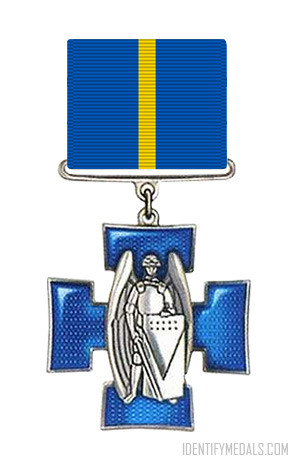
The Order of the Heavenly Hundred Heroes (Орден Героїв Небесної Сотні) is awarded for civil courage, constitutional principles of democracy, human rights and freedom; humanitarian, social and charitable activities; selfless service to the Ukrainian people and any events related to the protection of the independence, sovereignty and territorial integrity of Ukraine.

The name “Heaven’s Hundred” refers to the participants killed during Euromaidan, a wave of demonstrations and civil unrest in Ukraine, which began on 21 November 2013 with large protests in Maidan Nezalezhnosti (Independence Square) in Kyiv. 

Order of the Heavenly Hundred Heroes Design

A nationwide contest for the best design of the Order of Heroes hundreds of Heaven was won by Taras Wozniak and Konstantina Kovalyshyn from Lviv.
The Order of Bohdan Khmelnytsky

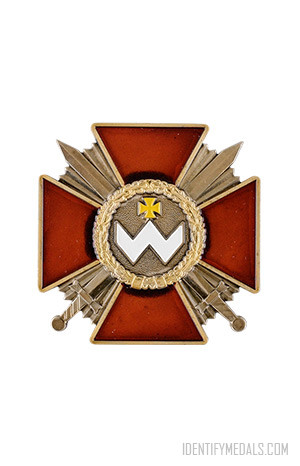
The Order of Bohdan Khmelnytsky (Орден Богдана Хмельницького) was established in 1995 to commemorate the 50th anniversary of the end of the Second World War in Europe. It’s named after Bohdan Khmelnytsky, Hetman of the Ukrainian Cossacks (a group of predominantly East Slavic Orthodox Christian people who became known as members of democratic, self-governing, semi-military communities).

The Order of Merit (Ukraine)

The Order of Merit (Орден За заслуги) is given to individuals for outstanding achievements in economics, science, culture, and politics.

  • Time Period: Post-WW2
  • Year of Institution: 22 September 1996
  • Country: Ukraine

The Order of Merit (Орден «За заслуги») is given to individuals for outstanding achievements in economics, science, culture, military or political spheres of activity. The Order was first established by Ukrainian president Leonid Kuchma on August 18, 1992. On September 22, 1996, it was transformed into three classes of the Order of Merit.

There are 3 grades to the Order, the highest being the first grade honors. Those who are awarded the Order of Merit have the official title Chevalier of the Order of Merit. The order can be granted posthumously.

The Order of Merit Design

Awards to serving members of the armed forces bear crossed swords.

The Order of Liberty (Ukraine)

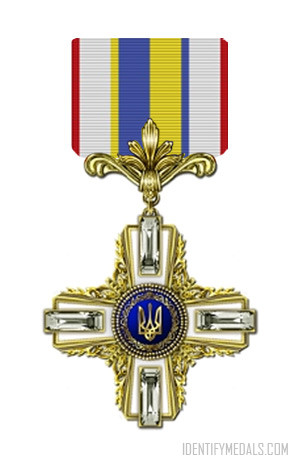
The Order of Liberty (орден Свободи) was instituted on April 10, 2008 to honour merits of citizens for strengthening the Sovereignty and Independence of Ukraine, as well as for consolidating Ukrainian society, developing Democracy, advancing socio-economic and political reforms, and advocating the Constitutional Rights and Liberties of Man and Citizen.

The Order was instituted by President Yushchenko by decree № 1177/2005. It can be given to citizens of Ukraine, foreigners and stateless persons may be awarded the Order of Freedom.

Awarding the Order of Freedom may be carried out posthumously. Those awarded the Order of Freedom are called a Knight of the Order of Freedom.

The Order of Liberty Medal Design

 The Commission on State Awards and Heraldry was instructed to hold an all-Ukrainian competition to develop designs for the Order of Freedom. On May 20, 2008, Decree of the President of Ukraine Viktor Yushchenko № 460/2008 approved the Statute of the Order, which includes a description of the Order’s badge.

The sign of the Order of Freedom is made of gilded silver and has the shape of an equilateral cross with diverging sides. The sides are covered with white enamel and decorated with four rectangular Swarovski crystals. In the centre of the cross is a round blue enamel medallion with a gold image of the Sign of the Princely State of Vladimir the Great framed by a laurel wreath. The sides of the corners of the cross are framed by stylized floral ornaments. The reverse side of the sign of the order is flat with the engraved number of the sign.

The ribbon is white silk moire with longitudinal stripes – in the middle of wide blue and yellow, bordered on the edges by narrow stripes of yellow and blue, respectively, and on the edges of the ribbon by narrow strips of orange. 

A person awarded the Order of Freedom is awarded a badge of the order and an order book of the established pattern.

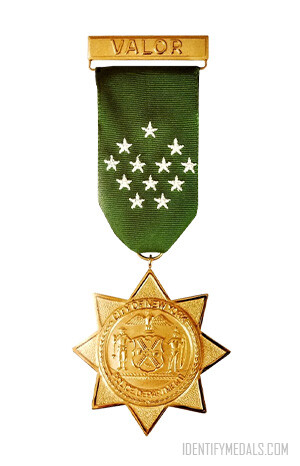
The New York City Police Department Combat Cross

The New York City Police Department Combat Cross is the second highest departmental award of the NYPD and awarded for heroism.

The New York City Police Department Combat Cross is the second highest departmental award of the NYPD. It was established in 14 Augusta, 1934, and awarded to police officers who, “having received Honorable Mention awards, successfully and intelligently perform an act of extraordinary heroism while engaged in personal combat with an armed adversary under circumstances of imminent personal hazard to life”.

The Police Combat Cross was first awarded July 19, 1934, to six members of the police department for heroic service in the previous year. More than two hundred members of the New York Police Department have been awarded the Police Combat Cross.

The New York City Police Department Combat Cross Design

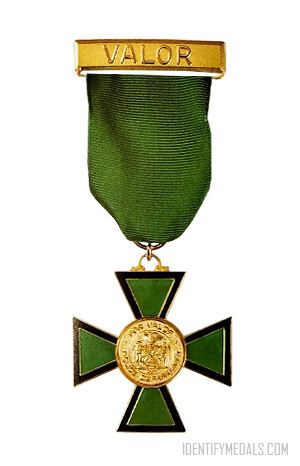
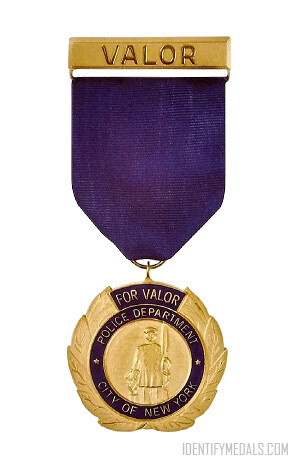
The medal is a gold Maltese Cross with the seal of New York City set in the center obverse and surrounded by the inscription, “For Valor, Police“. The name of the holder and the year of awarding are engraved on the reverse.

The cross is suspended by a ring from green silk ribbon. If the Combat Cross is awarded a second time, a gold palm leaf is set in the center of the ribbon.

More New York City Police Department Medals

NYPD medals are awards presented by the New York City Police Department to recognize and honor the bravery, service, and exceptional achievements of its officers. These medals serve as symbols of honor and pride within the NYPD, highlighting the commitment and sacrifice of its members in safeguarding the communities they serve. 

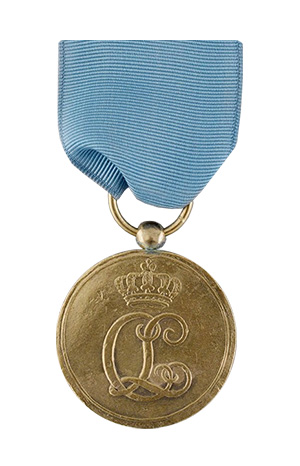
The Long Service Decoration (Bourbon-Parma Lucca)

The Long Service Decoration (Bourbon-Parma Lucca) is a medal instituted in 1833 and awarded to NCO’s and Enlisted Men for ten years’ service.

The Long Service Decoration (or Decorazioni di servizio per gli ufficiali e sottufficiali in Italian, also Medaglia di Anzianitá) is a medal instituted in 1833 and awarded to NCO’s and Enlisted Men who had served at least ten (round medal) or thirty years (cross).

The medal was created during the period of the House of Bourbon-Parma, a cadet branch of the Spanish royal family. Their members once ruled as Duke of Parma and Piacenza, Guastalla, and Lucca.

The Long Service Decoration Design

The medal is round, struck in bronze gilt and measures 33 mm (wide) x 37.7 mm (hight) inclusive of its laterally-pierced ball suspension.

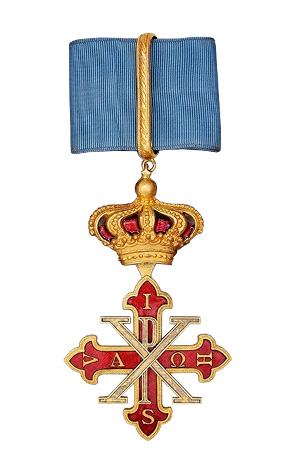
The Constantinian Order of St. George (Parma)

The Constantinian Order of St. George, or Order of St. Angelus / Order of the Golden Chevaliers is a dynastic order of knighthood.

The Sacred Military Constantinian Order of Saint George, also known as the Imperial Constantinian Order of Saint George and the Order of the Constantinian Angelic Knights of Saint George, is a dynastic order of knighthood of the House of Bourbon-Two Sicilies.

The order is allegedly founded in its original form by Constantine the Great and restored under later Byzantine emperors. However, the actual origin of the order can be traced to the 16th century, when it was founded by an Albanian family by the name Angelo Flavio Comneno. Chivalric orders were completely unknown in the Byzantine world, so it’s believed the story of the links between the Comneno family and their claim to be connected to the Byzantine Komnenos and Angelos dynasties was invented much later.

The Order is best recognized for its Parma iteration. Duke Francesco Farnese of Parma made several amendments to the Order statutes in 1705. These changes were  recognized by Pope Clement XI in 1706 and finalized as a dynastic Order of the Duchy of Parma by a Papul Bull in 1718. In 1731, the Order became a dynastic Order of the Kingdom of the Two Sicilies. When Marie Louise ascended to the throne of the Duchy of Parma, Piacenza and Guastalla she restored it as a dynastic Order of the Duchy of Parma, resulting in the creation of two Order branches.

The motto of the Order is “In hoc signo vinces,” or “In this sign you will conquer.

The Constantinian Order of Saint George Design

There are several insignia for this order. The medal is a bronze, silver, or gold cross with a collar, sash or ribbon. 

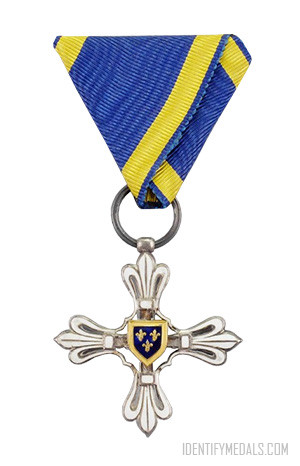
The Civil Merit Order Of St. Louis (Parma)

The Civil Merit Order Of St. Louis is an order of the Duchy of Parma (today Italy). The Order was established in c. 1860.

The Civil Merit Order Of St. Louis is an order of the Duchy of Parma (today Italy) awarded for extraordinary merit within civil services. It has five grades and the Grand Master of the Order was always the Duke of Parma

The Order of St. Louis was initially founded in the Duchy of Lucca in 1836 by Charles Louise (also known as Charles II). His son, Charles III Duke of Parma, revived the Order at Parma, on August 11, 1849, as an award of merit. Membership to the Order was primarily restricted to noble Catholics. When a non-noble became the recipient of the Grand Cross or Commander grades they were bestowed with hereditary nobility.

The Order of St. Louis Design

The insignia for this order is a silver 4 multifaceted armed star, measuring 45 mm (w) x 46.8 mm, with a central gold crest on both the obverse and the reverse. The medal also has finely detailed red, blue, white enameled centers. The suspension is a French style ring with right facing eagles head.

The Vayu Sena Medal

The Vayu Sena Medal is a gallantry award for servicemen in the Indian Air Force. It was instituted in 1960 and usually awarded in peacetime.

  • Time Period: Post-WW2
  • Institution: 17 June 1960
  • Country: India

The Vayu Sena Medal is a gallantry award for servicemen in the Indian Air Force. It was instituted on 17 June 1960 by the President of India and is usually awarded in peacetime. However, it has been granted during times of conflict for acts of gallantry in the face of enemy (although not as many times as the Vir Chakra Decoration).

It is possible to receive the Vayu Sena Medal posthumously. 

The Vayu Sena Medal Design

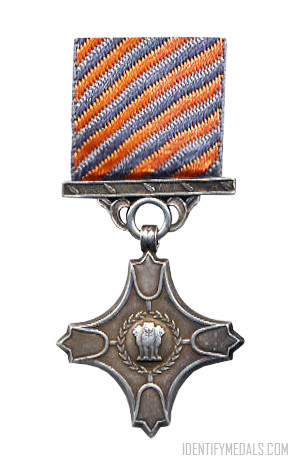
The medal is a four-armed silver star with the ends shaped like lotus flower blooms. 

The obverse bears the national emblem of India. The reverse shows a Himalayan Eagle with wings spread, and the legend, above and below, in Hindi “Vayu Sena Medal” or “Air Force Medal“. 

The ribbon measure 30 mm wide and alternates 2mm diagonal stripes in grey and orange-saffron. 

The Civil Merit Medal (Austria-Hungary)

The Civil Merit Medal (Austria-Hungary) is a medal established by Emperor Karl I in 1918 to recognize extraordinary service in war or peace.

The Civil Merit Medal is an Austro-Hungarian medal established by Emperor Karl I in 1918 to recognize extraordinary service in time of war or outstanding service in peace time by civil servants of all ranks or other civilians in support of the empire or the emperor. The medal could be awarded retroactively.

There are two classes of this award:

  • Gold Civil Merit Medal
  • Silver Civil Merit Medal

The Civil Merit Medal Design

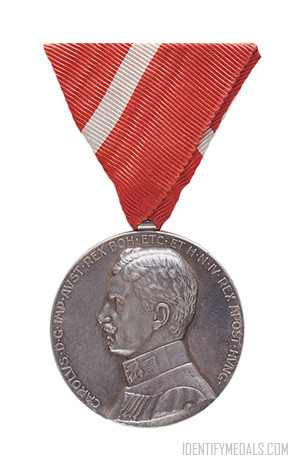
The medal is round with an attached wedge shaped suspension eye. It measures 42 mm in diameter and is struck in silver gilt bronze and gold gilt bronze.

The obverse features the image of Emperor Karl in a Field Marshal’s uniform with decorations facing to the viewers left. Surrounding the image is the inscription: “CAROLVS D G IMP AVST RX BOH ETC ET H N IV APOST HVNG”. The reverse is a laurel on the left and an oak bough on the right within which is the inscription “SIGNVM LAVDIS” (“A token of esteem”) in two lines.

The ribbon is red with a white center stripe and measures 38-40 mm wide.