The Karl Troop Cross

The Karl Troop Cross is a medal of Austria-Hungary created on 13 December 1916 and awarded for service up to the end of the First World War.

The Karl Troop Cross (or Karl-Truppenkreuz in German) is an Austro-Hungarian medal instituted on 13 December 1916 by Emperor Karl I.

The medal was awarded for service up to the end of the First World War to soldiers and sailors of all arms of the Austro-Hungarian armed forces, regardless of rank, who had been with a combatant unit for at least twelve weeks and who had participated in at least one battle. Members of the air service who made ten flights over enemy lines were also eligible.

The Karl Troop Cross Design

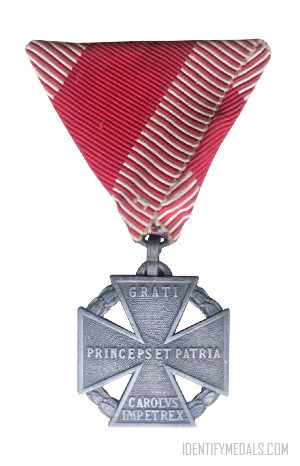
The medal is cross pattée resting on a laurel wreath made of zinc.

The obverse shows the Latin inscription “GRATI PRINCEPS ET PATRIA, CAROLVS IMP.ET REX“, (A grateful prince and country, Karl, Emperor and King). The reverse bears the Austrian Imperial and Hungarian Royal crowns above the letter “C” (for Carolus) with the inscription “VITAM ET SANGVINEM“, (“With life and blood“) and the date MDCCCCXVI, (1916).

The cross was worn on the left chest from a red ribbon with alternate red-white side strips towards each edge.
The National Order of Quebec

  • Time PeriodPost-WW2
  • Institution: 26 June 1902
  • Country: Commonwealth Realms, Canada

The National Order of Quebec (l’Ordre national du Québec in French) is a civilian honor for merit in the Canadian province of Quebec. It was instituted in 1984 and administered by the Governor-in-Council to current or former Quebec residents for conspicuous achievements in any field. The Order is the highest honor in Quebec.

The order contains three grades, each with accordant post-nominal letters:

  • Grand Officer (grand officier/grande officières) (GOQ)
  • Officer (officier/officières) (OQ)
  • Knight (chevalier/chevalière) (CQ)

The National Order of Quebec Design

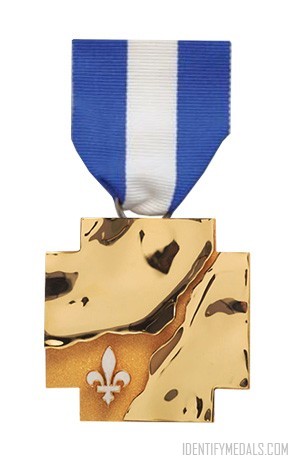
Members are presented with various insignia of the organization: a medallion, miniature, and button. They were all designed by Madeleine Dansereau, who was inspired by the heraldic elements of the provincial flag (the colors blue and white for the ribbon and the fleur-de-lis).

The badge of a Grand Officer is two 18kt gold plates in the shape of a cross. They are formed by two 60 millimeters (2.4 in) by 40 millimeters (1.6 in) arms, symmetrically superimposed atop one another. The obverse is a high-polish, rusticated surface with a white enamel fleur-de-lis on the lower left corner. On the reverse is inscribed the order’s motto—Honneur au peuple du Québec (homage to the people of Quebec) and a serial number.

The badge for Officers is nearly identical but made of arms 50 millimeters (2.0 in) long by 25 millimeters (0.98 in) wide. Knights have a brushed silver medallion with a 40 millimeters (1.6 in) diameter. Each member also receives miniature versions of their insignia.

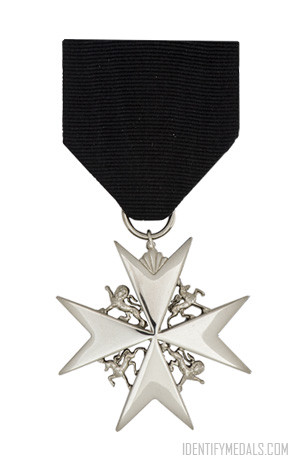
The Most Venerable Order of the Hospital of St. John of Jerusalem

The Most Venerable Order of the Hospital of St. John of Jerusalem is a working order of charitably minded men and women established in 1888.

The Most Venerable Order of the Hospital of St. John of Jerusalem, and also known as the Order of St John or St John International, is a British royal order of chivalry constituted in 1888 by Queen Victoria and dedicated to St John the Baptist, an itinerant preacher in the early 1st century AD.

The order can be tracked back to the Knights Hospitaller in the Middle Ages. The Knights Hospitalle were a medieval and early modern Catholic military order, later known as the Order of Malta. A faction moved to Britain in the early 1830s and became associated with the founding in 1882 of the St John Ophthalmic Hospital near the old city of Jerusalem and the St John Ambulance Brigade in 1887.

The Order of St John is also known for the health organizations it has founded, such as St John Ambulance and St John Eye Hospital Group. 

The Order of the Hospital of St. John of Jerusalem Design

The insignia of the Order is a Maltese cross, or eight-pointed cross in white enamel set in silver-colored metal. The cross is embellished in each of its main angles with lions and unicorns, with a lion in the top left and bottom right angles. 

The insignia of a Bailiff or Dame Grand Cross consists of a breast star and a sash badge. The insignia of a Knight or Dame of Justice or of Grace is a breast star and a neck badge. The insignia of a Commander is a neck badge, the Officer insignia is silver and enameled white, and he insignia of a Member is also worn on the left breast but is bright silver without enamel.

The badges have a ring attached to the top through which the ribbon passes. The ribbon for all grades is black watered.

The Order of Military Merit (Canada)

The Order of Military Merit (CMM) is a Canadian national order established in 1972 to recognize conspicuous merit and exceptional service.

The Order of Military Merit (Ordre du mérite militair in French) is a Canadian military honor for merit, the second highest order administered on behalf of the Canadian monarch. The Order was created in 1972 to replace a grouping within the Order of Canada and recognize members of the Canadian Forces who have demonstrated dedication and devotion beyond the call of duty, achieving conspicuous merit and exceptional military service. 

The Canadian monarch is the fount of honor and is thus at the apex of the Order of Military Merit as its sovereign. The governor general of Canada serves as the fellowship’s chancellor and the chief of the Defence Staff as the principal commander. There are no limits to the population of any grade, and promotions are possible although rare.

The Order has three grades:

  • Commander: For outstanding meritorious service and demonstrated leadership in duties of great responsibility. 
  • Officer: For outstanding meritorious service in duties of responsibility. 
  • Member: For exceptional service or performance of duty.

The Order of Military Merit Design

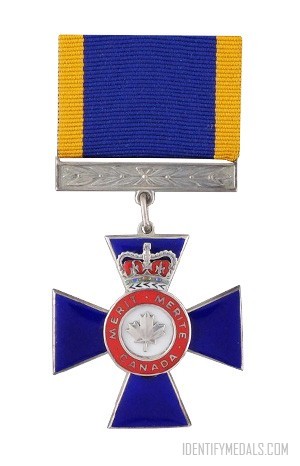
The badge of the order is a blue-enameled, straight-end cross pattée.

The insignia is edged in gold and bears, on the obverse, a red maple leaf in its center, on a white background, surrounded by an annulus enameled red which bears the inscription “MERIT-MERITE-CANADA” in gold. The annulus is surmounted by the Royal Crown enameled in full colors.

The reverse is plain with the exception of an inventory number. The Commander’s insignia has a small link at the top, to which is attached a larger ring, and the ribbon passes through this for wearing around the neck.

The ribbon of the Order is blue and measures 38 millimeters wide.

The Order of Merit (Canada)

The Order of Merit (OM) is a Canadian order bestowed as a personal gift of the Sovereign. The Order has a military and a civil division.

  • Time Period: Pre-WW1
  • Institution: 26 June 1902
  • Country: Commonwealth Realms, Canada

The Order of Merit (Ordre du Mérite in French) is an order for the Commonwealth realms that recognizes distinguished service in the armed forces, science, art, literature, or for the promotion of culture.

The Order was established in 1902 by King Edward VII (who ruled 22 January 1902 until his death in 1910) and admission into it remains the personal gift of its Sovereign. Edward VII founded the Order of Merit as a means to acknowledge “exceptionally meritorious service in Our Navy and Our Army, or who may have rendered exceptionally meritorious service towards the advancement of Art, Literature and Science“.

The order is restricted to a maximum of 24 living recipients from the Commonwealth realms (plus a limited number of honorary members).

All members are awarded the right to use the post-nominal letters OM and wear the badge of the order. This honor is administered by the Central Chancery of the Orders of Knighthood at St. James’s Palace in London in the United Kingdom.

The Order of Merit Design

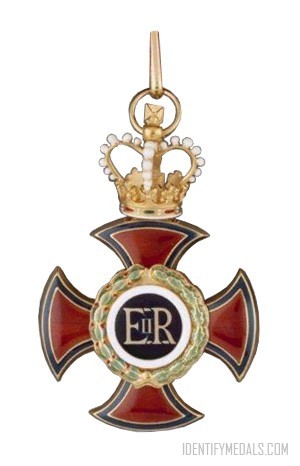
The badge of the Order is an eight-pointed cross of red and blue enamel surmounted by the imperial crown. In the center, upon blue enamel and surrounded by a laurel wreath, is the inscription ‘For Merit‘, in gold lettering.

The insignia for the military division is differentiated by crossed swords placed between the angles of the cross of the badge.

The ribbon of the Order measures 40 millimeters in diameter and is divided into two stripes of red for the Order of the Bath and blue for the Order of the Garter.

The Cross of Valour (Canada)

The Cross of Valour (CV) is a Canadian honor that recognizes acts of the most conspicuous courage in circumstances of extreme peril.

The Cross of Valour (CV) is a Canadian decoration and part of the Canadian system of honors. It’s the second highest award, surpassed only by the Victoria Cross and the highest honor available for Canadian civilians. The Cross of Valour was created in 1 May 1972 and recognizes acts of the most conspicuous courage in circumstances of extreme peril.

Both Canadians and foreigners, living and deceased can be awarded the medal and receive the ability to use the post-nominal letters CV

The Cross of Valour Design

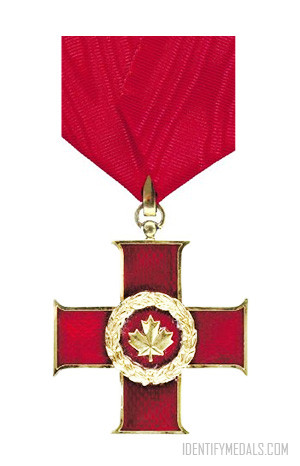
The medal is a cross with four equal limbs. It’s rendered in gold, with the obverse enameled in red and edged with gold.

On the center obverse is a gold maple leaf surrounded by a gold laurel wreath. On the reverse is the Royal Cypher of the reigning Canadian sovereign and a crown above. The words VALOUR • VAILLANCE are etched below, extending along the upper edge of the two lateral arms of the cross. The recipient’s name and the date of the incident are engraved underneath the motto.

This medallion is worn suspended from a red ribbon around the neck (for men) and below the left shoulder suspended from a red ribbon fashioned into a bow (for women). A miniature cross may be worn on the ribbon bar in undress.

The ribbon is light crimson and measures 38 mm in width.

The Grand Cross of the Iron Cross

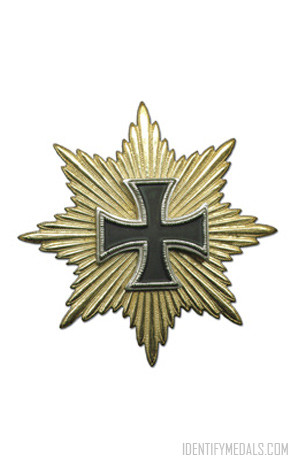
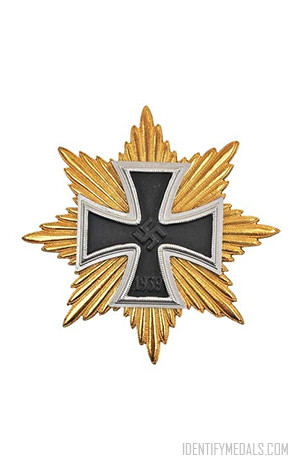
The Grand Cross of the Iron Cross was the highest grade Nazi decoration above the various classes of the Knight’s Cross.

The Grand Cross of the Iron Cross (or Großkreuz des Eisernen Kreuzes in German) was reinstituted as a German decoration in September 1939. The Grand Cross of the Iron Cross is above the different classes of Knight’s Cross of the Iron Cross

During World War II, only one person received the Grand Cross of the Iron Cross: Hermann Göring. 

The original award was destroyed during an air raid in 1943 – after Hitler had deprived Göring of his after feeling betrayed. 

The Grand Cross of the Iron Cross Design

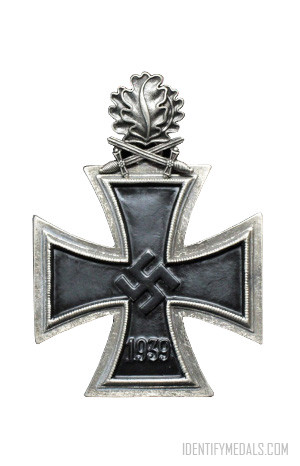
The Grand Cross was designed as having an outline in gold. However, this was changed before Göring’s award. He actually had several copies made of his medal, one with platinum edges which he wore. Göring was wearing this version at the time of his surrender in 1945.

The medal was awarded in a red leather case with an embossed gold Reich Eagle. The interior was made in black velvet. 

More Variations of the Iron Cross

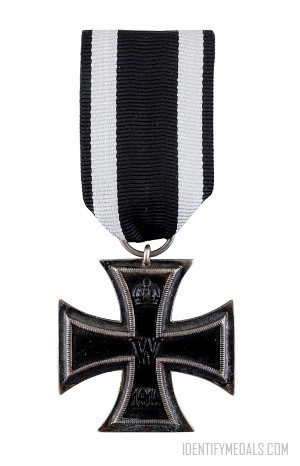
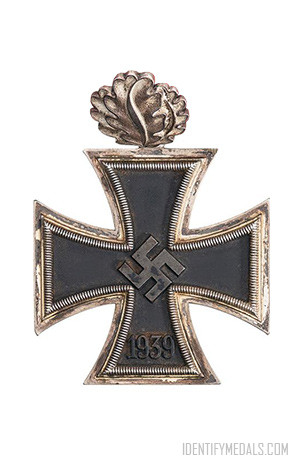
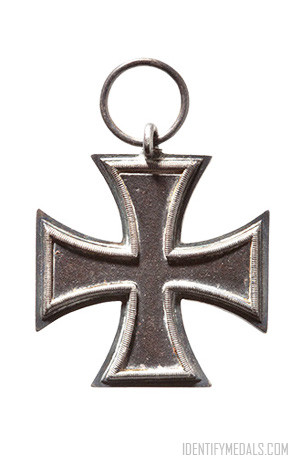
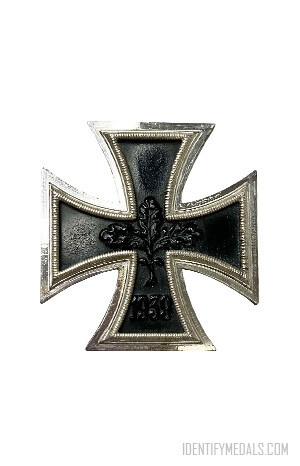
The Iron Cross, a prestigious German military decoration, has undergone several variations since its inception. For example, the Iron Cross 1813 was instituted during the Napoleonic Wars by King Frederick William III of Prussia, the Iron Cross 1914 was awarded during World War I, it was reinstated by Kaiser Wilhelm II, and the Iron Cross 1939 was revived by Adolf Hitler for World War II, with modifications including a swastika.

Find the Iron Cross Medal Online

Right Now on eBay 
Clicking a link to eBay may result in a referral commission being paid if a purchase is made.
Loading...

Further Reading About the Iron Cross

Discover the stories behind the Iron Cross with these compelling books and delve into the rich history and significance of this prestigious military decoration.

The Cross of Military Valor (Senegal)

The Cross of Military Valor is a Senegalese medal established on 1st February 1968 and awarded for acts of valor in peace or war.

The Cross of Military Valor is a Senegalese medal established by Law 68-109 from 1 February 1968 and awarded to individuals and units in peace or in wartime.

The Cross of Military Valor Design

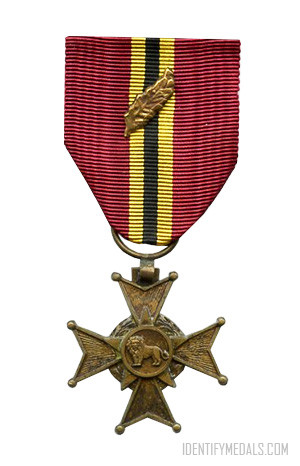
The Cross of Military Valor is a bronze cross patee with a central five-pointed star and a lion. 

The ribbon is red with two central yellow stripes and one black stripe.

The Knights Cross of the War Merit Cross

The Knights Cross of the War Merit Cross was a decoration of Nazi Germany awarded during World War II created by Adolf Hitler.

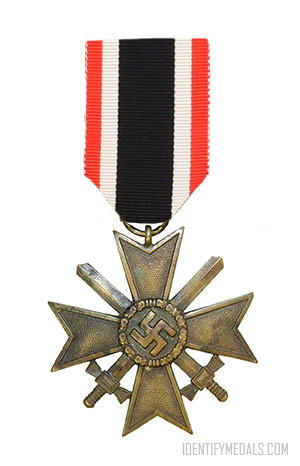
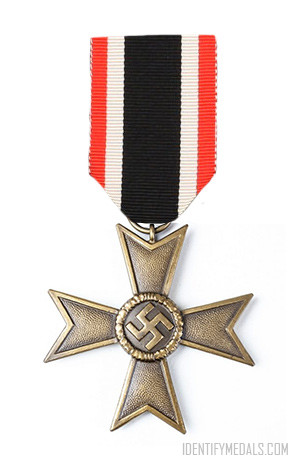
The Knights Cross of the War Merit Cross (or Kriegsverdienstkreuz in German) was a decoration of Nazi Germany awarded to military personnel and civilians during the Second World War. It was created by Adolf Hitler in October 1939 as a successor to the non-combatant Iron Cross which was used in earlier wars.

The award had four variantswith swords given to soldiers for exceptional service “not in direct connection with combat”, without swords given to civilians for meritorious service in “furtherance of the war effort”, the Knights Cross of the War Merit Cross, and the rare Knight’s Cross of the War Merit Cross in Gold

The Knights Cross of the War Merit Cross Design

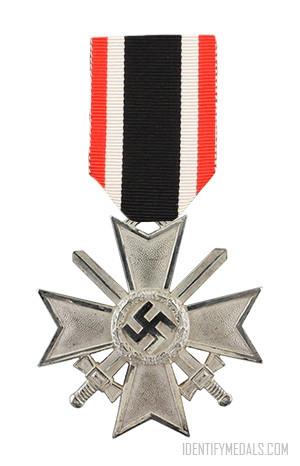
The medal consists of a silver Maltese Cross. The obverse has pebbled arms, with a central wreathed mobile swastika and crossed swords piercing the centrepiece. The reverse has a block hinge and a banjo-style pinback. The War Merit Cross measures 48.51 mm (w) x 48.48 mm (h) and weighs 17.6 grams.

Ribbon

The ribbon of the Knights Cross of the War Merit Cross was in red-white-black-white-red (the colors being reversed from the ribbon of the World War II version of the Iron Cross). 

Order of Wear

The Knights Cross of the War Merit Cross was a neck decoration and worn the same way as the Knights Cross of the Iron Cross.

Medal Variations

Find this Medal Online

The Knight’s Cross Of The War Merit Cross In Gold

The Knight’s Cross Of The War Merit Cross In Gold is a rare Third Reich variation of the War Merit Cross suggested by Albert Speer in 1944.

The Knight’s Cross of the War Merit Cross in Gold (or Ritterkreuz des Kriegsverdienstkreuzes in Gold in German) was a decoration of Nazi Germany and a variation of the War Merit Cross (Kriegsverdienstkreuz). The medal can be dated back to 7 July 1944 when Albert Speer suggested the need for a superior grade of the award. The goal was to recognize exceptional non-combatant contributions to the war effort in Germany. 

The medal was officially instituted on 13 October 1944. Only 21 Knight’s Cross of the War Merit Cross in Gold are known to have been awarded (with several dozen having been produced but not given).

The award had four variantswith swords given to soldiers for exceptional service “not in direct connection with combat”, without swords given to civilians for meritorious service in “furtherance of the war effort”, the Knights Cross of the War Merit Cross, and the rare Knight’s Cross of the War Merit Cross in Gold

Knight’s Cross of the War Merit Cross in Gold Design

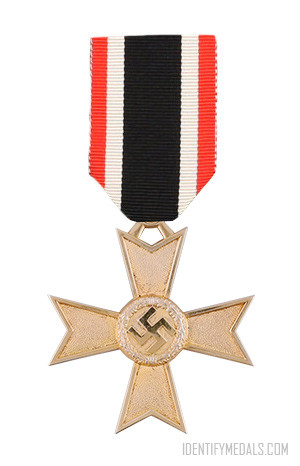
The medal consists of a gilded silver Maltese Cross. The obverse has pebbled arms, with a central wreathed mobile swastika and crossed swords piercing the centerpiece. The reverse has a block hinge and a banjo-style pinback. The cross measures 48.51 mm (w) x 48.48 mm (h) and weighs 17.6 grams.

Ribbon

The ribbon of the Knight’s Cross of the War Merit Cross in Gold was red-white-black-white-red (the colors being reversed from the ribbon of the World War II version of the Iron Cross). 

Order of Wear

Knight’s Cross of the War Merit Cross in Gold was a neck decoration and worn the same way as the Knights Cross of the Iron Cross.

Medal Variations

Find this Medal Online