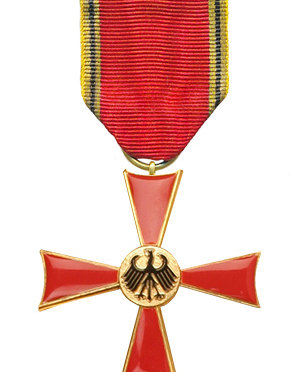
The Order of Merit of the Federal Republic of Germany

The Order of Merit of the Federal Republic of Germany was created by the first President of the Federal Republic of Germany in 1951.

The Order of Merit of the Federal Republic of Germany (or Verdienstorden der Bundesrepublik Deutschland ni German) was created by the first President of the Federal Republic of Germany, Theodor Heuss, on 7 September 1951, and has been awarded to over 200,000 individuals in total, both Germans and foreigners. It’s the only federal decoration of Germany.

The creation decree, which was co-signed by the President Heuss and Chancellor Konrad Adenauer as well as the Minister of the Interior, Robert Lehr, signed, states: “Desiring to visibly express recognition and gratitude to deserving men and women of the German people and of foreign countries, on the second Anniversary of the Federal Republic of Germany, I establish the Order of Merit of the Federal Republic of Germany. It is awarded for achievements that served the rebuilding of the country in the fields of political, socio-economic and intellectual activity, and is intended to mean an award of all those whose work contributes to the peaceful rise of the Federal Republic of Germany.”

The Order of Merit of the Federal Republic of Germany Design

Except for the lowest class, the badge is the same for all classes, with slightly different versions for men and women (the badge and ribbon are smaller for women): The badge’s obverse is a golden cross enameled in red, with a central disc bearing a black eagle. The star is a golden star with straight rays, its size and points vary according to class, with the badge superimposed upon it.

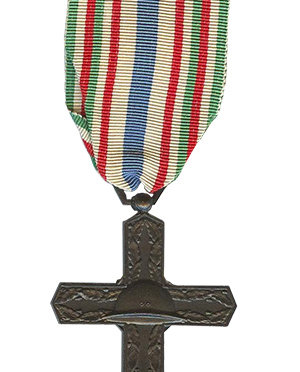
The War Cross for Military Valor

The War Cross for Military Valor is a decoration for military valor established in 1922. The cross may only be awarded in times of war.

The War Cross for Military Valor (or Croce di guerra al valor militare in Italian) is a decoration for military valor that was established in 1922.

It was created to honor acts of valor in combat by Italian soldiers, recognizing extraordinary bravery and heroism in the face of the enemy. The medal is awarded for individual acts of courage, whether during wartime or in significant military operations. It serves as a testament to the recipient’s gallantry and dedication to duty, reflecting Italy’s rich military tradition and commitment to honoring its courageous service members.

The cross may only be awarded in time of war.

The War Cross for Military Valor Design

The medal is a Greek cross made of copper.

Inscribed on the horizontal arms, in the obverse, is Al Valore Militare (For Military Valor). On the top arm of the cross is the monogram of the Italian Republic. The bottom arm depicts a Roman sword sheathed in bay leaves.

The reverse of the cross depicts a five-pointed star, with rays radiating from behind that star out to the arms of the cross. The cross is suspended from a solid blue ribbon.

The Order of Vittorio Veneto

The military Order of Vittorio Veneto was founded as national order by Giuseppe Saragat in 1968 to express the gratitude of the nation.

The military Order of Vittorio Veneto was founded as a national order by the fifth President of the Italian Republic, Giuseppe Saragat, in 1968, “to express the gratitude of the nation” to those decorated with the Medal and Cross of War for Military Valour who had fought for at least six months in World War I and earlier conflicts.

Awarded in the single degree of Knight, a small annuity was granted in favor of those recipients who did not enjoy an income above their tax allowance, payable to the widow or minor children on death. The allowance was also granted to those that fought in the former Austro-Hungarian armed forces who became Italian citizens after annexation.

The order was bestowed by decree of the President of the Republic, its head, on the recommendation of the Minister of Defence. A Lieutenant General chaired the council, which screened applications made by eligible parties to the municipality of residence. With the death of the last surviving Knights of Vittorio Veneto in 2008, the order fell into abeyance and in 2010, it was formally wound up by repeal of the original legislation.

The Order of Vittorio Veneto Medal Design

The Order of Vittorio Veneto Medal is made of bronze and shaped like a Greek cross with pointed ends to the arms.

The obverse shows a circular central medallion bearing the five-pointed star of the Italian Republic circumscribed ‘ORDINE VITTORIO VENETO’, the arms decorated with oak leaves.

The reverse is a circular central medallion bearing an Adrian helmet, the arms decorated with laurel leaves; on original ribbon.

Find This Medal

Right Now on eBay 
Clicking a link to eBay may result in a referral commission being paid if a purchase is made.
Loading...

The Order of the Roman Eagle

The Fascist Order of the Roman Eagle was founded in 1942 with civil and military divisions, and abolished in Italy in 1944.

The Fascist Order of the Roman Eagle was founded in 1942 with civil and military divisions and abolished in Italy in 1944 – although it continued to be awarded by Benito Mussolini in the short-lived Italian Social Republic until 1945.

A self-styled order of the same name was founded by Romano Mussolini, fourth and youngest son of Benito Mussolini, in 1997. The separate Order of the Patron Saints of Italy (Ordine dei Santi Patroni d’Italia), St. Francis of Assisi and St. Catherine of Siena, was also conferred by the so-called Republic of Salò between February and April 1945. An organisation of this name was also founded by Romano Mussolini in 1997.

The Fascist Order of the Roman Eagle Design

The medal measures 32 mm diameter.

The Order Insignias consist of a golden Roman Eagle on purple background; the Eagle is fixed on various crosses from Knight to Grand Officer, while it is a plaque for Knights Grand Cross.

On the obverse there are three Fasces. Military medals have two crossed Roman swords behind the image on the foreground, while military crosses have two crossed Roman swords with blade pointing high and passing between the crosses arms.

For the Knight: the Cross is 35 mm and is hanging by a ribbon; it is worn on the chest, left side; Officer: the Cross is 35 mm and is hanging by a ribbon; it is worn on the chest, left side; the ribbon has a rosette; Commander: the Cross is 50 mm and is hanging by a ribbon worn around the neck; Grand Officer: the Cross is 50 mm and is suspended by the ribbon worn around the neck; the Grand Officer also has a 65 mm four-pointed plaque-star. Knight Grand Cross (Gold and Silver): the Cross is 50 mm and is hanging by a band worn over the shoulder, from right to left. Alongside the band, there is a 80 mm eight-pointed plaque-star.

The Military Order of Savoy

The Military Order of Savoy was a military honorary order of the Kingdom of Sardinia first, and of the Kingdom of Italy later.

The Military Order of Savoy was a military honorary order of the Kingdom of Sardinia first, and of the Kingdom of Italy later. Following the abolition of the Italian monarchy, the order became the Military Order of Italy.

The origin of the Military Order of Savoy can be traced back to the first honorary degrees granted by Victor Amadeus III of Sardinia to its soldiers. Later this degree went into disuse because of the Napoleonic regime in Italy and especially in Piedmont. On 1 April 1815 these honorary degrees were used by Victor Emmanuel I of Sardinia and abolished on the 14th of August of the same year.

Later, all of these honorary degrees become part of one, and became, the Military Order of Savoy. This order was to be granted to the soldiers who fought in the Italian army of Napoleon and became part of the Legion of Honor (or either obtained the honorary degree of Order of the Iron Crown) due to military merit. This honorary degree was conceded to everyone no matter what religion or rank the soldier was.

Following the foundation of the Republic, the order was renamed the Military Order of Italy in 1947; it continues to be awarded under that title today.

The Military Order of Savoy Design

The Military Order of Savoy medal is a silver Savoy cross, for the militants, and golden for all the other rankings.

The cross is covered with white and red enamel and surrounded with a laurel crown covered with green enamel. On top of the medal there is the royal crown of Sardinia.

Find This Medal

Right Now on eBay 
Clicking a link to eBay may result in a referral commission being paid if a purchase is made.
Loading...

The Military Order of Italy

The Military Order of Italy (originally of Savoy) is the highest military order of the Italian Republic and the former Kingdom of Italy.

The Military Order of Italy (or Ordine Militare d’Italia in Italian) is the highest military order of the Italian Republic and the former Kingdom of Italy.

It was founded as the Military Order of Savoy, a national order by the King of Sardinia, Vittorio Emanuele I, Duke of Savoy in 1815.

The order is awarded in five degrees for distinguished wartime conduct of units of the armed forces or individual personnel that has “proven expertise, a sense of responsibility and valour.” The order was continued on the unification of Italy in 1861 and was revived, under its new name, following the foundation of the Republic in 1946.

The Military Order of Italy Design

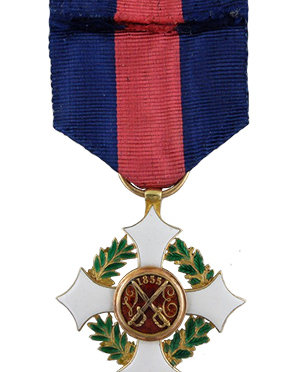
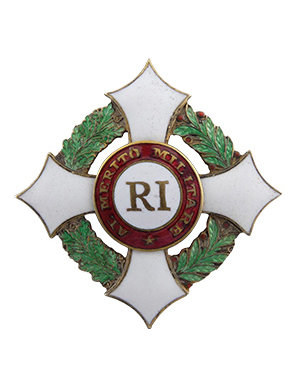
The badge is a golden matuna cross, enameled in white, with a wreath of green-enameled laurel and oak leaves between the arms of the cross.

The obverse during the monarchy was red enamel with a white enamel cross (the current version is in white enamel with the letters R.I. for Repubblica Italiana). The disc is surrounded by a red enamel ring bearing the inscription Al Merito Militare.

The reverse is in red enamel with crossed swords. During the monarchy it had the letters V.E. (for Vittorio Emanuele) on the sides of the sword and the year 1855 above it. The current version has no cypher but has the additional year 1947, the date of the promulgation of the Italian constitution, below the swords. The badge for the three higher classes are suspended by a wreath of green-enamelled laurel and oak leaves; the Officer’s badge is suspended by a golden trophy of arms instead and the Knight’s badge has neither emblems.

The Commemorative Medal for Voluntary Service in Free France

The Commemorative Medal for Voluntary Service in Free France is a French commemorative war medal and awarded during WW2.

The Commemorative medal for voluntary service in Free France (or Médaille commémorative des services volontaires dans la France libre in French) is a French commemorative war medal awarded to members of the Free French Forces who fought the Axis forces on most fronts during World War II. It was established by decree on 4 April 1946.

The Free French Forces were especially active in North Africa where they particularly distinguished themselves during the Battle of Bir Hakeim. Also part of the whole, the Free French Naval Forces and Free French Air Force, although limited in numbers and equipment nonetheless took part in most major engagements alongside allied forces including in the Soviet Union.

The Commemorative medal for voluntary service in Free France was awarded to all persons, civilian or military, French or foreign nationals who had voluntarily contracted in the Free French Forces prior to 1 August 1943 (for soldiers), or who had effectively served Free France on the territories controlled by the National Committee in London and in foreign countries prior to 1 August 1943 (for civil servants).

The Commemorative medal for voluntary service in Free France Design

The Commemorative medal for voluntary service in Free France was struck from silvered bronze in the shape of a Cross of Lorraine. Its obverse bears the relief inscription on two lines “FRANCE” on the upper horizontal arm and “LIBRE” on the lower arm. Its reverse bears the dates “18 JUIN 1940” on the upper arm and “8 MAI 1945” on the lower arm.

The Commemorative medal for voluntary service in Free France hangs from a dark blue silk moiré ribbon adorned with 2 mm wide red oblique stripes separated by 4 mm.

The War Merit Cross

The Italian War Merit Cross (Croce al Merito di Guerra) was instituted by King Victor Emanuel III in 1918 and awarded to the armed forces.

The Italian War Merit Cross (Croce al Merito di Guerra) was instituted by the King Victor Emanuel III in 1918, and was awarded to members of the armed forces with a minimum of one year’s service who had been in contact with the enemy, or to those who, when mentioned for war merit, received a promotion.

If an act of valour was deemed insufficient for the Medal of Military Valour, the War Merit Cross could be awarded instead.

From its institution until 30 May 1927, 1,034,924 Crosses were issued.

The Italian War Merit Cross Design

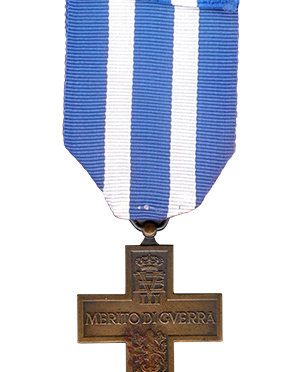
The War Merit Cross is made in bronze, it measures 38mm wide (1-1/2 inches) and has a blue ribbon. A second award was indicated by a bronze star on the ribbon. The reverse side of the medal bears a 5-pointed star on a background of rays, and the obverse shows the royal cypher (“VE III” under a crown) in the upper arm, with the words “MERITO DI GVERRA” (War Merit) on the horizontal arms and a Roman sword point upwards, on oak leaves, in the lower arm.

The Distinguished Service Cross

The Distinguished Service Cross is the second-highest United States Army military award and is given for extreme gallantry and risk of life.

The Distinguished Service Cross (or DSC) is the second-highest United States Army military award. It is given for extreme gallantry and risk of life in actual combat with an armed enemy force. This award was established by President Woodrow Wilson on January 2, 1918, during World War I.

The act or acts of heroism required for the Distinguished Service Cross must have been so notable and have involved risk of life so extraordinary as to set the individual apart from his or her comrades. These are of such degree that are above those required for all other U.S. combat decorations except the Medal of Honor.

While the Distinguished Service Medal is awarded to persons in recognition of service to the government, the Cross is only awarded for actions in combat.

The History of the Distinguished Service Cross

The award was first given during World War I, although a number of them were made for actions before WW1 to soldiers who had received a Certificate of Merit for gallantry. Others were belated recognition of actions in the Philippines during the Boxer Rebellion and on the Mexican Border.

During World War II, just over 5,000 awards were made. Only three men received the medal three times: Lieutenant Colonel John C. Meyer, Major General James A. Van Fleet, and Master Sergeant Llewellyn Chilson. A little over fifty soldiers and one sailor received two Distinguished Service Crosses in WW2.

Over 800 awards, over 300 posthumous, were given in the Korean War, and over 1,000 in the Vietnam War (almost 400 of which were posthumous).

The Distinguished Service Cross Design

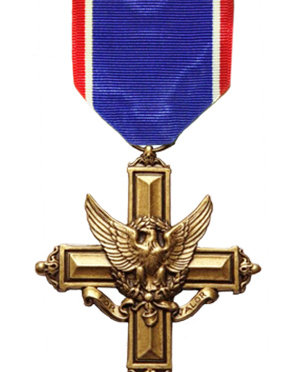
The Distinguished Service Cross award is a cross made of bronze and measures 2 inches in height and ​1 1316 inches in width.

The obverse shows an eagle in the center and a scroll below the eagle bearing the inscription “FOR VALOR.” On the reverse, the center of the cross is circled by a wreath with a space for engraving the name of the recipient. The Distinguished Service Cross was originally designed by J. Andre Smith, an artist employed by the United States Army during World War I.

During World War I, 6,309 awards of the Distinguished Service Cross were made to 6,185 recipients. In the aftermath of The Great War, 62 awards were made for actions in North Russia and Siberia during the Russian Civil War and approximately 132 retroactive awards were made for actions in previous conflicts. During World War II, just over 5,000 awards were made.

American Soldiers That Earned a
Distinguished Service Cross

Here are five individuals who earned the Distinguished Service Cross. They represent just a few examples of the many brave soldiers who have earned this award for their exceptional courage and selflessness in the face of danger.

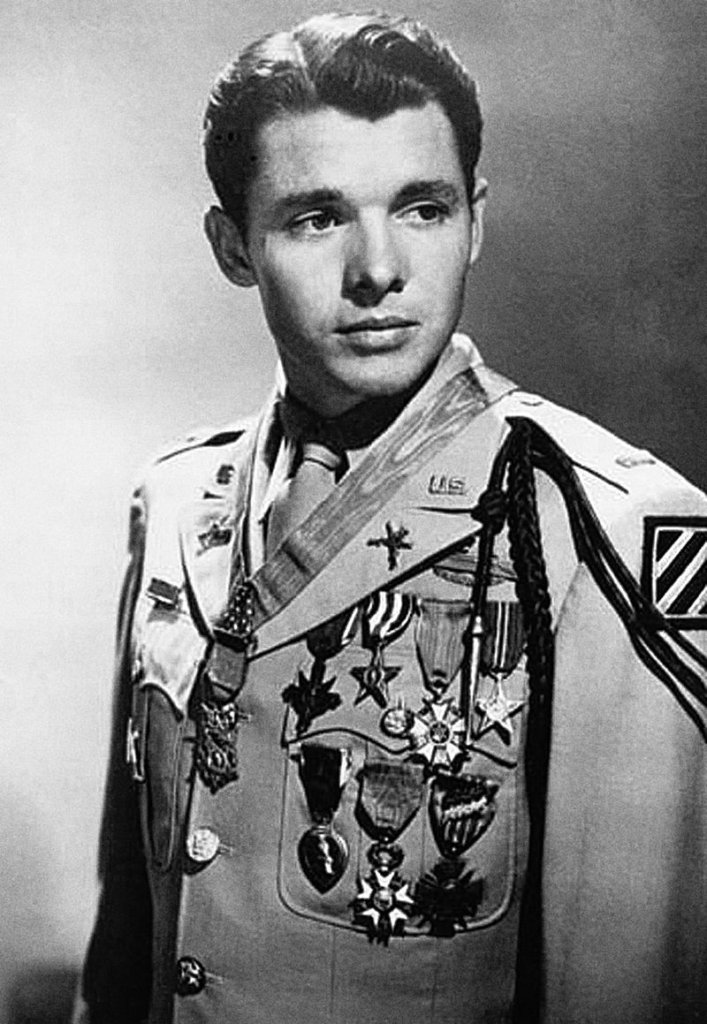
Audie Murphy

Audie Murphy, a highly decorated American soldier and actor, earned the Distinguished Service Cross for his actions during World War II. He received the medal for his heroic leadership and valor in combat, including single-handedly holding off a German attack.

Alvin C. York

Alvin C. York, a World War I soldier, was awarded the Distinguished Service Cross for his extraordinary actions during the Meuse-Argonne Offensive in 1918. He led an attack on a German machine gun nest, capturing 132 enemy soldiers and helping to secure the success of his unit.

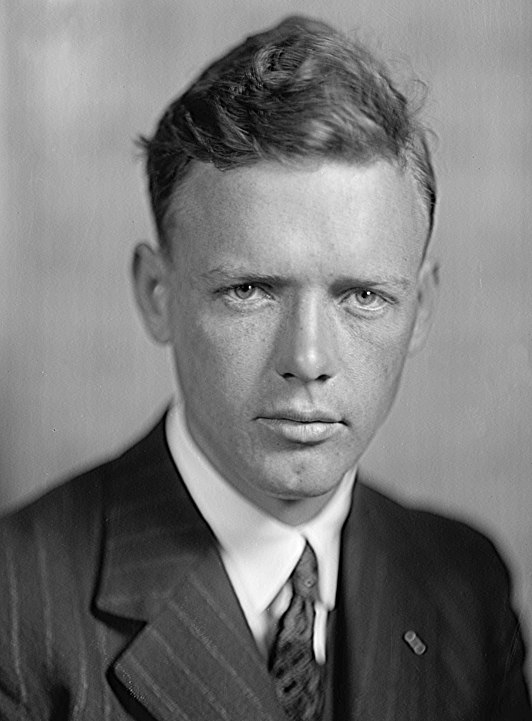
Charles Lindbergh 

Charles Lindbergh, the renowned aviator, received the Distinguished Service Cross for his pioneering transatlantic flight in 1927. The award recognized his significant contribution to aviation and the advancement of airmail services.

Theodore Roosevelt Jr.

Theodore Roosevelt Jr., the son of President Theodore Roosevelt, was posthumously awarded the Distinguished Service Cross for his actions during the D-Day invasion of Normandy in World War II. Despite being suffering from arthritis and heart problems, he landed with the first wave of troops and provided invaluable leadership during the assault.

Roy Benavidez

Roy Benavidez, a member of the U.S. Army Special Forces, earned the Distinguished Service Cross for his heroic actions during the Vietnam War. He saved the lives of numerous fellow soldiers during a six-hour battle, despite being severely wounded himself.

Audie Murphy photographed in 1948 wearing the U.S. Army khaki "Class A" (tropical service) uniform with full-size medals. Source: Wikipedia.
Col. Charles Lindbergh. Photo by Harris & Ewing, c. 1927.

Buy This Medal Online

Right Now on eBay 
Clicking a link to eBay may result in a referral commission being paid if a purchase is made.
Loading...

The Navy Cross

The Navy Cross is the United States military’s second-highest decoration and awarded to members of the Navy, Marine Corps, and Coast Guard. 

The Navy Cross holds a significant place among the military decorations awarded by the United States Department of the Navy. Established in 1919, it serves as the second-highest military decoration specifically for the Navy, Marine Corps, and Coast Guard personnel. The Navy Cross is presented to individuals who have displayed extraordinary acts of valor and heroism in combat or have demonstrated meritorious service in situations that do not meet the criteria for the Medal of Honor.

The Navy Cross is reserved for those who have shown exceptional bravery, selflessness, and dedication to their comrades and the mission at hand. It recognizes acts of valor performed in the face of the enemy, involving personal risk and exhibiting a level of courage that goes beyond what is expected of service members in the line of duty.

The medal is equivalent to the Army’s Distinguished Service Cross, the Air and Space Forces’ Air Force Cross, and the Coast Guard Cross.

A Short History of The Navy Cross

The introduction of the Navy Cross was closely linked to the United States’ entry into World War I. At that time, while several European nations had a tradition of honoring heroes from foreign countries, the U.S. only had the Medal of Honor as its sole award for valor. In response to this, the Army introduced the Distinguished Service Cross and Distinguished Service Medal in 1918, and the Navy followed suit in 1919, retroactively recognizing actions from 6 April 1917.

Initially, the Navy Cross held a lower precedence compared to the Medal of Honor and the Navy Distinguished Service Medal. This was because it was awarded for both combat heroism and other distinguished service. However, this order of precedence was revised by Congress on 7 August 1942, designating the Navy Cross as a decoration exclusively for combat actions, following the Medal of Honor in hierarchy.

Since its establishment, the Navy Cross has been bestowed upon individuals over 6,300 times

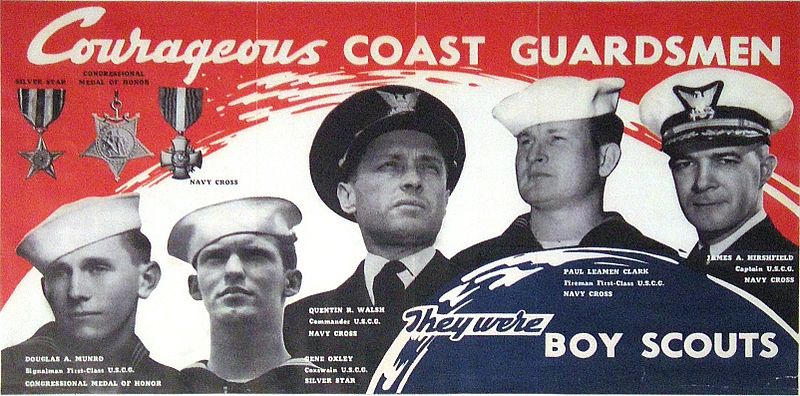
Courageous Coast Guardsmen poster
World War II vintage US poster used in New York City subways: "Courageous Coast Guardsmen / They were Boy Scouts". Image courtesy of Wikipedia.

The Navy Cross Medal Criteria

The criteria for receiving the Navy Cross are stringent, requiring evidence of outstanding leadership, extraordinary initiative, and steadfast devotion to duty. Recipients of the Navy Cross have displayed exceptional courage and have often placed themselves in extreme danger to protect their fellow servicemembers or achieve the mission’s objectives.

The awarding of the Navy Cross is typically accompanied by a citation, which describes in detail the recipient’s heroic actions or meritorious service. These narratives honor the individual’s extraordinary deeds and testify to their valorous or exceptional contributions.

The Navy Cross Medal Design

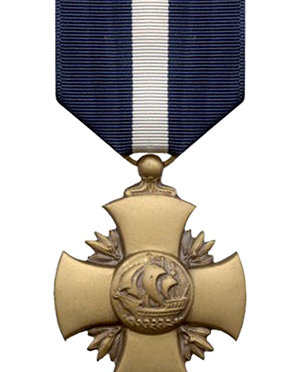
The obverse of the medal is a modified cross pattée one and a half inches wide. There are four laurel leaves with berries in each of the re-entrant arms of the cross, and in the center a sailing vessel is depicted on waves, sailing to the viewer’s left. The reverse shows a bronze cross pattée with crossed anchors from the pre-1850 period and cables attached. The earliest version of the Navy Cross (1919–1928) featured a narrow strip of white.

Around 6,900 medals were awarded. The first actual recipient of Cross is unknown because initial awards were made from a lengthy list published after World War I.

Right Now on eBay 
Clicking a link to eBay may result in a referral commission being paid if a purchase is made.
Loading...