The Order of Merit

The Order of Merit is an award established in 1902 that recognizes distinguished service in the armed forces, science, art, or culture.

The Order of Merit (or Ordre du Mérite in French) is an order of merit that recognizes distinguished service in the armed forces, science, art, literature, or for the promotion of culture.

The Order was established in 1902 by King Edward VII and is restricted to a maximum of 24 living recipients from the Commonwealth realms, plus a limited number of honorary members.

The first mention of a possible Order of Merit was made following the Battle of Trafalgar, in correspondence between First Lord of the Admiralty Lord Barham and William Pitt, though nothing else came of the idea. Queen Victoria, her courtiers, and politicians also considered it, as well as her husband Albert, Prince Consort.

Victoria’s son, King Edward VII, eventually founded the Order of Merit on 26 June 1902 as a means to acknowledge “exceptionally meritorious service in Our Navy and Our Army, or who may have rendered exceptionally meritorious service towards the advancement of Art, Literature and Science.

The Order of Merit’s precedence among other honors differs between countries. From its inception, the order has been open to women, Florence Nightingale being the first woman to receive the honor in 1907. Since 1991, it has been required that the insignia be returned upon the recipient’s death.

The Order of Merit Medal Design

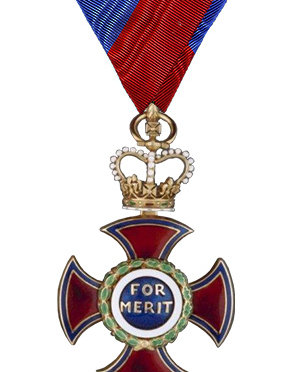
The Order of Merit badge consists of a golden crown suspended from a red enameled cross, which is centered by a disk of blue enamel surrounded by a laurel wreath and bearing in gold lettering the words FOR MERIT.

The insignia for the military grouping is distinguished by a pair of crossed swords behind the central disk. The ribbon is divided into two stripes of red and blue.

Men wear their badges on a neck ribbon, while women carry theirs on a ribbon bow pinned to the left shoulder, and aides-de-camp may wear the insignia on their aiguillettes.
The Wehrmacht Long Service Award

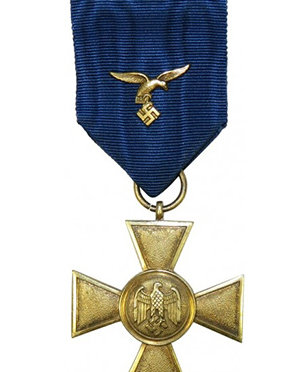
The Wehrmacht Long Service Award is a military service decoration of Nazi Germany issued for satisfactory completion of years in service.

The Wehrmacht Long Service Award (or Wehrmacht-Dienstauszeichnung in German) is a military service decoration of Nazi Germany, which was issued for satisfactory completion of a number of years (12, 18, 25 or 40) in military service.

On 16 March, 1936, Adolf Hitler ordered the institution of service awards for the first four classes. Afterwards, on 10 March, 1939, the 40 years service award was also introduced.

Each branch of the Wehrmacht (air force, army and navy) maintained their own version of the Long Service Award. The decoration was issued for four years (fourth class), 12 years (third class), 18 years (second class), 25 years (first class), and 40 years (1939 special class).

The Wehrmacht Long Service Award Design

The award was designed by Dr Richard Klein, a German artist known for his patriotic work as a medallist from the start of World War I and for his work as a favoured artist of the Nazi regime. Klein was director of the Munich School of Applied Arts and also one of Hitler’s favorite painters. His work was exhibited at the “Great German Art Exhibition” held at the Haus der Kunst in Munich in 1937, including plaques contributed from Adolf Hitler’s private collection.

Recipients of lower Wehrmacht Long Service year awards would wear the decoration simultaneously with higher level decorations in the following manner:

  • 3rd Class with 4th Class
  • 2nd Class with 4th Class
  • 1st Class with 3rd Class

The Long Service Award was retroactive throughout a service member’s career, including Reichswehr service and service during and before World War I. In consequence, there were a handful of 40 year awards presented even when the Nazi era only lasted 12 years, from 1933 to 1945.

The Star of the Grand Cross of the Iron Cross

The Star of the Grand Cross of the Iron Cross was the highest military decoration of the Kingdom of Prussia and the German Empire. 

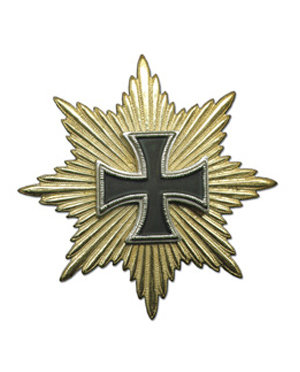
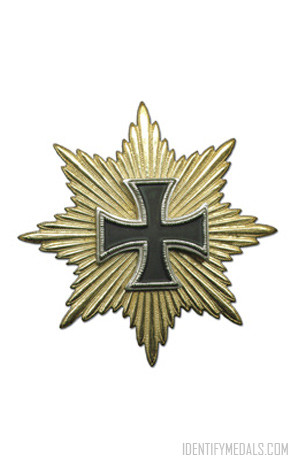
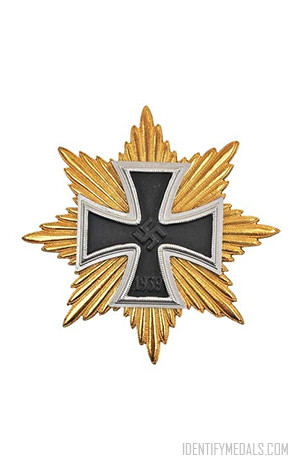
The Star of the Grand Cross of the Iron Cross (or Stern zum Großkreuz des Eisernen Kreuzes in German) was a senior decoration to the Grand Cross of the Iron Cross and the highest military decoration of the Kingdom of Prussia and the German Empire. The award is commonly known as “Blücher’s Star” (Blücherstern) after its first recipient.

This award was given to the most outstanding of generals who had performed feats of leadership that had extremely benefited the German state.

The Star of the Grand Cross of the Iron Cross was awarded only twice, a century apart. The first time it was to Field Marshal Gebhard von Blücher in 1815, to recognize his victory over Napoleon at the Battle of Waterloo. The second was awarded to Field Marshal Paul von Hindenburg in 1918 for his victory at the Battle of Tannenberg. Paul von Hindenburg received the Grand Cross of the Iron Cross (9 December 1916) to which the Golden Star added on 25 March 1918 (Star of the Grand Cross of the Iron Cross).

The Star of the Grand Cross of the Iron Cross Design

During the reign of Nazi Germany, Reichsmarschall Hermann Göring commissioned a new version of the Star of the Grand Cross of the Iron Cross medal, with the intention of awarding it to Adolf Hitler once Germany had won the Second World War. Because Germany was defeated in 1945, the award was never bestowed on him.

After the Allied victory in May 1945, the US Army seized the only known prototype of this medal, which had been securely stored in a bunker. It is now a part of the collection of the Museum of the United States Military Academy in West Point, New York.

More Variations of the Iron Cross

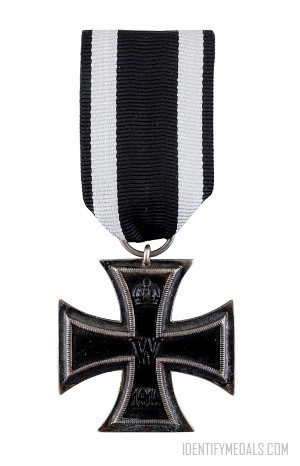
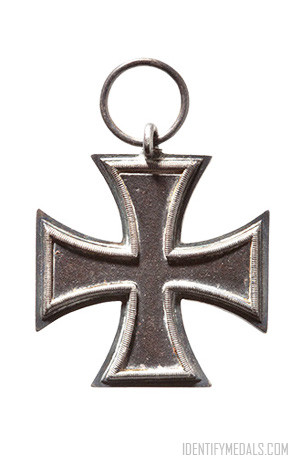
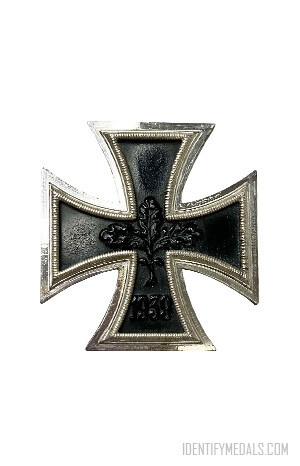
The Iron Cross, a prestigious German military decoration, has undergone several variations since its inception. For example, the Iron Cross 1813 was instituted during the Napoleonic Wars by King Frederick William III of Prussia, the Iron Cross 1914 was awarded during World War I, it was reinstated by Kaiser Wilhelm II, and the Iron Cross 1939 was revived by Adolf Hitler for World War II, with modifications including a swastika.

Find the Iron Cross Medal Online

Right Now on eBay 
Clicking a link to eBay may result in a referral commission being paid if a purchase is made.
Loading...

Further Reading About the Iron Cross

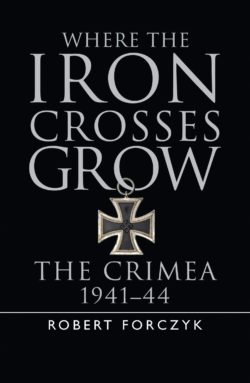
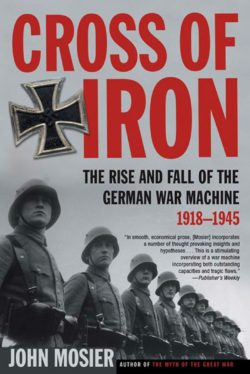
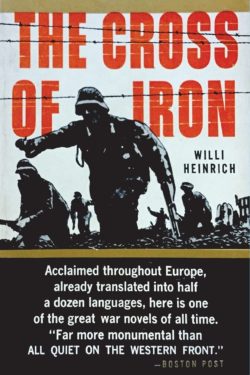
Discover the stories behind the Iron Cross with these compelling books and delve into the rich history and significance of this prestigious military decoration.

The Knight’s Cross of the Iron Cross (EK 1939)

The Knight’s Cross of the Iron Cross was the highest military and paramilitary award for the forces of Nazi Germany during World War II. 

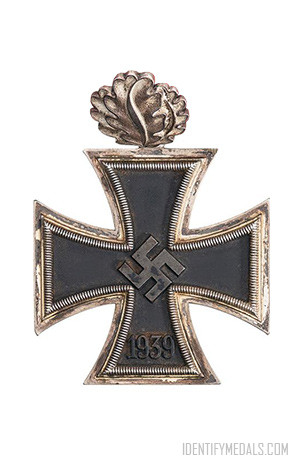
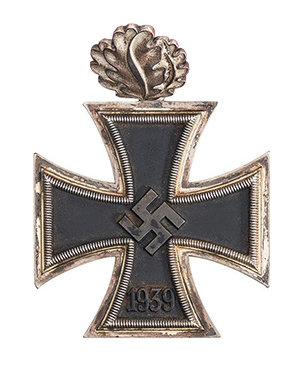
The Knight’s Cross of the Iron Cross (or Ritterkreuz des Eisernen Kreuzes in German, also known as the Knight’s Cross or Ritterkreuz), was the highest military and paramilitary award for the forces of Nazi Germany during World War II. The award was instituted on 1 September 1939, at the onset of the German invasion of Poland, although it had been initially created by King Friedrich Wilhelm III of Prussia on 17 March 1813 (EK 1813).

The Knight’s Cross was awarded across all ranks for a wide range of reasons like skilled leadership of troops in battle or single acts of military valor. It was awarded to members of the three military branches of the Wehrmacht (the Heer or army, the Kriegsmarine or navy, and the Luftwaffe, Waffen-SS, Reichsarbeitsdienst and Volkssturm), along with personnel from other Axis powers.

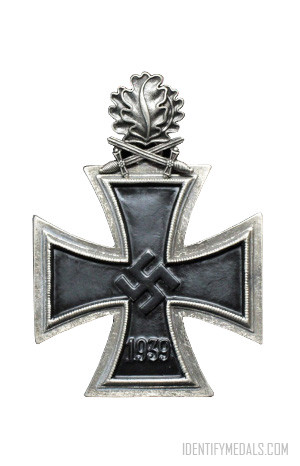
Several higher graded, like the Oak Leaves to the Knight’s Cross, the Knight’s Cross with Oak Leaves, Oak Leaves and Swords and with Oak Leaves, Swords and Diamonds between 1941 and 1944, when the final grade, the Knight’s Cross with Golden Oak Leaves, Swords and Diamonds, was created.

The Knight's Cross of the Iron Cross Design

The Iron Cross was established by the Prussian king Friedrich Wilhelm III at the beginning of the German campaign during the Napoleonic Wars. The design was a silver-framed cast iron cross on 13 March 1813.

The material utilized was iron, because it symbolised defiance and reflected the spirit of the age. To finance the Prussian state army repulse the French occupation, the king implored wealthy Prussians to turn in their jewels in exchange for a men’s cast-iron ring or a ladies’ brooch, each bearing the legend “Gold I gave for iron” (Gold gab ich für Eisen).

The Iron Cross was renewed in 1939 with the outbreak of World War II and with Adolf Hitler in his role as commander in chief of the German armed forces. A new grade of the series was introduced, the Knight’s Cross of the Iron Cross

Over 7,000 awards were made during the course of the war. Analysis of the German Federal Archives revealed evidence for 7,161 officially bestowed recipients: 863 awards of the Oak Leaves to the Knight’s Cross, 147 Swords and 27 Diamonds awards. The Golden Oak Leaves to the Knight’s Cross was awarded only once, to Hans-Ulrich Rudela German ground-attack pilot, on 29 December 1944.

More Variations of the Iron Cross

The Iron Cross, a prestigious German military decoration, has undergone several variations since its inception. For example, the Iron Cross 1813 was instituted during the Napoleonic Wars by King Frederick William III of Prussia, the Iron Cross 1914 was awarded during World War I, it was reinstated by Kaiser Wilhelm II, and the Iron Cross 1939 was revived by Adolf Hitler for World War II, with modifications including a swastika.

Find the Iron Cross Medal Online

Right Now on eBay 
Clicking a link to eBay may result in a referral commission being paid if a purchase is made.
Loading...

Further Reading About the Iron Cross

Discover the stories behind the Iron Cross with these compelling books and delve into the rich history and significance of this prestigious military decoration.

The Alsen Cross

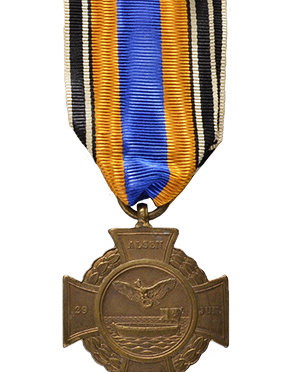
The Alsen Cross (Alsenkreuz) is a military medal of the Kingdom of Prussia established in 1864 to commemorate the victorious Battle of Alsen.

The Alsen Cross (or Alsenkreuz, in German) is a military medal of the Kingdom of Prussia established 7 December 1864 and commemorating the Prussian victory on 29 June 1864 during the Battle of Alsen.

Alsen is an island near the German border to which Danish forces had retreated. On the night of 29 June 1864, 2,500 Prussian troops crossed the Alssund in small boats and took the Danish lines, enabling a pontoon bridge to be built to bring up reinforcements. On 1 August, the Danish king renounced his right to Schleswig-Holstein in favour of Prussia and Austria.

The medal was initially awarded with two different suspension ribbons, for combatants and noncombatants. It was subsequently extended to those troops held in reserve at the battle and members of the Johanniter Orden who participated in the battle.

The Alsen Cross Design

The Alsen Cross is made of bronze cross pattée with a laurel wreath between the arms and a loop for ribbon suspension.

The obverse shows a circular central medallion bearing the head of King Wilhelm I facing left, and the inscription ‘WILHELM KOENING VON PREUSSEN’. The reverse bears a circular central medallion with the crowned Prussian royal eagle in flight, a laurel wreath in its talons, above a small boat in the sea before a stone wall, a standard bearing the Iron Cross to the right on its stern, the upper, left, right and lower arms inscribed ‘ALSEN’, ‘29’, ‘JUN.’, ‘1864’ respectively.

The Duppel Storm Cross

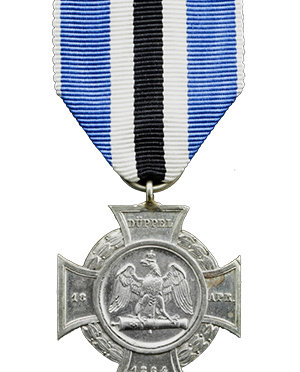
The Düppel Storm Cross was a military medal of the Kingdom of Prussia awarded to Prussian participants in the Battle of Dybbøl.

The Düppel Storm Cross (or Düppeler-Sturmkreuz in German) was a military medal of the Kingdom of Prussia awarded to Prussian participants in the Battle of Dybbøl which took place on 18 April 1864, during the Second Schleswig War.

The Düppel Storm Cross was established by Wilhelm, King of Prussia on 18 October 1864. The medal was initially awarded to combatants and noncombatants who had participated in the battle directly. In 1865, versions were created for those troops held in reserve at the battle and members of the Johanniter Orden who participated in the battle.

The Düppel Storm Cross Design

The Düppel Storm Cross was designed by Friedrich Wilhelm Kullrich, a Prussian court medalist. It was the first of three commemorative crosses awarded during the 1860s with similar designs.

The medal has the shape of a cross pattée. Between the arms of the cross is a laurel wreath and superimposed in its center is a round medallion. On the obverse, the medallion bears the left-facing effigy of King Wilhelm I and has the words WILHELM KOENIG VON PREUSSEN (William King of Prussia) written on it. The reverse of the medallion depicts a crowned Prussian eagle perched upon a Danish cannon.

The top arm of the cross has the word DÜPPEL, the left arm of the cross has 18, the right arm has APR., and the bottom arm of the cross bears the year 1864.

The Commemorative Cross of the 11th Army

The Commemorative Cross of the 11th Army is an Italian medal recognized on 15 April 1943 and awarded to members of the 11th Army.

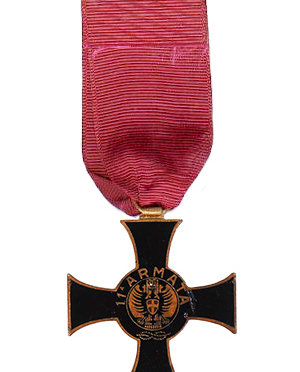
The Commemorative Cross of the 11th Army (or Croce Commemorativa dell’11a Armata in Italian) is an Italian medal recognized on 15 April 1943, and awarded during 1942 to members of the 11th Army who served in the campaign against Greece in 1940-1941.

It honored the efforts and contributions of those who participated in the military operations, reflecting their dedication and bravery in the conflict. The cross serves as a symbol of recognition for the sacrifices and achievements of the 11th Army in this challenging campaign.

The 11th Army

The 11th Army was a unit of the Royal Italian Army during World War II. It played a significant role in the Greco-Italian War, part of the larger Balkan Campaign.

The 11th Army was involved in the initial invasion of Greece in October 1940, which aimed to expand Italian influence in the Balkans. Despite initial setbacks and difficult terrain, the 11th Army’s efforts were part of Italy’s broader strategy in the region. The Commemorative Cross of the 11th Army was later awarded to recognize the service of its members during this campaign.

The Commemorative Cross of the 11th Army Design

The Commemorative Cross of the 11th Army medal is made of gilt-edged black enamel cross pattée with laterally-pierced cylinder suspension.

The obverse shows with a circular central medallion with the arms of Savoy of a white cross on a red shield imposed on the two-headed Albanian eagle, inscribed 11a ARMATA above and with a knot below. The reverse gilt with the black circular inscription ‘VEEMENZA E TENACIA’ (Vehemence and Tenacity) and dated ‘16 NOVEMBRE 1940 XIX’; on replaced correct ribbon.

The Commemorative Cross for the Expeditionary Corps in Russia

The Commemorative Cross for the Expeditionary Corps in Russia is an Italian medal given to the Italian Expeditionary Corps in Russia.

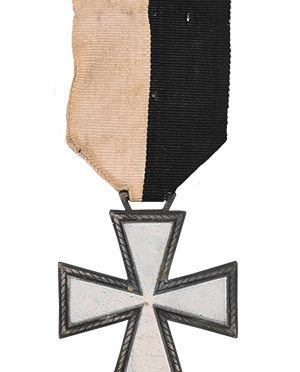
The Commemorative Cross for the Expeditionary Corps in Russia (also known as “Ice Cross”) is an Italian medal given to the Italian Expeditionary Corps in Russia – “C.S.I.R.” (Corpo di Spedizione Italiano in Russia).

During World War II, the Italian Expeditionary Corps in Russia was a corps-sized expeditionary unit of the Regio Esercito (Italian Army) that fought on the Eastern Front. In July 1942, the three divisions of the CSIR all became part of the Italian XXXV Army Corps.

The Commemorative Cross for the Expeditionary Corps in Russia Design

The Commemorative Cross for the Expeditionary Corps in Russia medal is made of zinc alloy and white enamels.

The medal measures 41.3 mm.

The Order of Saints Maurice and Lazarus

The Order of Saints Maurice and Lazarus is a Roman Catholic dynastic order of knighthood bestowed by the House of Savoy.

The Order of Saints Maurice and Lazarus (or Ordine dei Santi Maurizio e Lazzaro in Italian) is a Roman Catholic dynastic order of knighthood bestowed by the House of Savoy, founded in 1572 by Emmanuel Philibert, Duke of Savoy, through amalgamation approved by Pope Gregory XIII of the Order of Saint Maurice, founded in 1434, with the medieval Order of Saint Lazarus, founded circa 1119, considered its sole legitimate successor.

The order was formerly awarded by the Kingdom of Italy (1861–1946) with the heads of the House of Savoy as the Kings of Italy. Originally a chivalric order of noble nature, it was restricted to subjects of noble families with proofs of at least eight noble great-grandparents.

After the abolishment of the monarchy and the foundation of the Italian Republic in 1946, the legacy of the order is maintained by the pretenders of the House of Savoy and the Italian throne in exile.

The order is estimated to include about 2,000 members around the world.

The Order of Saints Maurice and Lazarus Medal Design

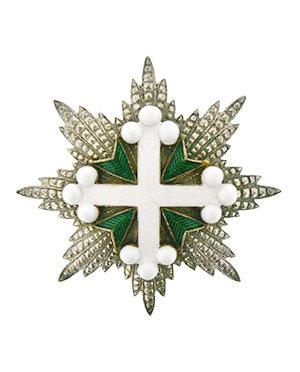
The badge of the order is in gilt, it displays a white-enameled cross bottony of the Order of Saint Maurice with a green-enameled Maltese Cross (the Cross of the Order of Saint Lazarus) placed between the arms of the cross botonny. The badge of each class except that of Knight and Dame is topped by a gilt crown.

The star of the Order is a silver faceted star, with eight points for Grand Cross and four points for Grand Officer, and with the badge (minus the crown) superimposed upon it.

The breast cross for the Commander “jus patronato” class is identical to the badge, minus the crown.

The ribbon of the Order is apple green, with slight variations for the several classes.

The Order of the German Eagle

The Order of the German Eagle, instituted by Hitler in 1937, was predominantly given to foreign diplomats during the German Nazi regime.

The Order of the German Eagle (or Verdienstorden vom Deutschen Adler, in German) was an award predominantly given to foreign diplomats during the German Nazi regime.

The Order was instituted on 1 May 1937 by Adolf Hitler and ceased to be awarded after the collapse of Nazi Germany at the end of World War II. This diplomatic and honorary award was given to prominent foreigners, particularly diplomats, who were considered sympathetic to Nazism.

In addition to awards to non-Germans, the Reich Foreign Minister and the Reich Protector of Bohemia and Moravia received a ‘Special Degree’ (Sonderstufe), with identical insignia to the Grand Cross of the Order.

The Order of the German Eagle Classes

From 1937 to 1943 the order was presented in six classes:

  1. Grand Cross of the Order of the German Eagle with star (Grosskreuz des Deutschen Adlerordens)
  2. Order of the German Eagle with Star (Deutscher Adlerorden mit Stern)
  3. Order of the German Eagle 1st Class (Deutscher Adlerorden, Erste Stufe)
  4. Order of the German Eagle 2nd Class (Deutscher Adlerorden, Zweite Stufe)
  5. Order of the German Eagle 3rd Class (Deutscher Adlerorden, Dritte Stufe)
  6. German Medal of Merit (Deutsche Verdienstmedaille)

A unique Grand Cross of the Order of the German Eagle in Gold with Diamonds (Grosskreuz des Deutschen Adlerordens in Gold und Brillanten) was also awarded to Benito Mussolini on 25 September 1937.

The Order of the German Eagle Design

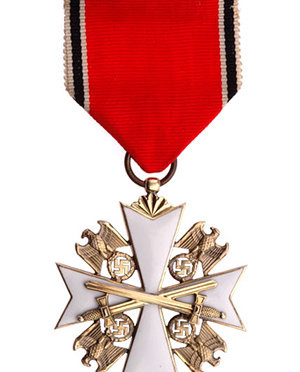
The Cross is based on the Maltese Cross, with German Eagles at each corner carrying a swastika. The Order also featured crossed swords for military recipients.

The overall appearance and name of the Order was an imitation of the Prussian Order of the Black Eagle and Order of the Red Eagle.

The cross was suspended from a 46 mm red ribbon with black, red, and white stripes. In the first two classes, the award also came in the form of a silver or gold eight-pointed star accompanied by a white Maltese Cross and gold eagles centered.

Buy an Order of the German Eagle

Note: As an eBay partner, I earn from qualifying purchases. This is all done automatically when you use a link and at no extra cost to you.

Right Now on eBay 
Clicking a link to eBay may result in a referral commission being paid if a purchase is made.
Loading...