The Order of the Crown (Prussia)

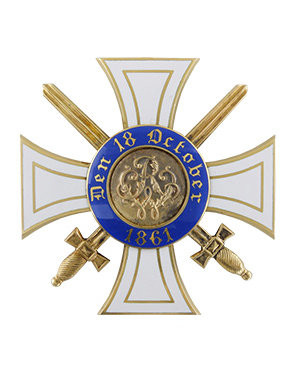
The Royal Order of the Crown was a Prussian order of chivalry instituted in 1861 as an honor equal in rank to the Order of the Red Eagle.

The Royal Order of the Crown (or Königlicher Kronen-Orden in German) was a Prussian order of chivalry instituted in 1861 as an honour equal in rank to the Order of the Red Eagle (officially both orders were equal, but most officials preferred to be appointed in the older Order of the Red Eagle).

Membership could only be conferred upon commissioned officers (or civilians of equivalent status), but there was a medal associated with the order which could be earned by non-commissioned officers and enlisted men.

The Order had six classes:

  • Grand Cross – wore the Grand Cross badge on a sash on the right shoulder, plus the star on the left chest;
  • 1st Class – wore the badge on a sash on the right shoulder, plus the star on the left chest;
  • 2nd Class – wore the badge on a necklet, plus the star on the left chest;
  • 3rd Class – wore the badge on a ribbon on the left chest;
  • 4th Class – wore the badge on a ribbon on the left chest;
  • Medal – wore the medal on a ribbon on the left chest.

The Order of the Crown Design

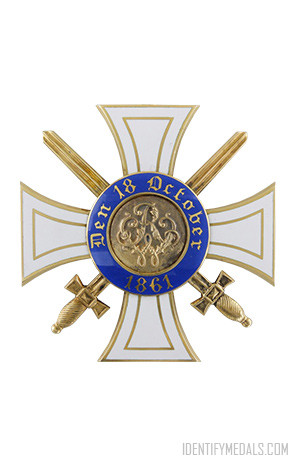
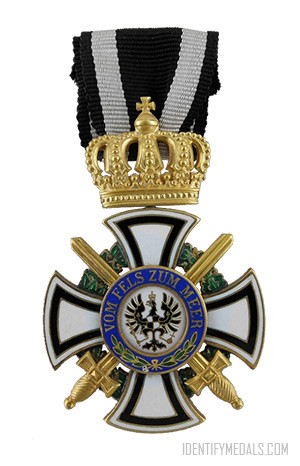
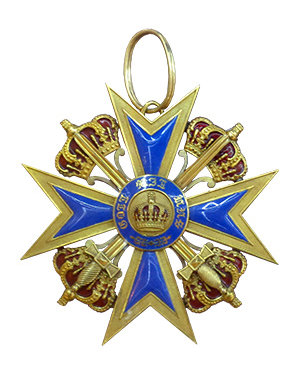
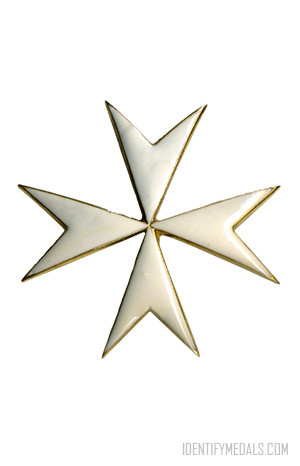
The insignia of the order could be awarded in dozens of variations. For example with superimposed Cross of Geneva (Red Cross – normally given to doctors for meritorious service), with swords and with oak leaves. The badge for the 1st to 4th classes is a gilt cross pattée with white enamel (except for the 4th Class, which was plain).

The obverse gilt central disc bears the crown of Prussia surrounded by a blue enamel ring bearing the motto of the German Empire “Gott Mit Uns” (“God With Us”).

The reverse gilt disc has the Prussian royal monogram, surrounded by a blue enamel ring with the date 18 October 1861.

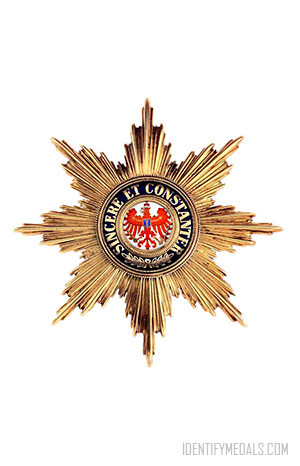
The star of the Order is (for Grand Cross) a gilt eight-pointed star, (for 1st Class) a silver eight-pointed star, or (for 2nd Class) a silver four-pointed star, all with straight rays.

The ribbon of the Order is blue.

More Prussian Orders

Throughout Prussian history, these orders played a significant role in the social hierarchy and served as tangible expressions of royal favor and recognition. They continued to be awarded even after the dissolution of the Kingdom of Prussia, remaining as enduring symbols of valor, service, and honor in German society. Here are some more about Prussian Orders:

The Order of Merit of the Prussian Crown

The Order of Merit of the Prussian Crown is an award of civil and military merit established on the bicentennial of the Kingdom of Prussia.

The Order of Merit of the Prussian Crown (or Verdienstorden der Preußischen Krone in German) is an award of civil and military merit established on the occasion of the bicentennial of the establishment of the Kingdom of Prussia 18 January 1901 by King Wilhelm II.

The order was presented in one class and consisted of a badge and a breast star. For military merit the award was presented with crossed swords. Once, it was presented with diamonds (to Maximilian von Seinsheim, from the Bavarian Court on 15 December 1913).

The medal was awarded only 57 times. General von Gossler was the only person who received the awards in both departments.

The Order of Merit of the Prussian Crown Design

The order consists of a badge (which is worn on a sash from right shoulder to the left hip), and a star worn on the left chest.

The badge is a blue-enamelled, eighteen-karat, yellow-gold Maltese cross with a granular border. In each of the compartments between the four arms of the cross is a red-enamelled crown surmounting the royal monogram (“W II”, for Wilhelm II).

The central disc on the obverse of the badge shows a golden crown with red enamel, surrounded by a blue-enamelled circular band bearing the gold-lettered motto, “Gott Mit Uns” (“God with Us”).

The disc on the reverse bears the intertwined initials “IR W II” (for “Imperator Rex Wilhelm II”: “Emperor King William II”), encircled by the date “18 January 1901”.

The star is a golden eight-pointed star with straight rays, displaying the central disc from the obverse of the badge. The sash of the order is blue, edged with orange stripes.

More Prussian Orders

Throughout Prussian history, these orders played a significant role in the social hierarchy and served as tangible expressions of royal favor and recognition. They continued to be awarded even after the dissolution of the Kingdom of Prussia, remaining as enduring symbols of valor, service, and honor in German society. Here are some more about Prussian Orders:

The Eastern Front Medal Winterschlacht im Osten

The Eastern Front Medal was a World War II German military decoration awarded to those who served during the winter campaign.

The Eastern Front Medal (or Medaille „Winterschlacht im Osten 1941/42“) was a World War II German military decoration awarded to both German and Axis personnel. It was awarded to those who served on the German Eastern Front during the winter campaign period of 15 November 1941 to 15 April 1942.

The medal was instituted on 26 May 1942 and was commonly known as the Ostmedaille (East Medal) or Russian Front Medal.

The medal was wryly called the Frozen Meat Medal or the “Order of the Frozen Flesh” (or Gefrierfleischorden in German) by Heer, Luftwaffe and Waffen-SS personnel to whom it was awarded. Armed service personnel qualified for the badge after a minimum of 14 days served in active combat; 30 combat sorties for Luftwaffe members; 60 days of continuous service in a combat zone; being wounded or suffering a “frozen limb”, severe enough to warrant the issue of a Wound Badge.

The medal could be awarded posthumously. It was officially decommissioned by Oberkommando der Wehrmacht on 4 September 1944.

The Eastern Front Medal Design

The medal measures 3.6 cm (1.4 in) in diameter, and is generally made of zinc. The medal was given a gun-metal coloured coating.

The concave obverse side features a national socialist eagle grasping a swastika with laurel behind.

The reverse features the text in capital letters: “WINTERSCHLACHT IM OSTEN 1941/42” (“Winter Battle in the East 1941/42”) featuring a crossed sword and branch below the text. A helmet and stick grenade below the medal loop as well as outer ring were finished in a polished silver effect.

The ribbon featured a central white-black-white (white for snow, black for the fallen soldiers) stripe with red (for blood) either side. The medal and ribbon were presented in a paper packet with the name of the medal on the front and the maker name on the reverse.

Buy an Eastern Front Medal

Note: As an eBay partner, I earn from qualifying purchases. This is all done automatically when you use a link and at no extra cost to you.

Right Now on eBay 
Clicking a link to eBay may result in a referral commission being paid if a purchase is made.
Loading...

The War Merit Cross (With Swords)

The War Merit Cross was a decoration of Nazi Germany during the Second World War awarded to military personnel and civilians.

The War Merit Cross (or Kriegsverdienstkreuz in German) was a decoration of of Nazi Germany awarded to military personnel and civilians during the Second World War. It was created by Adolf Hitler in October 1939 as a successor to the non-combatant Iron Cross which was used in earlier wars.

The award had four variantswith swords given to soldiers for exceptional service “not in direct connection with combat”, without swords given to civilians for meritorious service in “furtherance of the war effort”, the Knights Cross of the War Merit Cross, and the rare Knight’s Cross of the War Merit Cross in Gold

The War Merit Cross 2nd Class with Swords was presented to Military Personnel for bravery not necessarily in the face of the enemy, and in reality there was a gray area in which individuals received the medal when perhaps the non-combatant grade would have been appropriate.  A total of 6,134,950 were issued.

By the end of the war the War Merit Cross was issued in four degrees and had a related civil decoration. It was reissued in 1957 by the Bundeswehr in a de-Nazified version for veterans.

The War Merit Cross With Swords Design

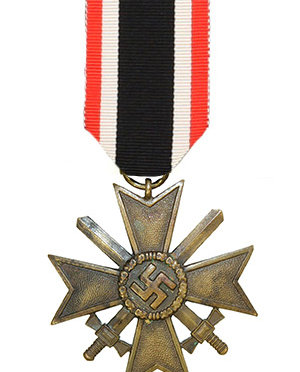
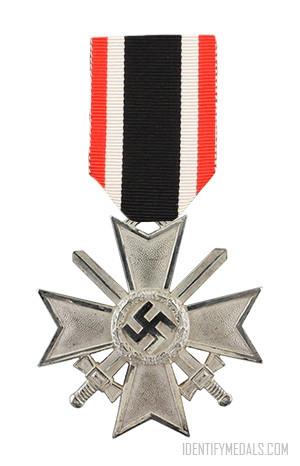
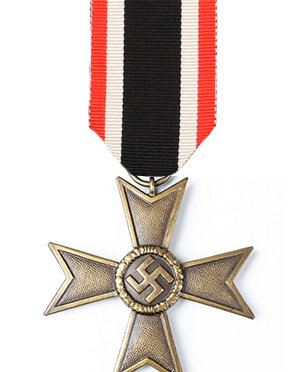
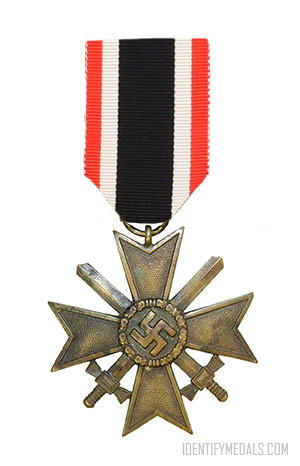
The medal consists of a bronze plated Maltese Cross. The obverse has pebbled arms, with a central wreathed mobile swastika and crossed swords piercing the centrepiece. The reverse has a block hinge and a banjo-style pinback. The War Merit Cross measures 48.51 mm (w) x 48.48 mm (h) and weighs 17.6 grams.

Materials

War Merit Cross with Swords was constructed from a wide range of materials, from zinc with a bronzed wash to a few very rare bronze pieces. As the war progressed, the quality of the materials decreased, and as a result late war crosses lose their bronze wash with the passing of time, yielding a gray appearance.

Ribbon

The ribbon of the War Merit Cross with Swords was in red-white-black-white-red (the colors being reversed from the ribbon of the World War II version of the Iron Cross). The ribbon for the War Merit Medal was similar, but with a narrow vertical red strip in the center of the black field.

Classes

The War Merit Cross without Swords 1st Class was a pin-backed medal worn on the pocket of the tunic. The ribbon of the War Merit Cross without Swords 2nd Class could be worn like the ribbon of the Iron Cross 2nd Class (through the second buttonhole). Combat soldiers tended to hold the War Merit Cross in low regard, referring to its wearers as being in ‘Iron Cross Training’.

Order of Wear

The War Merit Cross with Swords was a neck decoration and worn the same way as the Knights Cross of the Iron Cross.

Medal Variations

The War Merit Cross came in several variations, each with specific criteria and significance:

  1. War Merit Cross 2nd Class: Awarded with swords for bravery in combat or without swords for meritorious service in a non-combat role. This was worn as a ribbon on the uniform.

  2. War Merit Cross 1st Class: A higher distinction, awarded with or without swords, worn as a pin on the chest.

  3. Knights Cross of the War Merit Cross: The highest grade, also with or without swords, for exceptional service.

Find this Medal Online

Right Now on eBay 
Clicking a link to eBay may result in a referral commission being paid if a purchase is made.
Loading...

The War Merit Cross (Without Swords)

The War Merit Cross was a decoration of Nazi Germany during the Second World War awarded to military personnel and civilians.

The War Merit Cross (or Kriegsverdienstkreuz in German) was a decoration of Nazi Germany awarded to military personnel and civilians during the Second World War. It was created by Adolf Hitler in October 1939 as a successor to the non-combatant Iron Cross which was used in earlier wars.

The award had four variantswith swords given to soldiers for exceptional service “not in direct connection with combat”, without swords given to civilians for meritorious service in “furtherance of the war effort”, the Knights Cross of the War Merit Cross, and the rare Knight’s Cross of the War Merit Cross in Gold

The War Merit Cross 2nd Class without swords was presented to those whose actions were deemed to be in the furtherance of the war effort but not directly involved in military operations, for example teachers, industrialists, or Military personnel on occupation duty or POW camp guards. A total of 1,591,5673 medals were issued.

By the end of the war the War Merit Cross was issued in four degrees and had a related civil decoration. It was reissued in 1957 by the Bundeswehr in a de-Nazified version for veterans.n

The War Merit Cross Without Swords Design

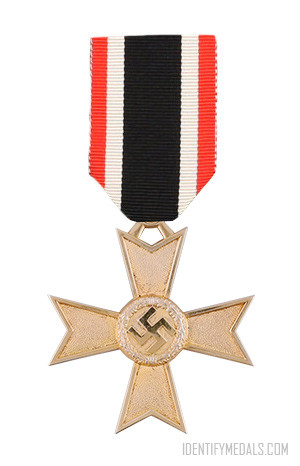
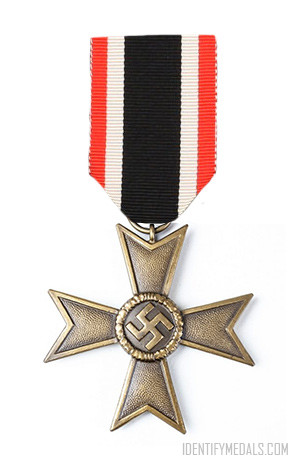
The medal consists of a bronze plated Maltese Cross. The obverse has pebbled arms, with a central wreathed mobile swastika and crossed swords piercing the centrepiece. The reverse has a block hinge and a banjo-style pinback. The War Merit Cross measures 48.51 mm (w) x 48.48 mm (h) and weighs 17.6 grams.

Materials

The War Merit Cross without Swords was constructed from a wide range of materials, from zinc with a bronzed wash to a few very rare bronze pieces. As the war progressed, the quality of the materials decreased, and as a result late war crosses lose their bronze wash with the passing of time, yielding a gray appearance.

Ribbon

The ribbon of the War Merit Cross without Swords was in red-white-black-white-red (the colors being reversed from the ribbon of the World War II version of the Iron Cross). The ribbon for the War Merit Medal was similar, but with a narrow vertical red strip in the center of the black field.

Classes

The War Merit Cross without Swords 1st Class was a pin-backed medal worn on the pocket of the tunic. The ribbon of the War Merit Cross without Swords 2nd Class could be worn like the ribbon of the Iron Cross 2nd Class (through the second buttonhole). 

Order of Wear

The War Merit Cross without Swords was a neck decoration and worn the same way as the Knights Cross of the Iron Cross.

Medal Variations

Find this Medal Online

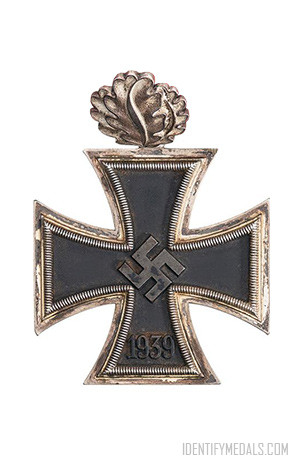
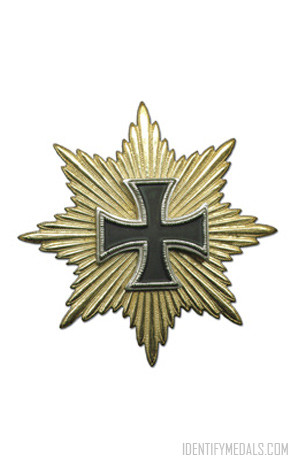
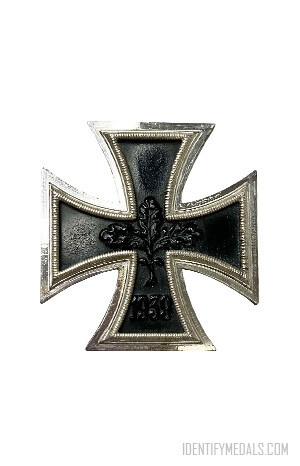
The Star of the Grand Cross of the Iron Cross (Nazi)

The Star of the Grand Cross of the Iron Cross was the highest military decoration of the Kingdom of Prussia and the German Empire. 
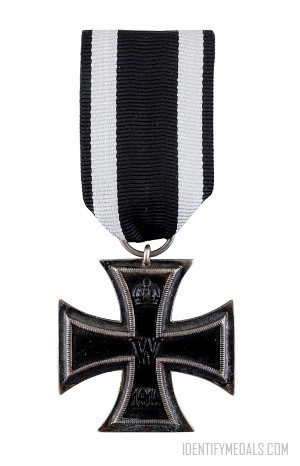
The Star of the Grand Cross of the Iron Cross (or Stern zum Großkreuz des Eisernen Kreuzes in German) was the highest military decoration of the Kingdom of Prussia and the German Empire.
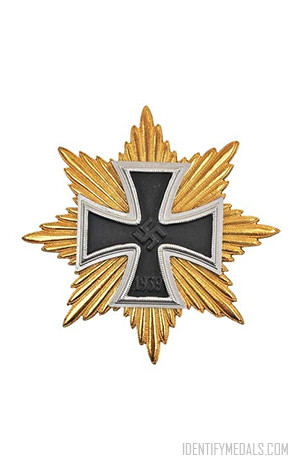
The Star of the Grand Cross of the Iron Cross was awarded to the most outstanding of generals who performed feats of leadership to the extreme benefit of the German state. It was awarded only twice, a century apart, to Field Marshal Gebhard von Blücher in 1815 for his victory over Napoleon at the Battle of Waterloo, and to Field Marshal Paul von Hindenburg in 1918 for his victory at the Battle of Tannenberg. The award is commonly known as “Blücher’s Star” (Blücherstern) after its first recipient.

Paul von Hindenburg received the Grand Cross of the Iron Cross (9 December 1916) to which the Golden Star added on 25 March 1918 (Star of the Grand Cross of the Iron Cross).

During the reign of Nazi Germany, Reichsmarschall Hermann Göring commissioned a new version of the medal, intending to award it to Adolf Hitler once Germany won the Second World War.

Since Germany was defeated in 1945, the award was never bestowed on the intended recipient. Following the Allied victory in May 1945, the US Army seized the only known prototype, which had been stored in a bunker. It is now a part of the collection of the Museum of the United States Military Academy in West Point, New York.

The Star of the Grand Cross of the Icon Cross Design

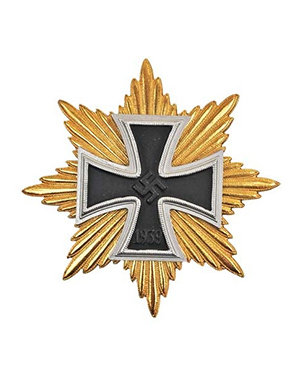
The design of the Star of the Grand Cross of the Iron Cross is similar to that od the Grand Cross of the Iron Cross, but with a golden crown and a swastika symbol.

More Variations of the Iron Cross

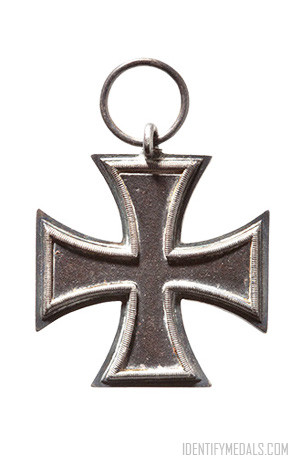
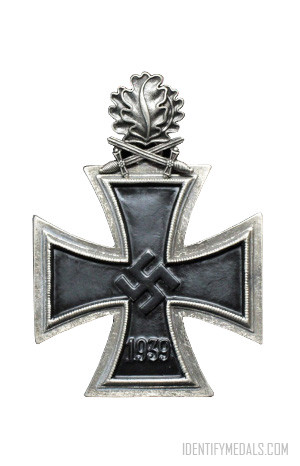
The Iron Cross, a prestigious German military decoration, has undergone several variations since its inception. For example, the Iron Cross 1813 was instituted during the Napoleonic Wars by King Frederick William III of Prussia, the Iron Cross 1914 was awarded during World War I, it was reinstated by Kaiser Wilhelm II, and the Iron Cross 1939 was revived by Adolf Hitler for World War II, with modifications including a swastika.

Find the Iron Cross Medal Online

Right Now on eBay 
Clicking a link to eBay may result in a referral commission being paid if a purchase is made.
Loading...

Further Reading About the Iron Cross

Discover the stories behind the Iron Cross with these compelling books and delve into the rich history and significance of this prestigious military decoration.

The Army Gold Medal (Peninsular Gold Medal)

The Army Gold Medal (also known as the Peninsular Gold Medal with an accompanying Gold Cross) is a British campaign medal awarded in recognition of field and general officers’ successful commands in campaigns, mainly the Peninsular War.

The Army Gold Medal was established in 1810 to reward service at Napoleonic War battles since 1808. It was awarded only to majors and above and in two sizes, with the larger going to senior officers. The award could be awarded posthumously and sent to the officer’s family.

The Army Gold Medal was not a general medal because it was issued only to officers whose status was no less than that of battalion commander or equivalent.

The Army Gold Medal Design

The medal came in three styles: Large, small and gold.

The Large Gold Medal was designed by Thomas Wyon and was restricted to general officers. It measures 2.12 inches (54 mm) in diameter, and is mounted in a gold frame, glazed on both sides. The obverse shows Britannia with shield, seated and facing left and holding a laurel wreath in her right hand and a palm branch in her left. Behind her, the head of a lion can be seen. The reverse displays a laurel wreath surround, with the name of the battle engraved in the center, although that for Barrosa was die struck.

The Small Gold Medal was awarded to officers between the rank of major and colonel. It measures 1.3 inches (33 mm) in diameter, it’s mounted in a gold frame and glazed, and of the same design as the Large Medal.

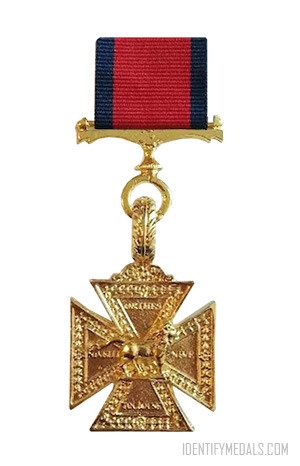
The Gold (or Peninsular) Cross was awarded to those who earned four or more gold medals, which it replaced. Worn around the neck, it is an ornamental cross pattée 1.5 inches (38 mm) across, with a proud lion at its center and the four qualifying actions embossed on its arms. The obverse and reverse are the same. Any further actions were marked with a clasp.

The Royal Red Cross

The Royal Red Cross is a military decoration established by Queen Victoria and awarded for exceptional services in military nursing.
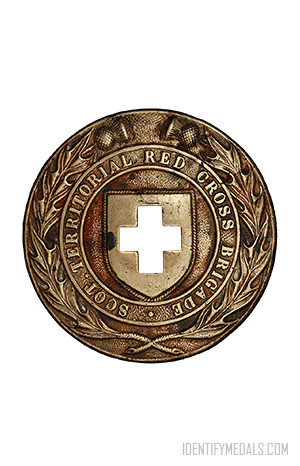
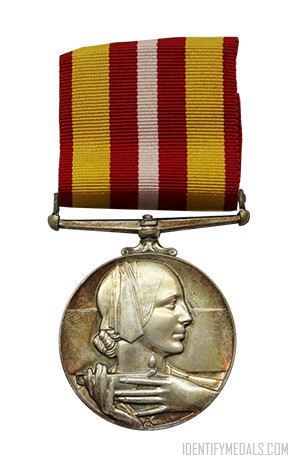
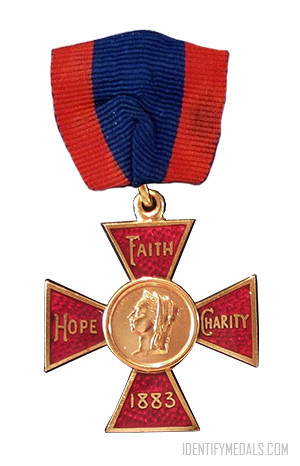
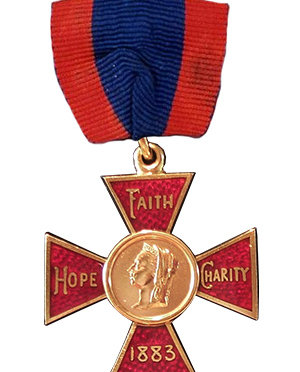
The Royal Red Cross is a military decoration awarded in the United Kingdom and Commonwealth for exceptional services in military nursing. It was established on 27 April 1883 by Queen Victoria.
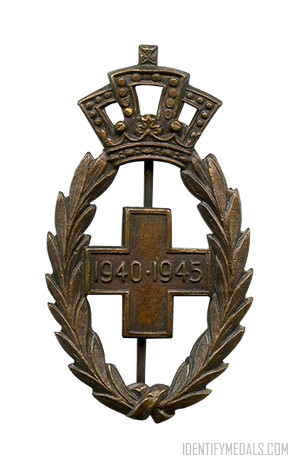
The Royal Red Cross has a single class of Member and it was first awarded to the founder of modern nursing, Florence Nightingale. A second and lower class, Associate, was added during World War I in 1917.

The award is awarded to a fully trained nurse of an officially recognized nursing service, military or civilian, who has shown exceptional devotion and competence in the performance of nursing duties, over a continuous and long period, or who has performed an exceptional act of bravery and devotion at her or his post of duty.

The decoration was conferred exclusively to women until 1976.  Recipients of the Royal Red Cross are entitled to use the post-nominal letters “RRC” or “ARRC” for Members and Associates respectively.

The Royal Red Cross Medal Design

The badge for RRC is shaped like a golden cross. It measures 1.375 inches (or 3.49 cm) wide.

The obverse is enameled red, with a circular medallion (now bearing an effigy of the reigning monarch) at its centre. The words “Faith“, “Hope” and “Charity” are inscribed on the upper limbs of the cross, and the year “1883” in the lower limb.

The reverse is plain except a circular medallion bearing the Royal Cypher of the reigning monarch.

The ribbon for both grades is dark blue with crimson edge stripes. To recognise further exceptional devotion and competency in the performance of nursing duties or exceptional act of bravery and devotion at her or his post of duty, a bar may be awarded to a recipient of the RRC. The bar is linked to the cross and is made of red enamel. A rosette is worn on the ribbon in undress to denote a bar to the RRC.

Find Red Cross Medals Online

More Red Cross Medals

The Conspicuous Gallantry Cross and Medal

The Conspicuous Gallantry Cross (CGC) is a second level military decoration of the British Armed Forces created in 1993.

The Conspicuous Gallantry Cross (also known as CGC) is a second level military decoration of the British Armed Forces created in 1993 after a review of the British honors system as part of the drive to remove distinctions of rank in awards for bravery.

The CGC now serves as the second level award for gallantry for all ranks across the whole armed forces. The CGC may be awarded posthumously, “in recognition of an act or acts of conspicuous gallantry during active operations against the enemy“.

All ranks of the Royal Navy, Royal Marines, British Army, and Royal Air Force may be awarded the CGC in recognition of qualifying acts of gallantry. Recipients are entitled to the postnominal letters CGC

The Conspicuous Gallantry Cross and Medal Design

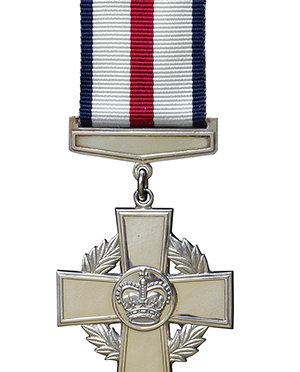
The medal is in the shape of a cross pattée and truck in silver. Arranged behind the cross, visible between the arms is a laurel wreath.

On the obverse, the circular medallion in the center depicts St. Edward’s crown. The reverse is plain which allows room for the engraving of the rank, name, and unit of its recipient.

The award date is also engraved on the reverse of the medal. The medal is suspended by a white ribbon with two narrow dark blue stripes at the edge and one center stripe in crimson.

The Order of the British Empire

The Most Excellent Order of the British Empire is a British order of chivalry that rewards charitable works and public service.
The Most Excellent Order of the British Empire is a British order of chivalry that rewards work with charitable and welfare organizations, contributions to the arts and sciences and public service outside the Civil service.

The Most Excellent Order of the British Empire was established on 4 June 1917 by King George V, and comprises five classes across both civil and military divisions. The most senior two of them make the recipient either a knight (male) or Dame (female).

The five classes of appointment to the Order are, in descending order of precedence:

  1. Knight Grand Cross or Dame Grand Cross of the Most Excellent Order of the British Empire (GBE)
  2. Knight Commander or Dame Commander of the Most Excellent Order of the British Empire (KBE or DBE)
  3. Commander of the Most Excellent Order of the British Empire (CBE)
  4. Officer of the Most Excellent Order of the British Empire (OBE)
  5. Member of the Most Excellent Order of the British Empire (MBE)

The senior two ranks of Knight or Dame Grand Cross, and Knight or Dame Commander, entitle their members to use the title of Sir for men and Dame for women before their forename.

The Order of the British Empire Medal Design

Members of the Order wear elaborate vestments on important occasions, which vary by rank: The mantle was originally made of yellow satin lined with blue silk but is now rose pink satin lined with pearl-grey silk. It’s worn only by Knights and Dames Grand Cross. The collar is made of gold and consists of six medallions depicting the Royal Arms, alternating with six medallions depicting the Royal and Imperial Cypher of George V (GRI, which stands for “Georgius Rex Imperator“) and is also worn by only Knights and Dames Grand Cross.

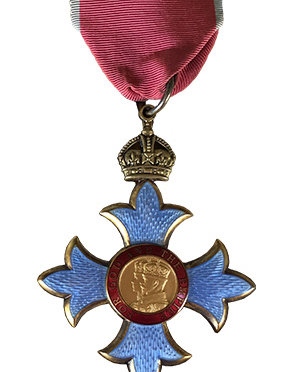
The star is an eight-pointed silver star worn pinned to the left breast and bearing a crimson ring with the motto of the Order inscribed. Within the ring, before 1937 a figure of Britannia was originally shown. Since then, the effigies of George V and Mary of Teck are shown instead.

The badge was, until 1937, suspended on a purple ribbon with a red central stripe for the military division. After 1937 the ribbon became rose-pink with pearl-grey edges, with the addition of a pearl-grey central stripe for the military division. The badge is in the form of a cross patonce, the obverse of which bears the same field as the star; the reverse bears George V’s Royal and Imperial Cypher. Both are within a ring bearing the motto of the Order. The size of the badges varies according to rank.

Find This Medal

Right Now on eBay 
Clicking a link to eBay may result in a referral commission being paid if a purchase is made.
Loading...