The Military Order of Max Joseph

The Military Order of Max Joseph was founded on 1 January 1806 by Maximilian I Joseph of Bavaria, the first king of Bavaria.

The Military Order of Max Joseph (or Militär-Max-Joseph-Orden in German) was founded on 1 January 1806 by Maximilian I Joseph of Bavaria, the first king of Bavaria and was the highest military order of the Kingdom of Bavaria.

The order came in three classes: Grand Cross (Großkreuz), Commander’s Cross (Kommandeurkreuz) and Knight’s Cross (Ritterkreuz). Individuals who received the order and were not already members of the nobility were ennobled and would add the title of “Ritter von” to their family name.

The order became obsolete in 1918 with the collapse of the Bavarian monarchy on Germany’s defeat in World War I although the orders chancery continued to process outstanding award recommendations to at least 1922.

The Military Order of Max Joseph Design

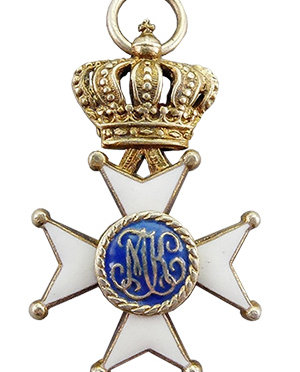
The badge of the order is a white-enameled gold Maltese cross with balls at each cross point.

In the obverse, the center medallion, in blue enamel and edged in gold, features the monogram of Max Joseph (a cursive “MJK“). On the reverse it displays the Latin motto of the order, “Virtuti pro patria” (“Bravery for the fatherland”), both in gold. Above the cross is a gold crown.

The badge of the Knight’s Cross is much smaller than that of many other military orders and decorations, measuring only 28-mm in width (and 50-mm in height including the crown and ring). It was worn from a ribbon on the officer’s medal bar ahead of other decorations or, typically, separately worn through the buttonhole. The badge of a Commander’s Cross was somewhat larger (38-mm by 55-mm) and worn from a ribbon around the neck. The Grand Cross was still larger (68-mm by 100-mm), with golden rays between the arms of the cross.

The star of the order, which only came with the Grand Cross, was a silver eight-pointed star (with each point made of five rays). The center of the star featured a badge of the order, but with an oversized medallion, bearing the motto “Virtuti pro patria”.

The ribbon of the order was black moiré with inner white and outer blue edge stripes.
The Royal Order of Saint George (Immaculate Conception)

The Royal Military Order of Saint George for the Defense of the Faith and the Immaculate Conception was founded by Maximilian II Emanuel.

The Royal Military Order of Saint George for the Defense of the Faith and the Immaculate Conception (also known as the Royal Bavarian House Equestrian Order of Saint George, Königlich Bayerischer Haus-Ritter-Orden vom Heiligen Georg in German) was founded by Maximilian II Emanuel, Elector of Bavaria around 1726 to honor the nobility and recognize distinguished civil and military service.

Its status as a Catholic Order was confirmed in a Papal Bull of 15 March 1728 – specifically comparing the Order with the Teutonic Order, which had likewise been transformed from a Crusading Order to an exclusive chivalric religious institution for the Nobility.

Various Bavarian Princes who in the fifteenth century had made pilgrimages to the Holy Sepulcher and were there invested as knights had each made a promise to Saint George, the patron saint of chivalry. Maximilian’s son, the Elector Karl-Albrecht, gave the new Order its title of Order of the Holy Knight and Martyr Saint George and the Immaculate Conception of the Holy Virgin Mary and established its statutes on March 28, 1729 as a Military Order of Chivalry for Roman Catholic noblemen.

The Royal Order of Saint George Design

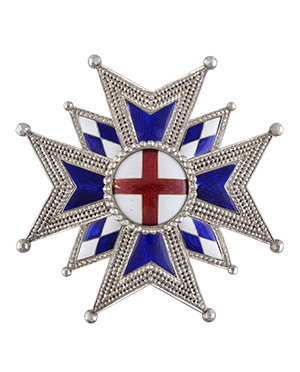
The badge of the Order is a blue enameled gold Maltese cross with white enameled borders and small gold balls on the points. There are blue diagonal lozenges (each bearing a gold letter, V. I. B. I., representing the words Virgini Immaculatae Bavaria Immaculata) between the arms also with white enameled borders.

The round gold medallion in the center obverse has the image of the Virgin Mary within a white enameled border. The reverse of the badge has the same design except that the arms of the cross are enameled red and the blue lozenges bear the letters I. V. P. F. (Justis Vt Palma Fiorebit or “Distinguished for Justice and Glory”). The center gold medallion is of Saint George slaying the Dragon within a green enameled laurel wreath.

The badge hangs from a light blue silk moire ribbon with white stripes near its border with narrow dark blue stripes on the inside of these white stripes. It’s suspended by a gold lion’s head holding in its mouth a blue reverse crescent shaped handle of the gold and enamel strapwork supporting the badge proper.

The officials of the order wore a special heraldic cross, a Maltese cross like the former, but with its round central medallion bearing the red cross of St. George.

On formal occasions the badge is worn by the members of the first class of the order (i.e., Grand Master, Grand Priors and Grand Commanders) from a gold collar formed of links in the form of a gold rectangle with gold Bavarian royal crowns on the either side of this rectangle, or in the form of two gold lions rampart combatant standing on a gold scroll.

The Merit Cross for War Aid

The Merit Cross for War Aid is a war decoration of Prussia awarded during World War I. The medal was instituted on 5 December 1916.

  • Time Period: Pre-WW1WW1
  • Institution: 5 December 1916
  • Country: Germany (Kingdom of Prussia)

The Merit Cross for War Aid (or Verdienstkreuz für Kriegshilfe in German) is a war decoration of Prussia awarded during World War I. The medal was instituted on 5 December 1916 and awarded for patriotic war aid service, without regard to status or rank.

An order was placed with the Nürnberg-based company Lauer as soon as Wilhelm II approved the floating sketch. Specimen crosses were submitted for imperial approval on December 26, 1915 and first 200 pieces were then ordered for immediate production and further distribution among distinguished Prussians. A special emphasis was made on luxury casing (brown leather boxes) for half of that lot reserved for dignitaries.

The very first recipients of Verdienstkreuz für Kriegshilfe were Wilhelm II himself and Generalfeldmarschall Paul von Hindenburg. Altogether 500,000 crosses and 167,643 m of ribbon worth 857,000 Marks were ordered.

The Merit Cross for War Aid Design

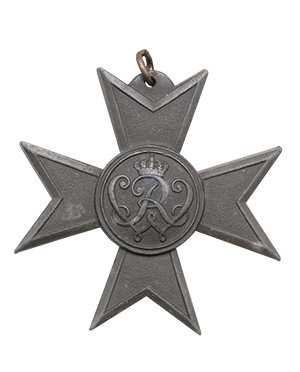
The Merit Cross for War Aid is in the shape of a Maltese cross, typically found made of blackened Kriegsmetall alloy.

The obverse of the Merit Cross for War Aid bears a circular central medallion with the crowned cipher of King Wilhelm II. On the reverse the central medallion is inscribed FÜR KRIEGS-HILFSDIENST (For War Aid Merit) above an oak wreath.

The upper arm is attached to a loop for suspension from its ribbon. The ribbon is red, white and black. Design of a new decoration was based on a Silver Merits Cross with an exception of central medallion on reverse (both sides of the latter were identical) and ribbon color.

The Military Honor Medal

The Military Honor Medal (Militär-Ehrenzeichen) is a military decoration awarded by the Kingdom of Prussia to military personnel.

  • Time Period: Pre-WW1
  • Institution: 1814
  • Country: Germany (Kingdom of Prussia)

The Military Honor Medal (or Militär-Ehrenzeichen in German) is a two-class military decoration awarded by the Kingdom of Prussia to military personnel from the rank of sergeant and below. The Military Honor Medal could also be awarded to foreign troops, an example being 52 awards to Russian soldiers for service in China in 1902.

The Military Honor Medal was typically awarded during wars when the Iron Cross was not. These conflicts included the wars of German Unification such as the Revolutions of 1848 in the German states, the Second Schleswig War in 1864, and the Austro-Prussian War in 1866. 

In 1864, King Wilhelm I reauthorized the Military Honor Medal for award with a redesign of the 1st class cross and a 2nd class medal. This new authorization also changed the criteria of the medal, meaning it was no longer necessary to be awarded the 2nd class medal before the 1st class cross.

The Military Honor Medal Design

The 1814 version shares the same design as the Honor Decoration, the only difference between the awards at that time was the color of ribbon suspending the cross.

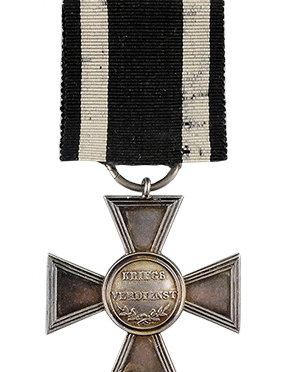
The 1st class medal is struck in silver and measures 36 mm. The design is a cross pattée with a center medallion. The obverse of the medallion bore the inscription VERDIENST UM DEN STAAT (Merit for the State) in three lines, while the reverse bore the crowned cypher of Friedrich Wilhelm III. The 2nd class is a 39 mm circular silver medal also bearing the inscription VERDIENST UM DEN STAAT on its obverse, surrounded by a laurel wreath, with the reverse depicting a large crowned cypher of Friedrich Wilhelm III.

In 1830, the General Honor Decoration, 1st class, became the Fourth Class of the Order of the Red Eagle, with the medallion in the center of the cross being replaced by an enamelled insignia of the Order of the Red Eagle.

The 1st class cross from 1864 is still in the form of a silver cross pattée, but the obverse now bore the inscription KRIEGS VERDIENST (War Merit) above a spray of laurel leaves. The reverse bore the crowned cypher of King Wilhelm. The 2nd class medal was still in the form of a circular medal but also gained the updated obverse inscription KRIEGS VERDIENST, with its obverse bearing the crowned cypher of King Wilhelm.

The Military Merit Cross (Prussia)

The Military Merit Cross was the highest bravery award of the Kingdom of Prussia for non-commissioned officers and enlisted soldiers.

  • Time Period: Pre-WW1
  • Institution: February 27, 1864
  • Country: Germany (Kingdom of Prussia)

The Military Merit Cross (or Militär-Verdienstkreuz in German, also known as Golden Military Merit Cross or Goldenes Militär-Verdienstkreuz) was the highest bravery award of the Kingdom of Prussia for non-commissioned officers and enlisted soldiers.

The Military Merit Cross was founded by King Wilhelm I of Prussia on February 27, 1864 and originally reserved for those in the rank of Feldwebel (the highest NCO grade) and below. Eligibility was later extended to soldiers in the rank of Offizier-Stellvertreter, comparable to a warrant officer-type rank.

The first 16 awards were made for the Austro-Prussian War of 1866. No awards were made for the Franco-Prussian War of 1870-71. The next group of awards were 17 made in 1879 to Russian soldiers for bravery in the Russo-Turkish War of 1877-78. Only five more awards were made before World War I: four for colonial conflicts and one for the Boxer Rebellion.

The first Military Merit Cross was awarded in October 1916, followed by 54 more awards in 1917. Despite the much larger number of awards in 1918, the decoration remained extremely rare. Recipients received a monthly stipend, which was maintained even after the end of the Prussian monarchy in November 1918 through the Third Reich era.

The Military Merit Cross Design

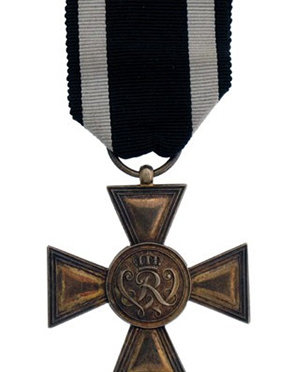
The design of the Military Merit Cross medal is a gold cross pattée with a center medallion. It measures 37.96 mm (wide) x 37.82 mm (high) and weighs 16.0 grams.

In the obverse is inscribed “Kriegsverdienst” (Military Merit). The reverse bears the crowned Royal Monogram of Wilhelm Rex.

The medal hangs from a double loop suspension.

The Iron Cross (EK 1813)

The Iron Cross (Eisernes Kreuz) is a military decoration of the Kingdom of Prussia and later the German Empire and Nazi Germany.

  • Time Period: Pre-WW1
  • Institution: March 1813
  • Country: Germany (Kingdom of Prussia)

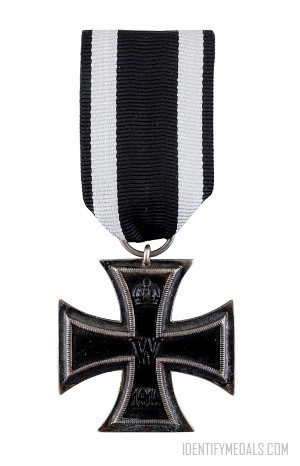
The Iron Cross (or Eisernes Kreuz, EK, in German) is a military decoration of the Kingdom of Prussia (and later the German Empire 1871–1918 and Nazi Germany 1933–1945.

It was established by King Friedrich Wilhelm III of Prussia in March 1813 and backdated to the birthday of his late wife Queen Louise on 10 March 1813 during the Napoleonic Wars. Louise was the first person to receive this decoration (posthumous).

The Iron Cross was normally a military decoration only, though there were instances of it being awarded to civilians for performing military functions.

The Iron Cross Design

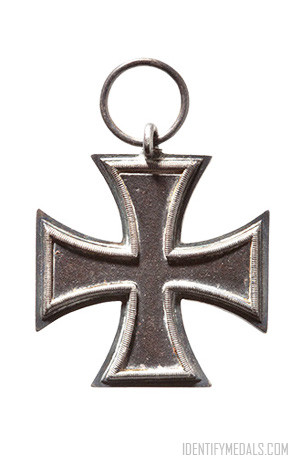
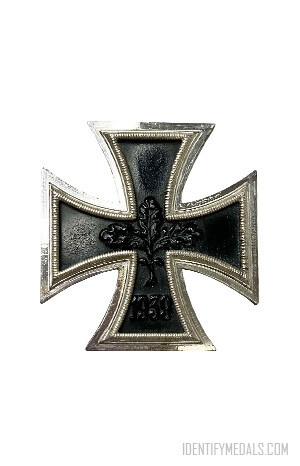
The design of the cross symbol is black with a white or silver outline, and was ultimately derived from the cross pattée of the Teutonic Order, used by knights on occasions from the 13th century.

It was designed by neoclassical architect Karl Friedrich Schinkel, based on a sketch by Frederick William. This heraldic cross took various forms throughout the order’s history, including a simple Latin cross, a cross potent, cross fleury and occasionally also a cross pattée.

The ribbon for the 1813 EK was black with two thin white bands, the colors of Prussia. The non-combatant version of this award had the same medal, but the black and white colors on the ribbon were reversed.

More Variations of the Iron Cross

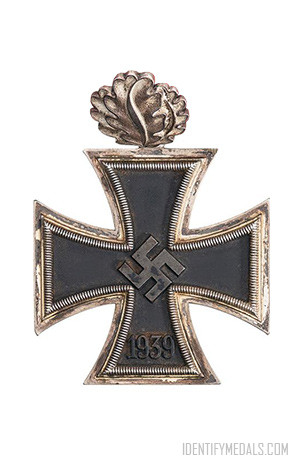
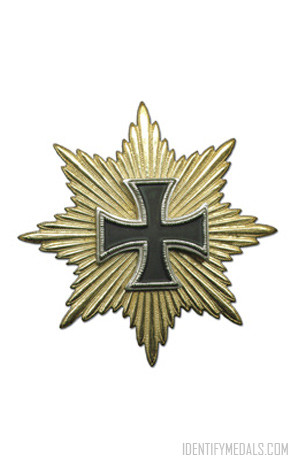
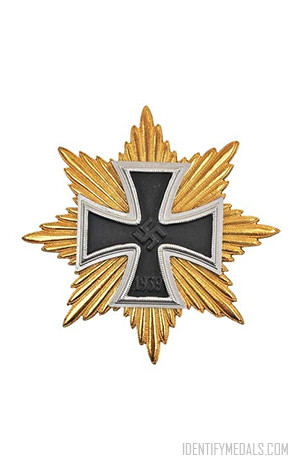
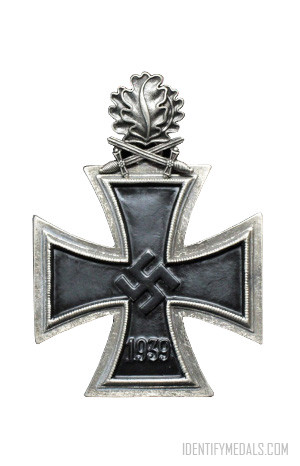
The Iron Cross, a prestigious German military decoration, has undergone several variations since its inception. For example, the Iron Cross 1813 was instituted during the Napoleonic Wars by King Frederick William III of Prussia, the Iron Cross 1914 was awarded during World War I, it was reinstated by Kaiser Wilhelm II, and the Iron Cross 1939 was revived by Adolf Hitler for World War II, with modifications including a swastika.

Find the Iron Cross Medal Online

Right Now on eBay 
Clicking a link to eBay may result in a referral commission being paid if a purchase is made.
Loading...

Further Reading About the Iron Cross

Discover the stories behind the Iron Cross with these compelling books and delve into the rich history and significance of this prestigious military decoration.

The Order of Louise

The Order of Louise was founded on 3 August 1814 by Frederick William III of Prussia to honor his late wife, the beloved Queen Louise.

The Order of Louise (or Luisen-Orden in German) was founded on 3 August 1814 by Frederick William III of Prussia to honor his late wife, the beloved Queen Louise. It was intended strictly for women whose service to Prussia was worthy of such high national recognition. Its dame companion members were limited to 100 in number, and were intended to be drawn from all classes.

The Chief of the Order of Louise was the reigning queen. Daughters in the royal family were invested with this order in lieu of the Order of the Black EagleOrder of the Red Eagle Grand Cross, Prussian Crown Order First Class, and Royal House Order of Hohenzollern that were reserved for the sons.

The Order of Louise was renewed with each successive monarch. At its initial creation in 1814, the Order was only available in one class. A second class was added during the reign of Wilhelm I.

The Order of Louise Design

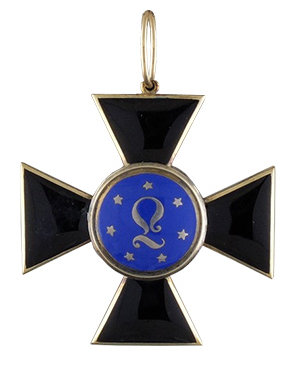
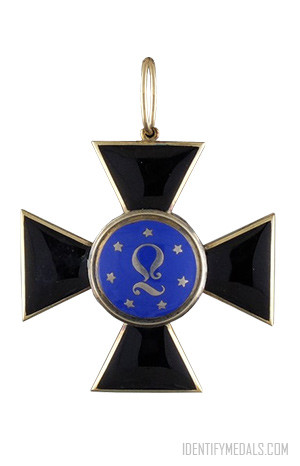
Dames, First Class, wore the black-enameled cross with its blue-enameled, medallion centerpiece, suspended from a predominantly white ribbon, with three black stripes, as tied in a bow. Though the statutes indicate that the badge was to be worn on the left breast, many period portraits show the members wearing the badge on or at the left shoulder of their dresses.

Dames, Second Class, wore a similarly-designed silver cross, minus the black enamel, which was also worn suspended from the white and black bow. The Prussian State Handbook of 1907 indicates further variants and subsets of the Second Class of the order: II.1 with silver crown, II.1 (without crown), and II.2.

More Prussian Orders

Throughout Prussian history, these orders played a significant role in the social hierarchy and served as tangible expressions of royal favor and recognition. They continued to be awarded even after the dissolution of the Kingdom of Prussia, remaining as enduring symbols of valor, service, and honor in German society. Here are some more about Prussian Orders:

The Order of Saint John (Johanniter Order)

The Bailiwick of Brandenburg of the Chivalric Order of Saint John of the Hospital at Jerusalem is the oldest surviving chivalry order.

The Bailiwick of Brandenburg of the Chivalric Order of Saint John of the Hospital at Jerusalem (or Balley Brandenburg des Ritterlichen Ordens Sankt Johannis vom Spital zu Jerusalem in German), also known as the Order of Saint John or the Johanniter Order, is the German Protestant branch of the Knights Hospitaller, the oldest surviving chivalry order.

The order is considered to have been founded in Jerusalem in the year 1099 AD.

It is led by its thirty-seventh Herrenmeister (“Master of the Knights” or Grand Master), Prince Oskar of Prussia. Each of its knights is either a Knight of Justice (Rechtsritter) or a Knight of Honor (Ehrenritter). There are also classes of Honorary Commander (Ehrenkommendator), given to Knights of Justice who have rendered distinguished service to the Order, and Honorary Member (Ehrenmitglieder).

Along with the Roman Catholic Sovereign Military Order of Malta, these four “Alliance Orders” represent the legitimate heirs of the Knights Hospitaller: The London-based Most Venerable Order of the Hospital of Saint John of Jerusalem, the Swedish Johanniterorden i Sverige, and the Dutch Johanniter Orde in Nederland.

The Order of Saint John Design

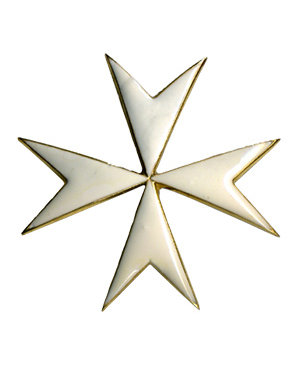
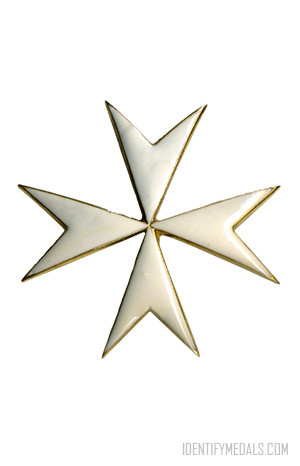
The basic insignia of the Order is a white-enamelled Maltese cross. The crowned Brandenburg eagles between the arms of the crosses date from 1668; they are gold for Knights of Justice, Honorary Commanders, Commanders, and the Herrenmeister. On the crosses of Knights of Honour and Honorary Members, the eagles are enameled black with only the tiny crowns on each eagle’s head left enameled gold.

The cloak of the Order is plain black with a large, white, linen eight-pointed cross on the left breast. 

Excluding the crown, the cross is between 5 cm and 7cm in diameter, depending on the rank. Each cross is worn from a black-moire, 4.5-centimeter-wide ribbon worn about the neck. All members of the Order may also wear a plain, Maltese cross as a star or ‘breast badge’. A white-enameled Maltese cross in either gold or silver may be worn on the left lapel of a knight’s suit coat or sportcoat.

From the late eighteenth century, the Johanniter have had a uniform similar to the Knights of Malta. Though not abolished, this uniform has not been worn since before the Second World War.

More Prussian Orders

Throughout Prussian history, these orders played a significant role in the social hierarchy and served as tangible expressions of royal favor and recognition. They continued to be awarded even after the dissolution of the Kingdom of Prussia, remaining as enduring symbols of valor, service, and honor in German society. Here are some more about Prussian Orders:

Orden of Merit Pour le Mérite

The Pour le Mérite (“For Merit” in French) is an order of merit established in 1740 by King Frederick II of Prussia.

The Pour le Mérite (“For Merit” in French) is an order of merit established in 1740 by King Frederick II of Prussia. The order was awarded as both a military and civil honor and ranked, along with the Order of the Black Eagle, the Order of the Red Eagle and the House Order of Hohenzollern, counting among the highest orders of merit in the Kingdom of Prussia.

The Pour le Mérite was conferred both for military (1740–1918) and civil (1740–1810, after 1842 as a separate class) services, strictly as a recognition of extraordinary personal achievement – rather than a general marker of social status or a courtesy-honour.

The order was secular, and membership endured for the remaining lifetime of the recipient, unless renounced or revoked. The order was named in French because it was the leading international language and the favored language at Frederick’s court. Despite the rising tide of nationalism and increasing hostility between French and Germans during the 19th century, the name remained the same. Ironically, many of its recipients were honored for acts performed in wars against France.

The Pour le Mérite Design

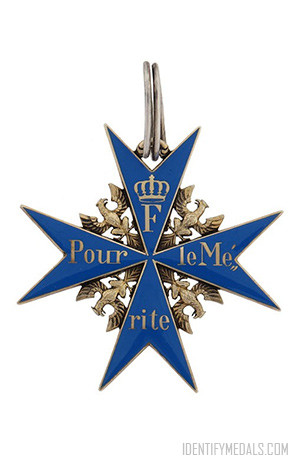
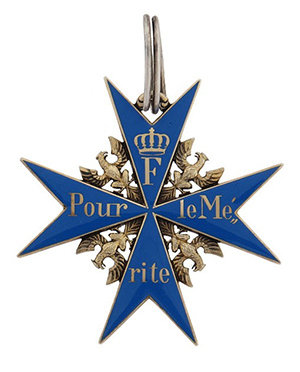
The insignia of the military award is a blue-enameled Maltese Cross with golden eagles between the arms (which is based on the symbol of the Johanniter Order).

The Prussian royal cypher and the words “Pour le Mérite” (“For Merit”) are written in gold letters on the body of the cross.

More Prussian Orders

Throughout Prussian history, these orders played a significant role in the social hierarchy and served as tangible expressions of royal favor and recognition. They continued to be awarded even after the dissolution of the Kingdom of Prussia, remaining as enduring symbols of valor, service, and honor in German society. Here are some more about Prussian Orders:

The House Order of Hohenzollern

The House Order of Hohenzollern is a dynastic order of knighthood of the House of Hohenzollern awarded to officers and civilians.

The House Order of Hohenzollern (or Hausorden von Hohenzollern or Hohenzollernscher Hausorden in German) is a dynastic order of knighthood of the House of Hohenzollern awarded to military commissioned officers and civilians of comparable status.

The House Order of Hohenzollern was instituted on December 5, 1841, by joint decree of Prince Konstantin of Hohenzollern-Hechingen and Prince Karl Anton of Hohenzollern-Sigmaringen. These two principalities in southern Germany were Catholic collateral lines of the House of Hohenzollern, cousins to the Protestant ruling house of Prussia. On August 23, 1851, after the two principalities had been annexed by Prussia, the order was adopted by the Prussian branch of the house.

Associated with the various versions of the order were crosses and medals which could be awarded to lower-ranking soldiers and civilians.

The Royal House Order of Hohenzollern came in the following classes:

  • Grand Commander (Großkomtur)
  • Commander (Komtur)
  • Knight (Ritter)
  • Member (Inhaber) – For soldiers who were not officers, as well as civilians.

The House Order of Hohenzollern Design

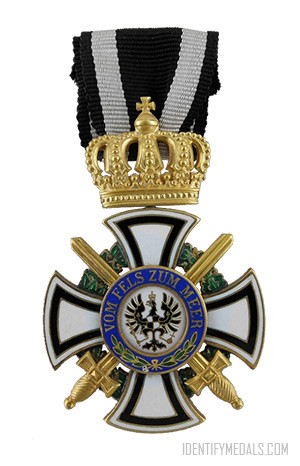
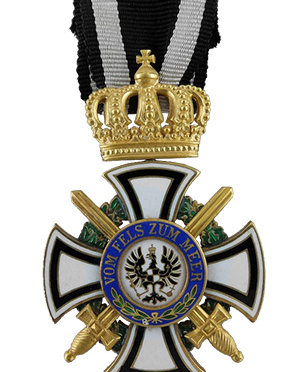
The badge is a cross pattée or “Alisee” cross with convex edges and curved arms. All versions of the badge feature white enamel on the higher classes and a black enameled stripe near the sides of the cross. Between the arms of the cross is a wreath of laurel leaves (left side) and oak leaves (right side).

The cross bears a center medallion with different coats of arms, mottos, dates and ciphers for each of the Royal, Princely and Romanian versions:

  • The white-enameled medallion bears a black Prussian royal eagle with the Hohenzollern house coat of arms on a shield on the eagle’s chest and a gold-rimmed band of blue enamel with the motto in gold letters: vom Fels zum Meer (“From the cliffs to the sea”) and a wreath of laurel below.
  • The white-enameled medallion of the Princely House Order of Hohenzollern bears the Hohenzollern coat of arms (a quartered shield of black and white) under a princely crown.
  • The white-enameled medallion of the Romanian House Order bore a black Romanian eagle with the Hohenzollern coat of arms on a shield on the eagle’s chest.

The ribbon of the order is white with three black stripes (with slight variations among the Royal, Princely and Romanian versions).

More Prussian Orders

Throughout Prussian history, these orders played a significant role in the social hierarchy and served as tangible expressions of royal favor and recognition. They continued to be awarded even after the dissolution of the Kingdom of Prussia, remaining as enduring symbols of valor, service, and honor in German society. Here are some more about Prussian Orders: