The Lifesaving Medal

The Lifesaving Medal was a civil decoration of the Kingdom of Prussia awarded to those who had saved a person’s life at risk to their own.

The Lifesaving Medal (on Rettungsmedaille am Band” in German) was a civil decoration of the Kingdom of Prussia.

Established 1 February 1833, it was awarded to individuals who had saved another person’s life, at risk to their own.

This medal is referred to as the Lifesaving Medal on Band to differentiate it from a previous non-portable award established in 1802. Otto von Bismarck received it for rescuing a drowning man.

The Lifesaving Medal Design

The medal is circular and struck in silver. The obverse presents the head of King Friedrich Wilhelm III in relief, facing left, in the center.

Around it is circumscribed FRIEDRICH WILHELM III KÖNIG VON PREUSSEN. The reverse has inscribed FÜR RETTUNG AUS GEFAR (FOR RESCUE FROM DANGER) within an oak leaf wreath, measuring 24.79 mm in diameter, on loop for suspension from the period original ribbon, and in fine condition.
The Red Crescent Medal

The Red Crescent Medal was instituted in 1912 to reward services to the Red Crescent (the equivalent of the Red Cross in Islamic countries).

The Red Crescent Medal was instituted in 1912 by the 35th Sultan of the Ottoman Empire Mehmed V Reshad to reward services to the Red Crescent (the equivalent of the Red Cross in Islamic countries). It was issued to Red Crescent members and volunteers regardless of their gender for merits in care of sick and wounded.

This medal came in three classes: Gold, silver and bronze. Recommendations for award of the two lower classes were made by the Executive Committee of the Red Crescent, but only the Sultan himself could recommend a recipient of the first class.

This medal continued to be awarded after World War I, until the establishment of the Republic.

The Red Crescent Medal Design

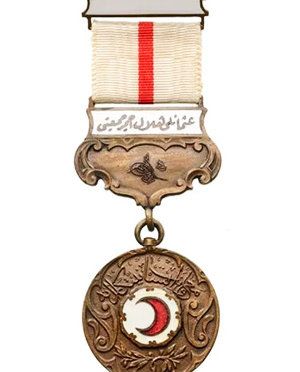
The Red Crescent medal is round, 29 mm in diameter. The obverse bears a red crescent facing left on a white field enameled in the center. Below it is a sprig of laurel, and above it the inscription “Humane Assistance“. The suspension bar bears the tughra of Sultan Mehmed Reshad V below a white enameled bar reading “Ottoman Red Crescent Association.” There is also a bar at the top of the ribbon, enameled white, which is sometimes seen with year designations on the bar, indicating years served with the Red Crescent.

The medal was worn suspended from a silk white ribbon with a central vertical red stripe. Women recipients wore decoration on a traditional bow.

The Liyakat Medal

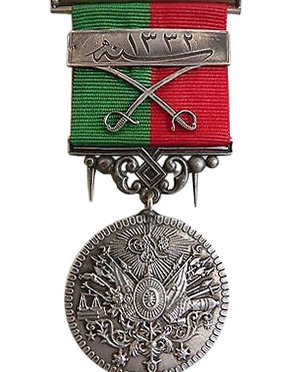
The Liyakat Medal (Liyakat Madalyasi) was a decoration of the Ottoman Empire established in 1890 and awarded in two classes: gold or silver.

The Liyakat Medal (or Liyakat Madalyasi in Turkish) was a decoration of the Ottoman Empire established in 1890 and awarded in two classes: gold or silver. The medal was not strictly a military award and could be awarded for general merit in society such as to civilians for general merit to society.

The medal was a common military decoration through the end of the First World War. In 1905 the statutes were amended to allow women to receive the medal for charitable work, service to mosques or schools, and other decidedly civilian merits.

The Liyakat Medal Design

The medal measured 25 mm in diameter came in both gold and silver classes. It’s suspended from a red ribbon with narrow green side stripes.

The obverse bears the ottoman trophy of arms with the sultan’s cipher above it. The reverse bears the inscription “Medal of Merit Especially for Those Who Have Shown Loyalty and Bravery” and the date AH 1308 (1890 AD).

During World War I a clasp of two crossed swords was attached to the ribbon with the date AH 1333 (1915) inscribed upon them. Copies of the Liyakat medal made in Germany and Austria around the First World War are sometimes found with and without the crossed sabers device.  These copies are rarer than original pieces, and command a premium among collectors.

The Imtiyaz Medal

The Imtiyaz Medal (İmtiyaz Madalyası), also known as Nishan-i-Imtiaz (Nişan-ı İmtiyaz) is an Ottoman military decoration instituted in 1882.

The Imtiyaz Medal (or İmtiyaz Madalyası in Turkish), also known as Nishan-i-Imtiaz (Nişan-ı İmtiyaz) is an Ottoman military decoration that was instituted in 1882.

The gold Imtiyaz medal was the highest-ranking military decoration of the Ottoman Empire while the silver one ranked above the silver Liyakat Medal, but below the gold Liyakat.

A few examples of this medal are known to have been struck with the name of the recipient in raised letters, usually given to the heads of state of Turkey’s allies during World War I.

The Imtiyaz Medal Design

The medal is presented in two classes: gold and silver. The medal measures 37 mm and bears the Ottoman military coat of arms on the obverse, with its inscription “Relying on Divine Guidance and Assistance, Abdulhamid Khan, Sultan of the Ottoman Empire“. The tughra of Sultan Abdulhamid II is at the top.

The reverse has an inscription in Ottoman that translates roughly as “Medal for Those That Have Shown Exceptional Loyalty and Bravery for the Ottoman Empire“. Below that is a curved rectangular area where the name of the recipient could be engraved, and at the bottom is the date 1300 (1882).

The ribbon of this medal is half red, half green. Awards dating from World War I have a ribbon device, in the same material as the medal itself, consisting of a bar with the year 1333 (1915) above a pair of crossed sabers.

The Turkish Medal for the Siege of Silistria

The Turkish Medal for the Siege of Silistria is a campaign medal issued to British personnel present during the period of the Crimean War.

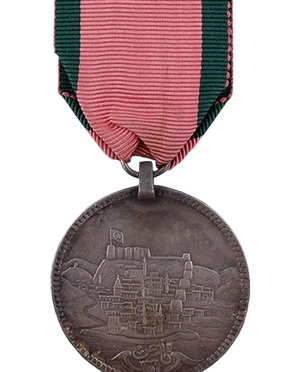
The Turkish Medal for the Siege of Silistria (or Silistre Madalyası in Turkish) is a campaign medal issued to the handful of British personnel who were present during the period of the Crimean War (28 March 1854 to 30 March 1856).

During the battle, Russian forces besieged the Ottoman fortress of Silistra. If the Russians were to make a success of their campaign on the Danube, they needed to capture the stronghold of Silistria, but the successful resistance mounted by the Turks during the course of a two month siege (April-June 1854) was unexpected by the Russians. While initially successful, the Russians were forced after several weeks to abandon the siege and retreat due to political pressure. The failure of the siege signaled a general withdrawal by Russia from the Principalities, which was largely completed by September 1854.

The Medal for the Siege of Silistria Design

The medal is made in silver and measures 36.5 mm.

The Iftikhar Sanayi Medal

The Iftikhar Sanayi Medal is a medal made of gold or silver awarded by the Ottoman Empire and first granted by Sultan Abdulhamid II.

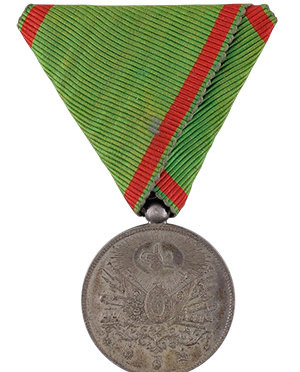
The Iftikhar Sanayi Medal (also known as Medal of Iftikhar or Medal of Sanayi) is a medal made of gold or silver awarded by the Ottoman Empire and first granted by Sultan Abdulhamid II.

The medal was generally awarded for loyalty, valor, heroism, and accomplishments in various fields such as agriculture, arts, and crafts. These medals were also used as war medals by attaching inscribed clasps to their ribbons. The name of this medal was originally “Iftihar Madalyasi“, which was used earlier for the General Service Medal, but was later changed to “Sanay-i Nefise Madalyasi” which translates roughly as “Medal of Beautiful Arts“.

Most of the recipients were artists and artisans such as personnel of the Yildiz porcelain factory, or performers at the private theater of Sultan Abdulhamid II at the palace.

The medal was awarded in two classes: Gold and Silver.

The Iftikhar Sanayi Medal Design

The obverse of the Sanayi medal features an Ottoman trophy of arms and on the reverse side has a laurel wreath in the center, leaving a blank space for the awardee’s name to be engraved.

The Doggersbank Medal

The Doggersbank Medal was awarded to the officers who took part in the battle of Doggersbank, a naval battle that took place in 1781.

The Doggersbank Medal was awarded to the officers who took part in the battle of Doggersbank, a naval battle that took place on 5 August 1781 during the Fourth Anglo-Dutch War.

Both sides claimed victory although no ships were captured and both convoys escaped. Casualties were high on both sides, considering the number of ships involved. Because the Dutch merchantmen reached the harbor and the British fleet first left the battlefield, it was a victory in the eyes of the Dutch.

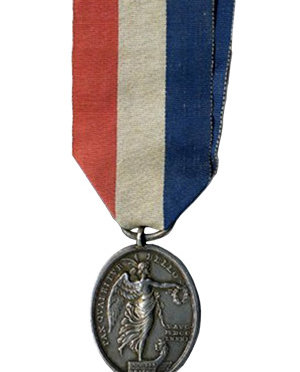
The Netherlands honored the fleet with numerous parades, receptions, poems and plays. As well as receiving a monetary reward, surviving officers, midshipmen and non-commissioned officers weew awarded a commemorative medal, the Doggersbank Medaille. Nineteen gold medals with a red, white and blue ribbon were awarded to Admiral Zoutman, his first officer (Van Kinsbergen) and the 17 captains of the escorting fleet. Willem V personally hung them around the neck of the flag and supreme officers.

The Doggersbank Medal Design

The Doggersbank medal is oval in shape and thirty-six millimeters high.

On the obverse, the winged Goddess Victoria is depicted on the bow of a warship. In her right hand she holds a wreath of leaves and on the hull of the ship is written “DOGGERSBANK“. Beginning at her right foot and ending at the wreath of  foliage, the left side of the medal reads “PAX QVAERITVR BELLO” (Latin for: “Peace is achieved through war“). The date of the battle “V AVG MDCCLXXXI” (August 5, 1781) is indicated on the right side of the medal.

The reverse of the medal features the text “EXI MIÆ VIRTU TIS PRÆM IVM” (“As a reward for outstanding prowess“) in a wreath of orange tree leaves.

The senior officers received silver medals on the same ribbon. The lieutenants received a silver medal on an orange ribbon.

The Inter Allied Victory Medal (Greece)

The Greek Victory Medal was instituted to commemorate the Allied victory in the First World War. It was designed by Henry-Eugène Nocq.

The Allied Victory Medal was recommended by an inter-allied committee in March 1919. Fourteen victorious countries finally awarded the medal after World War I, and each allied nation would design a ‘Victory Medal’ for award to their own nationals. Certain features were to be shared: a winged figure of Victory on the obverse and the same ribbon.

For most of the war, Greece was officially neutral. Finally in 1918 Greece sided with the allies, sending 230,000 troops to fight in Macedonia. The Greek Victory medal followed the proposal made by French Marshal Ferdinand Foch, who was the supreme commander of the Allied Forces during the war. It was instituted on 22nd September 1920 and was awarded to military personnel who had served at least 3 months active service or had been wounded in action, died of wounds or had been killed in action and to sailors with service of at least a year between 14th June 1917 and 25th November 1918. Approximately 200,000 medals were issued.

The Greece Inter Allied Victory Medal Design

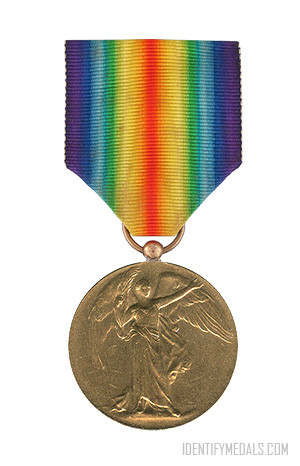
The Victory Medal measures 36 millimetres (1.4 in) in diameter and was designed by William McMillan. The design and ribbon was also adopted by Belgium, Brazil, Cuba, Czechoslovakia, France, Greece, Italy, Japan, Portugal, Romania, Siam, Union of South Africa and the USA. Each allied nation would design a ‘Victory Medal’ for award to their own nationals, all issues having certain common features, including a winged figure of victory on the obverse and the same ribbon.

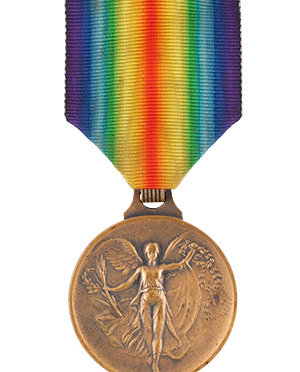
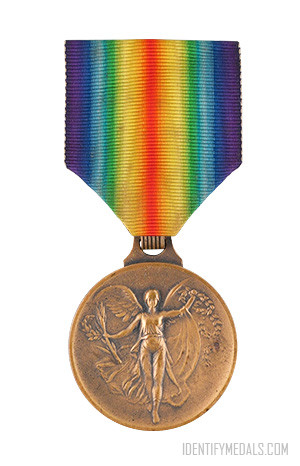
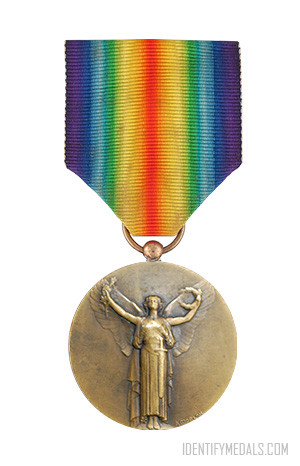
The obverse of the medal bears the winged, full-length figure of Victory designed by Henry-Eugène Nocq (1868–1944), a recognized French sculptor and medalist who lived in Paris, where the medal was also struck. The image of Victory was modeled after the 5th Century BCE statue of Nike by Paionios. The reverse bears “The Great War for Civilization” in Greek, and an infant Hercules wrestling with two snakes. The tablet in the center reads “Allies and Comrades” and lists the allied nations.

The 39 millimeters (1.5 in) wide watered ribbon has an iridescent color scheme, with the violet moving through to a central red stripe where both schemes meet. It attaches to the medal through a ring suspender. The recipient’s name, rank, service number and unit were impressed on the edge of the medal. The name of the regiment or corps was omitted on medals awarded to Army officers.

All the Inter-Allied Victory Medal Variations

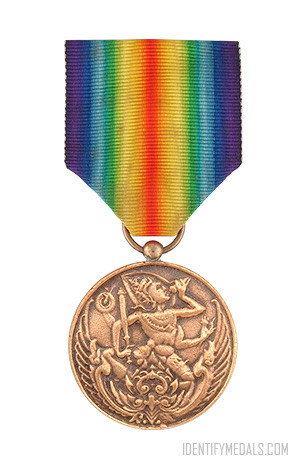
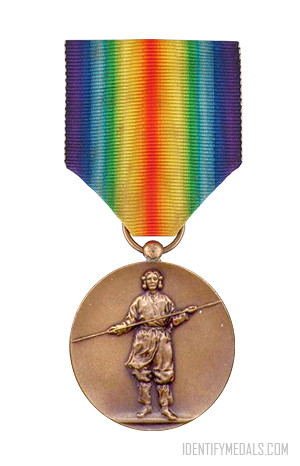
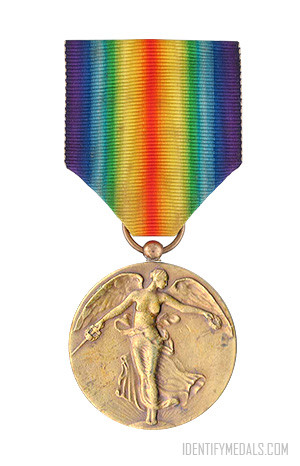
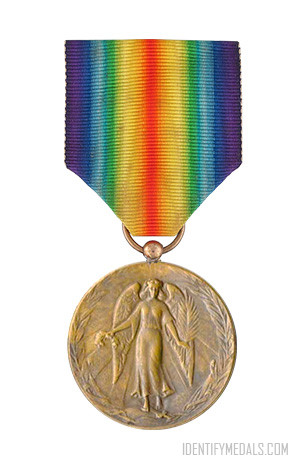
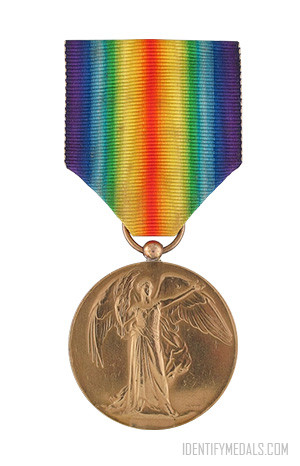
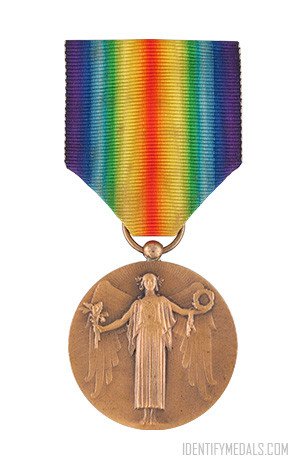
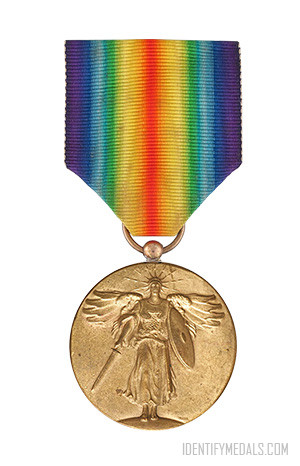
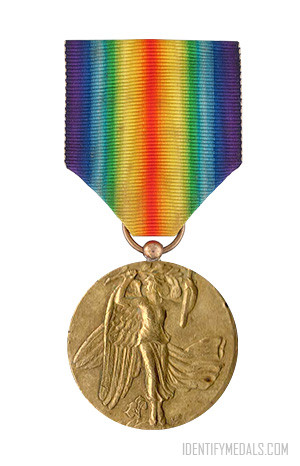
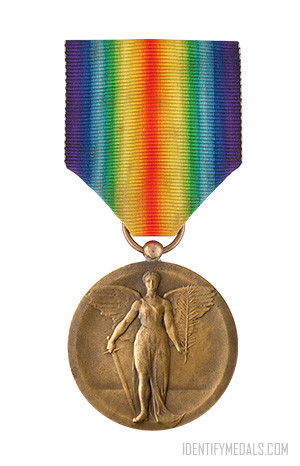
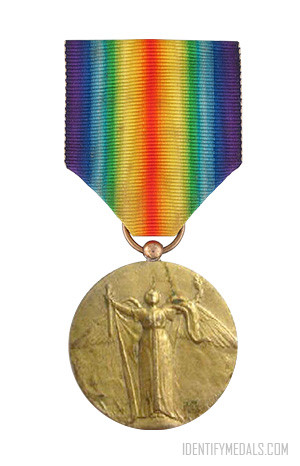
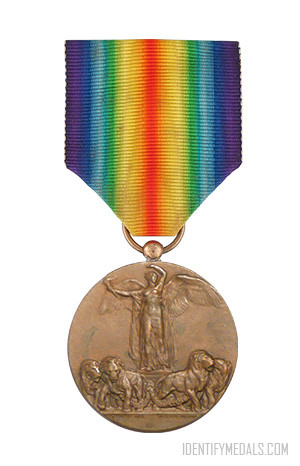
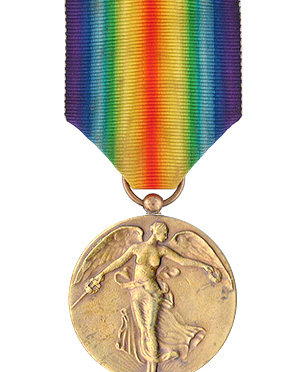
Although each country designed its own version of the Inter-Allied Victory Medal, all of them shared some common elements, such as a winged victory figure on the obverse and a similar ribbon with rainbow colors symbolizing unity among the Allies. Here are the versions for all countries:

Find an Inter-Allied Victory Medal Online

Right Now on eBay 
Clicking a link to eBay may result in a referral commission being paid if a purchase is made.
Loading...

The Inter Allied Victory Medal (Belgium)

The Belgian Victory Medal was established by royal decree on 15 July 1919 and awarded to all members of the Belgian Armed Forces.

The Allied Victory Medal was recommended by an inter-allied committee in March 1919. Fourteen victorious countries finally awarded the medal after World War I, and each allied nation would design a ‘Victory Medal’ for award to their own nationals. Certain features were to be shared: a winged figure of Victory on the obverse and the same ribbon.

The Belgian Victory Medal was established by royal decree on 15 July 1919 and awarded to all members of the Belgian Armed Forces.

The Belgium Inter Allied Victory Medal Design

The Victory Medal measures 36 millimetres (1.4 in) in diameter and was designed by William McMillan. The design and ribbon was also adopted by Belgium, Brazil, Cuba, Czechoslovakia, France, Greece, Italy, Japan, Portugal, Romania, Siam, Union of South Africa and the USA. Each allied nation would design a ‘Victory Medal’ for award to their own nationals, all issues having certain common features, including a winged figure of victory on the obverse and the same ribbon.

The obverse of the medal was designed by Belgian sculptor Paul Du Bois.

The reverse shows the words ‘THE GREAT / WAR FOR / CIVILISATION / 1914-1919’ surrounded by a laurel wreath.

The 39 millimeters (1.5 in) wide watered ribbon has an iridescent color scheme, with the violet moving through to a central red stripe where both schemes meet. It attaches to the medal through a ring suspender. The recipient’s name, rank, service number and unit were impressed on the edge of the medal. The name of the regiment or corps was omitted on medals awarded to Army officers.

All the Inter-Allied Victory Medal Variations

Although each country designed its own version of the Inter-Allied Victory Medal, all of them shared some common elements, such as a winged victory figure on the obverse and a similar ribbon with rainbow colors symbolizing unity among the Allies. Here are the versions for all countries:

Find an Inter-Allied Victory Medal Online

Right Now on eBay 
Clicking a link to eBay may result in a referral commission being paid if a purchase is made.
Loading...

The Inter Allied Victory Medal (Brazil)

The Brazilian Victory Medal was established in January 24, 1919 and awarded to all military personnel or civilians employed in war service.

The Allied Victory Medal was recommended by an inter-allied committee in March 1919. Fourteen victorious countries finally awarded the medal after World War I, and each allied nation would design a ‘Victory Medal’ for award to their own nationals. Certain features were to be shared: a winged figure of Victory on the obverse and the same ribbon.

The President of the United States of Brazil, adopted the proposal of Marshal Foch in January 24, 1919 so that all the fighters of the Great War received a commemorative medal. Brazil had a sizable merchant fleet and had lost a number of ships to German submarines when it joined the allies in October 1917, contributing with two cruisers and two destroyers and their crews placed under command of the British Admiralty.

Brazilians also sent a medical mission to Europe and a number of soldiers to set up several field medical stations and a 300-bed hospital near Paris. Approximately 2,500 medals were produced for these sailors, soldiers and medical personnel.

The Brazil Inter Allied Victory Medal Design

The Victory Medal measures 36 millimetres (1.4 in) in diameter and was designed by William McMillan. The design and ribbon was also adopted by Belgium, Brazil, Cuba, Czechoslovakia, France, Greece, Italy, Japan, Portugal, Romania, Siam, Union of South Africa and the USA. Each allied nation would design a ‘Victory Medal’ for award to their own nationals, all issues having certain common features, including a winged figure of victory on the obverse and the same ribbon.

The obverse of the Brazilian Victory Medal featured a symbolic figure of Victoria fringed with two palms on a plain background.

The reverse shows the words ‘THE GREAT / WAR FOR / CIVILISATION / 1914-1919’ surrounded by a laurel wreath.

The 39 millimeters (1.5 in) wide watered ribbon has an iridescent color scheme, with the violet moving through to a central red stripe where both schemes meet. It attaches to the medal through a ring suspender. The recipient’s name, rank, service number and unit were impressed on the edge of the medal. The name of the regiment or corps was omitted on medals awarded to Army officers.

All the Inter-Allied Victory Medal Variations

Although each country designed its own version of the Inter-Allied Victory Medal, all of them shared some common elements, such as a winged victory figure on the obverse and a similar ribbon with rainbow colors symbolizing unity among the Allies. Here are the versions for all countries:

Find an Inter-Allied Victory Medal Online

Right Now on eBay 
Clicking a link to eBay may result in a referral commission being paid if a purchase is made.
Loading...