The Kenyan Silver Star

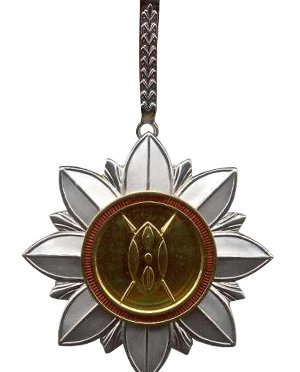
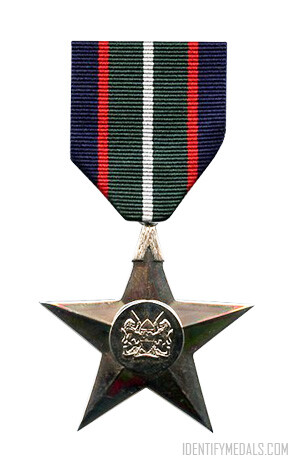
The Kenyan Silver Star was instituted on 8 December 1983 and is awarded to members of the uniformed services for conspicuous acts of valor.
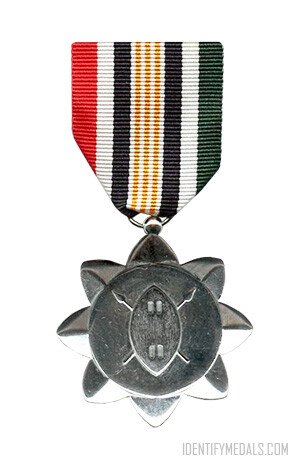
The Kenyan Silver Star was instituted on 8 December 1983 and is awarded to members of the uniformed services for conspicuous acts of valor, self-sacrifice, or devotion to duty in the face of danger.

The medal is a cupro-nickel, 18.7 mm (0.74 inches) five-pointed star and bears the arms of the Republic of Kenya on the obverse. The reverse is plain. 

Find Kenyan Medals Online

More Kenyan Medals

Books About Kenyan History

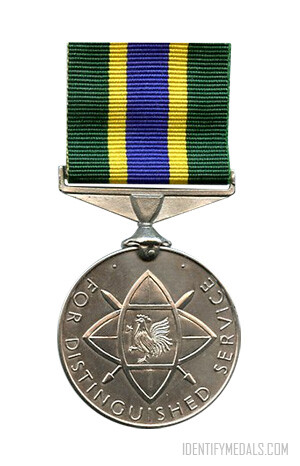
The Distinguished Conduct Medal of Kenya

The Distinguished Conduct Medal is a Kenyan award given for exceptionally distinguished service or devotion by members of the Armed Forces.

  • Time Period: Post-WW2
  • Institution: 21 April 1966
  • Country: Kenya

The Distinguished Conduct Medal is a Kenyan award given for exceptionally distinguished service or devotion to duty by members of the Armed Forces. 

It was instituted on 21 April 1966. During the presidency of Arap Moi, the Coat of Arms on the obverse of the medal has been replaced by the effigy of the President.

Find Kenyan Medals Online

More Kenyan Medals

Books About Kenyan History

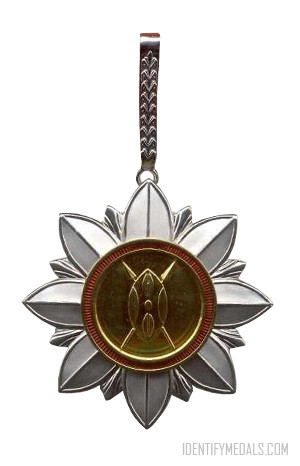
The Order of the Grand Warrior of Kenya (O.G.W)

The Order of the Grand Warrior of Kenya is an award presented to individuals in recognition of outstanding service rendered to the country.

The Order of the Grand Warrior of Kenya (or OGW) is an award presented to individuals in recognition of an outstanding service rendered to the country. Especially, those who put their lives at risk to save their fellow countrymen and protect others.  

Among the notable recipients of this award include Former Senate Speaker, Hon. David Ekwee Ethuro, current speaker of the National Assembly, Hon. Justin Bedan Muturi, former leader of the majority party in the Senate, Hon. Prof. Kithure Kindiki, and the current leader of majority party in the national assembly Hon. Adan Duale.

The Order of the Grand Warrior of Kenya Design

The Order of the Grand Warrior of Kenya medal features a central emblem, in the obverse, with a shield and crossed spears. The medal is adorned with a ribbon in the colors of the Kenyan flag: black, red, green, and white.

About the Kenyan Presidential Awards

In Kenya, it’s tradition to present various presidential awards during National Holidays to honor individuals for their excellent service to the nation. These awards are conferred by the sitting President and government, advised by the National Honors and Awards Committee.

Nominees are recommended by county commissioners, NGOs, government agencies, religious institutions, individuals, and community groups. The National Honors Act of 2014 outlines criteria for eligibility, such as displaying exceptional abilities, courage, leadership, and making significant contributions in fields like social, economic, scientific, public service, and governance. Recipients often include state or public office holders and athletes who have brought glory to the country.

Once awarded, recipients can add the honor’s initials before their name.

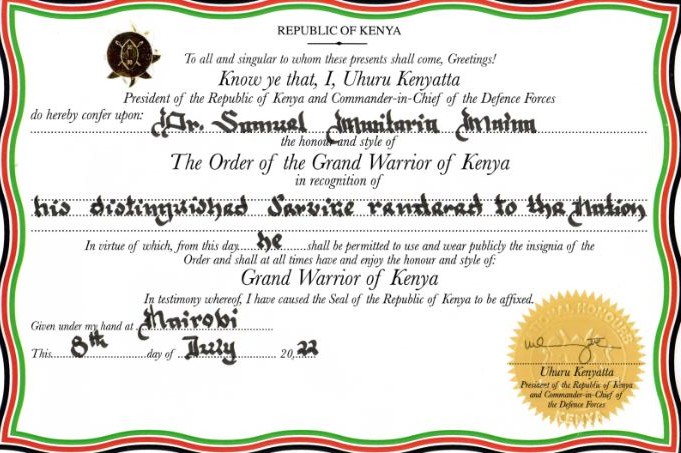
A Grand Warrior of Kenya title awarded to Dr. Samuel Maina Mwituria.
A Order of the Grand Warrior of Kenya (OGW) title awarded to Dr. Samuel Maina Mwituria in 2022 by His Excellency Uhuru Kenyatta, President and Commander-in-Chief of the Defence Forces of the Republic of Kenya.

What's the Meaning of OGW?

The meaning of OGW refers to The Order of the Grand Warrior of Kenya, a prestigious award presented to individuals for outstanding service to the nation. It recognizes those who have shown exceptional dedication, bravery, and contributions in various fields such as social, economic, scientific, public service, and more. The award honors acts of valor, leadership, and significant achievements that benefit the country.

The Order of the Burning Spear

The Order of the Burning Spear was instituted for distinguished services to dignitaries, members of the public service, and professionals.

The Order of the Burning Spear was instituted on 21 April 1966 for distinguished services to dignitaries, members of the public service, and professionals.

The Order is divided into three classes:

  • Chief of the Order of the Burning Spear (C.B.S)
  • Elder of the Order of the Burning Spear (E.B.S)
  • Moran of the Order of the Burning Spear (M.B.S)

Some of the notable figures who received this award include former Statehouse Spokesman Manoah Esipisu, 800 meters Olympic Champion and world record holder David Rudisha, and veteran journalist Jeff Koinange of Citizen Television Kenya.

The Order of the Burning Spear Design

The elder rank of the Order of the Burning Spear is always a breast star and a neck badge, while the insignia of Moran Burning Spear (M.B.S.) and it’s ONLY a neck badge.

The ribbon is black, half green with a wide white-edged red central stripe. The earlier insignia of the Moran of the Burning Spear had a silvered center.

Find Kenyan Medals Online

More Kenyan Medals

Books About Kenyan History

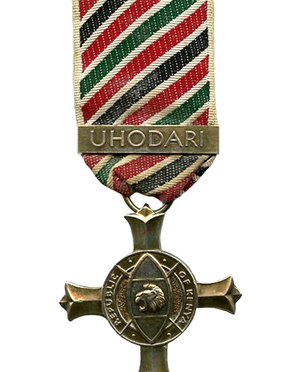
The Uhodari Medal

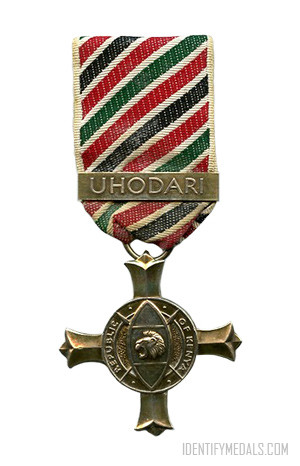
The Uhodari Medal is awarded to individuals for their most outstanding acts of bravery and sacrifice while serving in the armed forces.

The Uhodari Medal is awarded to soldiers and individuals for their most outstanding acts of bravery and sacrifice while serving in the armed forces. The medal was instituted on 21 April 1966. As the country’s utmost gallantry honor, it is presented to the most conscious bravery or for some daring act of valor, extreme devotion to duty, and self-sacrifice. The recipients of this prestigious award put the lives of other first in an act of selflessness.

For over 20 years no one had received this award- until the incumbent H.E. Uhuru Kenyatta awarded Major Ndeke Fredrick Afande the Uhodari Medal. The most notable figure to have received this award is former Defense Forces General Mohammed for his role in defending the country during the 1982 coup attempt.

Find Kenyan Medals Online

More Kenyan Medals

Books About Kenyan History

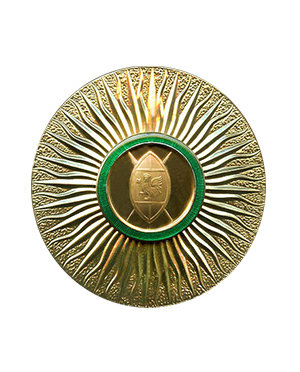
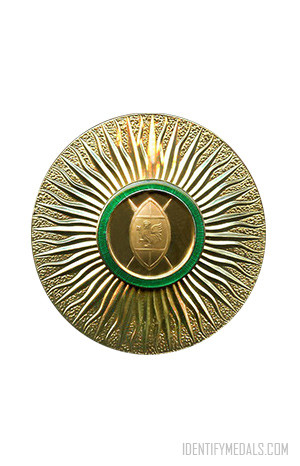
The Chief of the Order of the Golden Heart of Kenya Medal

The Chief of the Order of the Golden Heart of Kenya Medal is the highest-ranked award and presented to the holders of the president’s office.

The Chief of the Order of the Golden Heart of Kenya is the highest-ranked award and is presented to the holders of the president’s office. The incumbent, President Uhuru Muigai Kenyatta is the holder of the award Chief of the Order of the Golden Heart of Kenya.

The Order is divided into three categories based on seniority:

  • The Chief of the Golden Heart, awarded to a sitting president.
  • The Elder of the Order of the Golden Heart of Kenya (E.G.H), awarded to the deputy President of the Republic, Speakers of the House and Senate, Cabinet Secretaries, the First Lady, etc. 

The Chief of the Order of the Golden Heart of Kenya Design

The medal is a breast star made by Spink with an inverted backplate. It measures about 73 millimeters in diameter.

Find Kenyan Medals Online

More Kenyan Medals

Books About Kenyan History

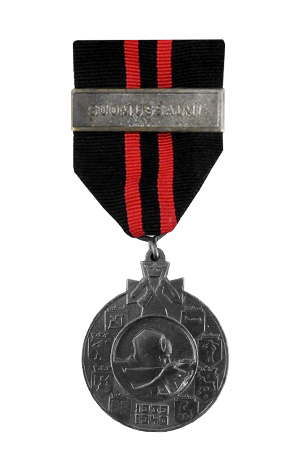
The Winter War 1939-1940 Medal

The Winter War 1939-1940 Medal was established on 2 August 1940 and awarded to soldiers and civilians for serving the Nation’s best interests. In particular, to honour those who had helped to keep Finland’s independence.

The 1939-1940 War Service Medal was created through Number 418 Finnish Code of Regulations 1940 by President Kyösti Kallio and the Minister of Defense Rudolf Walden. The first medals were presented in September of the same year.

The criteria was as follows: The medal was ‘established to commemorate the war of 1939–1940 and the unanimous will to defend it and the deeds done for the benefit of the motherland.’ The medal was generally very liberally granted to those engaged in some form of war work. This could range from those who cooked and baked in canteens to soldiers and young boys and girls who helped pass messages and washed uniforms.

Over 700,000 of all versions of the 1939-1940 War Service Medal were awarded.

The Winter War 1939-1940 Medal Design

The medal was designed by Major Aarno Karimo, who had helped found the Voimaliitto (Power League) in 1906. He was a well-known and respected poet and artist who had spent the Winter War designing propaganda posters.

The medal is made from blackened iron and measures 35 mm wide. The obverse is divided in two: An 18mm diameter circular centerpiece and a 17mm wide border. The centerpiece displays a silhouette of a snow-covered rifleman surrounded by eight provincial coats of arms of Finland. At the bottom is a stylized text reading 1939–1940. The reverse has an embossed conifer wreath around the border and the inscription ‘KUNNIA ISÄNMAA’ meaning ‘Honour Fatherland’. 

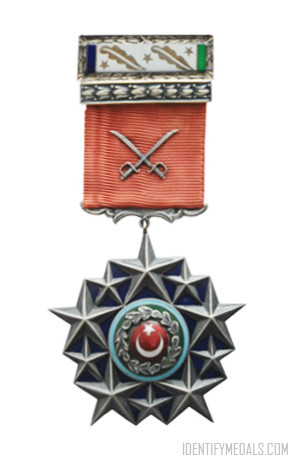
The Turkish Armed Forces Medal of Distinguished Service

The Turkish Armed Forces Medal of Distinguished Service (Türk Silahlı Kuvvetleri Üstün Hizmet Madalyası) was first created in 1967.

The Turkish Armed Forces Medal of Distinguished Service (or Türk Silahlı Kuvvetleri Üstün Hizmet Madalyası n Turkish) was first created on July 27, 1967 (although it took its current form on July 29, 1983). 

During war or peace, the medal is bestowed upon individuals whose contributions to the strengthening of the Turkish Armed Forces (TAF) have been extraordinarily high, serving national interests with exemplary determination and contributing greatly to the prestige and strength of the TAF.

This can encompass any military, scientific, material, or administrative contribution, in or outside the territory of the Republic of Turkey.

The medal can be given to civilians or soldiers, regardless of nationality. It is bestowed by any of the Commanders of the four main branches of the TAF (the Army, the Navy, the Air Force, or the Gendarmerie). 

The Turkish Armed Forces Medal of Distinguished Service Design

The medal is struck in bronze and measures 60 mm wide. It has five large and five small stars on dark blue background circling an insignia of a crescent moon and a star on red background (the symbol of the Turkish flag) pointing upwards.

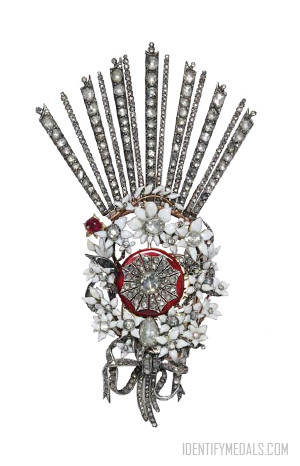
The Chelengk

The Chelengk (çelenk) was a military decoration of the Ottoman Empire that continued to be awarded for military merit up to the 1820s.

The Chelengk (çelenk) was a military decoration of the Ottoman Empire that continued to be awarded for military merit up to the 1820s.

A çelenk was “a bird’s feather which one attaches to the turban as a sign of bravery” and became institutionalized practice amongst the Ottoman military. 

A specially-made Chelengk was awarded to Horatio Nelson by Sultan Selim III after the Battle of the Nile (a major naval battle fought between the British Royal Navy and the Navy of the French Republic at Aboukir Bay on the coast off the Nile Delta) in 1798. This was the first time that a Chelengk was conferred on a non-Ottoman. Selim III also gave a chelengk to Russian Admiral Fyodor Ushakov after the capture of Corfu in 1799.

The Chelengk Medal Design

The Chelengk is a jeweled aigrette (the tufted crest or head-plumes of the egret, used for adorning a headdress) consisting of a central flower with leaves and buds, and upward-facing rays.

A Frozen Hell: The Battle of Suomussalmi and the Winter War

The Winter War and Battle of Suomussalmi. Joseph Stalin, World War II and the frozen confrontations at the border.

As Joachim Von Ribbentrop and Vyacheslav Molotov signed the infamous Molotov-Ribbentrop Pact, linking Nazi Germany and the Soviet Union, Europe was split into two. This Pact created two spheres of influence that the Nazis and the Communists would dominate after World War II.

Finland had never had normal relations with the Soviet Union. As this poor country broke free from the Tsardom of Russia and saw a political revolution ensuring the victory of the “Whites” against the Finnish Bolsheviks, it became the target of the Soviet Union.

Operation Barbarossa and Stalin

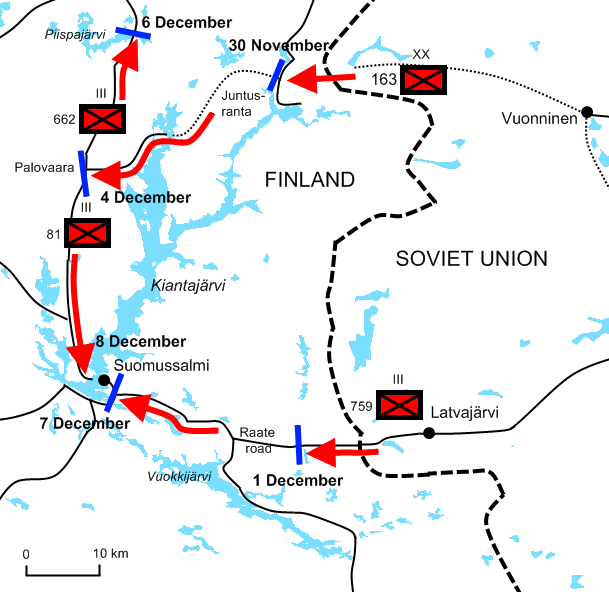
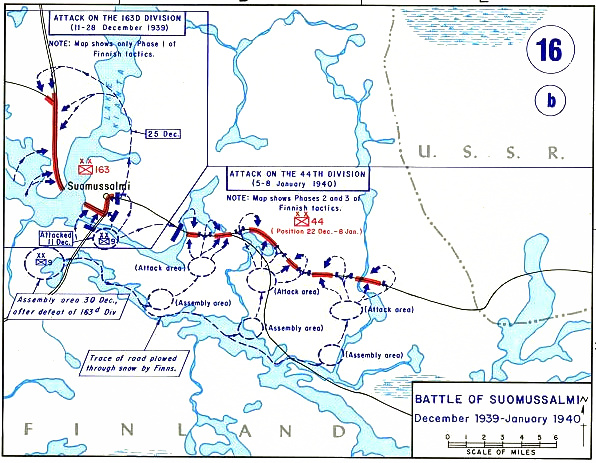
Diagram of the Battle of Suomussalmi from 30 November to 8 December 1939. The Soviet 163rd Division advanced to the town of Suomussalmi. Source: Wikipedia.

When you look back at the events of 1941 and Operation Barbarossait is easy to understand why the Soviets were so aggressive towards Finland during the 1930s, and why it ultimately led to war. Joseph Stalin said: “We can not move Leningrad back from the frontier, so we will have to push back the Frontier“.

Finland and the Soviet Union signed a non-aggression pact in 1932 and negotiations took place between the two countries to normalize their relationship and to reassure Stalin about his frontiers, the Finnish one being a possible theater of war since the Finnish government (and Finnish socialists too) was so anti-bolshevik.

The ultimate negotiations in November 1939 were nearly done but the Finns refused to lease the Hanko Harbour for 30 years, and so, they ultimately failed. The fate was sealed and war was thus inevitable.

The beginning of a disaster

The 28th of November 1939, a false flag attack was carried by the Soviet Union. They attacked one of their own village near the Finnish border with artillery shots and killed 4 of their own soldiers. Moscow thus immediately asked for excuses from the Finnish Government, and as they refused to excuse themselves, war broke out the 1st of December 1939. The Winter War had started.

The Soviet tactic was not a well thought one. They decided to attack in waves, but the terrain wasn’t the best for it. It proved to be absolutely disastrous when performed in forests – which covers most of Finland and its borders.

In Suomussalmi, not too far north but of strategic importance, the Soviet attack was a catastrophe. The original Soviet plan was to punch through the town and the Region, then to cut off Finland in two at Oulu at the Bothnia gulf coast. With its country split into two, it could be impossible for Finland to keep fighting and it would have been a fantastic victory for Stalin and the Soviet Union.

But something was not being accounted for: the sisu. The Sisu is a concept of hard determination, bravery, resilienceThe Finns would have rather all died than let their country becoming a Soviet satellite state.

As the Soviets decided to attack to Oulu, the Finnish only had one battalion located outside Suomussalmi, at Raate. That was only one battalion to face enormous enemy forces, around 45 to 55,000 Soviets.

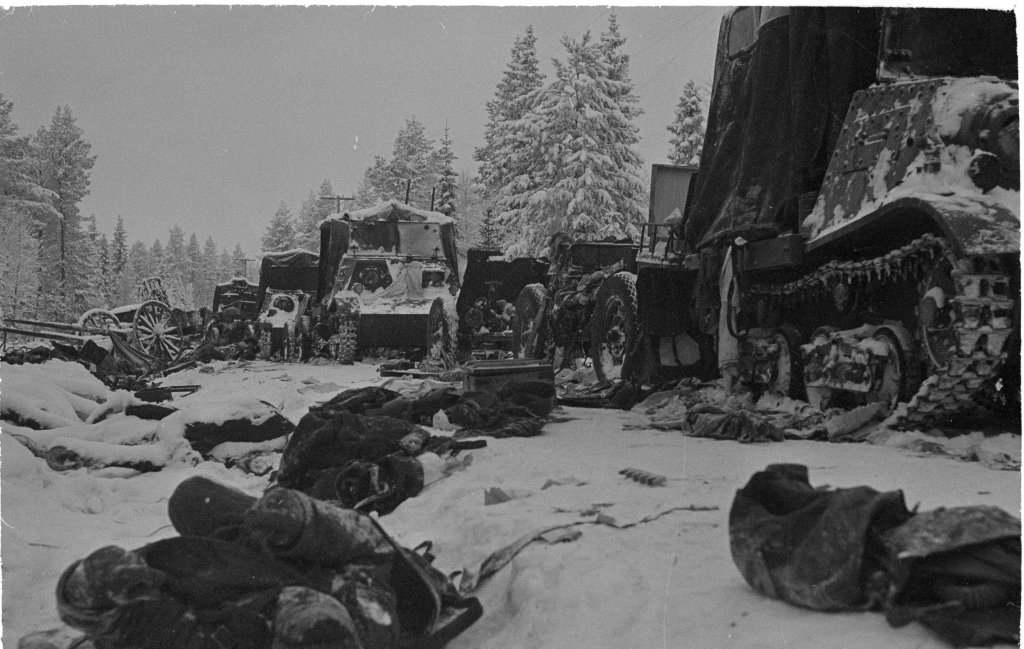
Soviet equipment and fallen soldiers at Raate Road, Suomussalmi
Soviet equipment and fallen soldiers at Raate Road, Suomussalmi. Courtesy Finnish Wartime Photograph Archive.

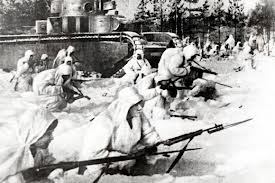
On December 7th, the Battle started. Suomussalmi was easily taken by the Soviets but in their retreat, the Finnish practiced the tactic that later saved the Soviet Union in 1941, the scorched-earth. The Winter War was exceptional because of the extreme temperatures the troops had to face during winter 1939-1940.

The very first day of the offensive was a victory. The following days would lead from disaster to shipwrecks. On Decembre 8th, the Soviets kept attacking through the lakes west of Suomussalmi but they never managed to break through the Finnish defensive line. The next offensives would prove to be even more and more disastrous. They also tried to attack farther north-west but it failed completely too. As the Soviet morale was sinking in the bottom of the lakes surrounding Suomussalmi, the Finnish were reinforced by a fresh battalion, led by intrepid Col. Hjalmar Siilasvuo. The initiative was not on the Soviet side anymore. Low morale, heavy casualties, failing tactics, equipment shortage, disaster was looming the soldiers of the Red Army.

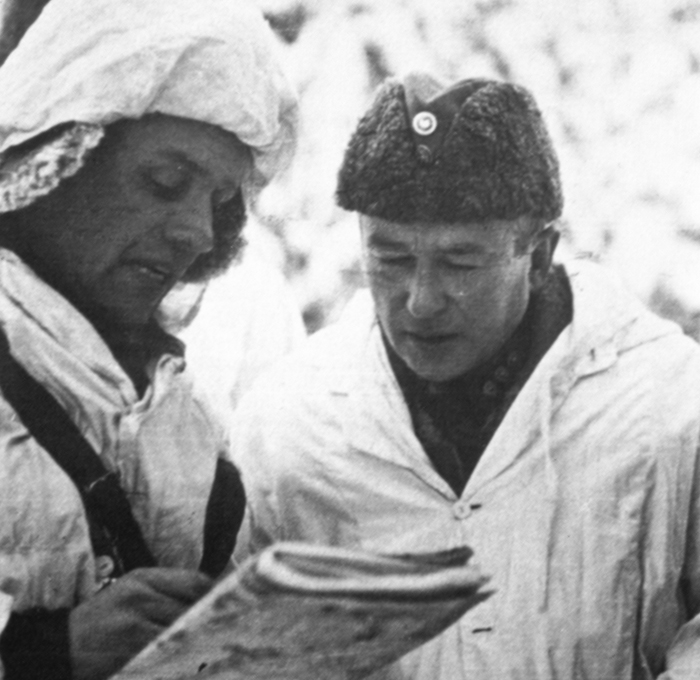
Colonel Siilasvuo receiving a briefing during the Battle of Suomussalmi, 1940.
Colonel Siilasvuo receiving a briefing during the Battle of Suomussalmi, 1940. Courtesy of The Finnish Defence Forces.

Reinforced the 9thSiilasvuo reorganized the units and went on the attack to recapture Suomussalmi, which proved to be a pyrrhic victory. The Soviets would not budge from the town and the Finnish would suffer (relatively) heavy casualties. The Soviets had bad tactics, but their art of defense would prove later to be a problem for Nazi Germany in Operation Barbarossa.

In Modern Warfare, mobility is the key and the Soviets with their heavy equipment and their tanks would try to push farther and farther in Finland but would stick to the roads. The objective to cut Finland in half, rushing to Oulu has made no sense since the region they had to cross was a forest. A giant one. As the Soviets were getting stuck on the roads and would progress very slowly, the Finnish would start attacking them, day and night.

Their mobility with the skis was the key to victory. They would harass the Soviet divisions and finally cut them off from reinforcements. Most of the 45 to 55,000 men were then totally encircled with no shelter and no equipment.

The end of the 163rd Division

The legendary Motti tactics then happened. Motti is very simple: You have to cut the enemy into different parts and encircle them. You then have two choices, either you can assault frontally and destroy the enemy pocket or you can let the Motti “cook” itself and wait for the enemy to starve and die by himself. On the 26th, most of the enemy forces were encircled and most of them were starting to die or surrender.

On the 27th, the Finnish would finally retake Suomussalmi.

This was the end of the Battle of Suomussalmi. The casualties for the Finnish were high if you consider their very low manpower, as they lost 900 men. But in comparison with the Soviet casualties, they were inexistent. On the ~50,000 men the Soviets engaged in the Battle, half of them were killed in action or missing in action, so at least 25,000 casualties.

Map of the Battle of Suomussalmi 1939/40 by Edward J. Krasnobowski, Frank Martini.
Map of the Battle of Suomussalmi 1939/40 by Edward J. Krasnobowski, Frank Martini. Source: Wikipedia.

One battle leads to another…

The consequences following the end of the Battle were immediate and harsh for the Soviets. The 163rd Division was destroyed and the 44th Division, trailing by a few kilometers was the next target of the Finnish, on the Raate Road. 12 kilometers east of Suomussalmi, the 44th was waiting for orders from its General, Alexeï Vinogradov. Unfortunately, for them, the 44th was the target of attacks from all the available battalions from the Finnish side and this battle was even more costly than the one that took place only a few days before.

Starting the 5th and ending on the 7ththe 3,600 Finnish faced around 25,000 Soviets. It is estimated that more than 17,500 Soviets were killed or missing in action following these three days of hell. Vinogradov was held guilty by the High Command for not retreating fast enough from this tornado and was sentenced to death, and executed officially for losing 56 cantinas to the Finnish.

The Winter War 1939-1940 Medal and the Suomussalmi Battle Clasp

Those who took part in this slaughter on the Finnish side all received a medal: The Winter War 1939-1940 Medal. The Suomussalmi battle clasp was awarded to those who had barely a chance of winning the battle. Facing enormous mechanized troops from the East, they all deserved to get this award. 

This medal, awarded in august 1940 was very simple. A black and red ribbon linked with a blackened iron plate with “Kunnia Isänmaa” inscribed on it, which could be translated as “Motherland“.

The criteria for the award of this medal was as follows: The medal was ‘established to commemorate the war of 1939–1940 and the unanimous will to defend it and the deeds done for the benefit of the motherland.’ The medal was generally very liberally granted to those engaged in some form of war work. This could range from those who cooked and baked in canteens to soldiers and young boys and girls who helped pass messages and washed uniforms.

Conclusion

Little Finland had no chance had the beginning of the War and nobody expected them to hold for such a long time. For a few months, the Finnish destroyed divisions, tanks, planes all day long. This performance was absolutely stunning but in the end, even with their heroic defense, they couldn’t hold forever.

In late February, the situation was pretty clear: the Mannerheim line was breached in the South and, the Soviets were starting to push hard through Finland. The end of the war was near and, the Soviets searched for an armistice.

Even though some people may argue that the Soviets lost the war, I believe they are mostly wrong. Since the Soviets obtained even more then what they asked before the breakout of the war, they are victorious, but at a terrible price. This war served as a good lesson for the Soviets and what they saw in Suomussalmi and the scorched-earth tactic would be later employed in Belarus and Ukraine to slow the German advance in Operation Barbarossa.

We can all wonder what would have happened to Finland if the Soviets had cut them off in two. But thanks for to the defenders of Suomussalmi and the sacrifice, nobody knows it. They played a major role in this war and would be of great help when negotiations set off between Finland and the Soviet Union.

This battle, and many others, would shine all over the world and the Finnish would always be seen as a harsh warrior.

Guest Contributor: Kjetil Vion is a writer and a history enthusiast. A passionate of France and modern military history, he has a special interest into the Prussian state, specially since the Sadowa battle against Austria. Always wanting to learn more, he now looks to spread his knowledge in history.