Flying Aces: Erich Alfred Hartmann, the Most Successful Fighter Ace of WW2

Erich Alfred Hartmann was a Geman fighter pilot and the most successful fighter ace of World War II. Here’s his story and medals.

Erich Alfred Hartmann was a Geman fighter pilot. Not only did he fly 1,404 combat missions, but he was also the most successful fighter ace 🔗 of World War II. Here’s his story and the medals he was awarded for his actions.

Who Was Erich Alfred Hartmann?

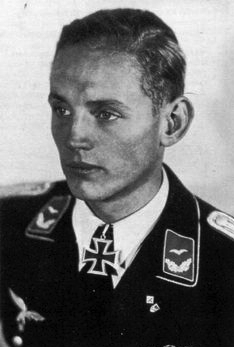
Erich Hartmann as a Luftwaffe Leutnant (1942–1944).
Erich Hartmann as a Luftwaffe Leutnant (1942–1944). Image courtesy of Wikimedia Commons.

Erich Alfred Hartmann was born on 19 April 1922 in Weissach, Württemberg, Germany. He spent his childhood in China because his father had to work there after the economic depression that followed World War I. When the Chinese Civil War erupted in 1928, the family had to return to Germany. 

Hartmann attended Volksschule in Weil im Schönbuch and gymnasium in Böblingen, the National Political Institutes of Education in Rottweil, and Korntal, where he obtained his Abitur. Korntal was also where Hartmann met his wife-to-be, Ursula. 

His flying career began soon after when he joined the Glider training program of the fledgling Luftwaffe. In fact, he was taught to fly by his mother, Elisabeth Wilhelmine Machtholf, one of the first female gliders in the country! Although the Hartmanns had owned a light aircraft, they had been forced to sell it in 1932.

The rise to power of the Nazi Party in 1933 resulted in increased support for gliding – reason why his mother was able to open a blub in Weil im Schönbuch where she served as an instructor. 

The Early Military Career of Erich Alfred Hartmann

Erich Alfred Hartmann’s military career began in 1 October 1940, when he started training with the 10th Flying Regiment in Neukuhren. He soon progressed to making his first flight as an instructor with the the Luftkriegsschule 2 (Air War School 2) in Berlin-Gatow. Hartmann then moved on to advanced flight training at pre-fighter school 2 in Lachen-Speyerdorf on 1 November 1941.

Lachen-Speyerdorf was where Hartmann learned gunnery skills and combat techniques. Between 1 March 1942 and 20 August 1942, he actually learned to fly the Messerschmitt Bf 109 đź”—

Although Hartmann was a talented pilot, his training didn’t always go smoothly. In 1942, he ignored regulations to perform acrobatics using his Bf 109, which led to a week of confinement and a loss of two-thirds of his pay. Of this event, Hartmann actually said:

That week confined to my room actually saved my life. I had been scheduled to go up on a gunnery flight the afternoon that I was confined. My roommate took the flight instead of me, in an aircraft I had been scheduled to fly. Shortly after he took off, while on his way to the gunnery range, he developed engine trouble and had to crash-land near the Hindenburg-Kattowitz railroad. He was killed in the crash.

He learned from this experience, as he later passed on his credo to younger pilots. This was the idea that you should fly with your head, not your muscles. 

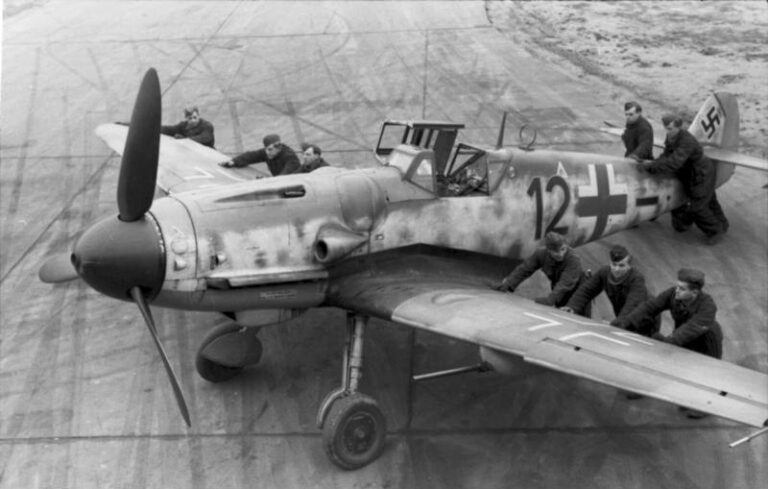
A Messerschmitt Me 109 aircraft.
A Messerschmitt Me 109 aircraft. Image courtesy of Wikipedia.
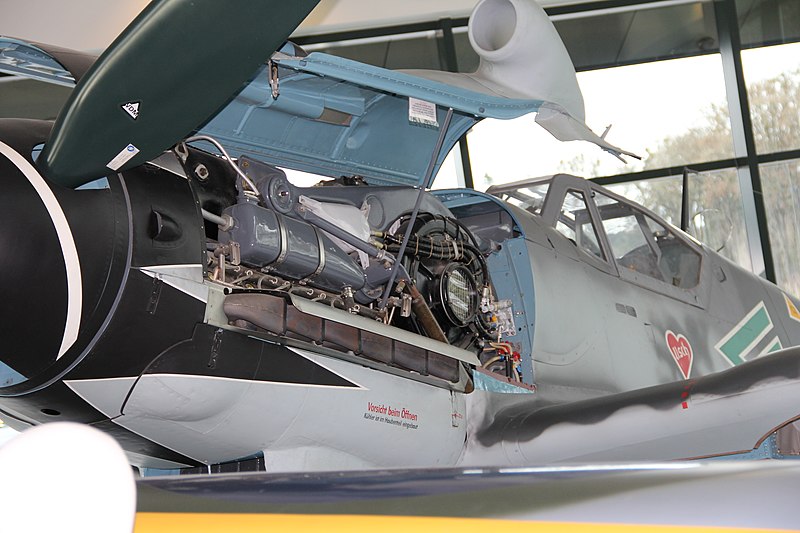
Bf 109 in the Hartmann color scheme.
Bf 109 in the Hartmann color scheme on display at the Evergreen Aviation & Space Museum. Image courtesy of Wikipedia.

Erich Alfred Hartmann During World War II

Erich Alfred Hartmann’s first assignment was as pat of the wing called Jagdgeschwader 52 (or JG 52), on the Eastern Front in the Soviet Union. Although the wing was equipped with Messerschmitts Me 109s, Hartmann and other pilots were instructed with ferrying Junkers Ju 87 Stukas down to Mariupol. During his fist flight, he actually had a brake failure and crashed the Stuka, destroying the controller’s hut. He was then assigned to III Gruppe of JG 52, led by group commander Major Hubertus von Bonin. During this time, he flew with experienced pilots such as Hans Dammers, Josef Zwernemann, and Alfred Grislawski (who said of Hartmann that he was a talented pilot). 

Perhaps one of the reasons why Hartmann became a success had to do also with his place as wingman to Paule RoĂźmann, who became a sort of teacher to him. with the help of these other pilots, Hartmann soon adopted the tactic “See – Decide – Attack – Break,” which had originated from RoĂźmann’s solution to being injured in one arm (“Stand off, evaluate the situation, select a target that was not taking evasive action, and destroy it at close range).

Erich Alfred Hartmann's Fighting Techniques

Hartmann was a master of stalk-and-ambush tactics. This meant that he preferred to ambush and fire at close range instead of dogfighting his enemies. When asked about his victories, Hartmann frequently explained that, along with firing at close range, Soviet maneuvers and defensive armament were inadequate, too. 

Here are some of the things that characterized Erich Alfred Hartmann’s method of attack:

  • Hold fire until the enemy aircraft is extremely close (20 meters/66 feet or less).
  • When attacking, unleash a short burst at point blank.

Additionally, Hartmann would also:

  • Only reveal his position at the last minute.
  • Compensate for low muzzle velocity by using higher ones (for exampe, those of the Bf 109 model). 
  • Shoot accurately and use less ammunition.
  • Prevent the adversary from making evasive maneuvers.

Once Hartmann got the kill, he immediately vacated the area. Survival was paramount, as another pilot could re-enter the zone and have combat advantage. 

Hartmann's Fighter Ace Victories - The Total Count

Erich Alfred Hartmann survived 1,400 missiles over the course of the Second World War. In total, he’s believed to have downed 352 allied aircraft (mostly Soviet, but also American). This makes him the most successful fighter ace in history. 

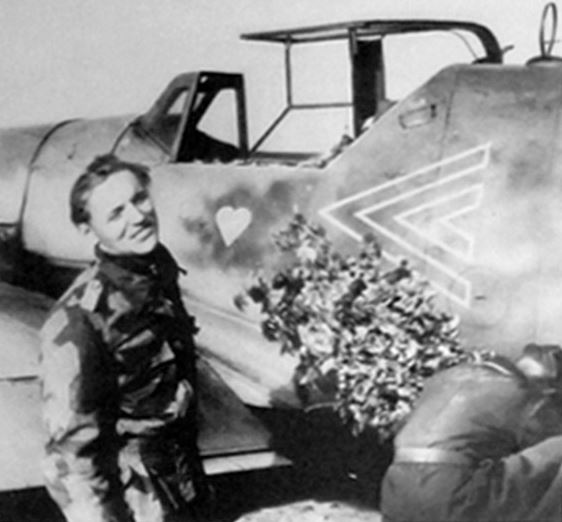
His ability to take on enemy aircraft was so effective, it’s said many Soviet pilots evaded his plane as soon as they would recognize the black tulip he had gotten painted on his aircraft. They’d rather retreat back to their base than face the ace.

Hartmann's Karaya 1 and Black Tulip

Hartmann used a scheme in the shape of a black tulip on the engine cowling. Soon, Soviet pilots became familiar with both the symbol of the black tulip he had flown on a few occasions and his radio call sign of Karaya 1, and put a price of 10,000 rubles on his head. An interesting fact is that, because many pilots didn’t want to face Hartmann, the Germans would allocate his plane to novices because they could fly it in relative safety. 

Hartmann had the tulip removed on 21 March 1944, after his kill rate dropped due to the reluctance of Soviet pilots. With the symbol gone, his aircraft claimed over 50 victories in the following two months. 

Erich Alfred Hartmann's Military Medals

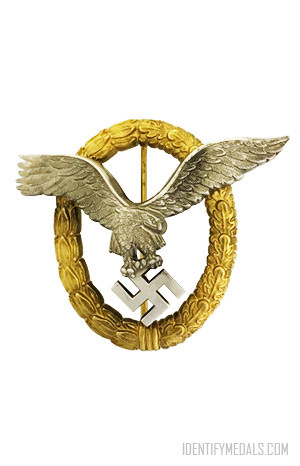
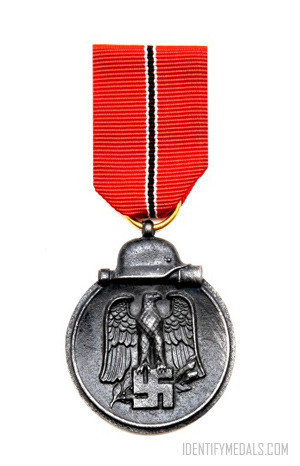
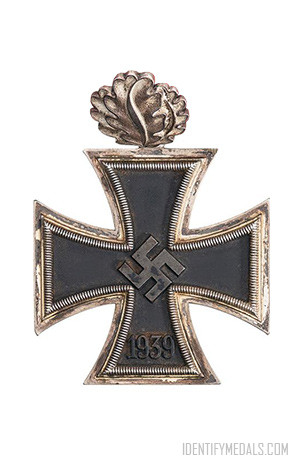
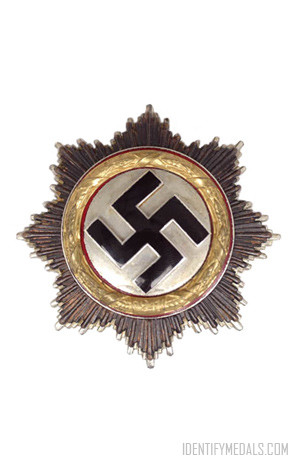
Erich Alfred Hartmann received multiple medals during his career. The first one was the Knight’s Cross of the Iron Cross (or Ritterkreuz des Eisernen Kreuzes in German), which was awarded to him on 29 October 1943. After passing the 3000mark on 24 August 1044, Hartmann was summoned to the “Wolf’s Lair” (FĂĽhrerhauptquartier Wolfsschanze), Adolf Hitler’s military headquarters close to Rastenburg, where he was awarded the Diamonds to the Knight’s Cross. Other medals given to Hartmann include the Front Flying Clasp of the Luftwaffe in Gold with Pennant “1300”, the Pilot/Observer Badge in Gold with Diamonds, the Eastern Front Medal, the Iron Cross (2nd and 1st class), the Honour Goblet of the Luftwaffe, the German Cross in Gold, and the Knight’s Cross of the Iron Cross with Oak Leaves, Swords and Diamonds.

Why Even the Allies Admired Field Marshal Erwin Rommel and The Medals He Won

While Erwin Rommel would become one of Germany’s most respected and honored generals, he did not grow up in a military family.

While Erwin Rommel would become one of Germany’s most respected and honored generals, he did not grow up in a military family. Rather, born in Heidenheim, Germany on November 15, 1891, Rommel was the son of a teacher.

Who Was Erwin Rommel?

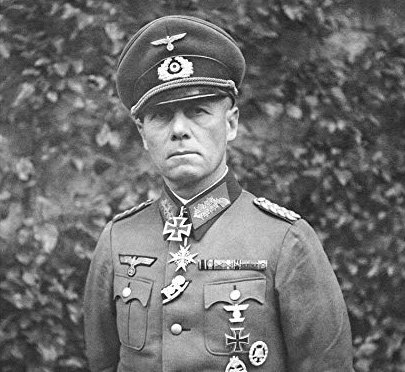
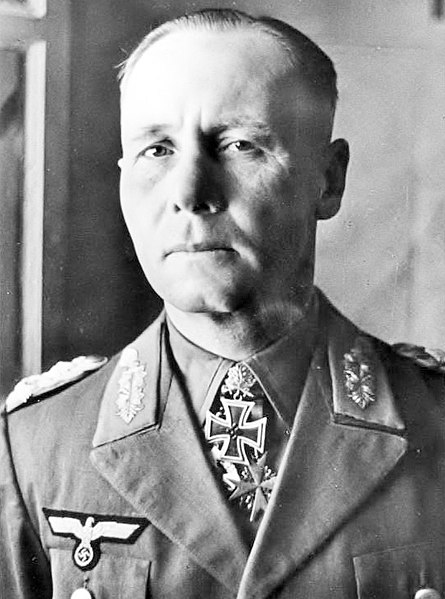
Photo of Field Marshal Erwin Rommel, c. 1942.
Photo of Field Marshal Erwin Rommel, c. 1942. Source: Wikipedia.

In 1909, as an eighteen-year-old, Rommel first attempted to join the military either in the artillery or as an engineer, but was rejected. Finally, however, in 1910, Rommel was accepted into the Germany infantry. As a cadet, Rommel was considered to be a “useful soldier,” an appellation that the rest of his military career would confirm.

Rommel served in World War I in France, Romania, and Italy and quickly learned to love the vigor of war. He became known as someone who would participate in dangerous raids and recon missions, causing his men to joke, “Where Rommel is, there is the front.”

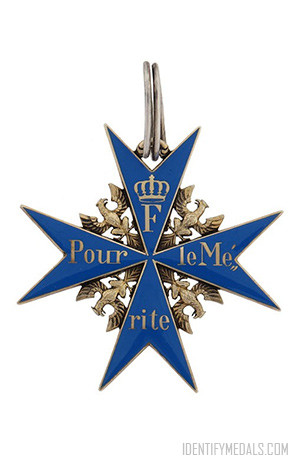
Quite the driven soldier, Rommel was intent on winning Germany’s highest military honor, known as the Pour le Merite or Blue Max, before the end of the war, which he would do in 1917. At the Battle of Caporetto, Rommel’s leadership of his company in a surprise attacked captured Mount Matajur and outflanked thousands of Italian troops, meriting the Blue Max. Rommel would proudly wear his Blue Max medal for the rest of his life.

In the mid-1930s, Rommel would write Infantry Attacks, a book that would perhaps completely alter Rommel’s military career. After Hitler read Rommel’s book in 1937, he was impressed and decided to appoint Rommel as the German Army’s liaison with the Hitler Youth. Two years later, Hitler gave Rommel command of his personal bodyguard during the Invasion of Poland in 1939.

Erwin Rommel and the Panzer Division

Finally, in February 1940, Hitler named Rommel as the commander of the 7th Panzer division, one of the new panzer units. It was in this command that Rommel would become a household name in countries beyond Germany. During the Battle of France, Rommel’s 7th Panzer division raced from Sedan on the border of Germany and France to the coast of the English Channel, covering 200 miles in just one week and capturing over 100,000 Allied troops as well as the French garrison of Cherbourg.

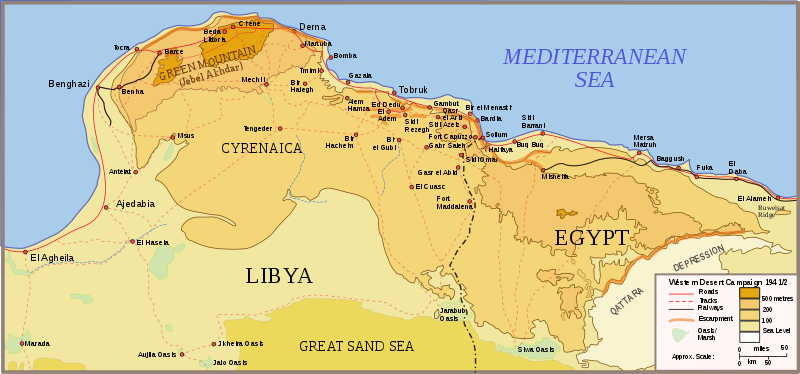
Due in large part to this success, Rommel was appointed commander of the German troops in North Africa, the Afrika Korps, a year later. At first, Rommel was unsuccessful in taking the port city of Tobruk from the British in December 1941, but when Rommel returned in June 1942, he took the city in an attack known as the Battle of Gazala. It was then that Hitler would promote Rommel to Field Marshal.

During the brief time of Rommel’s success in North Africa, which ended up lasting only several months, he would begin to win the respect of the Allies. Prime Minister Winston Churchill called Rommel “a very daring and skillful opponent” and even “a great general.” George Patton and Bernard Montgomery who both fought Rommel in North Africa likewise sang his praises.

Rommel too had a great regard for the military prowess of his enemies, Patton and Montgomery, noting that the former had “the most astonishing achievement in mobile warfare” and that the latter “never made a serious strategic mistake.”

In the fall of 1942, Rommel’s success would turn with the British recapture of Tobruk at the Battle of El Alamein and the eventual loss of North Africa in May 1943. No longer needed in Northa Africa, Rommel returned to Europe to oversee the defense of the Atlantic coast in early 1944, exactly where the D-Day landings would occur in June 1944.

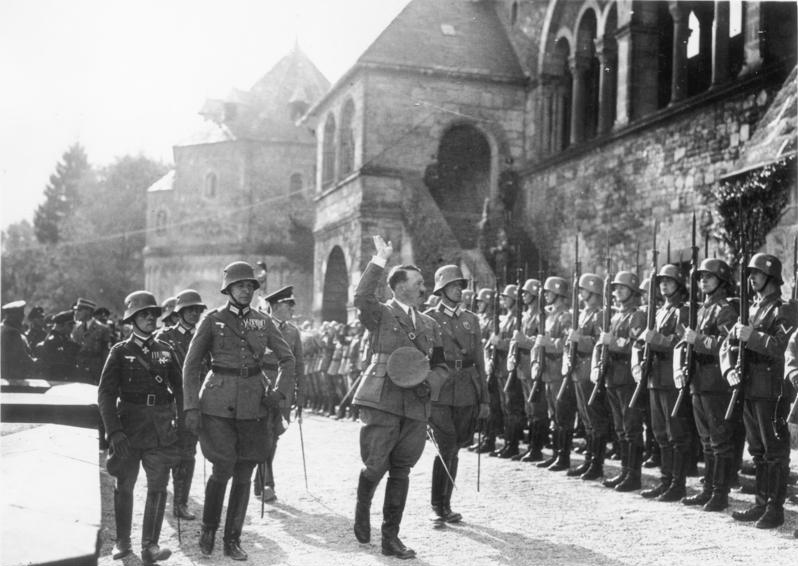
Rommel and Adolf Hitler in Goslar, 1934
Rommel and Adolf Hitler in Goslar, 1934. Foto Scherl Bilderdienst Berlin S.W.
Egypt & Cyrenaica, Libya: Map of the Western Desert Campaign and its Operation Compass Battle Area 1941.
Egypt & Cyrenaica, Libya: Map of the Western Desert Campaign and its Operation Compass Battle Area 1941. Source: Wikipedia.

Erwin Rommel and the 944 July Plot

Although Rommel had trusted Hitler’s leadership up until this point and did not question the Fuhrer, Rommel began to change his tune in 1944 because he believed that Germany was going to lose the war.

Although Rommel doubted Hitler’s abilities for peace-making, evidence suggests that he did not want to dispose of him. Even so, Rommel’s contact with the conspirators in the 1944 July Plot, which was an assassination attempt against Hitler on July 20, 1944, implicated the Field Marshal in the plot against Hitler.

Given the option of facing a public trial or committing suicide, Rommel opted for the latter in order to protect his family. On October 14, 1944, German officers arrived at Rommel’s home to take him to a remote location where Rommel committed suicide through a cyanide capsule. He was 52 years old and received a full military burial, likely to appease the German public who did not know of Rommel’s connection to the assassination attempt.

Some of Erwin Rommel’s Medals

See all German Medals

In fact, the German government even told the people that Rommel had died from injuries due to Allied aircraft strafing Rommel’s car earlier in 1944. Rommel had actually won his last victory from a hospital bed recovering from these injuries. Rommel had encouraged defensive preparations at the strategic city of Caen that ended up holding the Allies at bay and inflicting heavy casualties. The truth about Rommel’s suicide would not be revealed until after the war.

Respected by his comrades and his enemies, Rommel became known as the “Desert Fox” due to his penchant for surprise attacks and the “People’s Marshal” among his countrymen. Widely regarded as one of Hitler’s most successful generals and one of Germany’s most popular military officers, Rommel has continued to be honored to this day.

In addition to the adulation Rommel received from friend and foe alike, Field Marshal Rommel’s list of decorations and awards is extensive:

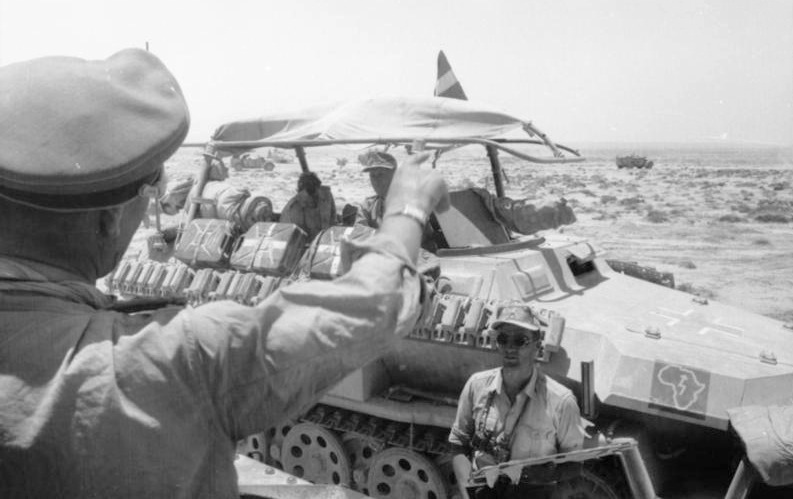
North Africa, Rommel in a Sd.Kfz. 250/3
North Africa, Rommel in a Sd.Kfz. 250/3. Source: Wikipedia.
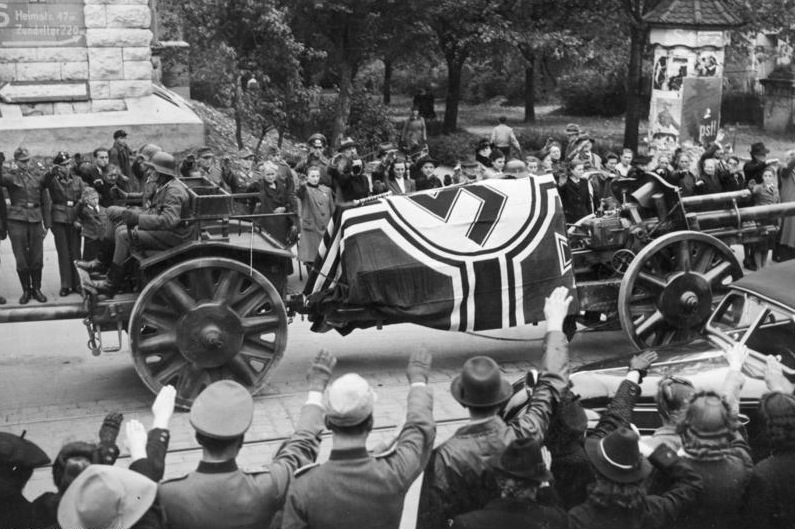
Rommel's funeral procession.
Rommel's funeral procession. Source: Wikipedia.

In contrast to other well-known World War II-era Germans, Rommel has largely not been vilified. His name can be seen on two military bases, several German streets, and a monument in his hometown. While Rommel did have experience with the Nazi party and was close to Hitler, most historians agree that Rommel seemed to care more about winning military victories and promoting his own military career than condoning Nazi atrocities.

Sources

Guest Contributor: Rachel Basinger is a former history teacher turned freelance writer and editor. She loves studying military history, especially the World Wars, and of course military medals. She has authored three history books for young adults and transcribed interviews of World War II veterans. In her free time, Rachel is a voracious reader and is a runner who completed her first half marathon in May 2019.

The Battle of Königgrätz Sadowa and the Birth of a New Era

Königgrätz Sadowa is one of the most important battles in history. Its modern tactics would be later used in the Franco-Prussian War and WW1.

It only takes one man and his dream to deeply change the world. Back in the 19th century, Germany was a mass of Duchies and little kingdoms dominated by Austria. But as Napoleon started shaking Europe, Austria began to lose its grip on the German states and the ruins of the Holy Roman Empire. The congress of Vienna tried to rebuild this order, introducing the German Confederacy but the tension between its two major powers, Prussia and Austria, kept raising through the years.

The birth of the Zollverein in 1834, a custom union unifying the northern German states and Prussia, left Austria isolated. The prosperity of this union kept reinforcing the power of Prussia and the members of this Union soon became “vassals” of Prussia. The War of the Duchies, fought in 1864 against Denmark, gave even more power to the Prussian Kingdom and the war between Austria and Prussia became unavoidable. The final fight between these two kingdoms would leave only one winner, a winner would dominate the German states for many years to come.

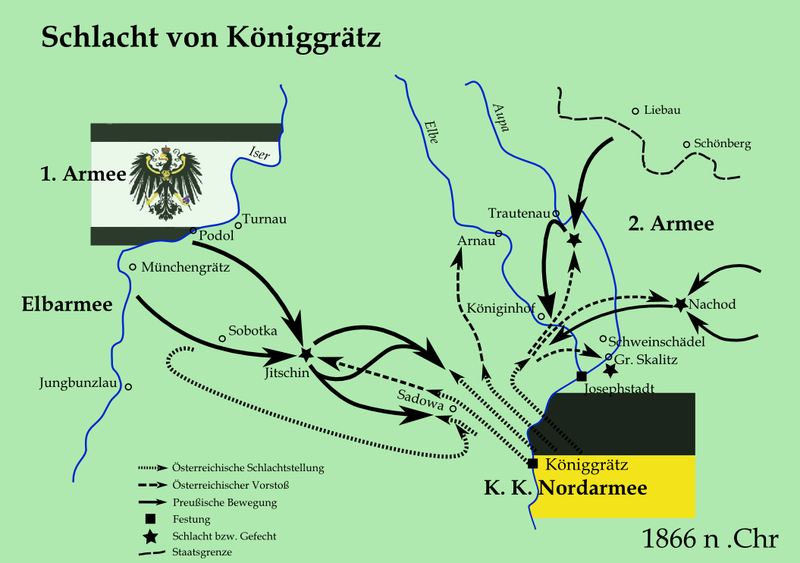
Battle of Koniggrätz between prussian and austrian soldiers (1866)
Overview of the Battle of Koniggrätz between prussian and austrian soldiers (1866).

“The Deutscher Krieg”

On the 8th of June 1866, Prussia decided to go on and occupy the Duchies ceded by Denmark to Austria in 1864. Austria thus chose to mobilize its army and war was on its way. Both sides had multiple allies: Prussia had the Kingdom of Piedmont-Sardinia (Later known as Italy) and minor German states such as Bremen, Lübeck and Hamburg. Austria had substantial allies such as the Kingdoms of Bavaria and Saxony. Both sides were of equal size but a long economic crisis was plaguing Austria. The state was heavily indebted, suffering from the Hungarian revolution (1848) and the second Italian war of Independence.

The Prussian economy was in a very good shape and was ready. Its army was the most modern in the World and the reforms they did several years before the war were crucial in boosting the morale and the willpower of its infantry.

As the war was escalating, it became clear that no major power would join the war. Russia still bore a grudge about the Crimean war a few years before and France was confidently thinking that the Austrians would defeat Prussia.

Gitschin, the early days

The first “real” encounter of the war between Austria and Prussia took place in Gitschin on the 29th of June. A few battles had already taken place in Italy as Austria defeated the Italians. But in Gitschin, the course of the battle would be very different: The Austrians and the Saxons would suffer way higher casualties than Prussia and would retreat in a very disorganized manner.

Strategy was very difficult to function, as the officers from different ethnicities would not always listen or trust each others. The Hungarians would often disobey the Austrian High Command, and the same thing would happen several days after that, in Sadowa.

This battle is perhaps one of the most important in the military history. Not only because it would consolidate the position of Prussia as the main power in Germany, but also because it would be a glimpse of the modern tactics that would be later used in the Franco-Prussian War, World War I and many, many more.

Let’s get back to the battle. Gitschin was the first opportunity for Austrians to see the Prussians in front of their cannons and it would prove to be a harsh discovery. But on the 3rd of July 1866, it would be a disastrous lesson. The Austrian Army, strong of around 215,000 men, would face in the morning only 120,000 Prussians, divided into two groups. Hiding behind fortified positions and with artillery support, the Austrians were confident. As they first encountered the enemy, they fired and then decided to retreat behind a river, in good order. The beginning of the Battle was in the advantage of the Austrians.

The Prussians were advancing, but very slowly and even if the river was easy to cross for Infantry, it wouldn’t be the same for the artillery. Austria’s manpower and firepower held the high ground.

At 11:00, the Austrians decided to attack the Prussian Infantry stuck in the woods around Sadowa. Meanwhile, the Hungarian officers decided to attack on their own. A general counter attack would have been decisive: the Prussian frontline may break, and what would happen then?

Unfortunately, the right flank of the Austrian army was now weakened and the Prussian saviors arrived, another army of around 100,000 men. They attacked the flank of the enemy, inflicting high casualties as the Prussian artillery pounded the center of the Austrian army. It was time for a general attack from the Prussians, as the three groups engaged in the battle attacked simultaneously, destroying the Austrian lines. The Austrian Army was broken. Even when the Prussians lost around 9,000 men, the Austrian lost more than 32,000. Retreat was inevitable.

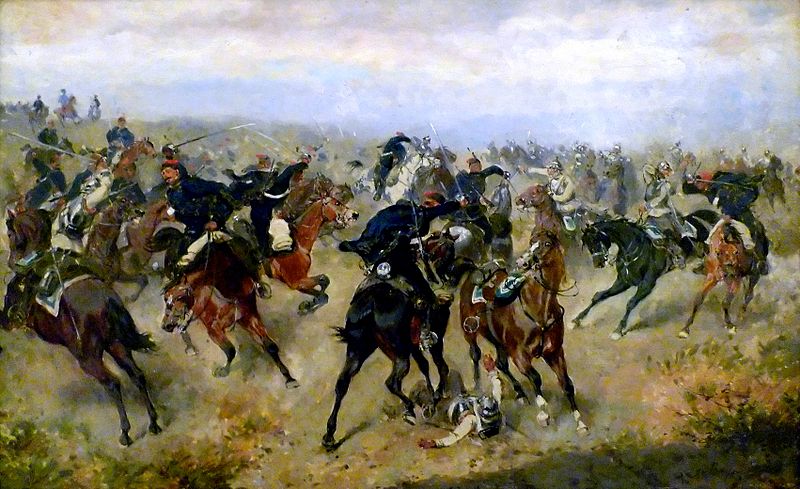
Skirmish between Austrian hussars and Prussian cuirassiers at the Battle of Königgrätz. Oil on wood, Heeresgeschichtliches Museum Wien.
Skirmish between Austrian hussars and Prussian cuirassiers at the Battle of Königgrätz. Oil on wood, Heeresgeschichtliches Museum Wien. Souce: Wikipedia.

The Austrian Empire is Starting to Shake…

As the Prussians were starting to overrun all the position the Austrians held in the morning, a fierce pursuit engaged between them. The Austrians, retreating as fast they could, would be skirmished until the armistice was signed on the 22nd. The objective of Bismarch was not to chase the Austrians until they reached the Austrian mainland and even maybe Vienna. It would have been possible, since the Prussians were so much stronger than their enemy. The Austrians had no choice but to give up on everything. Besides, a total victory of Prussia over Austria would have warned the neighbors of these two countries and the peace treaty may have not been in favor of the Prussians. They needed to win, but not to destroy their enemy.

And Prussia is Rising in the North

Prussia had jumped in the world of Imperialism and was now the only major power ready to unify the German states. They were given everything they demanded: territories, money. They also gained an alliance with pretty much all of the German states that fought against them like Bavaria and Saxony. These two Kingdoms would prove to be very useful in the Franco-Prussian war in 1870.

But the biggest victory Prussia achieved through the Peace treaty of Prague was the following: Austria would never play a major role ever again in the “German Question”. Prussia would be the only one leading the unification of the German states and Austria would be left out of it.

The Königgrätz Cross

The Prussians won this battle. And it was such a victory that an award was necessary to recognize the efforts done by the Infantry, those who stayed under artillery fire behind the river or those who held the ground in the forest near Sadowa.

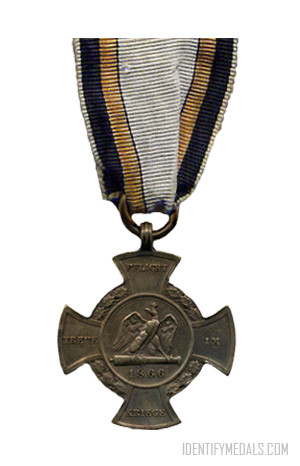
To commemorate this victorious campaign, four different crosses were created and awarded. Called the Königgrätz Cross, it was issued to more than 120,000 different soldiers who either participated directly or indirectly to the battle. The medal has the shape of a cross pattée with a round medallion superimposed on its center and a round wreath between its arms and is made of bronze from captured Austrian cannons.

There were four different crosses instituted to commemorate 1866 victorious campaign: The Königgrätz Cross, the “Main Army” Cross, the “Loyal Fighters” Cross and the “Loyal to its duty in times of war” Cross.

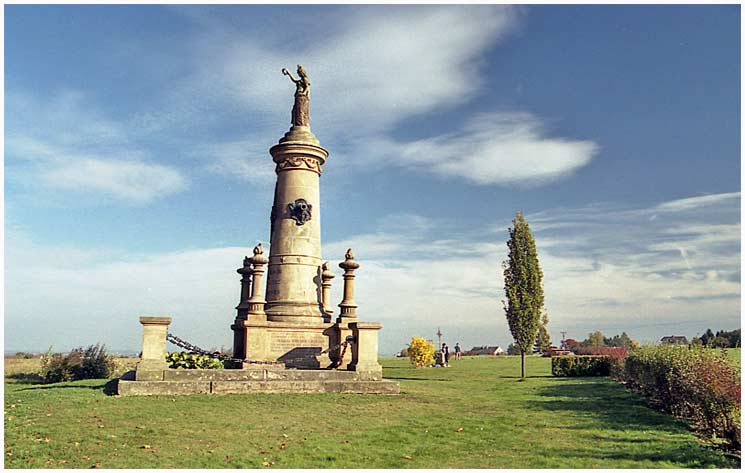
Memorial to Battery of the Death at Chlum conmemorates one of heaviest fights during Battle of Battle of Königgrätz.
Memorial to Battery of the Death at Chlum conmemorates one of heaviest fights during Battle of Battle of Königgrätz. Source: Wikipedia.

Conclusion

This battle was the beginning of something new. A new era started when the Austrians started retreating towards Vienna. The Prussian, and later German, hegemony over Europe marked the beginning of an era that could only lead to disaster. Imperialism and competition between France, Germany, Austria-Hungary, Russia and the United Kingdom could only lead to fierce fighting and what happened in 1914 is the result of many years of sleeping conflicts and diverging interests. And it all started on this day of July.

Guest Contributor: Kjetil Vion is a writer and a history enthusiast. A passionate of France and modern military history, he has a special interest into the Prussian state, specially since the Sadowa battle against Austria. Always wanting to learn more, he now looks to spread his knowledge in history.

The Battle of Verdun, the Frenco-German Bloodbath and its Medal

1915 could have been the turning point of the First World War. What if the German leadership decided to attack further in Russia or choose a different spot on the Western front? Did they really had a chance of choosing which way was the best for 1916?

Which way to go?

he German leadership had multiple options. They could continue to attack and desorganize the Russians or try and break through the French front. The first solution was nearly impossible to achieve; Russia was far too wide and backward for the fight to continue in the country. The war would have been lost, not just because the Russians were fierce fighters, but mostly because of attrition and lack of communications on the front.

Erich Von Falkenhayn, the chief of the German General Staff, had to take the decision to move west. He had to choose the perfect location for the troops to attack and pierce the french lines. Even though most successes by the German Imperial Army were happening on the East, the Western Front was the perfect spot to do something big. It had to happened in France.

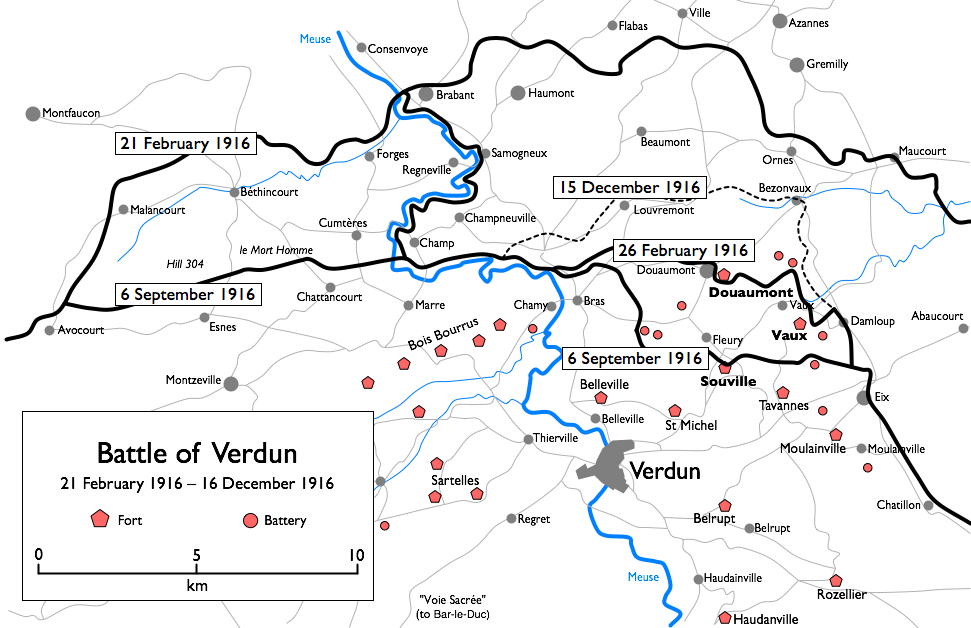
Map of the Battle of Verdun, 1916.
Map of the Battle of Verdun, 1916. Source: Wikipedia. CC.

Verdun, the ideal location?

The German General Staff had to thing fast about what to do. The main idea that was shared by most officers was that Verdun was the ideal location to attack. It was a bulge in the frontlines and could be a location where a major French attack could take place, as it would endanger the German communication and supply lines and break the front for good.

The plan was very simple. Falkenhayn decided to put all the avaiable artillery guns he could find and to stack them in the area. Artillery fire would take place for several hours and then infantry would attack and seize Verdun.

On the French side, the General Staff knew that something was hapening in this area: the German preparations couldn’t go unnoticed but would it be a lure or a real attack?

Monday, 21st February: Hell on Earth

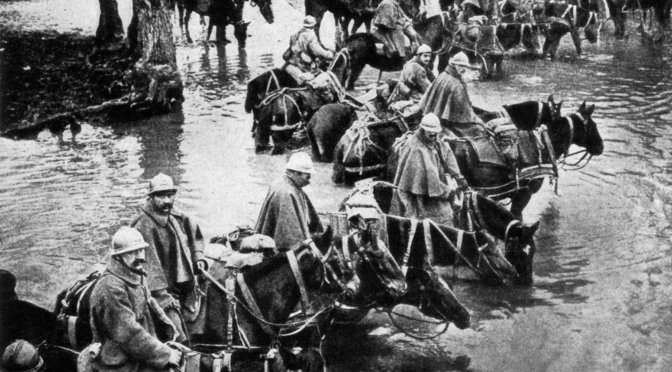
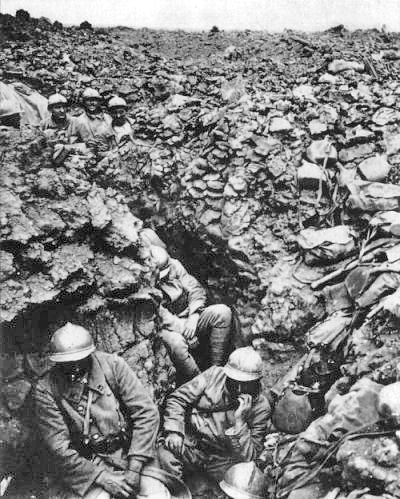
French trench at CĂ´te 304, Verdun
French trench at CĂ´te 304, Verdun. Source: Wikipedia. CC>

In one day, 2 million shells were fired on the French positions. As the fire was raging on and behind the French lines, 60,000 Germans attacked. The Germans expected to find demoralized and desorganized units but they encountered fierce and brave resistance from the French. As the French were trying anything they could do to slow down the German forces, it was looking more and more like Falkenhayn’s plan was starting to fail. Even worse, as the artillery fired more than 2,000,000 shells as previously stated, the ground was destroyed and it was very hard for the infantry to advance into this mayhem. Time was the key in this operation and every minute was important. It would later explain why the attack was a failure in the first days: the Germans were too slow to do capture anything strategic. The French could start firing back with their own artillery fire and reinforce the destroyed divisions.

The first few days of the battle were showing that the Germans advanced. But the main objective was to capture Verdun or at least a large portion of enemy land. The operation was a failure but the battle wasn’t over just yet…

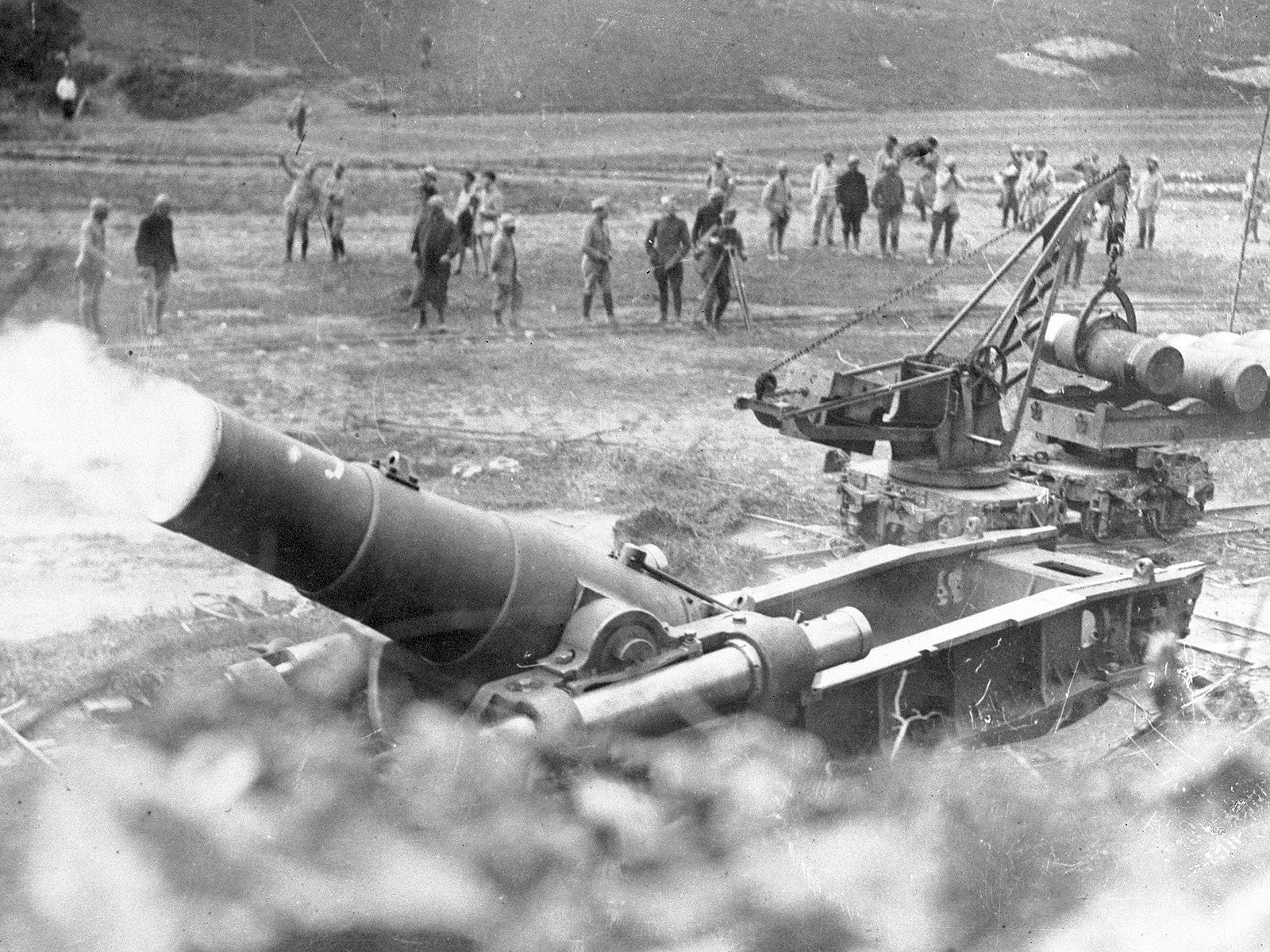
A French Army 370mm mortar being fired from a gully known as La Baraquette.
A French Army 370mm mortar being fired from a gully known as La Baraquette. Source: Wikipedia. CC.

“Ils ne passeront pas!”

For several months, the battle of Verdun would looked as if the fires of hell would burn anything to the ground. Thousands upon thousands of men would die under artillery fire. The French General Staff under Philippe Pétain and Robert Nivelle would prove to be far more effective than the German leadership. The “Voie Sacrée”, a road made to reinforce the French positions, was one of the key factor of why the Frenchs managed to hold for so long. 90,000 men were transported across this road to reinforce the frontlines each week, and you can only imagine how many tons of supplies were shipped across this road.

Unfortunately for the Germans, the general situation of the war was not in their favor. The Russians started the Brussilov Offensive, the Somme Battle started during mid-1916 and the Italians were winning against the Austrians on the Isonzo.

A bas-relief depicting the Voie Sacrée on a commemorative monument near Verdun
A bas-relief depicting the Voie Sacrée on a commemorative monument near Verdun. Source: Wikipedia. CC.

The end of the Battle

The Germans couldn’t hold for long and as the Frenchs attacked to regain the territories they lost in February, they couldn’t do a lot to stop them. Thus retreat was the only solution for the German Army. They virtually gained no land for enormous casualties. The consequences of this battle were not that big for the war in the general but the world would remember the courage and the bravery of the French during this battle.

On the 21st of December 1916, all lost territory was recaptured by the French. The battle of Verdun was finished.

The Verdun medal

Created in late 1916 even before the end of the battle, the medal of Verdun was made for who we call in France, the “Poilus”. These soldiers, holding for several months under intense pressure from infantry attacks and heavy artillery pounding, held their ground. Around 70% of all the French soldiers that were engaged in World War I participated to the battle of Verdun.

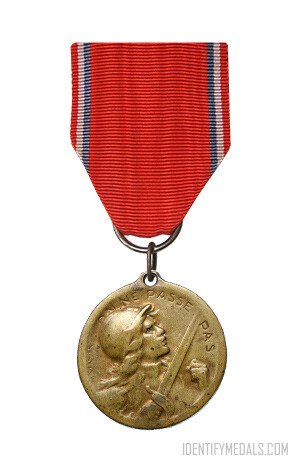
The medal is very simple: A red ribbon with a French flag is supporting a bronze badge. On this badge, you can find the head of the Republic (a symbol of the IIIrd French Republic) and the famous sentence pronounced by Robert Nivelle: “Ils ne passeront pas”, translated as: they will not break through. It is relatively common medal to find but it was an immense measure of respect in the civil life. It was carried with pride to show that these soldiers participated in the biggest attack France had to suffer in its history.

You can still claim the medal today. If you have any relatives that do so for the last 100 years, and if you can show a certificate or anything that shows that a family member particpated in the battle of Verdun, you can officialy claim and get the medal as a show of respect for your relatives. So if you know anybody that has made through the hell of Verdun and that this person never claimed or was decorated, give it a chance!

Conclusion

The battle of Verdun wasn’t decisive in any way for the western front. Status quo was the outcome of the Battle, not much changed. Well, something did actually change: the morale of the French population. Enhanced by this defensive victory which was in the end costly for both sides, the Frenchs were now absolutely sure that the Germans would never break through ever again. In the end, the Germans broke through but the war was already on its way to the victory for France. The French morale couldn’t get down anymore after Verdun. Verdun was the starting point of victory, it was showing that it was possible for France to win. And they did.

Guest Contributor: Kjetil Vion is a writer and a history enthusiast. A passionate of France and modern military history, he has a special interest into the Prussian state, specially since the Sadowa battle against Austria. Always wanting to learn more, he now looks to spread his knowledge in history.