The Constantinian Order of St. George (Parma)

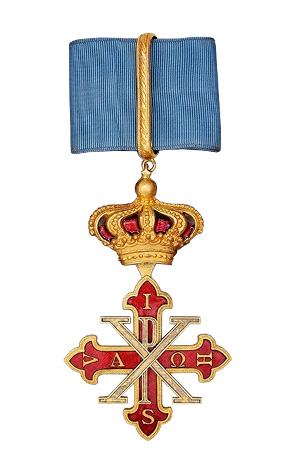
The Constantinian Order of St. George, or Order of St. Angelus / Order of the Golden Chevaliers is a dynastic order of knighthood.

The Sacred Military Constantinian Order of Saint George, also known as the Imperial Constantinian Order of Saint George and the Order of the Constantinian Angelic Knights of Saint George, is a dynastic order of knighthood of the House of Bourbon-Two Sicilies.

The order is allegedly founded in its original form by Constantine the Great and restored under later Byzantine emperors. However, the actual origin of the order can be traced to the 16th century, when it was founded by an Albanian family by the name Angelo Flavio Comneno. Chivalric orders were completely unknown in the Byzantine world, so it’s believed the story of the links between the Comneno family and their claim to be connected to the Byzantine Komnenos and Angelos dynasties was invented much later.

The Order is best recognized for its Parma iteration. Duke Francesco Farnese of Parma made several amendments to the Order statutes in 1705. These changes were  recognized by Pope Clement XI in 1706 and finalized as a dynastic Order of the Duchy of Parma by a Papul Bull in 1718. In 1731, the Order became a dynastic Order of the Kingdom of the Two Sicilies. When Marie Louise ascended to the throne of the Duchy of Parma, Piacenza and Guastalla she restored it as a dynastic Order of the Duchy of Parma, resulting in the creation of two Order branches.

The motto of the Order is “In hoc signo vinces,” or “In this sign you will conquer.

The Constantinian Order of Saint George Design

There are several insignia for this order. The medal is a bronze, silver, or gold cross with a collar, sash or ribbon. 
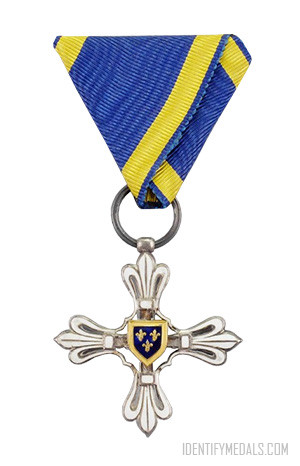
The Civil Merit Order Of St. Louis (Parma)

The Civil Merit Order Of St. Louis is an order of the Duchy of Parma (today Italy). The Order was established in c. 1860.

The Civil Merit Order Of St. Louis is an order of the Duchy of Parma (today Italy) awarded for extraordinary merit within civil services. It has five grades and the Grand Master of the Order was always the Duke of Parma

The Order of St. Louis was initially founded in the Duchy of Lucca in 1836 by Charles Louise (also known as Charles II). His son, Charles III Duke of Parma, revived the Order at Parma, on August 11, 1849, as an award of merit. Membership to the Order was primarily restricted to noble Catholics. When a non-noble became the recipient of the Grand Cross or Commander grades they were bestowed with hereditary nobility.

The Order of St. Louis Design

The insignia for this order is a silver 4 multifaceted armed star, measuring 45 mm (w) x 46.8 mm, with a central gold crest on both the obverse and the reverse. The medal also has finely detailed red, blue, white enameled centers. The suspension is a French style ring with right facing eagles head.

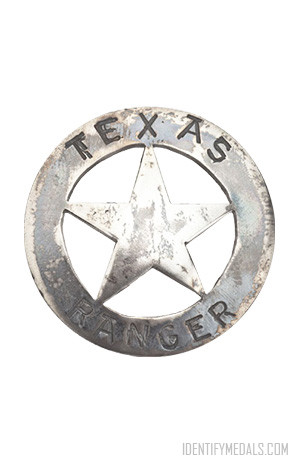
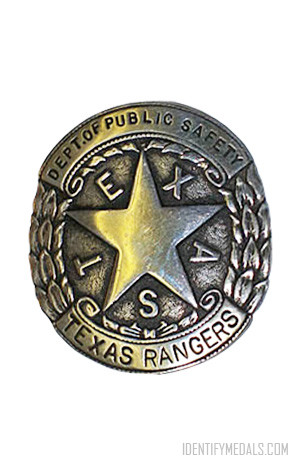
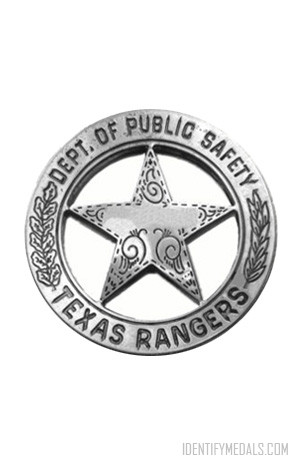
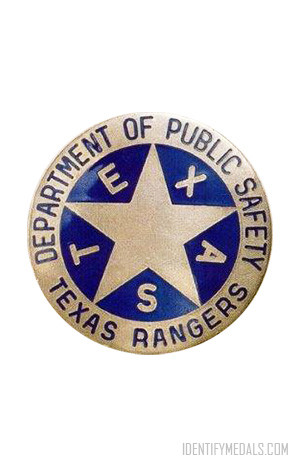
The Texas Rangers Ira Aten Badge

The Texas Rangers Ira Aten Badge dates to the 1880s. It is the earliest surviving Texas Rangers badge known and belonged to Ira Aten.

The Texas Rangers Ira Aten Badge dates to the 1880s. It is the earliest surviving Texas Rangers badge known and belonged to Ira Aten. 

Ira Aten (September 3, 1862 – August 5, 1953) was a Texas Ranger born in Cairo, Illinois. Aten was assigned to the counties bordering the Rio Grande, and due to the rough nature of this area, he became involved in numerous dangerous encounters. He was inducted into the Texas Rangers Hall of Fame.

Other Texas Rangers Badges

Find Texas Rangers Badges Online

Right Now on eBay 
Clicking a link to eBay may result in a referral commission being paid if a purchase is made.
Loading...

Further Reading About the Texas Rangers

The Most Venerable Order of the Hospital of St. John of Jerusalem

The Most Venerable Order of the Hospital of St. John of Jerusalem is a working order of charitably minded men and women established in 1888.

The Most Venerable Order of the Hospital of St. John of Jerusalem, and also known as the Order of St John or St John International, is a British royal order of chivalry constituted in 1888 by Queen Victoria and dedicated to St John the Baptist, an itinerant preacher in the early 1st century AD.

The order can be tracked back to the Knights Hospitaller in the Middle Ages. The Knights Hospitalle were a medieval and early modern Catholic military order, later known as the Order of Malta. A faction moved to Britain in the early 1830s and became associated with the founding in 1882 of the St John Ophthalmic Hospital near the old city of Jerusalem and the St John Ambulance Brigade in 1887.

The Order of St John is also known for the health organizations it has founded, such as St John Ambulance and St John Eye Hospital Group. 

The Order of the Hospital of St. John of Jerusalem Design

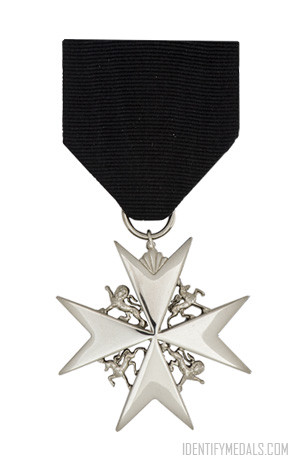
The insignia of the Order is a Maltese cross, or eight-pointed cross in white enamel set in silver-colored metal. The cross is embellished in each of its main angles with lions and unicorns, with a lion in the top left and bottom right angles. 

The insignia of a Bailiff or Dame Grand Cross consists of a breast star and a sash badge. The insignia of a Knight or Dame of Justice or of Grace is a breast star and a neck badge. The insignia of a Commander is a neck badge, the Officer insignia is silver and enameled white, and he insignia of a Member is also worn on the left breast but is bright silver without enamel.

The badges have a ring attached to the top through which the ribbon passes. The ribbon for all grades is black watered.

The Order of Merit (Canada)

The Order of Merit (OM) is a Canadian order bestowed as a personal gift of the Sovereign. The Order has a military and a civil division.

  • Time Period: Pre-WW1
  • Institution: 26 June 1902
  • Country: Commonwealth Realms, Canada

The Order of Merit (Ordre du Mérite in French) is an order for the Commonwealth realms that recognizes distinguished service in the armed forces, science, art, literature, or for the promotion of culture.

The Order was established in 1902 by King Edward VII (who ruled 22 January 1902 until his death in 1910) and admission into it remains the personal gift of its Sovereign. Edward VII founded the Order of Merit as a means to acknowledge “exceptionally meritorious service in Our Navy and Our Army, or who may have rendered exceptionally meritorious service towards the advancement of Art, Literature and Science“.

The order is restricted to a maximum of 24 living recipients from the Commonwealth realms (plus a limited number of honorary members).

All members are awarded the right to use the post-nominal letters OM and wear the badge of the order. This honor is administered by the Central Chancery of the Orders of Knighthood at St. James’s Palace in London in the United Kingdom.

The Order of Merit Design

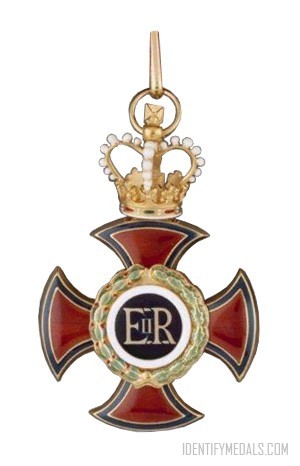
The badge of the Order is an eight-pointed cross of red and blue enamel surmounted by the imperial crown. In the center, upon blue enamel and surrounded by a laurel wreath, is the inscription ‘For Merit‘, in gold lettering.

The insignia for the military division is differentiated by crossed swords placed between the angles of the cross of the badge.

The ribbon of the Order measures 40 millimeters in diameter and is divided into two stripes of red for the Order of the Bath and blue for the Order of the Garter.

The Chelengk

The Chelengk (çelenk) was a military decoration of the Ottoman Empire that continued to be awarded for military merit up to the 1820s.

The Chelengk (çelenk) was a military decoration of the Ottoman Empire that continued to be awarded for military merit up to the 1820s.

A çelenk was “a bird’s feather which one attaches to the turban as a sign of bravery” and became institutionalized practice amongst the Ottoman military. 

A specially-made Chelengk was awarded to Horatio Nelson by Sultan Selim III after the Battle of the Nile (a major naval battle fought between the British Royal Navy and the Navy of the French Republic at Aboukir Bay on the coast off the Nile Delta) in 1798. This was the first time that a Chelengk was conferred on a non-Ottoman. Selim III also gave a chelengk to Russian Admiral Fyodor Ushakov after the capture of Corfu in 1799.

The Chelengk Medal Design

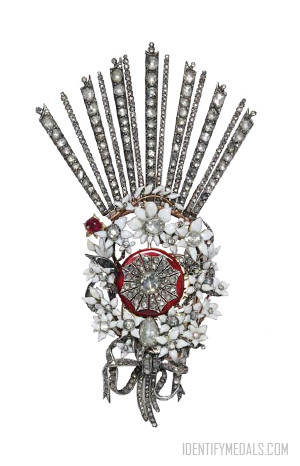
The Chelengk is a jeweled aigrette (the tufted crest or head-plumes of the egret, used for adorning a headdress) consisting of a central flower with leaves and buds, and upward-facing rays.

The Lorenz Lindelöf Scientific Award Medal

Time Period: Pre-WW1
Institution: Pre-WW1
Country: Finland

The Lorenz Lindelöf Scientific Award Medal is a finish medal established before WW1.

Finland had been ceded to Russia in 1809. At the time that time, Leonard Lorenz Lindelöf (November 13, 1827 – March 3, 1908)’s father was appointed professor of mathematics at the university, the main building of the university on Senate Square had recently been completed. Lindelöf spent the year 1891 in Stockholm, and the years 1893-94 in Paris returning to Helsingfors where he graduated in 1895. He then taught there as a docent, visiting Göttingen in 1901. Helsinki was still under Russian control and indeed the Russians had implemented a policy of Russification, in reply to the national movements which had arisen.

Lindelöf remained as a professor of mathematics in Helsinki until he retired in 1938. It was a time of rapid economic growth for the new country and the university flourished and rapidly expanded. Lindelöf supported his new country undertaking his university duties with great enthusiasm. Later in his life, Lindelöf gave up research to devote himself to teaching and writing textbooks.

For his outstanding contributions to Scandinavian mathematics, he was honoured by the universities of Uppsala, Oslo, Stockholm, and Helsinki.

The Lorenz Lindelöf Scientific Award Medal Design

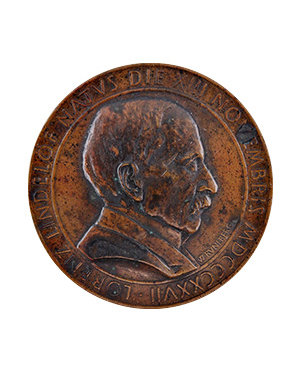
The medal is struck in bronze and measures 56.5 mm. The obverse illustrates the right-facing bust of Lorenz Lindelöf, surrounded by the inscription “LORENZ LINDELÖF NATVS DIE XII NOVEMBRIS MDCCCXXVII” (1827).

The reverse illustrates a branch of laurel leaves at the left and a branch of oak leaves at the right, inscribed in the centre is “SECRETARIO SVO QVADRAGENARIO SOCIETAS SCIENTIAS FENNIAE / DIE XIII NOVEMBRIS MCMVII” (1907).

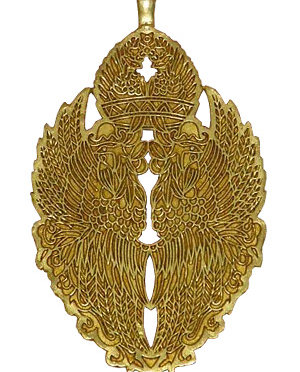
The Order of the Auspicious Phoenix

The Order of the Auspicious Phoenix (Bongjang) was instituted by Emperor Yunghui. It was limited to women only and awarded in eight classes.

The Order of the Auspicious Phoenix (Bongjang) was instituted by Emperor Yunghui. It was limited to women only.

The Order was awarded in eight classes:

  • Grand Cordon
  • Second Class
  • Third Class
  • Fourth Class
  • Fifth Class
  • Sixth Class
  • Seventh Class
  • Eighth Class

The last two are equivalent to a gold and silver medal of a European Order.

The Order of the Auspicious Phoenix Design

The medal is struck in bronze and has a pink silk ribbon.

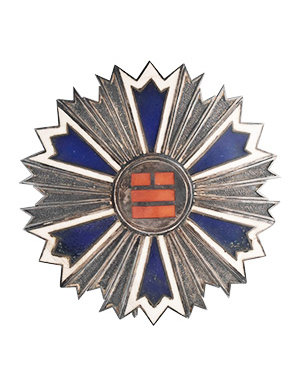
The Order of the Eight Trigrams

The Order of the Eight Trigrams (P’alwaejang) was instituted on 17th April 1901 by Emperor Kwangmu, the last King of Joseon and the first Emperor of Korea.

The Order was awarded in eight classes:

  • Grand Cordon
  • Second Class
  • Third Class
  • Fourth Class
  • Fifth Class
  • Sixth Class
  • Seventh Class
  • Eighth Class

The last two are equivalent to a gold and silver medal of a European Order.

The Order of the Eight Trigrams Design

The symbolism of the Order insignia is the Chinese Ba Gua, based on Taoist principles. These Bagua or Pakua symbols are used in Taoist cosmology to represent the fundamental principles of reality, seen as a range of eight interrelated concepts. Each consists of three lines, each line either “broken” or “unbroken”, respectively representing yin or yang, 0 or 1 forming binary numbers 000-111 (0 to 7).

The 1st Class medal is enameled on both sides. The other classes have a plain reverse with an inscription in kanji.

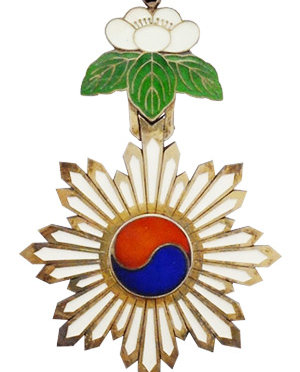
The Order of Taeguk or Order of the National Crest

The Order of Taeguk or Order of the National Crest (Taegukjang) was instituted on 11th April 1900 by Emperor Kwangmu, the last King of Joseon and the first Emperor of Korea.

The Order was only awarded in a superior class and eight ordinary classes:

  • Grand Cordon
  • Second Class
  • Third Class
  • Fourth Class
  • Fifth Class
  • Sixth Class
  • Seventh Class
  • Eighth Class

The last two are equivalent to a gold and silver medal of a European Order.

The Order of Taeguk Design

The insignia of the order is struck in silver with red, white, and blue enamels. It measures 88.5 mm (wide) x 89.5 mm (high). The Order is mounted on a wight-pointed starbase, each of the star points with three rays.