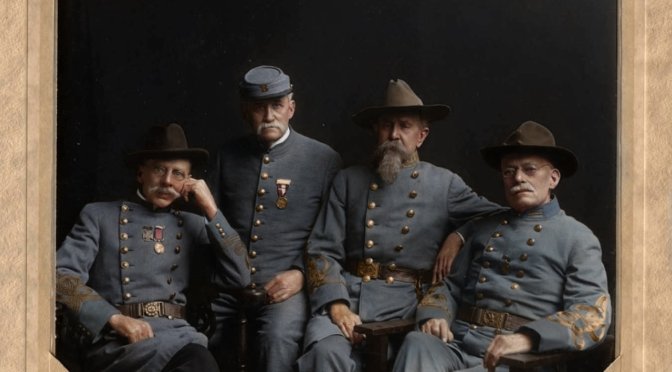
It Only Takes Two, and Other Sundry Facts About American Civil War Medals

Even if you don’t know much about military medals, you probably know a thing or two about some of the medals awarded during World War I or World War II. But unless you’re a Civil War history buff, you may have no clue about the medals, decorations, and orders received during the American Civil War of 1861-1865.

It turns out that it doesn’t take many medals to have a complete U.S. Civil War collection unlike other military medal collections such as Third Reich medals or USSR medals. You only need two for an official Civil War medal collection!

Civil War Medals: The Medal of Honor
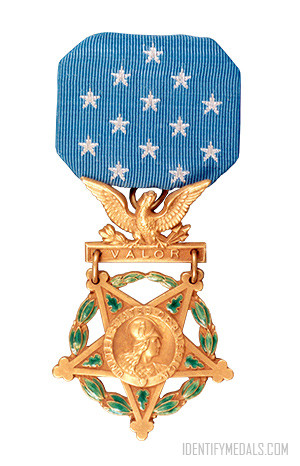
There was only one federally sponsored and issued medal during the Civil War, and that was the Medal of Honor, which was actually created during the Civil War. Signed into law by President Abraham Lincoln, a Navy Medal of Honor was first authorized on December 21, 1861 followed by an Army Medal of Honor, which was authorized on July 14, 1862.

Now the Medal of Honor is the highest military decoration that any member of the U.S. Armed Forces can receive, but it was the only decoration in the Civil War, and only enlisted personnel were eligible. Today the criteria to receive a Medal of Honor are very high, but it was different during the Civil War.

As an example, Secretary of War Edwin M. Stanton promised a Medal of Honor to any man who extended his enlistment in the 27th Maine Volunteer Regiment, and because there was no official list of names who did and didn’t, the War Department issued 864 Medals of Honor, one for every man in the unit. These 864 medals were later reviewed and revoked in 1916 by a military board.

Over 40 percent of the Medals of Honor awarded to date—1,522 out of 3,464 medals—were bestowed during the Civil War. In fact, some Civil War Medals of Honor years after the end of the war, including Andrew Jackson Smith whose medal was awarded in 2001 and Alonzo Cushing in 2014.

While we can’t begin to list everyone, some famous recipients include Private Jacob Parrot of Andrews’ Raid, William Harvey CarneyDr. Mary Walker, and Thomas Ward Custer.

The first Medals of Honor were given to participants of Andrews’ Raid or the Great Locomotive Chase with Private Jacob Parrot as the first person ever to be awarded the Medal of Honor.

During Andrews’ Raid named after James J. Andrews, 22 Union volunteers snuck behind enemy lines to Atlanta to steal a train to ride up north to Chattanooga. They also tried to burn bridges, destroy railroad tracks, and cut telegraph lines. The idea was to cut off Chattanooga, which was under control of the Confederates, from reinforcements just as the Union Army was attacking the city. Unfortunately, the raid failed, and some of the raiders were captured and executed. Even so, the raiders were regarded as heroes, and all but two of the military members received Medals of Honor, some posthumously.

At least 32 Medals of Honor were awarded to African-Americans, and William Harvey Carney was the first. Born a slave in Virginia, he finally found freedom in Massachusetts. He volunteered to join the 54th Massachusetts Infantry Regiment, the first African-American unit in the northern states although it was led by white officers.

Tasked with taking Fort Wagner, a beachhead fortification that protected the southern Charleston Harbor, the 54th was chosen for the second attack. The Union flag bearer was killed as the soldiers stormed the fort, but Carney stepped in and held the flag for the remainder of the battle, never losing possession of the flag despite several injuries. Unfortunately, the 54th was forced to retreat, but, as Carney said after the battle, “the old flag never touched the ground.” Carney was awarded the Medal of Honor in 1900, thirty-five years after the end of the Civil War.

Individuals who have received two Medals of Honor are rare, and Thomas Ward Custer is a part of this elite group, receiving both medals for actions during the Civil War. His first medal was awarded for actions during the Battle of Namozine Church where he led a cavalry charge while under fire, seized a Confederate flag, and took 14 Confederates prisoner. Custer’s second medal was awarded for actions three days later at the Battle of Sailor’s Creek where he again took a Confederate flag during a cavalry charge. Singlehandedly breaking a Confederate line, Custer charged at the Confederate flag-bearer, received a shot to the face before quickly recovering to kill the flag-bearer, and finally presented the flag to his brother, George Armstrong Custer.

Thomas Custer, George Custer, and one other brother would die at the Battle of Little Bighorn in 1876.

Civil War Medals: The Civil War Campaign Medal
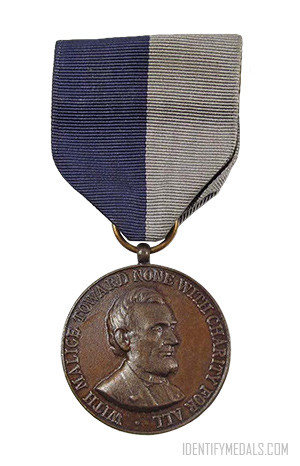
The other state-issued medal was the Civil War Campaign Medalauthorized by the War Department in 1907 for both Union and Confederate veterans who had served between April 15, 1861 and April 9, 1865 or service in Texas through August 20, 1866.

Referred to as a “badge” at the time, the Civil War Campaign Medal was first issued in 1909 (the medal was originally established as a badge because Congress would not approve a medal due to the costs involved.) The blue and gray ribbon denotes the respective uniform colors of the U.S. and Confederate troops. 

The medal was designed by Francis D. Millet, a noted sculptor who perished on the RMS Titanic in 1912. The monies necessary to mint and issue the medal were not appropriated by Congress until 1956 – 91 years after the war ended. The medal was then struck at the Philadelphia Mint. Its obverse displayed an engraved image of Abraham Lincoln while the Navy and Marine Corps versions depicted the USS Monitor and CSS Virginia‘s battle at Hampton Roads. The reverse has the words “The Civil War 1861-1865” encircled by a wreath. 

Civil War Medals: The Davis Guard Medal
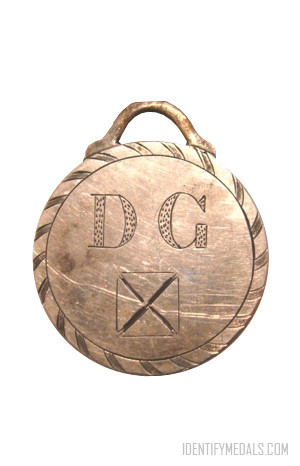
In addition, the Confederacy awarded one medal during the Civil War known as the Davis Guard MedalExtremely rare, the medal was given to the Davis Guards, a militia company organized in Houston, Texas, for their actions at the Battle of Sabine Pass on September 1, 1863. 

Issued by the residents of Sabine Pass although sanctioned by the Confederacy, the medal was issued in gratitude for the Confederate men who held back a Union force numbering in the thousands. It was presented as a one-time award to exactly 50 men (in addition to the 49 members of the battery, the award was also presented to Jefferson Davis as the unit’s honorary commander)

The medal consisted of a silver Mexican coin polished smooth with the letters “DG” on the front above a cross pattee. The reverse bore the inscription “Sabine Pass Sept. 23, 1864” in cursive script.

Civil War Medals: Other Medals

Even though you may have seen photos of Civil War soldiers or veterans with medals, most of these are medals from local military units or veteran medals of common organizations. As one example, many states awarded “first call” or “first defender” medals to individuals who voluntarily enlisted after President Lincoln’s first call to arms in April 1861.

Ohio was one of the first—if not the first—to issue state awards. Patterned after the British Crimean War Medal of 1854, 20,000 medals were produced immediately at the end of the war. The reverse of each medal is hand engraved to the recipient with his unit.

In addition, you should know that many of the awards given during the Civil War had some connection to capturing or saving regimental flags, which were the rallying point for the unit and guided its movements. Losing a flag could sometimes even disrupt a unit more than the death of the commanding officer.

In the end, you might want to consider starting a U.S. Civil War medal collection, as you’ll easily be able to say that you have all the official medals after just acquiring two! However, you might also enjoy trying to see how many different medals you could find from local units and veterans’ organizations. In that case, you’ll have to do a little bit more work!

Sources


Guest Contributor: Rachel Basinger is a former history teacher turned freelance writer and editor. She loves studying military history, especially the World Wars, and of course military medals. She has authored three history books for young adults and transcribed interviews of World War II veterans. In her free time, Rachel is a voracious reader and is a runner who completed her first half marathon in May 2019.
Florence Nightingale: The Life and Medals of the Lady With the Lamp

Florence Nightingale became a common household name due to her part in the Crimean War. She turned nursing into a respectable profession for women.

Born on May 12, 1820 to wealthy English parents, Florence Nightingale was named after the Italian city in which she was born—Florence, Italy—just like her sister Parthenope who had been born in Naples and was given the Greek name for the ancient city. 

When they returned to England, the Nightingale family divided their time between their two homes: Lea Hurst in Derbyshire for the summer and Embley in Hampshire for the winter.  

Who Was Florence Nightingale?

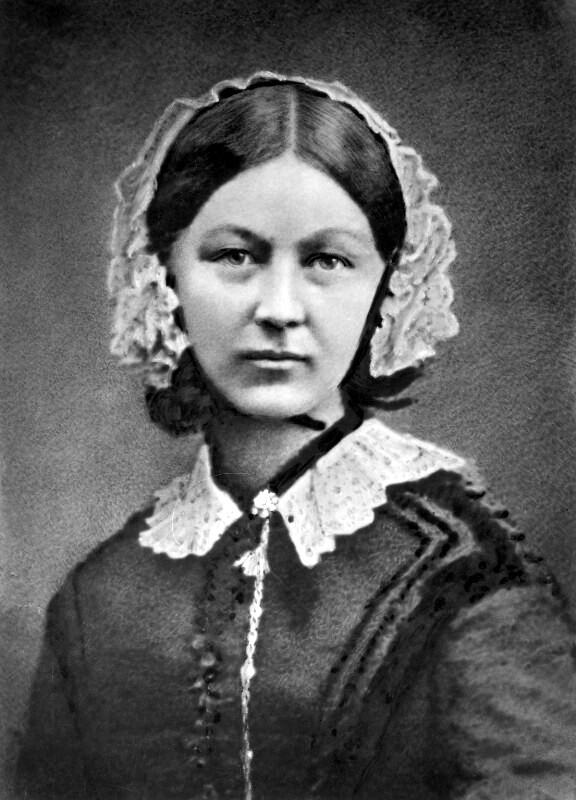
Florence Nightingale, circa 1860. Photograph by Henry Hering (1814-1893)
Florence Nightingale, circa 1860. Photograph by Henry Hering (1814-1893) - National Portrait Gallery, London.

Although many Victorian women did not attend universities, pursue professional careers, or receive an education, Florence’s father William believed that his daughters should have the opportunity to get an education. Thus, he decided to teach his daughters a variety of subjects, including Italian, Latin, Greek, history, and mathematics. Florence, in particular, excelled academically, and she received superb preparation in mathematics from her father and her aunt. It is due in part to Florence’s education as a child that her two greatest life achievements—pioneering the field of nursing and reforming hospitals—were possible.  

As Florence received her education from a young age, she also was very active in ministering to the ill and poor people in the village near her family’s estate. By the time she reached the age of 16, she believed that nursing was her calling and divine purpose. At first, her family did not take too kindly to this idea.

But Florence insisted. She turned down a marriage proposal and enrolled as a nursing student at the Lutheran Hospital of Pastor Fliedner in Kaiserwerth, Germany in 1844.

Florence Nightingale and the Crimean War

Florence Nightingale became a common household name due to her part in the Crimean War, which lasted from 1854 to 1856. In 1853, Florence had returned to London from Germany and began serving as an unpaid superintendent of an organization for gentlewomen suffering from illness and did so for a year. When the war broke out in 1854, Sidney Herbert, the Secretary of War, recruited Florence and 38 nurses to serve in Scutari during the Crimean War.

Florence and the nurses left London on October 21, 1854, crossing the English Channel, traveling through France to Marseilles, and sailing on to Constantinople (modern-day Istanbul) before arriving on November 3, 1854. Scutari was located near Constantinople, and the conditions were abysmal. The hospital was replete with vermin and lacked even basic equipment and provisions.

Moreover, the medical staff could not keep up with the substantial number of soldiers who were being shipped from across the Black Sea away from the fighting in Crimea. Even worse, more patients were dying from disease and infection than from battle wounds.

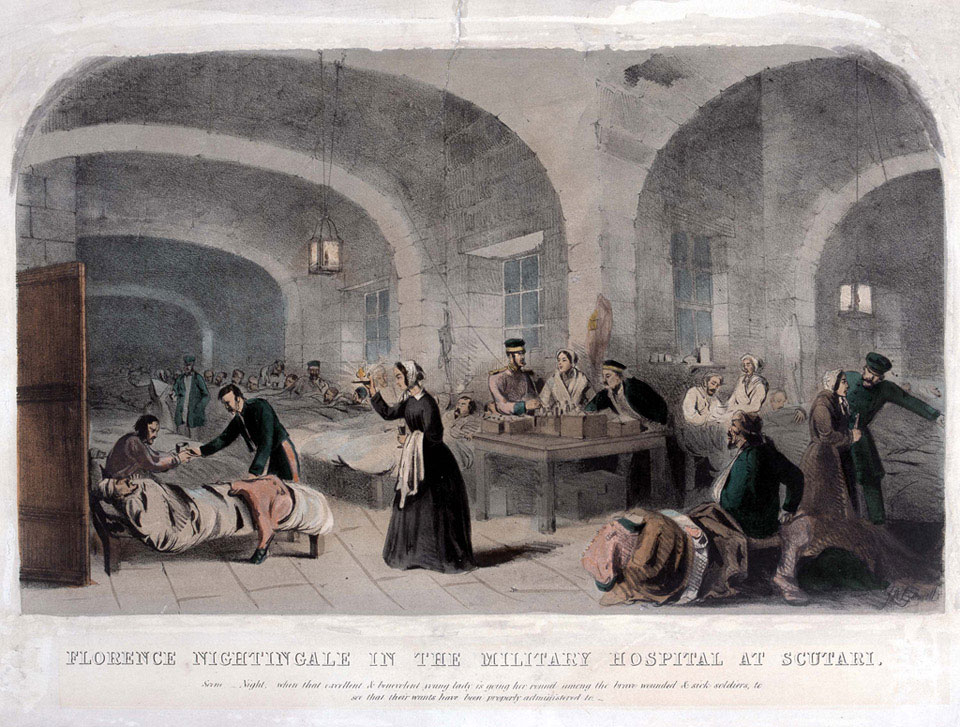
Florence Nightingale in the Military Hospital at Scutari', 1855
Florence Nightingale in the Military Hospital at Scutari, 1855. Courtesy of National Army Museum.

Florence Nightingale in Florence

Florence and her nurses got right to work. They turned the hospital into a significantly more healthy environment by washing the linens and clothes, improving the medical and sanitary arrangements, writing home on behalf of the soldiers, and introducing reading rooms. Within six months, the death rate of the patients fell from 40 percent to a mere 2 percent.

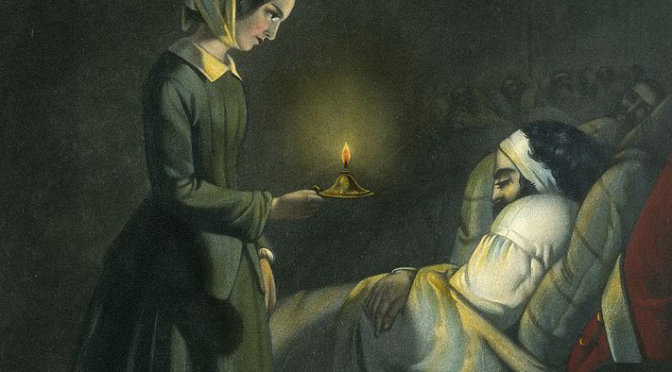
It was here at Scutari that Florence would acquire the nickname of “the Lady with the Lamp.” According to the TimesFlorence would walk among the beds at night, checking on the wounded men with a light in her hand. This image—in a similar way to the flag-raising at Iwo Jima—captivated the public, and she became a celebrity with her own “cult following.”

Henry Wadsworth Longfellow was one of many to admire Florence and immortalized her in his poem Santa Filomena:

Whene’er is spoken a noble thought Our hearts, in glad surprise, To higher levels rise. The tidal wave of deeper souls Into our inmost being rolls, And lifts us unawares Out of all meaner cares. Honor to those whose words or deeds Thus help us in our daily needs, And by their overflow Raise us from what is low! Thus thought I, as by night I read Of all the great army of the dead, The trenches cold and damp, The starved and frozen camp, — The wounded from the battle-plain In dreary hospitals of pain, The cheerless corridors, The cold and stony floors. Lo! in that house of misery A lady with a lamp I see Pass through the glimmering of gloom And flit from room to room. And slow, as in a dream of bliss, The speechless sufferer turns to kiss Her shadow, as it falls Upon the darkening walls. As if a door in heaven should be Opened, and then closed suddenly, The vision came and went, The light shone and was spent. On England’s annals, through the long Hereafter of her speech and song, That light its rays shall cast From portals of the past. A lady with a lamp shall stand In the great history of the land, A noble type of good, Heroic womanhood. Nor even shall be wanting here The palm, the lily, and the spear, The symbols that of yore Saint Filomena bore.

After several months of working at the hospital in Scutari, Florence desired to witness the conditions of the army at Balaklava herself and left on May 2, 1855. In just a few days of arriving in the harbor, she was struck with “Crimean fever,” and it was feared that Florence would die. By the end of the month, however, Lord Raglan telegraphed London that she was out of danger. Nonetheless, her complete recovery was slow due in part to her demanding schedule as a nurse.

Florence’s experiences in the Crimean War completely changed her, and when she returned to England in August 1856, she began to campaign for the reform of nursing and the sanitation of hospitals. Within three years, the Nightingale Fund had reached over £40,000, which Florence used to establish the Nightingale Training School at St. Thomas’ Hospital on July 9, 1860. After nurses received their training, they were sent to hospitals across Britain to introduce Florence’s ideas.

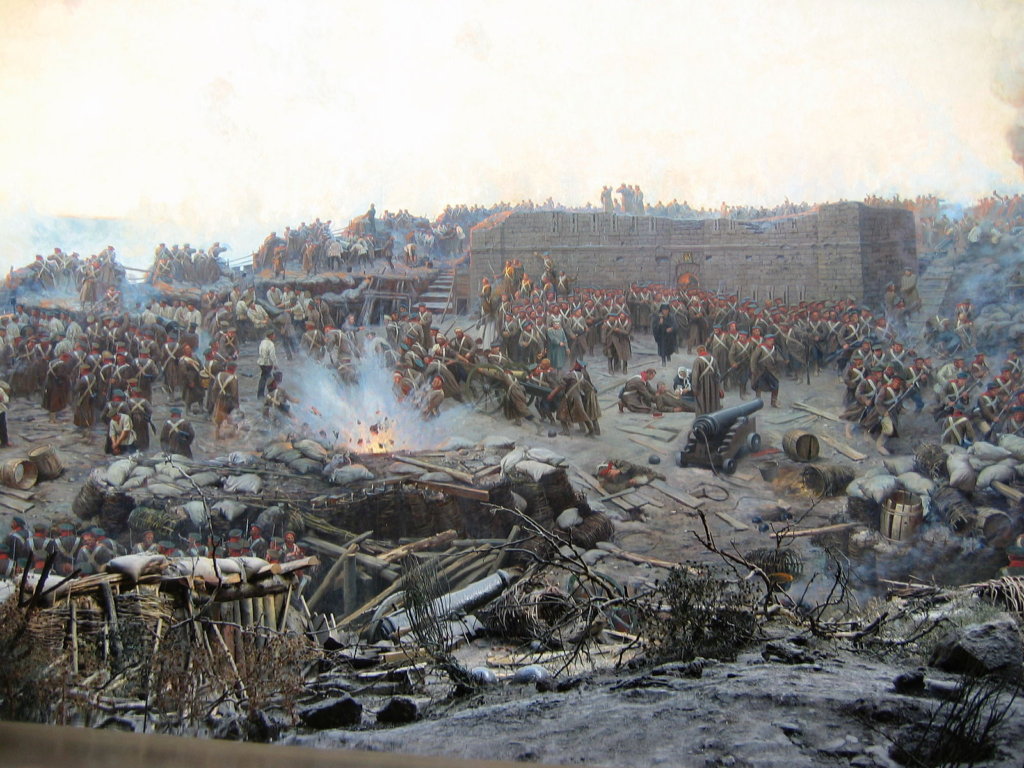
Detail of Franz Roubaud's panoramic painting The Siege of Sevastopol (1904).
Detail of Franz Roubaud's panoramic painting The Siege of Sevastopol (1904). Source: Wikipedia.

Florence Nightingale's Books

Around this time, Florence also published two books, Notes on Hospital and Notes on Nursing, both published in 1859. These books, in addition to about 200 other books, pamphlets, and reports on hospital, sanitation, and other health-related issues, would lay the foundations for modern nursing.

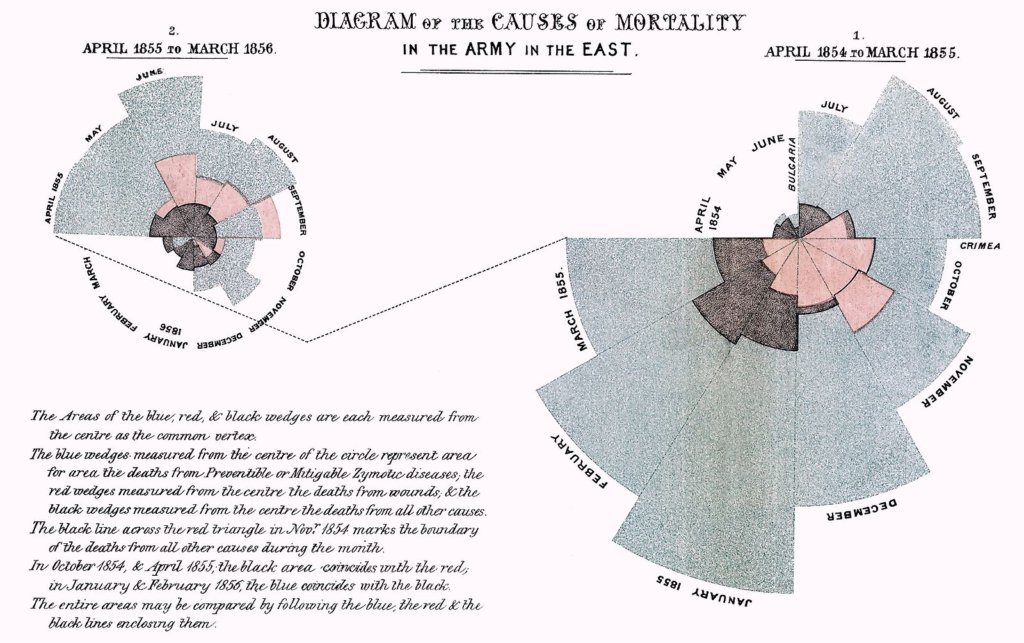
This "Diagram of the causes of mortality in the army in the East" was published in Notes on Matters Affecting the Health, Efficiency, and Hospital Administration of the British Army and sent to Queen Victoria in 1858.
This "Diagram of the causes of mortality in the army in the East" was published in Notes on Matters Affecting the Health, Efficiency, and Hospital Administration of the British Army and sent to Queen Victoria in 1858. Source: Wikipedia.

Florence lived until the age of 90, dying on August 13, 1910. Even though she had the opportunity to buried in Westminster Abbey, her relatives declined the offer, and she was instead buried at St. Margaret Church in East Wellow near her parents’ home.

Florence’s work and achievement cannot be understated. She turned nursing into a respectable profession for women. Previously with the exception of nuns, most women who worked as nurses were working-class and often poorly trained and disciplined. Florence was determined to educate women in the field of nursing and turn it into a respectable occupation. Due in large part to her work in Crimea, Florence helped to transform the public image of nursing.

The Legacy of Florence Nightingale

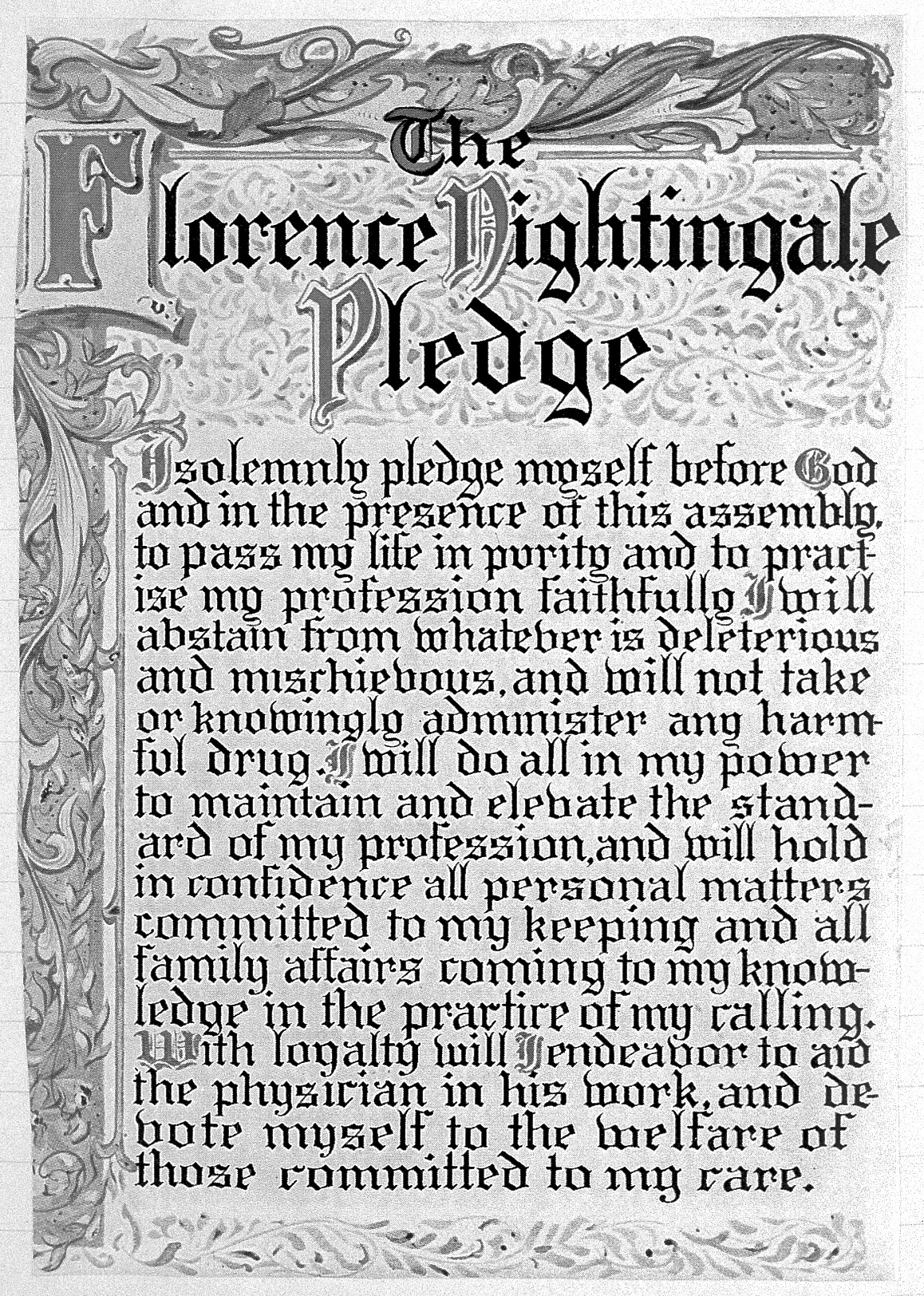
Pledge of Florence Nightingale. Credit: Wellcome Library, London.

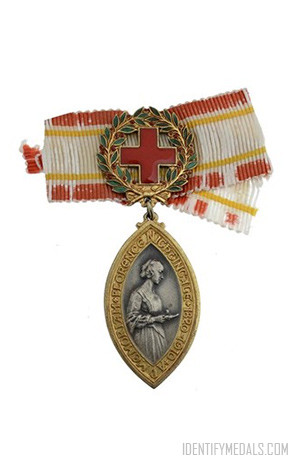
Even today, Florence continues to be recognized for her pioneering work. New nurses take the Nightingale Pledge, and the Florence Nightingale Medal, issued by the International Committee of the Red Cross beginning in 1912, is the highest international award that a nurse can achieve.

Like the woman named in honor, the Florence Nightingale Medal is awarded to nurses or nursing aides who exhibit “exceptional courage and devotion to the wounded, sick or disabled or to civilian victims of a conflict or disaster” or “exemplary services or a creative and pioneering spirit in the areas of public health or nursing education.” In addition, International Nurses Day has been celebrated on her birthday (May 12) each year since 1965.

Less well known are Florence’s mathematical achievements. However, her reforms in hospital sanitation methods were due to her use of new techniques in statistical analysis. Florence developed a “polar-area diagram” to depict the needless deaths that had been caused by unsanitary conditions. In this way, Florence was innovative in collection, graphical display, interpretation, and tabulation of descriptive statistics.

Even today, Florence continues to be recognized for her pioneering work. New nurses take the Nightingale Pledge, and the Florence Nightingale Medal, issued by the International Committee of the Red Cross beginning in 1912, is the highest international award that a nurse can achieve.

Like the woman named in honor, the Florence Nightingale Medal is awarded to nurses or nursing aides who exhibit “exceptional courage and devotion to the wounded, sick or disabled or to civilian victims of a conflict or disaster” or “exemplary services or a creative and pioneering spirit in the areas of public health or nursing education.” In addition, International Nurses Day has been celebrated on her birthday (May 12) each year since 1965.

Less well known are Florence’s mathematical achievements. However, her reforms in hospital sanitation methods were due to her use of new techniques in statistical analysis. Florence developed a “polar-area diagram” to depict the needless deaths that had been caused by unsanitary conditions. In this way, Florence was innovative in collection, graphical display, interpretation, and tabulation of descriptive statistics.

Florence even received an award from Queen Victoria herself: a jeweled brooch designed by Victoria’s husband, Prince Albert, with the dedication: “To Miss Florence Nightingale, as a mark of esteem and gratitude for her devotion towards the Queen’s brave soldiers.”

Sources:

Guest Contributor: Rachel Basinger is a former history teacher turned freelance writer and editor. She loves studying military history, especially the World Wars, and of course military medals. She has authored three history books for young adults and transcribed interviews of World War II veterans. In her free time, Rachel is a voracious reader and is a runner who completed her first half marathon in May 2019.
What Makes Vietnam War Medals Especially Unique

Did you know that some Vietnam War medals and decorations are especially unique because they were issued by South Vietnam, a country that ceased to exist after North Vietnam’s victory? Even so, U.S. military members who received foreign South Vietnamese decorations and medals are still authorized to wear them.

Due to the fall of South Vietnam, the official records of individuals who received awards from that country disappeared, although some U.S. military units maintained records of those awards. While South Vietnam issued a variety of awards and decorations, the U.S. only issued one medal specifically pertaining to the Vietnam War.

In addition, perhaps due to the unpopularity of the war, the Department of Defense never created lists of individuals who received military medals during the Vietnam War except for the Medal of Honor. Typically, the awards were only recorded in personnel records of casualties. In 2002, a team of volunteers began to record some medals awarded to each Vietnam War casualty.

In 2013, the Virtual Wall began to create its own database for these awards, which includes the Medal of HonorDistinguished Service CrossNavy CrossAir Force CrossSilver StarDistinguished Flying CrossBronze Star for Valor, Bronze Star to Meritorious Service or Achievement, Purple HeartAir Medal, Good Conduct Medal, and two foreign awards—Vietnam Gallantry Cross and Vietnam Military Merit Medal.

Here is just a small sample of the medals, awards, and decorations issued during the Vietnam War, three of which we’ll cover more in-depth:

The Vietnam Service Medal

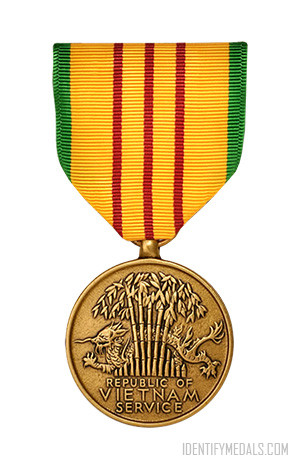
Authorized by executive order in 1965, the Vietnam Service Medal is a U.S. medal to honor service members who served in Vietnam, Laos, Cambodia, and/or Thailand from 1965 to 1973 for 30 consecutive or 60 nonconsecutive days.

The colors of the ribbon are green, yellow, and red, which represents the flag of the Republic of Vietnam at the time—yellow with red stripes running horizontally—and the green Vietnamese jungles. In addition, the three red stripes indicate the three ancient empires of Vietnam Tonkin, Annam, and Cochin China.

For those who participated in campaigns like the Tet counteroffensive in 1968 and the air offensive phases from 1966 to 1969, bronze stars on mounted on the ribbon for participation.

The Republic of Vietnam Campaign Medal

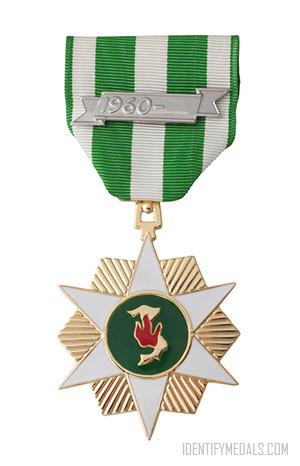
In addition to the U.S. medal, the Republic of Vietnam Campaign Medal is a foreign award, meaning a military decoration or award issued to American troops who aided that country in conflict. First introduced during the First Indochina War, the Republic of Vietnam Campaign Medal was authorized for wear on American service members as of December 1966 for their service in Vietnam.

In order to receive this medal, military members must have served in the Republic of Vietnam for six months between March 1, 1961 and March 28, 1973 or served outside Vietnam but gave combat support for six months or served less than six months but was wounded, captured and escaped enemy forces, or was killed in action.

What’s unique about the medal is that it comes with a default device, known as the 1960 device. It reads, “1960-”. Because they were produced and awarded during the war, it reads the start date of the conflict, but no end date was added.

Finally, its design helps to tell the story of the Vietnam War with the colors of the medal—green and white—to represent freedom and purity respectively. In addition, the medallion has a six pointed white enamel star, six golden rays between each point in the star, and a map of Vietnam in the center of the medallion. The putative red flames on the map represent the locations of the war.

The Vietnam Gallantry Cross

Under the Department of the Army General Order (DAGO) 43, 1970, all military personnel of all branches were awarded the Vietnam Cross of Gallantry if they had served in Vietnam between March 1, 1961 and March 28, 1973.

In addition, according to DAGO 8, 1974, the Vietnam Gallantry Cross, Unit Citation with Palm was awarded to Headquarters U.S. Military Assistance Command (MACV) and all subordinate units during February 8, 1962 to March 28, 1973. This meant that all military personnel who were assigned to units that served in-country Vietnam during this period were considered as assigned to MACV, regardless of service or component.

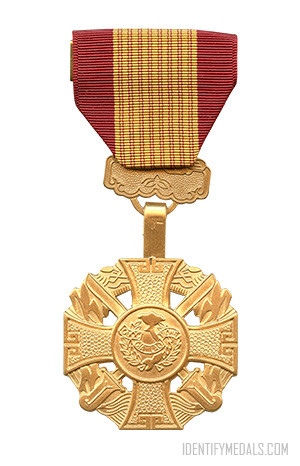
In other words, the Republic of Vietnam authorized this award for all foreign military personnel and units for valorous achievement and participation during the Vietnam War. Equivalent to the French Croix de Guerre, the medal demonstrates South Vietnam’s gratitude to the American and Allied soldiers who worked, fought, and sacrificed themselves for the freedom of the Republic of Vietnam.

In closing, the Vietnam War has always been a touchy subject. Since the war was quite unpopular, many veterans were not welcomed when they returned, even if they did not personally agree with the conflict. In addition, many Vietnam War vets rarely talked about their experiences during the war and their service—until somewhat recently—went undiscussed.

As a result, besides the Medal of Honor and other prestigious U.S. decorations, many individuals do not know much about the Vietnam War medals, which is unfortunate because they are especially unique.

From the unique device attached to the Republic of Vietnam Campaign Medal to the fact that some medals were issued by a now defunct country—South Vietnam, the medals specifically connected to the Vietnam War have a distinctive story to tell.  

Sources:

Guest Contributor: Rachel Basinger is a former history teacher turned freelance writer and editor. She loves studying military history, especially the World Wars, and of course military medals. She has authored three history books for young adults and transcribed interviews of World War II veterans. In her free time, Rachel is a voracious reader and is a runner who completed her first half marathon in May 2019.
A Visit to the Athens War Museum in Greece

There’s a lot to see in Athens, and even though it’s been raining cats and dogs all day my brother and I are determined to visit the Athens War Museum. We’ve read the reviews: This behemoth of a structure seems to be loved and dreaded in almost equal measure.

Reviewing sites agree on calling it old fashioned, but we’re definitely a little old fashion, too. “I was bored out of my skull,” writes one lady, and rates it one out of five. We haven’t yet found a museum we haven’t enjoyed, so we are cautious. “This is an excellent place to spend 4 hours!” shares an enthusiastic guy from Brisbane, plastering the review with five shiny stars. So there we went, curious to see who was right, and anxious to learn more about non-classical Greek history (spoilers: Brisbane guy was right. The Athens War Museum is a gem and one of my new favorite places in the world.)

My Visit to the Athens War Museum

The entrance to the Athens War Museum
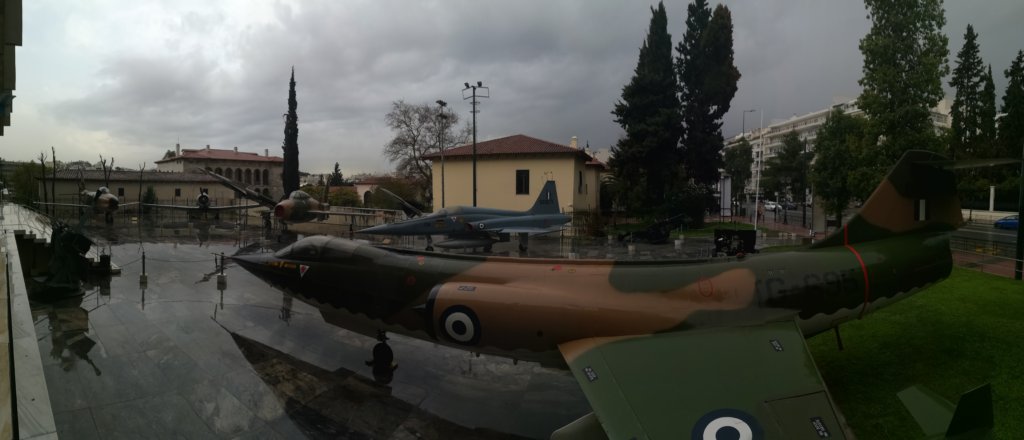
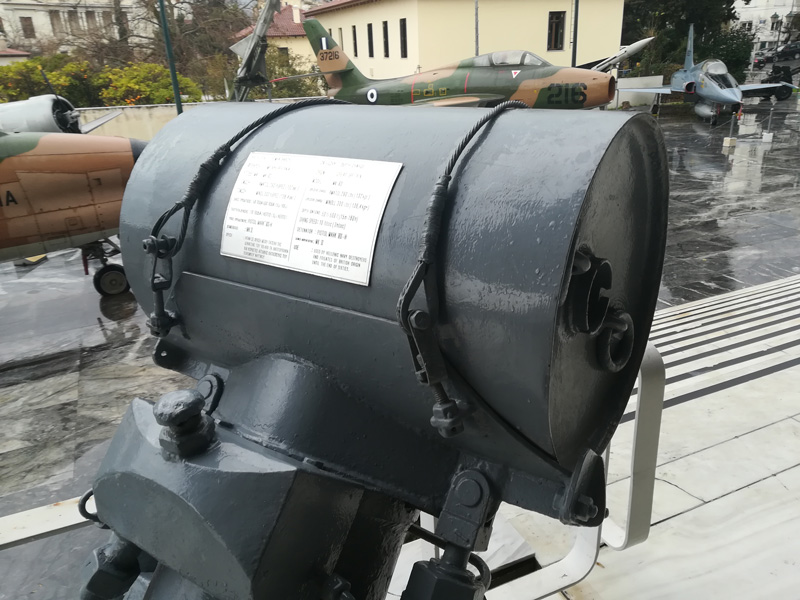
The entrance to the Athens War Museum and its outdoor exhibit of former aircrafts of the Hellenic Air Force.

Four Incredible Levels

The Athens War Museum was inaugurated after the fall of the military regime in July 1975 as the museum of the Greek Armed Forces. Its exhibition areas are distributed over four levels and honor all those who fought for Greece and its freedom. It houses incredible historical treasures, opening with several British 25 pounder field guns that NATO nations used up to the end of the 20th century and a pair of horse-drawn cannon turrets from the late 19th hundred among many other fascinating pieces of hardware.

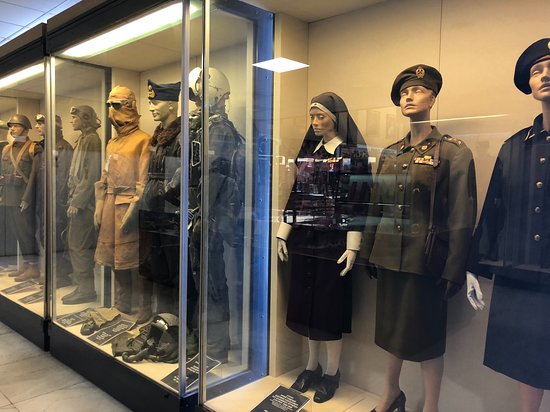
As you enter the museum, you are welcomed by a series of mannequins outfitted in the many military uniforms of past and present (and the friendliest reception staff in Europe). Climb the stairs, and begin to adventure through history: Each room covers a different time period, starting ancient warfare and continuing with the Greek war of freedom and World wars. The museum has guns and weapons from 1500 BC (Neolithic axes, bronze-age daggers) to the 20th century (guns, swords, bayonets).

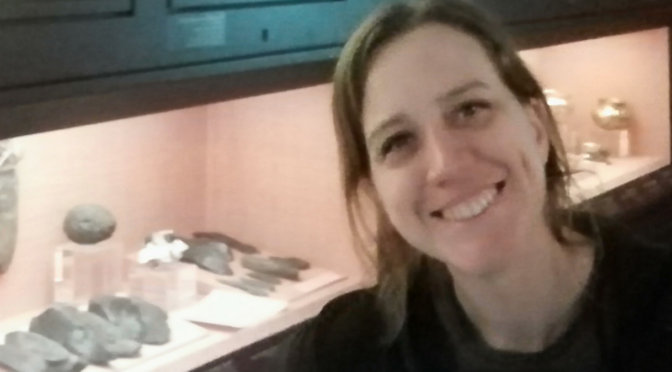
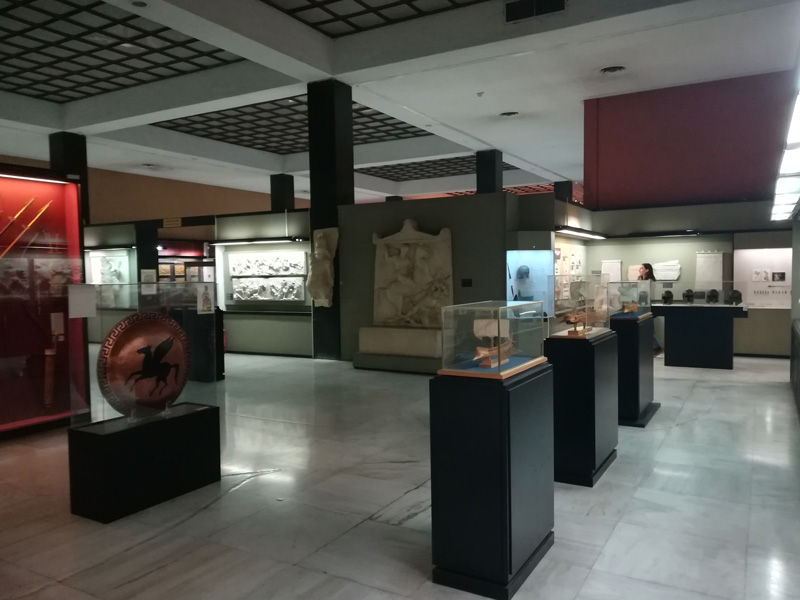
We particularly enjoyed the plaster maps that explained the military tactics of the Persian invasions (incredibly enough, no documentary can help you visualize the Battle of SalamisMarathon and Thermopylae so effectively. The maps helped us enormously when we then visited the actual places later in the week), and although a lot of the earlier objects are reproductions – albeit, you can see the real ones in other Greek museums!, they really do give you a great idea of the evolution of weapons and how they were used in conflict. As an anthropologist, I particularly appreciated being able to see what such weapons really looked like when they ‘brand new’ and imagine how they were utilized.

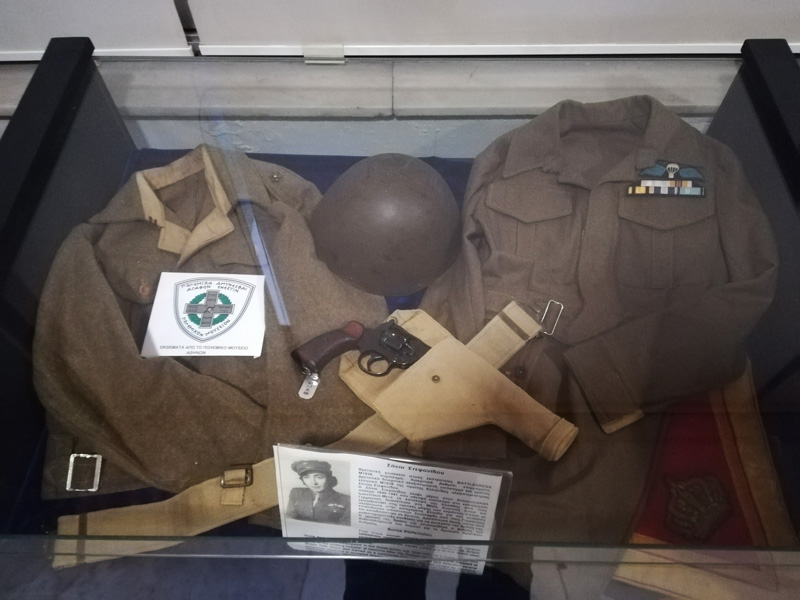
Uniforms on display (male and female) through the entrance of the museum.
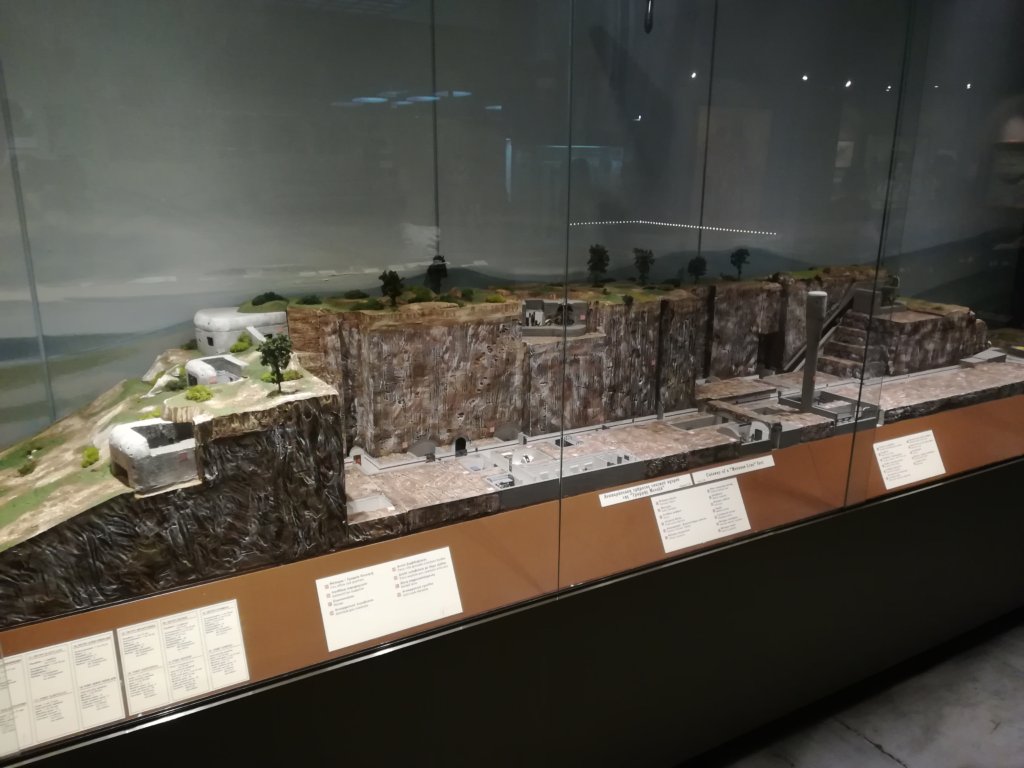
Most of the exhibits have dioramas, photos and objects to better understand what you're looking at.
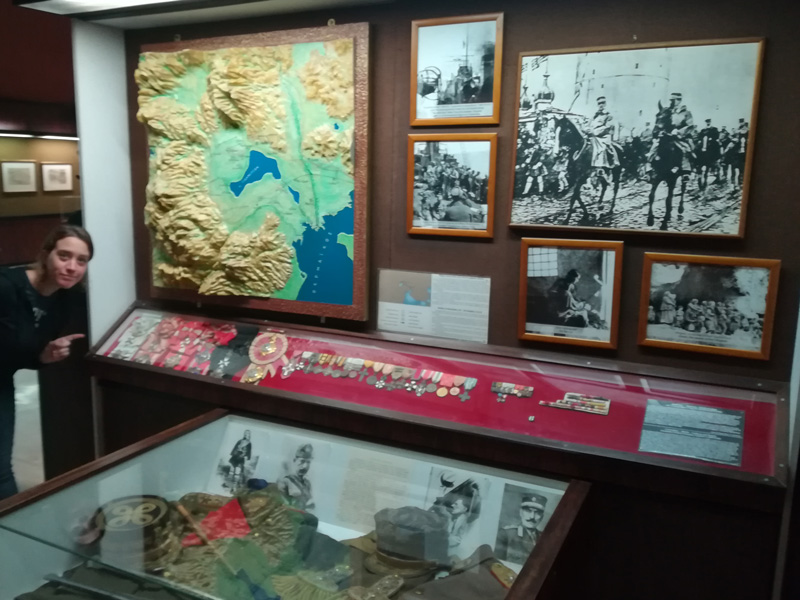
Most of the exhibits have dioramas, photos and objects accompanying them. Hey, look, medals!
Triremes, shields, spears and other antique goodies.

Visualizing War Thought Exhibits

The exhibits, in general, are in great condition – yes, they might look a little outdated compared to some of the new technologies other museums have incorporated, but the history remains the same! They all come with explanatory signs in both Greek and English (although the English ones tend to be shorter) and are carefully put together. One of the best things about this museum is that most exhibits are accompanied by related art, artifacts, scale models, video and photography, bringing the stories behind the objects to life. I’m a sucker for dioramas, and this museum has a ton of them. The whole thing is meticulously organized and presented.

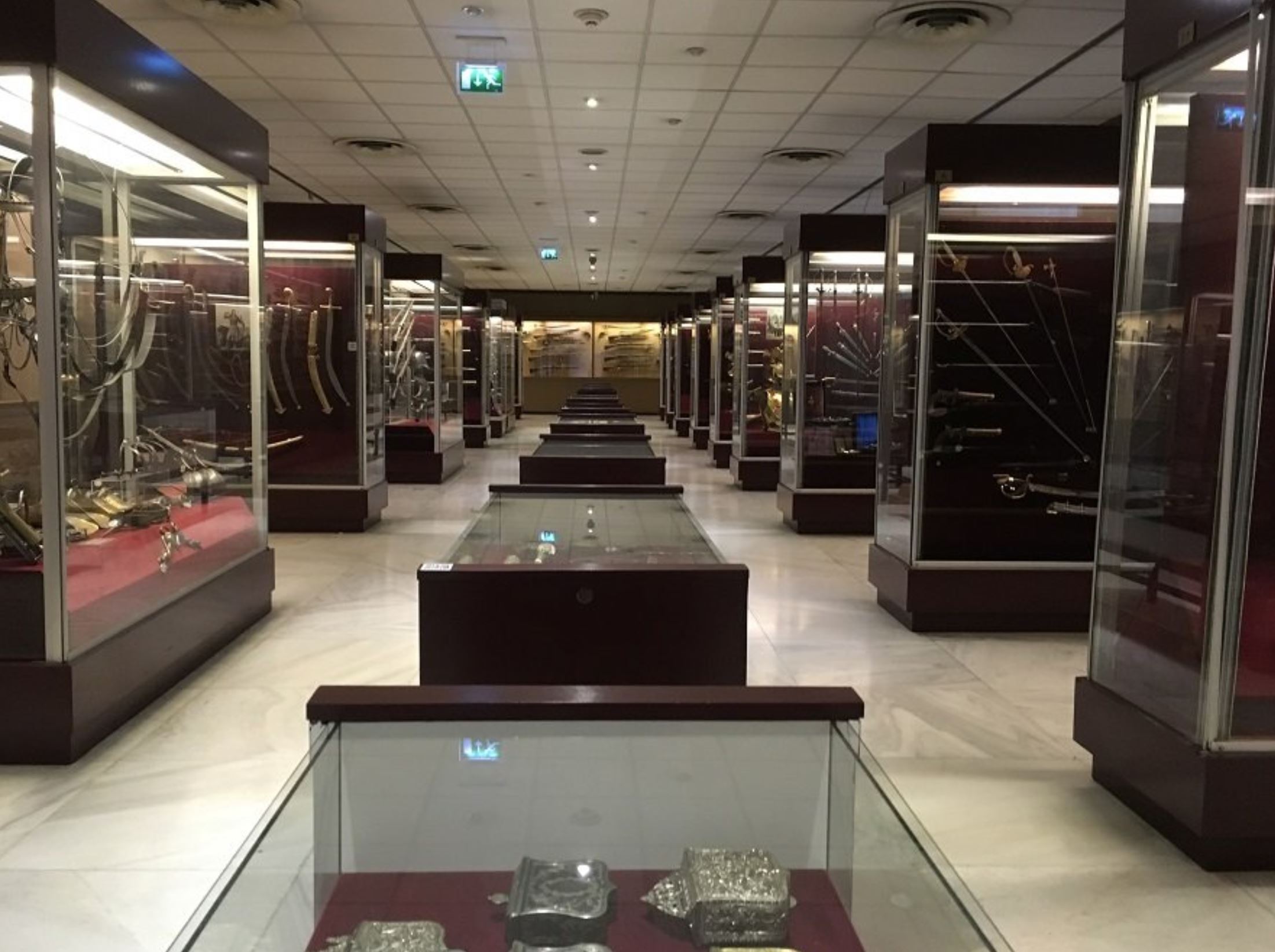
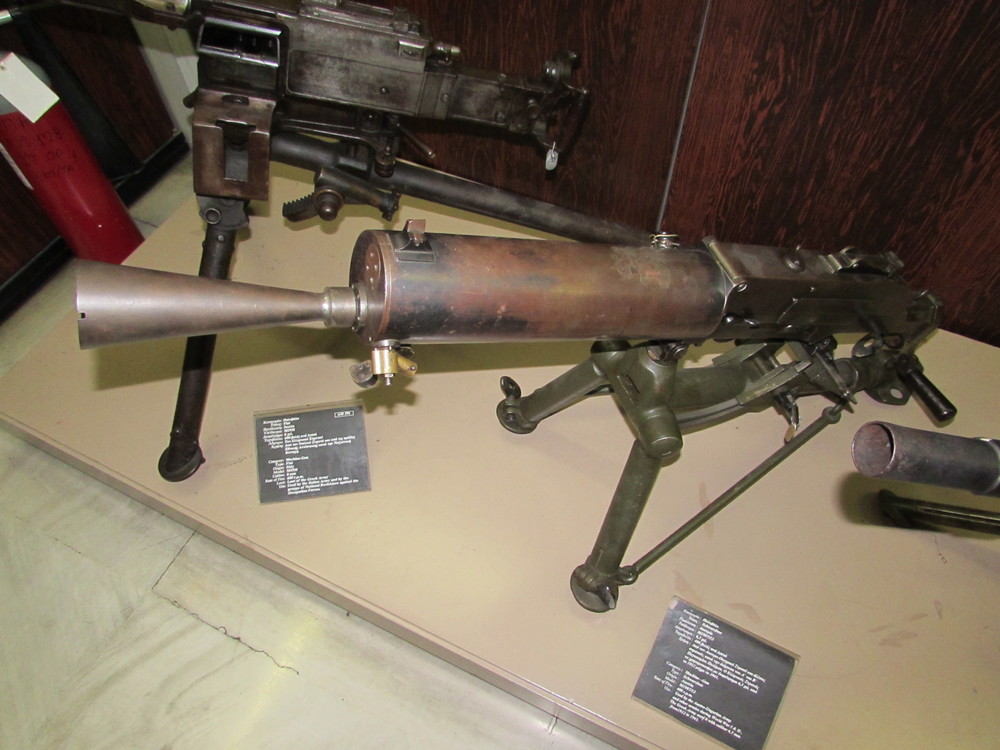
The museum has a large number of weapons used during conflicts that involved Europe and Greece, including but not restricted to guns, knives, swords, and bayonets (they have flint axes, modern fighter jets and everything in between!). There’s also an excellent collection of arms on the bottom floor, most notably from the 1800’s, which I believe it’s probably one of the better ones around. And if this is not enough, venture into the underground toilets and be blown away by displays of international warfare equipment, such as tortoiseshell shields, spears and armor like you’ve never seen before.

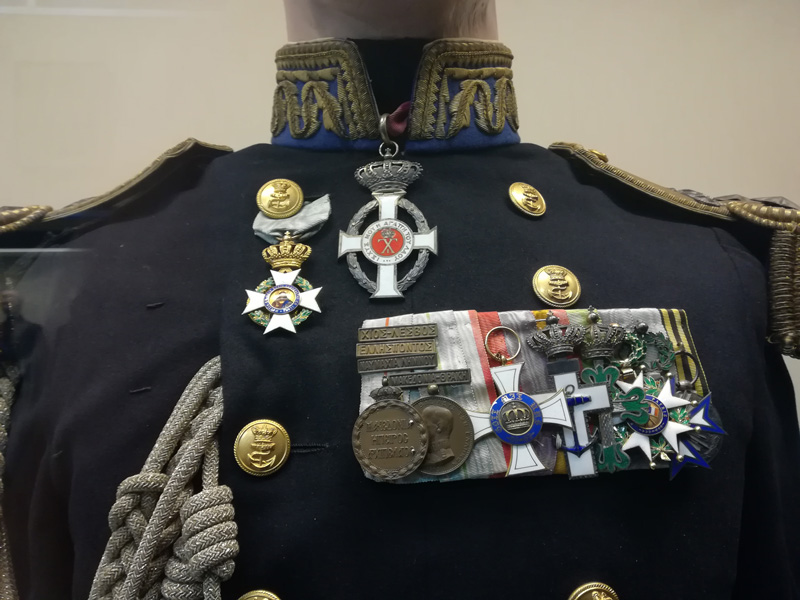
Among the top floor highlights, you’ll find objects like ex prime minister George Papandreu‘s pocket pistol, a well as submachine guns with gold plated parts given by the Saudi Arabian government to Greece’s ministers. There are personal belongings, literature of the time pertaining to the events and in the WWII room there’s even a written command in Greek and German declaring the use of reprisal executions for acts of sabotage and resistance. And my favorite, as a medal collector: Awards accompanied by letters, photographs and even the uniforms of those that were recognized with them. 

Athens War Museum - Arms and Guns exhibit.
Athens War Museum - Medals
Athens War Museum - Stories
Athens War Museum - Weapons from World Wars
Athens War Museum - Outside

Greek Freedom and World Wars

Each time period is explained on a sign above the doorframes. The museum utilizes several rooms to tell the story of the Greek Independence from the Ottoman Empire (Elliniki Epanastasi, or the Greek War of Independence) through art, objects and stories from those that were there. March 25, 1821 is what’s still celebrated as Greek Independence Day—when Germanos, archbishop of Pátrai, unfurled a Greek flag at the monastery of Ayia Lavra near Kalávrita.

The museum, of course, covers also WWI, the battles for Greece in WWII and the Greek Resistance in WWII. The showcases are powerful because they present real experiences, plus the social movements and practical equipment that accompanied them, like food supplies, flags and a whole lot of personal belongings. You might see a completely new side of war and of resistance.

Athens War Museum - Armor
Athens War Museum - Helmets and Medieval Weapons
Athens War Museum - Medals

Why you Should Visit the Athens War Museum

Although the related artifacts number the thousands, I personally found the photographs and personal objects the most compelling. On the whole, it all made for an unforgettable and very emotional experience. The museum galleries show ammunition, armors, uniforms, medals, flags, maps, photographs and all sort of documents related to military environment – but most of all, it shows sthe people behind them.

When you visit Greece, it’s not always easy to get a cohesive understanding of its complete history, from BC to today. Several aspects of Greek history escape the casual tourist, such as the matters of Greek nationalism and 20th century Greco-Turkish conflicts. The museum does a terrific job at displaying this country’s rich history in a way that is both logical (rooms arranged chronologically) and human.

I cannot but recommend a visit. Plus, it’s very accessible (easy to get there, has elevators and rooms with lots of space for people with reduced mobility), it has a great gift shop to ruin your baggage allowance and is very inexpensive: 3 euros.

And I shall reiterate, the staff was simply fantastic, as excited and honored to be there like us, humble history buffs.

The Inspiring, Yet Tragic Story of Colleen Cain: The Coast Guard’s First Female Helicopter Pilot

On January 1982, the U.S. Coast Guard’s first female helicopter pilot tragically became the first female Coast Guard pilot killed in the line of duty.

On January 7, 1982, the U.S. Coast Guard’s first female helicopter pilot tragically became the first female Coast Guard pilot killed in the line of duty. While a devastating story, Lieutenant Colleen Cain continues to inspire today’s generation of female pilots in Coast Guard, and we can honor her short life by learning her story.

Who Was Colleen Cain?

Finland had never had normal relations with the Soviet Union. As this poor country broke free from the Tsardom of Russia and saw a political revolution ensuring the victory of the “Whites” against the Finnish Bolsheviks, it became the target of the Soviet Union.

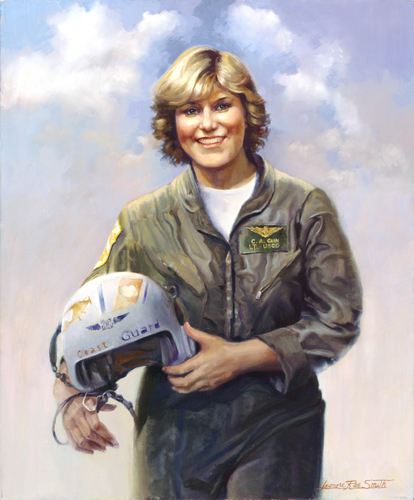
A portrait of Coast Guard heroine Lt. Colleen Cain by Leonora Rae Smith.

Born in 1953 and hailing from Burlington, Iowa, Cain graduated from the University of California in Santa Clara in 1974, two years before completing Officer Candidate School in 1976. She was extremely interested in being selected for flight training, so she obtained her Private Pilot’s License at her own expense (and on her own time!) in 1977.

In 1978, Cain’s dream came true as she began her military flight training in the Coast Guard, receiving her wings on June 8, 1979. She was Coast Guard Aviator #1988, the third female Coast Guard aviator and the first female HH-52 helicopter pilot.

Air Station Barbers Point, Hawaii was her first duty assignment. Tragically, she never had another. Even so, her short life was full. She flew many missions and earned qualifications as co-pilot, first pilot, and aircraft commander.

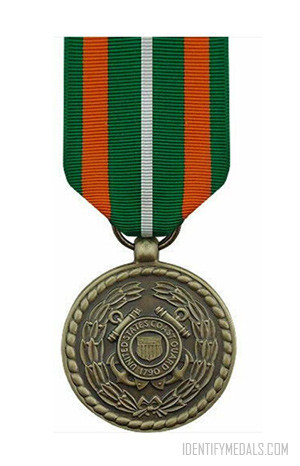
In fact, just one year after earning her wings, Cain flew a rescue mission in order to save a 3-year-old boy. He was on a fishing trip with his grandfather and slipped into the water. He was pulled from the water, and Cain resuscitated the boy. For her actions, she was awarded the Coast Guard’s Achievement Medal.

Colleen Cain's Last Flight

On January 7, 1982Cain and two other crew members launched in order to respond to a distress call from the Pan Am, a 74-foot fishing boat taking on water off Maui and in grave danger of sinking with seven people on board. When the helicopter lifted off at 4 a.m., there were torrential rains and heavy winds. Slightly over an hour later—around 5:15 a.m.—the Coast Guard had lost radio contact with the crew.

It wasn’t until nine hours later that another helicopter discovered the wreckage of Cain’s helicopter on a ridge in Molokai’s Wailua Valley. The chopper had crashed into the side of a mountain, and all the crew members of CG1420 were killed, including CainLieutenant Commander Horton “Buzz” Johnson, and Petty Officer 2nd Class David Thompson. Cain was not yet 30 years old.

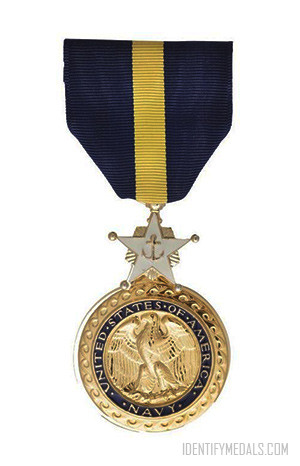
Cain’s pilot Johnson was renown in his own right. He was a veteran of search-and-rescue missions and had been awarded the Distinguished Flying Cross—seldom given in peacetime—in 1976 for rescuing a man who had crashed a light plane on a mountainside during practically bad weather.

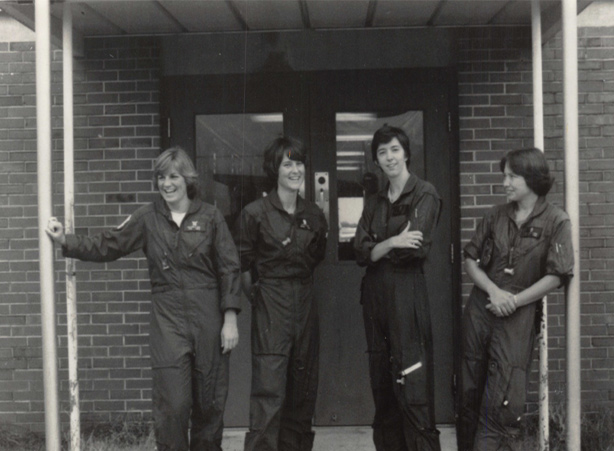
Group photo of Colleen Cain
Group photo of Colleen Cain.

Military leaders did not know whether Cain who was serving as co-pilot or Johnson who was the pilot were in control of the helicopter when it hit the Molokai Ridge, as the two had been taking turns at the wheel.

The Coast Guard faced difficulties in extricating the bodies of Cain and Johnson from the wrecked aircraft that dangled precariously on a steep slope at 2,200 feet. The other crew member, David Thompson, who had served as Aviation Machinist, had been thrown from the chopper upon hitting the cliff.

At the time of Cain’s death in 1982, she had been one of three pilots in the Coast Guard. Cain and one other woman were the first female helicopter pilots, and another woman flew fixed-wing aircraft.

Military leaders did not know whether Cain who was serving as co-pilot or Johnson who was the pilot were in control of the helicopter when it hit the Molokai Ridge, as the two had been taking turns at the wheel.

The Coast Guard faced difficulties in extricating the bodies of Cain and Johnson from the wrecked aircraft that dangled precariously on a steep slope at 2,200 feet. The other crew member, David Thompson, who had served as Aviation Machinist, had been thrown from the chopper upon hitting the cliff.

At the time of Cain’s death in 1982, she had been one of three pilots in the Coast Guard. Cain and one other woman were the first female helicopter pilots, and another woman flew fixed-wing aircraft.

Colleen Cain's Service

Even today years later, Cain is remembered for her service despite her short life of 29 years. In 1985, a 100-room residence hall at the Coast Guard Reserve Training Center in Yorktown, Virginia honored Cain with its name—“Cain Hall.”

In 2009, the Coast Guard dedicated a memorial at Air Station Barbers Point where Cain and the other crew members were stationed to honor the crews of CG1420 in 1982 as well as the more recent fatal crash of CG6505 in 2008.

Lieutenant Commander Charlotte Pittman, a Coast Guard helicopter pilot, speaking on behalf on all female pilots in the Coast Guard perhaps best remembered Cain’s life. Grateful for Cain’s service and her pioneering work, Pittman reflected on Cain’s sacrifice 30 years later. Like Cain, Pittman had been a reservist and wanted to be a Coast Guard helicopter pilot.

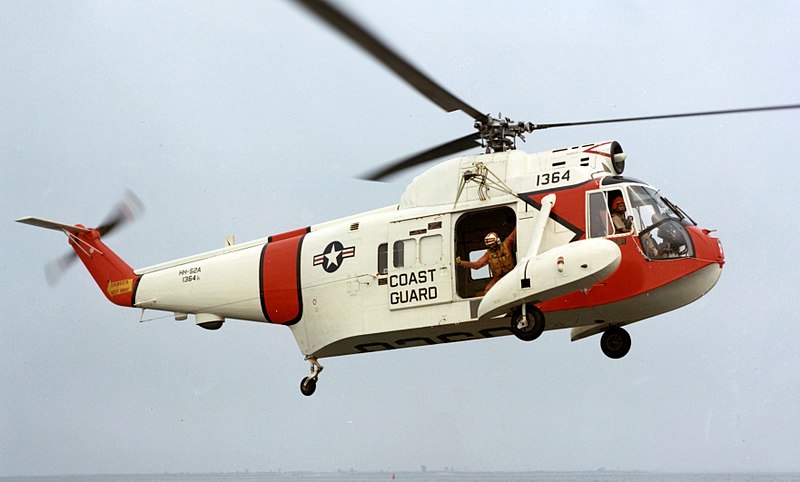
A U.S. Coast Guard HH-52A Seaguard helicopter.
A U.S. Coast Guard HH-52A Seaguard helicopter. Source: Wikipedia.
Wailua Valley State Wayside.
Wailua Valley State Wayside. Image courtesy of MauiGuidebook.

When Pittman earned her wings in 2001, she followed in the path that Cain had blazed twenty-two years prior. Even though Cain didn’t finish her first tour, Pittman admired her work and noted that Cain started a proud legacy of women in Coast Guard aviation.

Cain was part of a group of three officers and six enlisted women who demonstrated the role that women could play in military aviation, opening up the door for countless women in the future to pursue their dreams of military aviation. Known as the First Women of U.S. Coast Guard Aviation, nine women in the Coast Guard became aviators when the Coast Guard opened all aviation ratings to women on January 1, 1976.

In addition to Cain, other pioneering women included Vivien Crea and Janna Lambine (officers) and Erminia Chillon, Andrea Gardner, Dior Lowen Hubel, Kelly Mogk Larson, Robyn Rogers Norvell, and Elizabeth Uhrig (enlisted).

Unfortunately, Cain’s story has a sad ending, as she died much too young. However, it is an inspiration, as she was the Coast Guard’s first female helicopter pilot and a fitting model for future female aviators in the Coast Guard and other branches of the military.

Sources:

Guest Contributor: Rachel Basinger is a former history teacher turned freelance writer and editor. She loves studying military history, especially the World Wars, and of course military medals. She has authored three history books for young adults and transcribed interviews of World War II veterans. In her free time, Rachel is a voracious reader and is a runner who completed her first half marathon in May 2019.
Medals of The Few and The Proud: A Look at Marine Corps Medals

We all know the reputation of the Marine Corps as the toughest branch of the service, but there’s a good chance that unless you’re a Marine or you’re married to a Marine, you don’t know much about Marine Corps medals. But I’m going to change that today, as I give you a quick look at the medals our toughest service members receive.

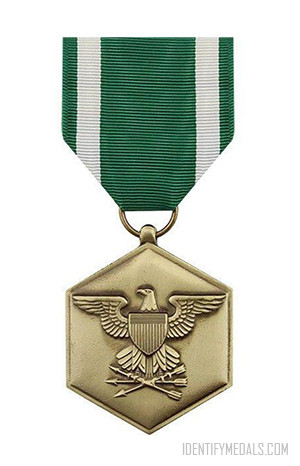
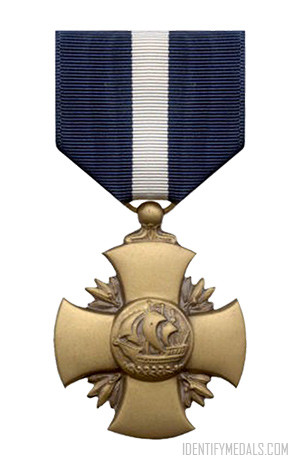
There are several combat awards that are specifically awarded to individuals serving with the U.S. Navy and U.S. Marine Corps only. These include the Navy Cross Medal, the Navy Distinguished Service Medal, the Navy/Marine Corps Commendation Medal and the Navy/Marine Corps Achievement Medal. The Combat Distinguishing Device may be authorized for latter two medals.

Navy Cross Medal

Just one step below the Medal of Honor, the Navy Cross Medal is awarded to individuals who have distinguished themselves by extraordinary heroism while serving with the Navy or Marine Corps. Because the Navy Cross Medal is a distinctive decoration, it is only awarded for acts performed in the presence of great danger or at great personal risk.

In order to receive the medal, they must demonstrate extraordinary heroism in one of three situations:


  1. While engaged in an action against an enemy of the United States;
  2. While engaged in military operations involving conflict with an opposing foreign force;
  3. While serving with friendly foreign forces engaged in an armed conflict against an opposing armed force, in which the United States is not a belligerent party.

Navy Distinguished Service Medal

Slightly lower than the Navy Cross but just above the Silver Star Medal is the Navy Distinguished Service Medal. The Distinguished Service Medal is awarded to individuals who display exceptionally meritorious service to the United States in a duty of great responsibility.

Generally, the medal is just awarded to officers in principal commands at sea or in the field who have gone clearly above normal expectations and contributed to the success of a major command or project. As the requirements note, “If there is any doubt as to the degree of service involved, the Legion of Merit [a slightly lower award] is the more appropriate award.”

Navy/Marine Corps Commendation Medal

Awarded for acts since December 6, 1941, the Navy/Marine Corps Commendation Medal is a mid-level medal awarded to individuals who have distinguished themselves while serving with the U.S. naval service.

To receive the Navy/Marine Corps Commendation Medal, individuals must have demonstrated one of three characteristics:

  1. Acts of Heroism that merit special recognition but in not to the degree necessary for a Bronze Star Medal (combat) or for the Navy and Marine Corps Medal (non-combat)
  2. Meritorious Achievement that is outstanding and deserves to be recognized as it is a definite contribution to the naval service, yet is not to the level of a Bronze Star Medal or Air Medal (combat) or Meritorious Service Medal or Air Medal (non-combat)
  3. Meritorious Service that is above and beyond what is usually expected of an individual at a particular grade and rate and can be demonstrated in the individual’s fitness report or personnel records, yet is not to the level of a Bronze Star Medal or Air Medal (combat) or Meritorious Service Medal or Air Medal (non-combat)

Navy/Marine Corps Achievement Medal

Originally established on May 1, 1961, the Navy/Marine Corps Achievement Medal was first a ribbon-only award. The current military medal was authorized by the Secretary of the Navy on July 17, 1967.

It is lower than the Commendation Medal and is awarded to members of the U.S. Navy and U.S. Marine Corps or members of the armed forces of a friendly foreign nation that meet the eligibility requirements.

The Achievement Medal is given for meritorious service or achievement in combat or non-combat situations where such actions merit more recognition than a fitness report but do not warrant a Navy/Marine Corps Commendation Medal or higher. Additionally, the Achievement Medal may be awarded to members of the reserves that are junior officers or enlisted personnel.

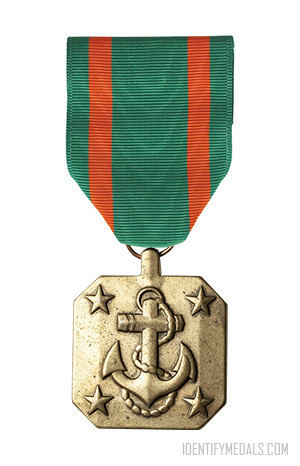
Designed by the Institute of Heraldry, the medal is a bronze square with clipped corners featuring a fouled anchor in the center. There are stars in each of the four corners. The back of the medal is blank so that the recipient’s name can be engraved, and the ribbon is myrtle green with stripers of orange near each edge. Additional awards are denoted by gold stars, and a Combat Distinguishing Device (Combat “V”) may be authorized.

To receive an Achievement Medal, individuals must demonstrate one of two characteristics:

  1. Professional achievement that clearly exceed the normal requirements and expectations given the individual’s grade and experience and be an important contribution that benefits the United States and the naval service
  2. Leadership achievement that is noteworthy, sustained or of such merit to earn singular recognition of the act(s), reflect well on the individual’s effort to accomplish the unit mission

While both medals—Commendation Medal and Achievement Medal—can also be given for non-combat situations, the Navy and Marine Corps also has a medal just for non-combat acts, the Navy and Marine Corps Medal.

Navy and Marine Corps Medal

Each branch of the service has its highest non-combat decoration. For the Army, it’s the Soldier’s Medal. For the Air Force, it’s the Airman’s Medal. For the Coast Guard, it’s the Coast Guard Medal. And for the Marines, it’s the Navy and Marine Corps Medal.

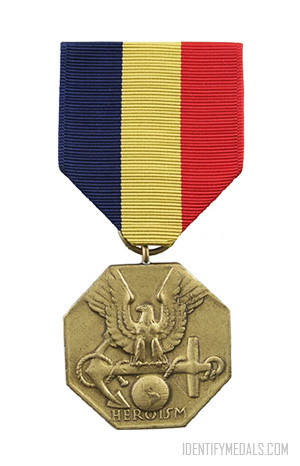
Established by an act of Congress on August 7, 1942 and first awarded during World War II, the Navy and Marine Corps Medal is a decoration higher than the Bronze Star Medal and is presented for heroism not involving conflict with the enemy to members of the U.S. Navy and U.S. Marine Corps.

If you’re curious about the order of precedence for Marine Corps medals and ribbons, you can visit this site that places the ribbons in order of precedence. In addition, you can also click on each ribbon to learn more about it. 

Hopefully, now you know just a bit more about what awards those serving with the U.S. Navy or U.S. Marine Corps can receive through our short look at Marine Corps Medals!


Sources:

Guest Contributor: Rachel Basinger is a former history teacher turned freelance writer and editor. She loves studying military history, especially the World Wars, and of course military medals. She has authored three history books for young adults and transcribed interviews of World War II veterans. In her free time, Rachel is a voracious reader and is a runner who completed her first half marathon in May 2019.
How to Look for British Soldiers from the Second World War WW2

There is a wide-ranging variety of records from the Second World War where you can research British soldiers and their histories. These are kept in different archives, all held by the Ministry of Defence. In this guide we will list them so you can search for information about those that put their lives at risk (and frequently lost them) during WW2.

Records Available Online

A lot of records can be accessed online, for free or for a very small fee. These include registers and documents provided in large by the National Archives and the Ministry of Defence.

1939

The 1939 Register

This 1939 register allows you to browse for documents by name or address. The site is paid, as it belongs to Findmypast.co.uk. Th register contains a survey of the civilian British population and was used as the basis for issuing ID cards and ration books, among others.

> Explore the 1939 Register

1915-1978

The Cabinet Papers

The Cabinet Papers lets you check records from the Cabinet Office. This includes documents concerning decisions and discussions before, during, and after the Second World War.

> Explore Cabinet Papers

1943-1945

The Allied Expeditionary Force Papers

This website allows you to browse copies of documents from the Supreme Headquarters Allied Expeditionary Force and 21 Army Group, which relate to a variety of headquarters responsibilities. The records are also available as digital microfilm in their catalog.

> Explore all WO229 Documents

Service Records

1920 – Present

Service Records by Veterans UK

Veterans UK offers summaries of service records from the Ministry of Defence. One important note: Only those who are next of kin can request access, as these are not available to members of the general public.

> Explore Service Records

National Archives in Kew Records

1939 – 1945

War Diaries from British Army Units

This website allows you to search British Army unit war diaries for the Second World War. They have a nice research guide you can use to get started.

> Explore War Diaries

1939 – 1945

UK Wartime Diaries and Personal Papers

This link will connect you with the Imperial War Museum website. Here, you will be able to access different records from their document archive, as well as from the various collections held by the museum and that refer to the Second World War.

> Visit the Imperial War Museum Website

Government and Military Records

The National Archives has an immense collection of documents you can consult, divided into Departments that cover government and military records for the Second World War. Just note that there’s likely to be some overlap between separate departments.

Most armed forces and general war records will be found in one of these:

Correspondence, policy and negotiation with other states can be explored in:

Correspondence to and from the Prime Minister’s office:

Domestic and internal affairs:

George Halas: Father of the NFL Who Also Served in Both World Wars

George Halas was a player, coach, and owner of the Chicago Bears. He also served in the Armed Forces and received the Bronze Star during WW2.

If you’re an NFL fan like I am, you know all the greats of the leagueGeorge Halas, player, coach, and owner of the Chicago Bears, definitely fits into that category. But what you might not know is that he served in the U.S. Armed Forces and even received the Bronze Star for his actions in the Pacific during World War II.

Let’s take a few moments to look at this incredible man who loved the sport of football so much but did not shirk from his duty to serve his country. Maybe this article will inspire you to read about all the other incredible NFL players who are also veterans!

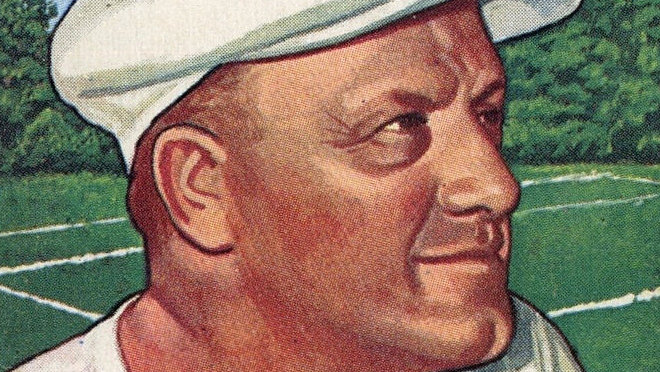
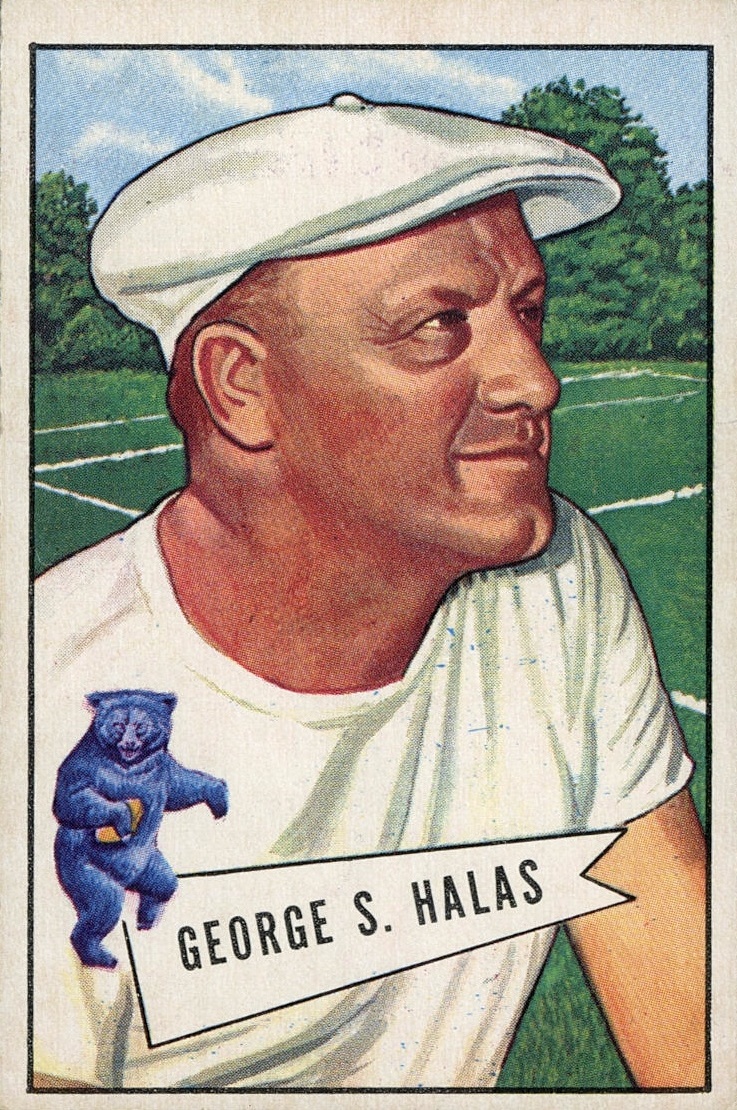
A George Halas sports card (#48) produced by Bowman Gum in 1952.
A George Halas sports card (#48) produced by Bowman Gum in 1952. Source: Wikipedia.

Who Was George Halas?

Born in Chicago on February 2, 1895, George Halas grew up in a very disciplined and frugal family. It’s no surprise then that he carefully saved money in order to attend the University of Illinois in Urbana-Champaign. He had been a sports nut since he was growing up, and he played football, baseball, and basketball in college.

Right before his final semester at Illinois, Halas enlisted in the United States Navy because the United States had World War I. Even though he did not complete all of the required coursework, Halas still later received his college degree. Assigned to Great Lakes Naval Base outside of Chicago, Halas was responsible for organizing the service football and basketball teams.

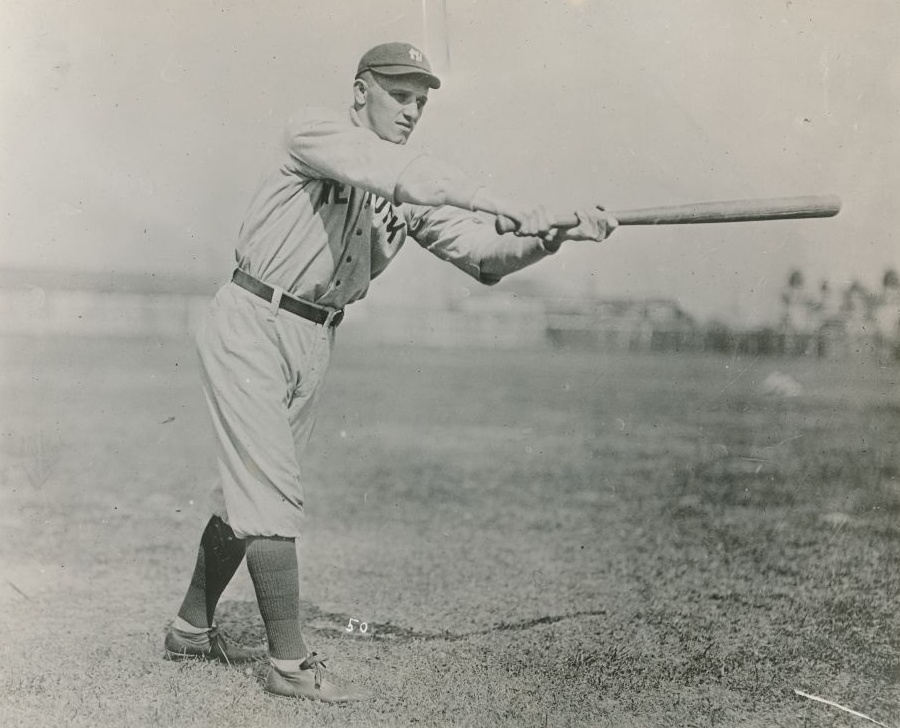
Halas’s first foray into the professional sports world was abysmal. Although he had gained a spot on the roster of the New York Yankees in 1919, a hip injury keep him relatively sidelined for a good portion of the season and he struggled when he hit the starting lineup.

George Halas After Baseball

His baseball career was over, so he returned to the Chicago area and worked for the railroad by day and played football on the weekends. In early 1920, Halas received a call from the Staley Starch Works, located in Decatur, Illinois. A.E. Staley, the owner of the company, wanted Halas to oversee the day-to-day operations of the manufacturing plant as well as organize and coach the company’s football and baseball teams. Halas was delighted.

Shortly after Halas arrived in Decatur, several club football teams of companies got together on September 17, 1920 in Canton, Ohio and formed the basic structure of the American Professional Football Association, which would later be renamed the National Football League (NFL) in 1924.

George Halas, "Papa Bear" New York Yankees Spring Training Hopeful
George Halas, "Papa Bear" New York Yankees Spring Training Hopeful. Source: Wikipedia.

Even though the Decatur team had had a successful season, A.E. Staley encouraged Halas to take the team to Chicago because the former didn’t think a professional football team could survive in Decatur. He offered Halas $5,000 to get started as long as Halas kept the team name of the Staleys for at least one season.

In 1922, Halas chose to rename the team the Bears to acknowledge the goodwill of William Veeck, Sr., the owner of the Chicago Clubs who allowed the Staleys to share Wrigley Field in exchange for a portion of the concessions, gate, and program sales.

In addition to coaching the Staleys and later Bears throughout the 1920s, Halas also played various positions on the team until he retired as a player after the 1929 season. In 1930, he hired another head coach for several years, who took the Bears to the 1932 championship. Perhaps because Halas wanted a championship himself, he returned to coaching. His 1933, 1940, and 1941 teams won the NFL championships with Halas as their head coach.

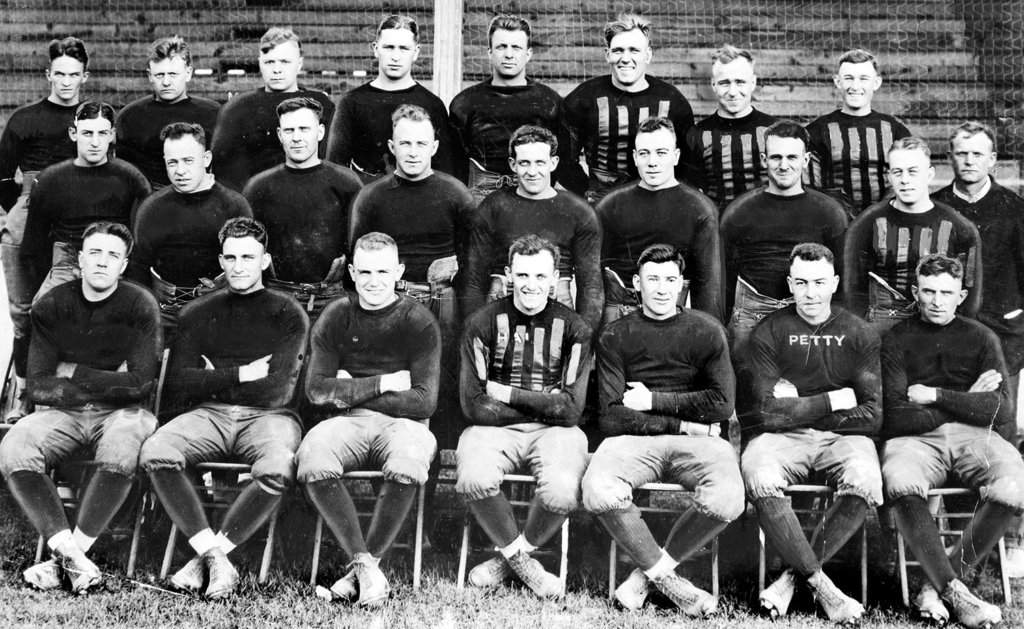
The 1920 Decatur Staleys football team. It would be later renamed "Chicago Bears".
The 1920 Decatur Staleys football team. It would be later renamed "Chicago Bears". Source: Wikipedia.

George Halas Enlists in the Navy

Following the attack on Pearl Harbor, Halas took a break from coaching for a while and re-enlisted in the Navy. He would spend the majority of his three years of service in the South Pacific, predominantly organizing R&R and entertainment for the troops there.

When he returned to the Bears at the end of the 1945 season, Halas led the Bears to yet another championship in 1946. Luke Johnsos and Hunk Anderson had won another title for the Bears in 1943.

The 1950s were a dry season for the Bears, as they won no championships, and Halas, who had come to be known as “Papa Bear” retired from coaching the Bears in 1955. Even though he continued to meddle on the sidelines for two years, Halas couldn’t stay away and returned to the head coach position.

He finally got his elusive one more championship in 1963. He would remain as Head Coach for several more years before finally giving up the reins, retiring after the 1967 season with 318 career wins and six NFL championships.

In 1982, Halas hired Mike Ditka, who had previously played with the Bears, as head coach, and a year later, Halas was diagnosed with pancreatic cancer, dying on October 31, 1983 at the age of 88.

Before he died, he gave Ditka a bottle of Dom Perignon champagne with the instructions that he wasn’t supposed to open it until Ditka won a Super Bowl. That happened on January 26, 1986 against the New England Patriots with a score of 46-10, and Ditka celebrated with that bottle of champagne!

Halas never forgot his service during the World Wars, though, as he hung a picture of Admiral Nimitz who Halas served under during World War II in his office. In addition, he helped start a Bears preseason tradition of the Armed Forces benefit game.

In a 1946 advertisement featuring a photo of Halas flanked by Nimitz and Dwight D. Eisenhower with Eisenhower handing Halas a football, the caption read: “We Must Carry the Ball for Them,” encouraging the general public to come to a game between the Bears and the Giants to support official relief agencies for the Army, Navy, and Army Air Forces.

Although Halas may be remembered more for his time in the NFL, we certainly can’t forget his service during both of the World Wars.

Sources

Guest Contributor: Rachel Basinger is a former history teacher turned freelance writer and editor. She loves studying military history, especially the World Wars, and of course military medals. She has authored three history books for young adults and transcribed interviews of World War II veterans. In her free time, Rachel is a voracious reader and is a runner who completed her first half marathon in May 2019.
The Battle of Königgrätz Sadowa and the Birth of a New Era

Königgrätz Sadowa is one of the most important battles in history. Its modern tactics would be later used in the Franco-Prussian War and WW1.

It only takes one man and his dream to deeply change the world. Back in the 19th century, Germany was a mass of Duchies and little kingdoms dominated by Austria. But as Napoleon started shaking Europe, Austria began to lose its grip on the German states and the ruins of the Holy Roman Empire. The congress of Vienna tried to rebuild this order, introducing the German Confederacy but the tension between its two major powers, Prussia and Austria, kept raising through the years.

The birth of the Zollverein in 1834, a custom union unifying the northern German states and Prussia, left Austria isolated. The prosperity of this union kept reinforcing the power of Prussia and the members of this Union soon became “vassals” of Prussia. The War of the Duchies, fought in 1864 against Denmark, gave even more power to the Prussian Kingdom and the war between Austria and Prussia became unavoidable. The final fight between these two kingdoms would leave only one winner, a winner would dominate the German states for many years to come.

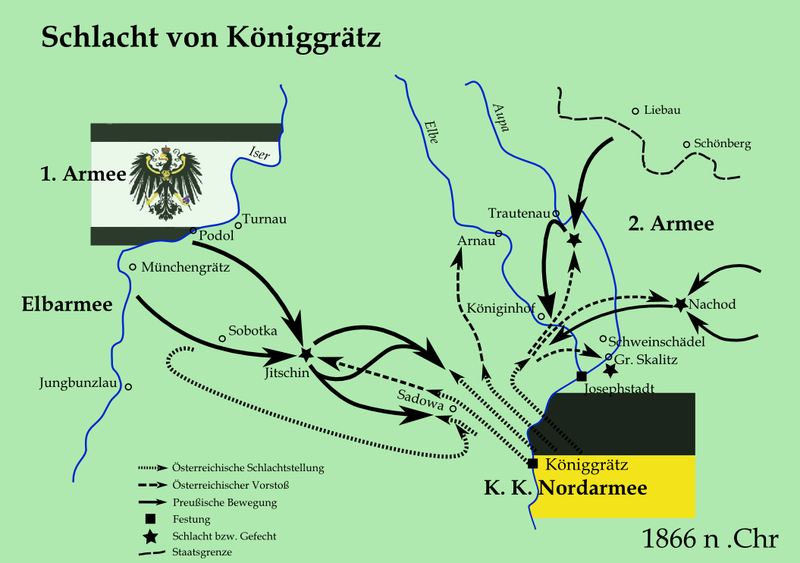
Battle of Koniggrätz between prussian and austrian soldiers (1866)
Overview of the Battle of Koniggrätz between prussian and austrian soldiers (1866).

“The Deutscher Krieg”

On the 8th of June 1866, Prussia decided to go on and occupy the Duchies ceded by Denmark to Austria in 1864. Austria thus chose to mobilize its army and war was on its way. Both sides had multiple allies: Prussia had the Kingdom of Piedmont-Sardinia (Later known as Italy) and minor German states such as Bremen, Lübeck and Hamburg. Austria had substantial allies such as the Kingdoms of Bavaria and Saxony. Both sides were of equal size but a long economic crisis was plaguing Austria. The state was heavily indebted, suffering from the Hungarian revolution (1848) and the second Italian war of Independence.

The Prussian economy was in a very good shape and was ready. Its army was the most modern in the World and the reforms they did several years before the war were crucial in boosting the morale and the willpower of its infantry.

As the war was escalating, it became clear that no major power would join the war. Russia still bore a grudge about the Crimean war a few years before and France was confidently thinking that the Austrians would defeat Prussia.

Gitschin, the early days

The first “real” encounter of the war between Austria and Prussia took place in Gitschin on the 29th of June. A few battles had already taken place in Italy as Austria defeated the Italians. But in Gitschin, the course of the battle would be very different: The Austrians and the Saxons would suffer way higher casualties than Prussia and would retreat in a very disorganized manner.

Strategy was very difficult to function, as the officers from different ethnicities would not always listen or trust each others. The Hungarians would often disobey the Austrian High Command, and the same thing would happen several days after that, in Sadowa.

This battle is perhaps one of the most important in the military history. Not only because it would consolidate the position of Prussia as the main power in Germany, but also because it would be a glimpse of the modern tactics that would be later used in the Franco-Prussian War, World War I and many, many more.

Let’s get back to the battle. Gitschin was the first opportunity for Austrians to see the Prussians in front of their cannons and it would prove to be a harsh discovery. But on the 3rd of July 1866, it would be a disastrous lesson. The Austrian Army, strong of around 215,000 men, would face in the morning only 120,000 Prussians, divided into two groups. Hiding behind fortified positions and with artillery support, the Austrians were confident. As they first encountered the enemy, they fired and then decided to retreat behind a river, in good order. The beginning of the Battle was in the advantage of the Austrians.

The Prussians were advancing, but very slowly and even if the river was easy to cross for Infantry, it wouldn’t be the same for the artillery. Austria’s manpower and firepower held the high ground.

At 11:00, the Austrians decided to attack the Prussian Infantry stuck in the woods around Sadowa. Meanwhile, the Hungarian officers decided to attack on their own. A general counter attack would have been decisive: the Prussian frontline may break, and what would happen then?

Unfortunately, the right flank of the Austrian army was now weakened and the Prussian saviors arrived, another army of around 100,000 men. They attacked the flank of the enemy, inflicting high casualties as the Prussian artillery pounded the center of the Austrian army. It was time for a general attack from the Prussians, as the three groups engaged in the battle attacked simultaneously, destroying the Austrian lines. The Austrian Army was broken. Even when the Prussians lost around 9,000 men, the Austrian lost more than 32,000. Retreat was inevitable.

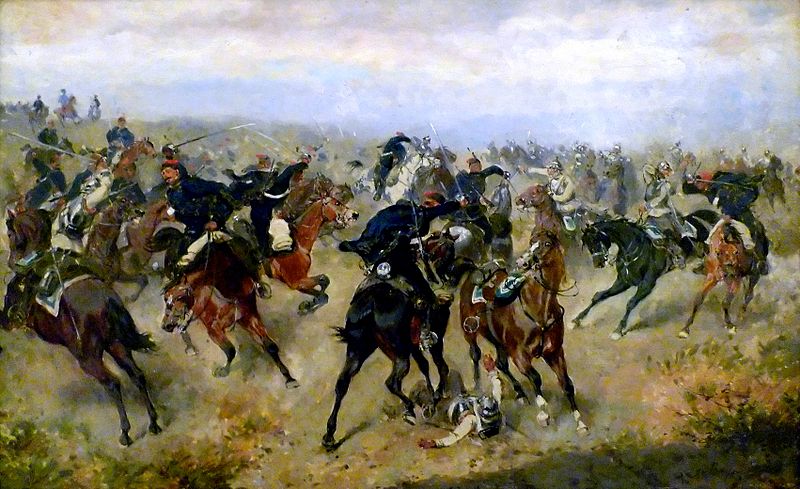
Skirmish between Austrian hussars and Prussian cuirassiers at the Battle of Königgrätz. Oil on wood, Heeresgeschichtliches Museum Wien.
Skirmish between Austrian hussars and Prussian cuirassiers at the Battle of Königgrätz. Oil on wood, Heeresgeschichtliches Museum Wien. Souce: Wikipedia.

The Austrian Empire is Starting to Shake…

As the Prussians were starting to overrun all the position the Austrians held in the morning, a fierce pursuit engaged between them. The Austrians, retreating as fast they could, would be skirmished until the armistice was signed on the 22nd. The objective of Bismarch was not to chase the Austrians until they reached the Austrian mainland and even maybe Vienna. It would have been possible, since the Prussians were so much stronger than their enemy. The Austrians had no choice but to give up on everything. Besides, a total victory of Prussia over Austria would have warned the neighbors of these two countries and the peace treaty may have not been in favor of the Prussians. They needed to win, but not to destroy their enemy.

And Prussia is Rising in the North

Prussia had jumped in the world of Imperialism and was now the only major power ready to unify the German states. They were given everything they demanded: territories, money. They also gained an alliance with pretty much all of the German states that fought against them like Bavaria and Saxony. These two Kingdoms would prove to be very useful in the Franco-Prussian war in 1870.

But the biggest victory Prussia achieved through the Peace treaty of Prague was the following: Austria would never play a major role ever again in the “German Question”. Prussia would be the only one leading the unification of the German states and Austria would be left out of it.

The Königgrätz Cross

The Prussians won this battle. And it was such a victory that an award was necessary to recognize the efforts done by the Infantry, those who stayed under artillery fire behind the river or those who held the ground in the forest near Sadowa.

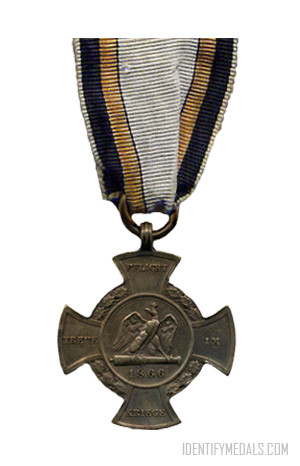
To commemorate this victorious campaign, four different crosses were created and awarded. Called the Königgrätz Cross, it was issued to more than 120,000 different soldiers who either participated directly or indirectly to the battle. The medal has the shape of a cross pattée with a round medallion superimposed on its center and a round wreath between its arms and is made of bronze from captured Austrian cannons.

There were four different crosses instituted to commemorate 1866 victorious campaign: The Königgrätz Cross, the “Main Army” Cross, the “Loyal Fighters” Cross and the “Loyal to its duty in times of war” Cross.

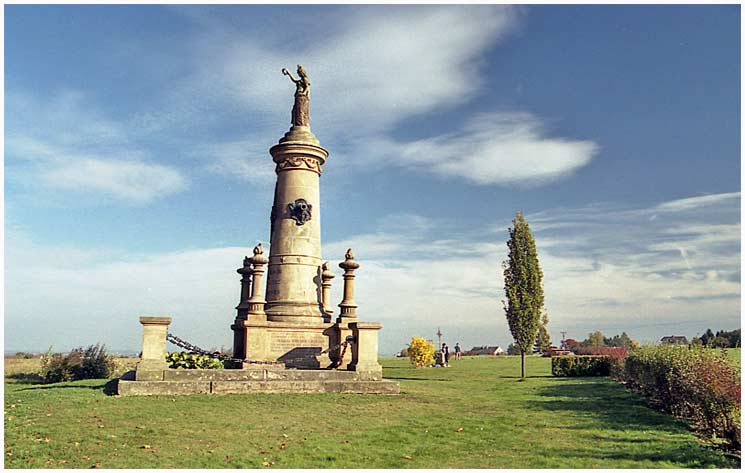
Memorial to Battery of the Death at Chlum conmemorates one of heaviest fights during Battle of Battle of Königgrätz.
Memorial to Battery of the Death at Chlum conmemorates one of heaviest fights during Battle of Battle of Königgrätz. Source: Wikipedia.

Conclusion

This battle was the beginning of something new. A new era started when the Austrians started retreating towards Vienna. The Prussian, and later German, hegemony over Europe marked the beginning of an era that could only lead to disaster. Imperialism and competition between France, Germany, Austria-Hungary, Russia and the United Kingdom could only lead to fierce fighting and what happened in 1914 is the result of many years of sleeping conflicts and diverging interests. And it all started on this day of July.

Guest Contributor: Kjetil Vion is a writer and a history enthusiast. A passionate of France and modern military history, he has a special interest into the Prussian state, specially since the Sadowa battle against Austria. Always wanting to learn more, he now looks to spread his knowledge in history.

Fighter Aces: Yekaterina Budanova, Soviet Air Force Pilot

Yekaterina Budanova was one of the world’s two female fighter aces. During WW2, she achieved five air victories, went solo hunting, and was awarded several medals.

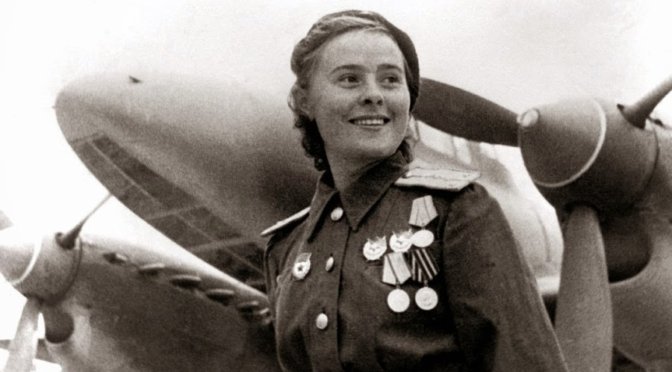
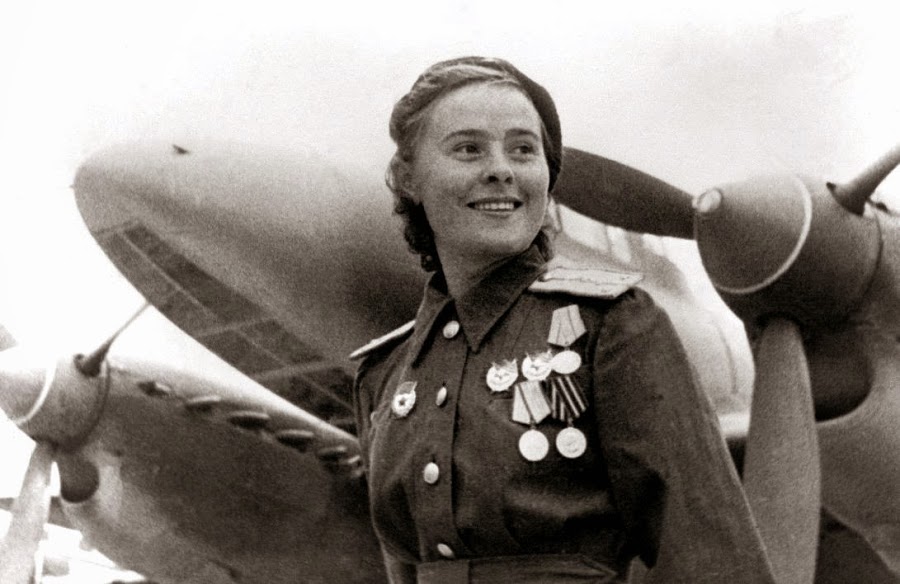
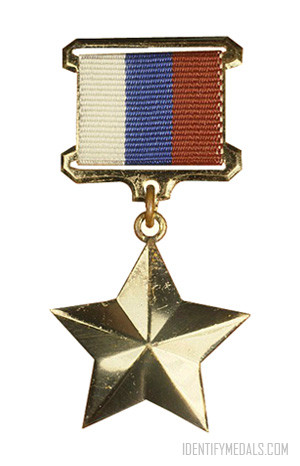
Yekaterina Budanova, also known as Katya, was one of the world’s two female fighter aces. During World War IIshe achieved five air victories and was given permission for “solo hunting,” an honor given to aggressive and successful pilots. She was posthumously awarded the title Hero of the Russian Federation medal in 1993.

Who Was Yekaterina Budanova?

Yekaterina Budanova c. 1940.
Yekaterina Budanova c. 1940. Source: Wikipedia.

Yekaterina was born in 1916 in Smolensk, a village in Russia, to a peasant family. She had top grades in school, but had to begin working as a nanny to care for her family after her father’s death. When she was thirteen, she was sent to Moscow to join her sister. She first began working as a carpenter in an aircraft factory, where she developed an interest in aviation. She soon joined a local aeroclub’s parachutist section and got her flying license in 1934, becoming a flight instructor in 1937. During several air parades she joined, she flew a Yakovlev UT-1 🔗, a single-seater trainer aircraft used by the Soviet Air Force from 1937 until the late 1940s.

It wasn’t until 1939 that a law on “universal military duty” was passed, allowing women to be formally accepted into the military. Even when the law proved to be more theoretical than practical and women faced harassment and disdain when enlisting, once they proved their ability to accomplish a number of tasks they quickly earned the respect of their commanders. Still, the work that women were doing was mostly hidden by the government as they did not want the Red Army to appear weak, or raise women’s expectations for permanent or front-line roles in the military.

Yekaterina Budanova and Her Military Career

Yekaterina enlisted in military aviation in June 1941, after the German attack on the USSR, and was assigned to the 586th Fighter Aviation Regimenta unit consisting only of female pilots and formed by Marina Raskova, record holder for a non-stop flight and survivor of a crash-landing in Siberia. The units consisted usually of three women, usually instructors or members of pre-war flying clubs.

On 10 September, Budanova was assigned with Lydia Litvyak, Mariya Kuznetsova, and Raisa Belyayeva to the 437th Fighter Aviation Regiment, based on the east bank of the Volga river and in constant engagement with the fighting over Stalingrad. This is where Yekaterina shot down her first opponent alongside Litvyak, a Messerschmitt Bf 109 🔗 fighter. Her first two solo victories were against a Junkers Ju 88 🔗 and a Bf 109.
Budanova and Litvyak later served with the elite 9th Guards Fighter Regiment, commanded by a Hero of the Soviet Union, Lev Shestakov, where they were allowed to remain for an extra three months after other women were returned to the 586th. While Yekaterina was described as a “cheerful, lively character”, Litvyak looked “thoughtful and quiet”.
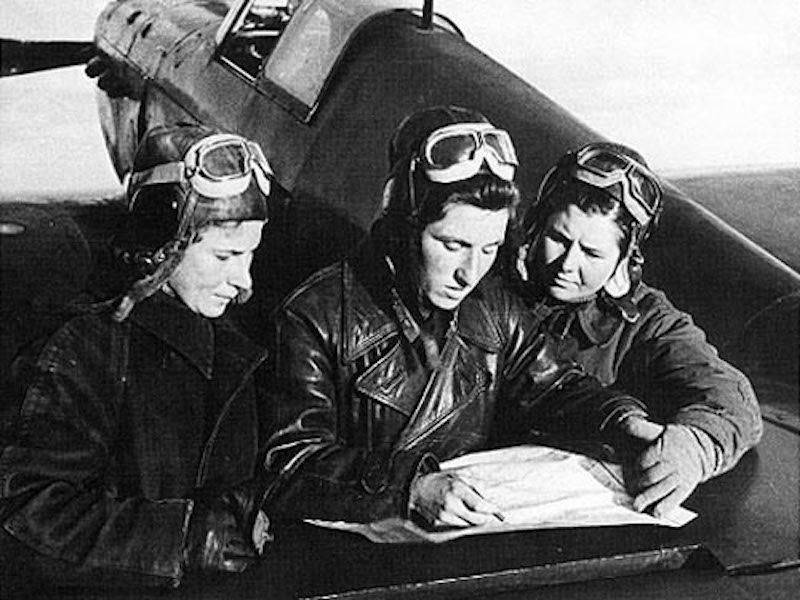
Pictured at center, Yekaterina Budanova was one of the only women fighter pilots of World War II.
Pictured at center, Yekaterina Budanova was one of the only women fighter pilots of World War II. Source: Wikimedia Commons.
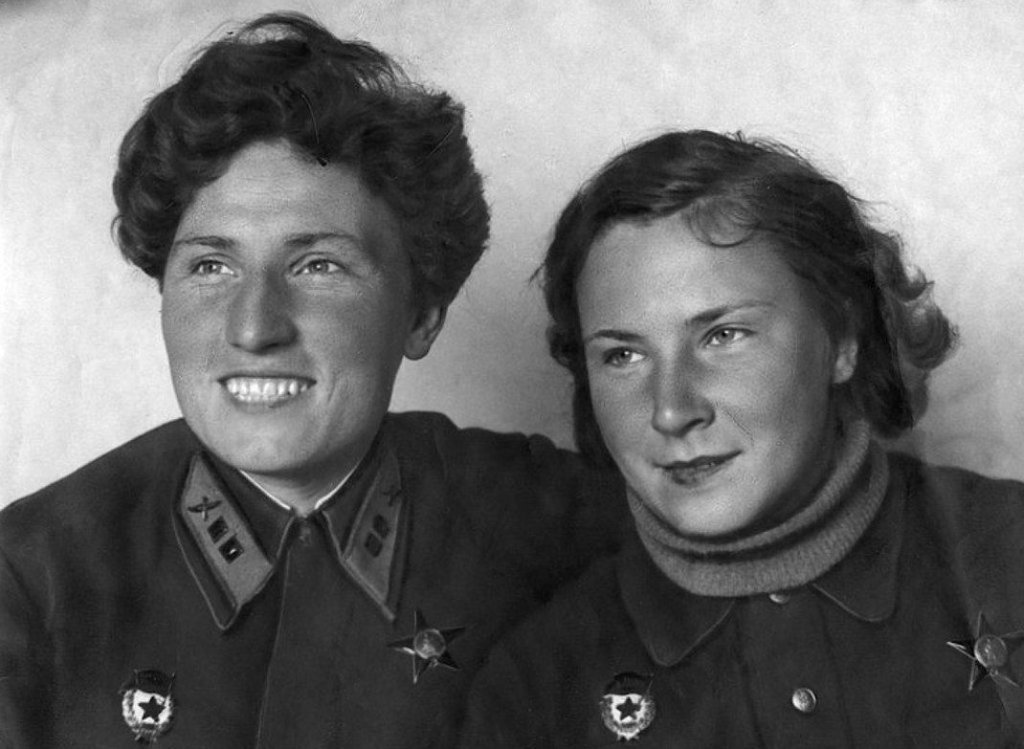
Yekaterina Budanova, left, with fellow ace Lydia Litvyak, posing together in 1943.
Yekaterina Budanova, left, with fellow ace Lydia Litvyak, posing together in 1943. Source: Wikimedia Commons.

Yekaterina Budanova's Lone Wolf Operations

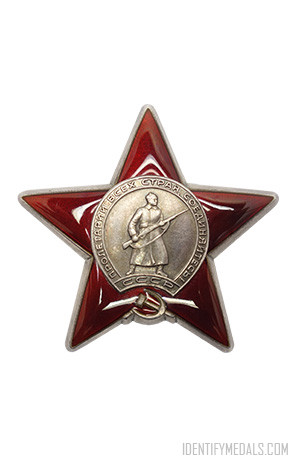
It was when Budanova and Litvyak were moved to the 296th Fighter Aviation Regiment of Nikolai Baranov (or 73rd Fighter Aviation Regiment) that they achieved the bulk of their combat claims. Budanova was given permission to become a “lone wolf” and do freelance operations just like the best male pilots. In 23 February 1943 she was awarded the Order of the Red Star. By June 1943, Budanova had six victories to her credit and heavy air combat saw her claims raised to 11.

Budanova’s last mission happened on 19 July 1943 near Novokrasnovka. In the morning she took off to do an escort mission and got involved in a dogfight with Bf 109s near Antratsit in Luhansk Oblast. She shot down one (her fifth solo kill) and damaged another, but her aircraft was also hit. She managed to put out the fire and force landed in no-man’s land, but she was already dead when local farmers tried to pull her from the aircraft.

Inna Pasportnikova recalled the fight:

She spotted three Messerschmitt going on the attack against a group of bombers. Katia attacked and diverted the enemy. A desperate fight developed in the air. Katia managed to pick up an enemy aircraft in her sight and riddle him with bullets. This was the fifth aircraft she killed personally. Katia’s fighter rapidly soared upward and swooped down on a second enemy aircraft. She “stitched” it with bullets, and the second Messer, streaming black smoke, escaped to the west. But Katia’s red starred fighter had been hit; tongues of flame were already licking at the wings.”

Budanova was buried on the outskirts of the village of Novokrasnovka. It’s believed that the pilot that shot her down was either Georg Schwientek of JG 52 or Emil Bitsch, of 8./JG 3.

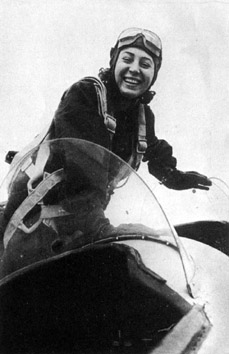
Yekaterina Budonova, Soviet Fighter Pilot Posing In Front Of Her Yak-1.
Yekaterina Budonova, Soviet Fighter Pilot Posing In Front Of Her Yak-1. Source: Wikimedia Commons.

Yekaterina Budanova's Medals

Yekaterina Budanova's Fighter Ace Victories

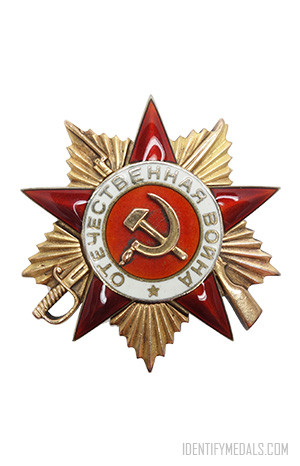
Yekaterina Budanova claimed an estimated total of 11 kills (5 of which were solo) in her career as a combat pilot, making her one of the war’s two female fighter aces. She was twice awarded the Order of the Patriotic War, and although she was nominated for the title of Hero of the Soviet Union during the war, she never received it. She was instead posthumously awarded the title Hero of the Russian Federation on 1 October 1993.

Although Budanova’s accomplishments were celebrated, most of the work done by women was quietly dismissed at the end of the war. Those who served in the military were forced to turn in their uniforms and take up more traditional roles, and Soviet paper Pravda wrote that the women soldiers should not “forget about their primary duty to nation and state—that of motherhood.”

In the 1960s and onward, women took on workforce roles in engineering and medicine, although men continued to dominate supervisory and leadership roles. Today, women  are allowed to serve in the Russian military, but still confront various forms of sexism, including being encouraged to participate in state-sponsored military beauty pageants.

Sources:

  • https://www.smithsonianmag.com/history/soviet-ace-shot-down-nazi-pilots-with-great-skill-but-her-feats-are-mostly-forgotten-today-180969698/
  • https://ww2db.com/person_bio.php?person_id=645
  • https://www.rbth.com/history/326811-two-young-soviet-top-guns