The Falklands War: Military Medals from Argentina and the United Kingdom

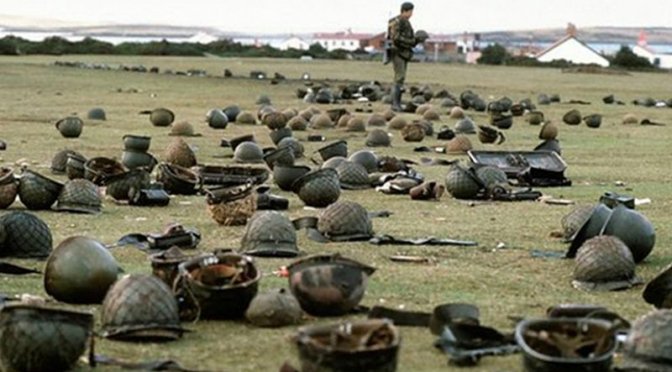
The Falklands War was a ten-week war between Argentina and the United Kingdom over two British dependent territories in the South Atlantic: the Falkland Islands, and its territorial dependency, the South Georgia and the South Sandwich Islands. 

Argentina suffered a state coup on March 24 th , 1976, and on April 2nd, 1982, the military government invaded and occupied the Falkland Islands in an attempt to rise the low public opinion regarding their political performance, as in the period from March, 1976 and December, 1983, 30,000 people were kidnapped, tortured and disappeared for being against the military government.

Decorations of the Falklands War

When it comes to the Falkland’s War decorations both Argentina and the United Kingdom medals to those who fought or performed outstandingly during the war.

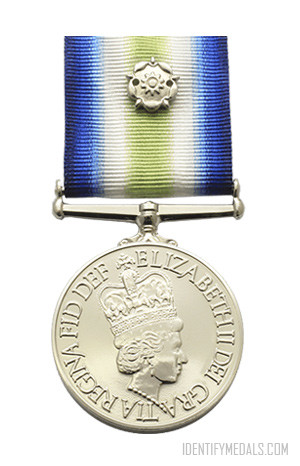
From the United Kingdom there’s just the South Atlantic Medal, which was awarded to British military personnel and civilians for service in the Falklands War of 1982. Over 33,000 of them were awarded.

Argentina, on the other hand, issued (at different points in time) several medals. The main ones being:

The Argentine Nation Cross to the Heroic Valour in Combat is the highest military decoration give by the Republic. It is granted to the military and security forces personnel, civilian police forces, Argentine or foreign, whom in combat motivated by extraordinary events have the character of a war function, perform isolated or in the exercise of command, a ponderable action that stands out considerably from the behavior patterns, usually considered correct. A total of 21 medals were given to Argentine heroes of the Falklands War, all of them having fought in the war, and eight of them having given the medal posthumously.

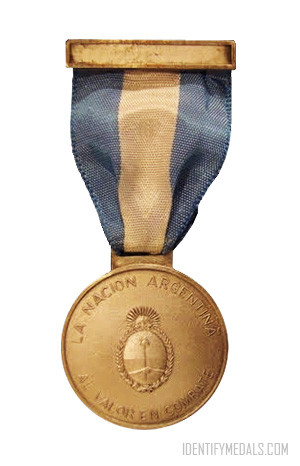
The Argentine Nation to the Valour in Combat Medal is the second highest military decoration given by the President of Argentina and it’s awarded to “Recognize acts during the Southern Atlantic war for merits, valour and heroism in the defense of the Motherland“. The medal can be given to Argentinian citizens as well as foreigners.

The Medal to the Fighters is a decoration given by the Argentinian Republic to everyone who fought in the territorial claim of the Falklands, South Georgia and South Sandwich Islands between April 2nd and June 14th 1982.
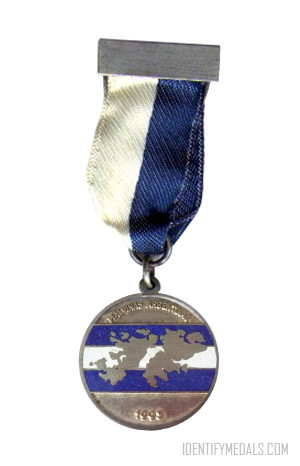
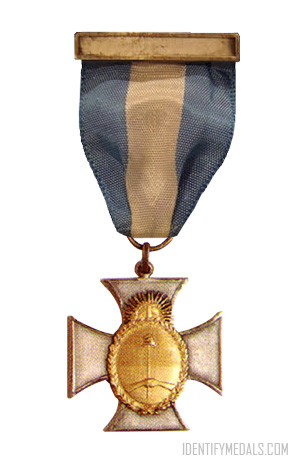
Argentinian Falklands War Decorations Recipients

The recipients of the Argentine decoration for service were:

  • Lieutenant Roberto Estévez (posthumously) for commanding, while severely injured by British bullets, his infantry troops and for guiding by radio the artillery fire in the first line of combat during Darwin’s battle. A last bullet impact ended his life.
  • Lieutenant Ernesto Emilio Espinosa (posthumously) covered from the top floor of Top Malo House farm, the retreat of all his fellows, while being surrounded and attack by special British forces, dying during action by the fire of enemy rifles, grenades and rockets.
  • First sergeant Mateo Antonio Sbert (posthumously) fought while being severely injured by enemy fire during the Top Malo House battle, and died in combat.
  • First Lieutenant Jorge Vizoso Posse fought with tremendous courage during the whole war, combating while being in disadvantage against the enemy’s special forces in the surroundings of Mount Kent, in spite of being isolated and injured, he kept fighting, forcing the enemy forces to retreat. He returnedby his own means to the Argentine lines, loosing a huge amount of blood.
  • Second Lieutenant Juan José Gómez Centurión led, while being in great material and numerical disadvantage, several counter attacks during Darwin’s battle.
  • Sergeant Roberto Bacilio Baruzzo fought in spite of being injured by bombardment splinters the day before Mount Harriet’s battle. He also transported injured soldiers under enemy fire and took them to a safe place, risking his life in several occasions, and continuing the fight body to body during those movements until he run out of ammunition, and even using his knife, until he fell prisoner of the Royal Marines.
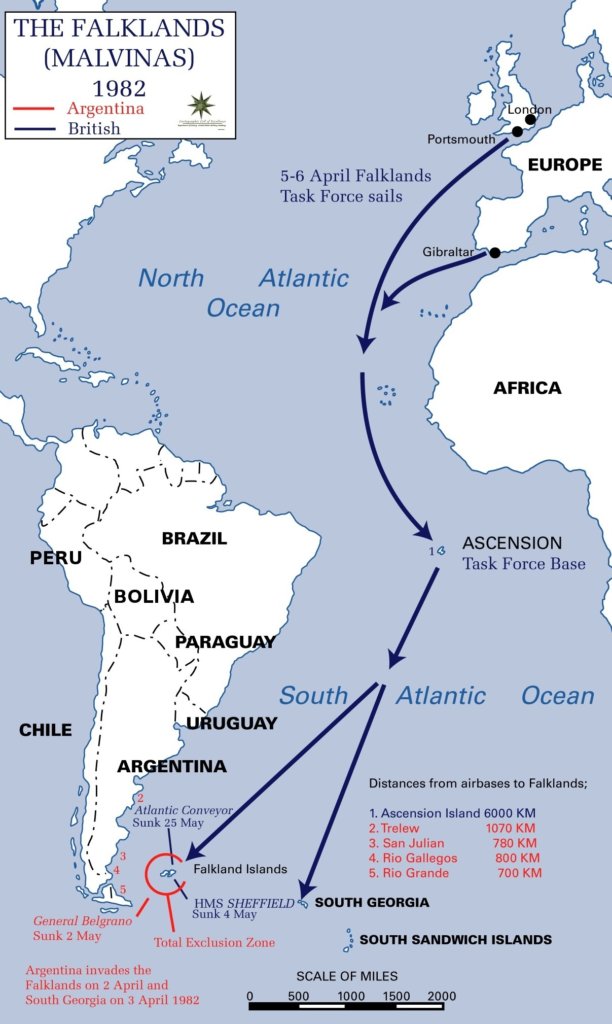
Map of the Falklands War.
Map outlining the British recapture of the islands. Source: Wikipedia.
  • Conscript soldier Oscar Poltronieri operated a machine gun during the Mount Two Sisters’ battle, ignoring the retreat order, and staying fighting by himself, allowing the effective retreat of all his fellows to safer areas, and holding the enemy with only his machine gun, preventing the whole British offensive from moving forward.
  • Commander Pedro Edgardo Giachino (posthumously) led, without opening fire against the British troops, the assault to the governor’s house where, when entering there, was severely injured by the Royal Marine’s fire, and died the same day at the hospital.
  • Ship Lieutenant Guillermo Owen Crippa piloted an Aermacchi MB-339 in the first aerial attack, and attacked all by himself the British troop based in the San Carlos Port, conformed by twelve ships strongly defended by anti aerial artillery and missiles, he left the HMS British ship out of service and returned safe to his base at Argentine Port.
  • Corvette Liberty Carlos Daniel Vázquez conducted his section of shooters during the defense of Tumbledown against the attack of a British unit resorting to the fire of his own artillery, without caring about his own security, and resigning his position just after the third attack, when he had no ammunition left and his section was practically destroyed.
  • NCO Júlio Saturnino Castillo (posthumously) for showing devotion and loyalty to his subordinates and superiors repeatedly, and conducting his men until his last breath, when he jumped to save a subordinate that was being killed with bayonets. An Argentine Army’s ship was named after him.
  • Conscript Félix Ernesto Aguirre (posthumously) fought body to body, bearing an immense superiority of the enemy and the fire against his position. He got injured in his legs and besides that, he tries to help Second Lieutenant Silva who was deadly injured near him and got injured again, dying in his position.
  • Corvette Lieutenant Héctor Miño led successfully several counter attacks facing an immense numerical and material disadvantage, holding the British forces, where he is severely injured, and then took as prisoner by enemy forces.
  • Brigadier Ernesto Ureta, Commodore Gerardo Guillermo Isaac, Captain José Daniel Vázquez (posthumously) and Captain Omar Jesús Castillo (post mortem) piloted an A-4C Skyhawk each, attacking the aircraft carrier HMS Invincible, which was at the very center of the British defensive fleet, and was left out of service. Captain Vázquez and Captain Castillo were killed during the attack.
  • Commodore Pablo Carballo led his section in the attack of two British ships in the north of the Falklands islands.
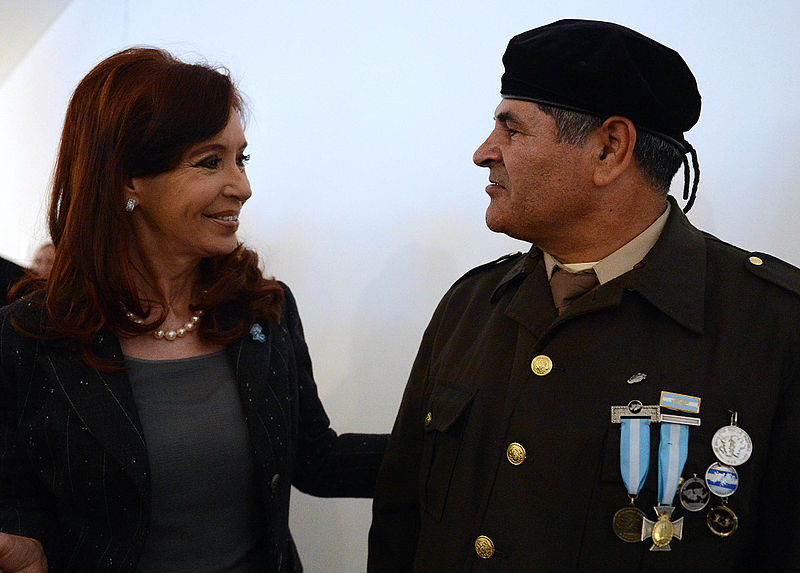
President Cristina Fernández with conscripted soldier Oscar Poltronieri during his medal ceremony on 10 June 2014.
President Cristina Fernández with conscripted soldier Oscar Poltronieri during his medal ceremony on 10 June 2014. Source: Gobierno de la Nación.
  • Chief Petty Officer Carlos Omar Ortiz, for leaving the refuge in the middle of red alerts to assist injured staff under enemy fire and in combat zone.
  • Chief NCO Pedro Prudencio Miranda for offering himself as an explosive screwdriver volunteer, first disarming by himself an active bomb inside the Argentine ship Formosa, later on disarming bombs in an A-4Q plain that had landed in the base, and lastly disarming a bomb that he had notice was accidentally activated and was just about to explode.
  • Aircraftman José Raúl Ibáñez, for repelling by own decision an aerial attack against his ship by two enemy’s Harrier, immensely superior in armament and firepower. In spite of not being in charge of the machine gun, he did not hesitate when the operator was shot, and responded to the attacks, getting to damage one of the planes with a light gun that was not prepared to fight against planes, forcing the British aerial patrol to retreat.
  • These are just a few examples of the enormous courage of the Argentine men that fought with an immense armament and numerical disadvantage during the whole war.

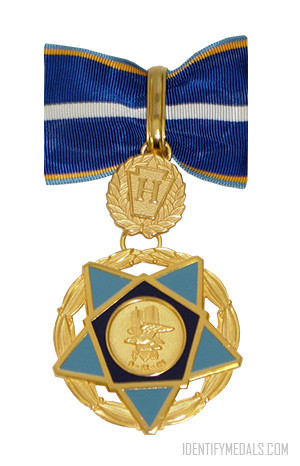
The 9/11 Heroes Medal of Valor: Honoring and Remembering the Fallen Heroes

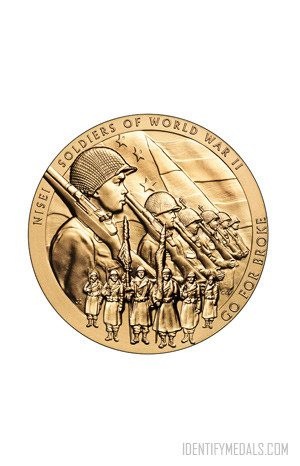
Many medals can be awarded posthumously, but the 9/11 Heroes Medal of Valor sadly did not have any living recipients. Created to honor the 442 first responders who were killed in the line of duty during the September 11, 2001 terrorist attacks.

Instead, the medals, which intentionally resemble the Public Safety Officer Medal of Valor and the military’s Medal of Honor, were presented by President George W. Bush to the families of the fallen officers at the White House on September 9, 2005.

The 9/11 Heroes Medal of Valor and Its Ceremony

During the ceremony nearly 4 years after the devastating terrorist attacks, President Bush would honor the lives of the public safety officers who died in the line of duty as well as comfort the families who were left behind and accepted the medals in remembrance of their deceased relatives. Around 1,200 family members and friends showed up at the ceremony to honor their friends and relatives who died on September 11.

Although not every name could be listed in President Bush’s brief speech, Attorney General Alberto Gonzales read all 442 names out loud so that all who gathered could honor every individual who gave his or her life on one of the most tragic days in American history.

The 442 public service officers included 343 New York City Fire Department members, 50 Port Authority police officers and assistants, 23 NYPD officers, 3 state court officers, and members of the Secret Service, FBI, and private ambulance workers.

At the conclusion of the last name, Gonzales began clapping, as a civilian salute to the sacrifice of the public safety officers and their families. After a loud ovation, a Marine Corps band called the “President’s Own” presented an emotional rendition of the “Battle Hymn of the Republic” before President Bush began to speak.

President Bush sadly could not take the time to tell the stories of every single one of those 442 men, but he did mention several.

Firefighter Donny Regan of Rescue Company 3 in Bronx had served for 17 years with the New York City Fire Department and was cited six times for bravery. Even though his son Peter lost his father on September 11, he still carried on his father’s legacy, serving in the Fire Department and later as a Marine reservist in Iraq.

Firefighter Ronnie Gies of Squad 288 in Queens had been with the New York Fire Department since 1988, and he rushed into the Twin Towers to save lives, as a video caught on that day illustrated. According to his wife, “You see him straight on, carrying equipment, with such a look of determination.”

Senior Court Officer Thomas Jurgens was one of roughly 25 New York State Court officers who responded after the plane hit the first tower. Even though he had been told to leave because the danger was too grave, Jurgens would not leave his post. He sent his last radio transmission from inside the burning tower with a simple, yet profound sentence: “There are people here who need our help.”

New York City Police Officer Moira Smith was known for not being afraid of danger. She even ran with the bulls in Pamplona, Spain. In 1991, she ran into a subway tunnel to save dozens of people who were trapped in what ended up being one of the worst subway accidents in New York history. That same fighting spirit shone on September 11, 2001 when she rushed into the burning towers of the World Trade Center. According to one person she helped to safety, he remembered Smith’s steady blue eyes and even voice despite the chaos and destruction around her. She was captured in the September 12 papers, an image of Smith assisting an injured man from the tower just before she rushed back in to save others. Unfortunately, she was not able to save anyone else, as the tower collapsed around her. Even though as one of Smith’s colleagues noted that she could have not rushed in and saved herself, “nothing would have stopped her saving one more person.”

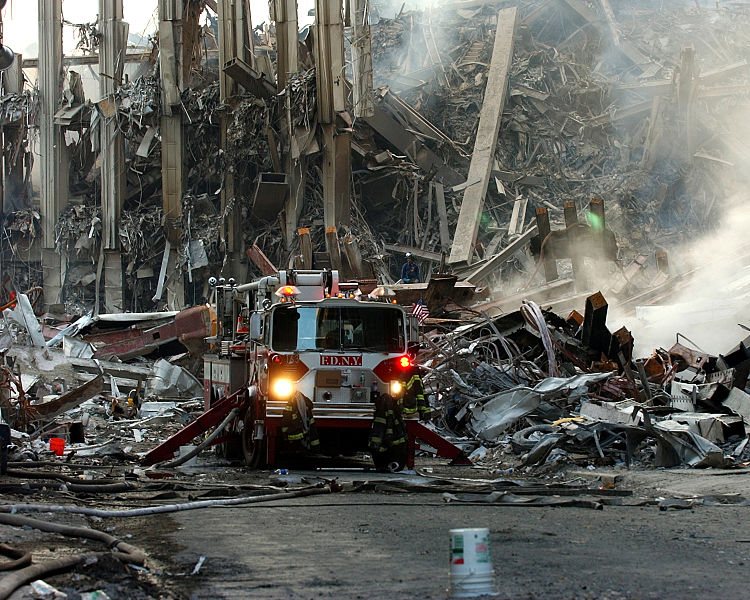
Ground Zero, New York City, N.Y. (Sept. 16, 2001) -- A lone fire engine at the crime scene in Manhattan where the World Trade Center collapsed following the Sept. 11 terrorist attack.
Ground Zero, New York City, N.Y. (Sept. 16, 2001) -- A lone fire engine at the crime scene in Manhattan where the World Trade Center collapsed following the Sept. 11 terrorist attack. Source: Wikipedia.

And these individuals that President Bush listed were only 4 of the incredible 442 men and women who put their lives on the line while on duty. Incredibly grateful for their sacrifice, President Bush ended his speech in a more hopeful tone:

And the legacy of peace and freedom we leave behind will be the greatest memorial to your fallen family members and friends.

The heroes of September the 11th will not be here to see that day. But their moms and dads and children and grandchildren can know a proud America will always stand in the long shadow of their service and sacrifice, and a proud nation will always remember them.

After President Bush and First Lady Laura Bush departed, families were lined up alphabetically in order to receive the medals from military officers spread out on the South Lawn of the White House.

Statement from FBI Director Robert Mueller

Later that day, FBI Director Robert Mueller would issued a statement noting the sacrifice of all of those who demonstrated “incomparable courage,” mentioning specifically Special Agent Leonard “Lenny” W. Hatton who had assisted with the evacuation of the World Trade Center. As Mueller noted, Hatton was last seen helping a victim escape one of the buildings before rushing back in to save more people.

The end of Mueller’s statement was a fitting honor not only to Hatton but also to the 441 other public safety officers who died on September 11, 2001 either at the World Trade Center or at the Pentagon.

This is a fitting tribute to those whose ultimate sacrifice saved so many. The impact of their courage is not limited to September 11. In truth, it will be felt for years to come—both in the lives of those they rescued from dire situations, and in the hearts of those who witnessed their bravery.

Lenny Hatton’s actions on September 11, 2001, exemplify the best of our nation. As his family receives his 9/11 Heroes Medal of Valor today, let us again pay tribute to his courage and honor his remarkable example of service and sacrifice.

Concluding Thoughts

As Sam Cannizzaro, who lost his son Brian, a firefighter, on September 11, stated, “Four years doesn’t make it easier—the pain doesn’t go away.” Even though it’s now been almost 18 years since 9/11, the pain is still there for those families and friends who lost loved ones.

And as September 11 becomes increasingly more an event of the past and of history, we as Americans have a greater honor and responsibility to remember those who gave their lives on that day.

Sources

Guest Contributor: Rachel Basinger is a former history teacher turned freelance writer and editor. She loves studying military history, especially the World Wars, and of course military medals. She has authored three history books for young adults and transcribed interviews of World War II veterans. In her free time, Rachel is a voracious reader and is a runner who completed her first half marathon in May 2019.

Kenyan Presidential Awards, Orders and Medals

During national celebrations, several Kenyans are conferred the presidential awards in recognition of their efforts towards their country.

During national celebrations, several Kenyans are usually conferred the presidential awards in recognition of the efforts they make to serve their country and others. Various athletes, politicians, clergymen, statesmen among others are awarded by the sitting president. But which awards do they receive? What do these awards mean and who are some of the recipients of these awards? And what are the criteria used to award these individuals? Read on.

The National Honors and Awards Committee advice the president on who to award the decorations and medals. The recipients are nominated by their county commissioners, government agencies, religious institutions, non-governmental entities, individuals, and other community-based groups.

You can find the most important Kenyan medals below. However, if you’re looking for the complete list of Kenyan awards and decorations, follow this link.

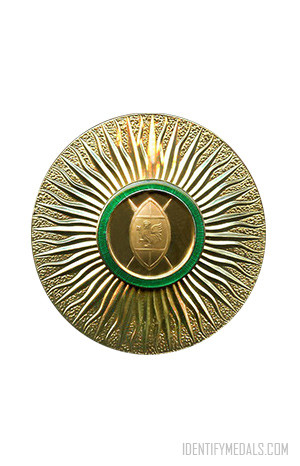
Chief of the Order of the Golden Heart of Kenya (C.G.H)

This is the highest-ranked award and is presented to the holders of the president’s office. Influential leaders like President Yoweri Museveni of Uganda, Former Liberia’s President Ellen Johnson Sirleaf and Aga Khan IV, have received this award despite not being Kenyans.

As you can see, it’s a breast star made by Spink with an inverted backplate. It’s not that big, and it’s about 73 millimeters in diameter. The incumbent, President Uhuru Muigai Kenyatta is the holder of the award Chief of the Order of the Golden Heart of Kenya.

The Order of the Golden Heart is divided into three categories based on their seniority:

The first is the Chief of the Golden Heart, which as indicated earlier, is awarded to a sitting president.

The next is the Elder of the Order of the Golden Heart of Kenya (E.G.H) that is awarded to among others the deputy President of the Republic of Kenya, Speakers of the August House and the Senate, the Cabinet Secretaries, the First Lady, The Deputy President’s wife, the Kenya Defense Forces (KDF) Chief of Staff and Personnel, and the Head of Public Service. In 2017, he awarded Mufaddal Saifuddin the Elder of the Order of the Golden Heart.

Last in this category is the Moran of the order of the Golden Heart of Kenya (M.G.H)

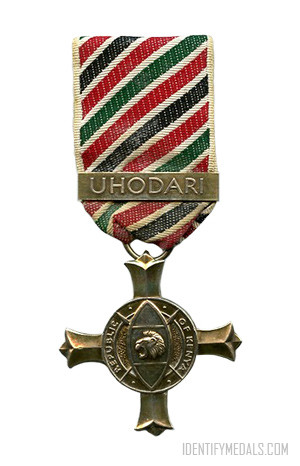
Uhodari Medal

In the Kenya Defense Forces, this award is very prestigious. The Uhodari Medal is awarded to soldiers and individuals recognized for their most outstanding acts of bravery and sacrifice while serving in the armed forces and in different capacities.

However, for over 20 years no one received this award. President Moi’s predecessor H.E. Mwai Kibaki didn’t award the Uhodari Medal to anyone. But recently, the incumbent, H.E. Uhuru Kenyatta awarded Major Ndeke Fredrick Afande the Uhodari Medal.

The most notable figure to have received this award is former Defense Forces General Mohammed for the role he played in saving the country during the 1982 coup attempt. He was awarded this medal by Retired president Daniel Arap Moi for saving the government.

Up to date, only 13 Kenyans have received this award, but a majority are not alive. As the country’s utmost gallantry honor, it is presented to the most conscious bravery or for some daring act of valor, extreme devotion to duty and self-sacrifice. The recipients of this prestigious award put the lives of other first in an act of selflessness.

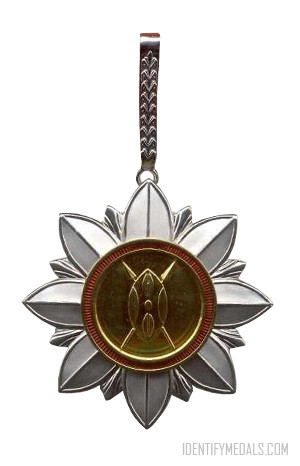
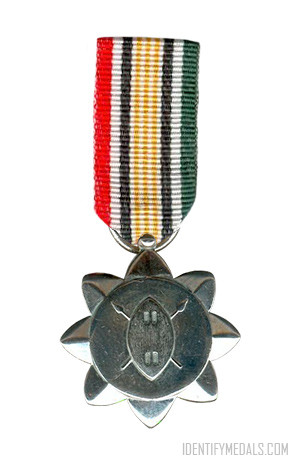
The Order of the Burning Spear

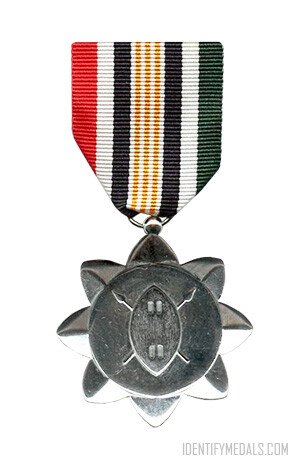
The Order of the Burning Spear was instituted on 21 April 1966 and measures 18.4mm (0.72 inches) in diameter. The award is given for distinguished services to public dignitaries, exemplary members of the public service, and other professionals.

The Order is divided into:

  • Chief of the Order of the Burning Spear (C.B.S)
  • Elder of the Order of the Burning Spear (E.B.S)
  • Moran of the Order of the Burning Spear (M.B.S)

Some of the notable figures who received this award include; former Statehouse Spokesman Manoah Esipisu, 800 meters Olympic Champion and world record holder David Rudisha, and veteran journalist Jeff Koinange of Citizen Television Kenya.

The elder rank of the Order of the Burning Spear is always a breast star and a neck badge, while the insignia of Moran Burning Spear (M.B.S.) and it’s ONLY a neck badge. The ribbon of the award is black, half green with a wide white-edged red central stripe. The earlier insignia of the Moran of the Burning Spear had a silvered center.

The Order of the Grand Warrior of Kenya (O.G.W)

The Order of the Grand Warrior (O.G.W) is an award presented to individuals in recognition of an outstanding service rendered to the country in different responsibilities and capacities. More importantly, it is an award presented to those who put their lives at risk to save their fellow countrymen.

The recipients of the O.G.W are those who leave a lasting image on their fellow countrymen by putting their country first before their personal feelings and interests. Among the notable recipients of this award include Former Senate Speaker, Hon. David Ekwee Ethuro, current speaker of the National Assembly, Hon. Justin Bedan Muturi, former leader of the majority party in the Senate, Hon. Prof. Kithure Kindiki, and the current leader of majority party in the national assembly Hon. Adan Duale.

Another notable figure to receive this award is Salah Farah, a Kenyan Muslim who shielded Christians during an Al-Shabaab ambush in Mandera town in Kenya.

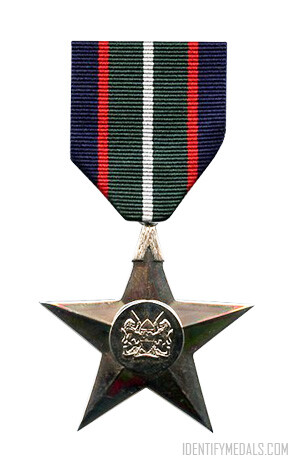
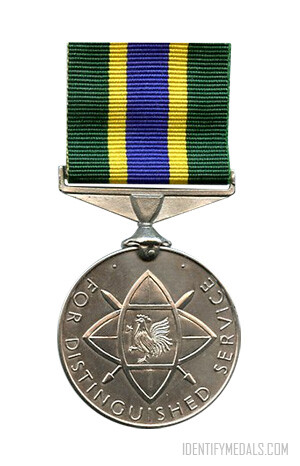
Other awards according to seniority include the Distinguished Conduct Order, the Distinguished Conduct Order, the Distinguished Service Medal, the Silver Star of Kenya and the President’s Commendations (Military and Civilian Division).

The national Honors Act of 2014 prescribes the minimum threshold one you must meet before being conferred with these honors: A recipient of any of these awards shall merit the conferment of the award if:

  • The individual displays exemplary abilities, actions, valor, courage, and leadership for the protection, advantage, and improvement of the nation.
  • The person has made tremendous contributions to the nation in the social, economic, scientific, public, academics, governance, administration, business, and other notable fields.
  • A state or public office holder who has made a significant impact in the improvement of their national and county governments, the legislature, judiciary, executive, independent offices and commissions.
  • A person who has brought glory and honor to the country, notably the athletes who exhibit exemplary performance at the global arenas.

All Kenyan Medals

Kenyan Medals: Uhodari Medal.

The Uhodari Medal

The Uhodari Medal is awarded to individuals for their most outstanding acts of bravery and sacrifice while serving in the armed forces.

Read More »

Find Kenyan Medals Online

Right Now on eBay 
Clicking a link to eBay may result in a referral commission being paid if a purchase is made.
Loading...

How to Start Collecting Medals, Badges and Awards

If you’ve been reading the articles on Identify Medals, there’s a good chance that you fit into one of two categories: 1) you are a medal collector, or 2) you are interested in becoming one. If you are the latter, this article will give you a broad overview of how to start collecting medals so that it can be a rewarding and enjoyable hobby!

1. Figure Out Your Approach

The first step in starting to collecting medals is to decide what your approach is. Rather than haphazardly collecting medals, you probably want to consider the types of medals you’d like to find. This will help you hone your focus.

Coin World suggests that you can adopt one of four approaches to collecting medals:

  1. Build a Set
  2. Collect an Artist
  3. Focus on an Individual Subject
  4. Profile an Event

I would posit that for military medals, it would be easiest to adopt the first or fourth approaches to collecting medals.

As an example of the first approach, you could put together a set of medals from a specific war or country. If you want to start small, putting together a set of Civil War medals is a great start because if you remember from a previous article, it only takes 2 medals to have a complete set!

By contrast, you might not want to start with putting together a set of USSR or Third Reich medals because you’ll have a lot more to collect! However, if you want this to be a lifetime activity, maybe you’d want to start with a larger collection.

For the fourth approach, you could focus on a specific battle of a war or a specific region. For example, maybe you’d want to collect all the medals and decorations that were awarded in northern France during World War I.

While the second approach is likely less conducive for military medals—unless you happen to really like the style of a certain artist, you could focus on collecting all the medals of a particular military hero like Erwin Rommel, for example.

I personally believe that this could be the most rewarding way to approach collecting medals. If you couple campaign medals with an individual award, you will be putting together a service member’s individual story, making it a historically significant group of medals that any collector would prize.

Plus, you could consider getting involved with your local museum and putting together a small exhibit about that service member and loaning your medals to the museum temporarily. This could be a great way to find a lot of meaning in your collecting. I personally would love this option because it tells a story and who doesn’t like stories?

2. Read Up on Your Event/Individual/War

Once you’ve figured out how you’re going to approach medal collecting, I’d encourage you to read up on your event/individual/war. This probably seems like an interesting suggestion, as it seemingly has nothing to do with medals. However, by reading up and visiting museums that pertain to your event/individual/war, you’ll have a better idea of what medals to look for.

As an example, I’m a huge history buff with a particular interest in World War II, and if I ever get into medal collecting (I have one right now!), I would definitely collect medals from World War II. But there are so many, and I’m constantly learning about more.

For example, I visited the Airborne Museum in Fayetteville, North Carolina recently, and I learned about seven new medals that I had never heard of before. Staying informed about your event/individual/war will not only give you more ideas of medals to find but also will make the process less mechanical and more enjoyable.

3. Take Advantage of Different Sources to Find Medals

With the age of the internet, you have so many options available to you for finding medals. You can buy medals online from various auction houses, eBay, or even links on our website here at Identify Medals.

Obviously, though, the important part is to make sure that you use reputable dealers to avoid fake medals. You can browse the Medal News magazine as well as the annual Medal Yearbook to get an idea of what medals are available and what price you should be prepared to pay.

Dan Wade from JustCollecting, a trading website, encourages medal collectors to ask about the back storyhow the seller got the medal, and look at the medal in person (if possible!).

If you’re willing to spend a bit more time searching, you can always try garage/yard sales, antique fairs, flea markets, thrift stores, and medal collectors fairs. If you go to any of these, it’s going to be a bit more like finding a diamond in the rough, and you may not find anything if you go looking for a specific medal.

However, if you’re open to seeing what’s out there and don’t have a specific medal in your mind, places like antique fairs and flea markets can be great options because they are likely going to be quite a bit cheaper.

As a side note, make sure that you pay the right price. Know what factors contribute to the difference in medal pricing. The battle in which the medal was awarded, the type of medal, the grade of the medal, and the condition of the medal all impact a medal’s price.

If a medal is in excellent condition, but the ribbon isn’t, you can always get a replacement ribbon. But remember to keep the original in case you ever want to sell the medal or for posterity’s sake.

Learn More About Your Newly Found Hobby

In addition to staying up-to-date about the focus of your medals, you should learn more about your newly found hobby. This will not only help ensure that you purchase genuine and not fake medals but also it will give you a greater appreciation for medals as a whole.

You could consider joining a medals society. For Americans, the Orders & Medals Society of America is the logical choice. Brits might look into the Birmingham Medal Society or the Orders, Medals, and Research Society.

You might also look into what books and articles you can read about medal collecting. One example includes Colin Narbeth’s bookCollecting Military Medals: A Beginner’s Guide. Also, don’t overlook a quick Google search about tips for medal collecting. The internet is replete with resources available to you, so be sure to use them.

You can even look up fun activities online like designing your own medal or taking this military medal quizDon’t forget to enjoy yourself even as you immerse yourself in the seriousness of prices and searching.

Conclusion

In the end, have fun! What makes military medals especially unique is that they tell the story of so many brave men and women who have been willing to sacrifice their lives for our freedom. And that’s something that’s worth memorializing.

Sources:

Guest Contributor: Rachel Basinger is a former history teacher turned freelance writer and editor. She loves studying military history, especially the World Wars, and of course military medals. She has authored three history books for young adults and transcribed interviews of World War II veterans. In her free time, Rachel is a voracious reader and is a runner who completed her first half marathon in May 2019.

Tarawa: The Toughest Fortified Position Marines Faced in World War II

We’ve all heard of the famous battle of the Pacific—Midway, Iwo Jima, Okinawa— but there’s a good chance that you’ve never heard of Tarawa.

We’ve all heard of the famous battle of the Pacific—Midway, Iwo Jima, Okinawa, and maybe even Saipan and Tinian—but there’s a good chance that you’ve never heard of the Battle of Tarawa.

The Americans faced the most sophisticated Japanese defensive positions here that would not be replicated until Iwo Jima in 1945. Even so, yard for yard, Betio—the main island of Tarawa atoll—was the toughest fortified position the Marines would ever face in World War II.

Betio and the Gilbert Islands

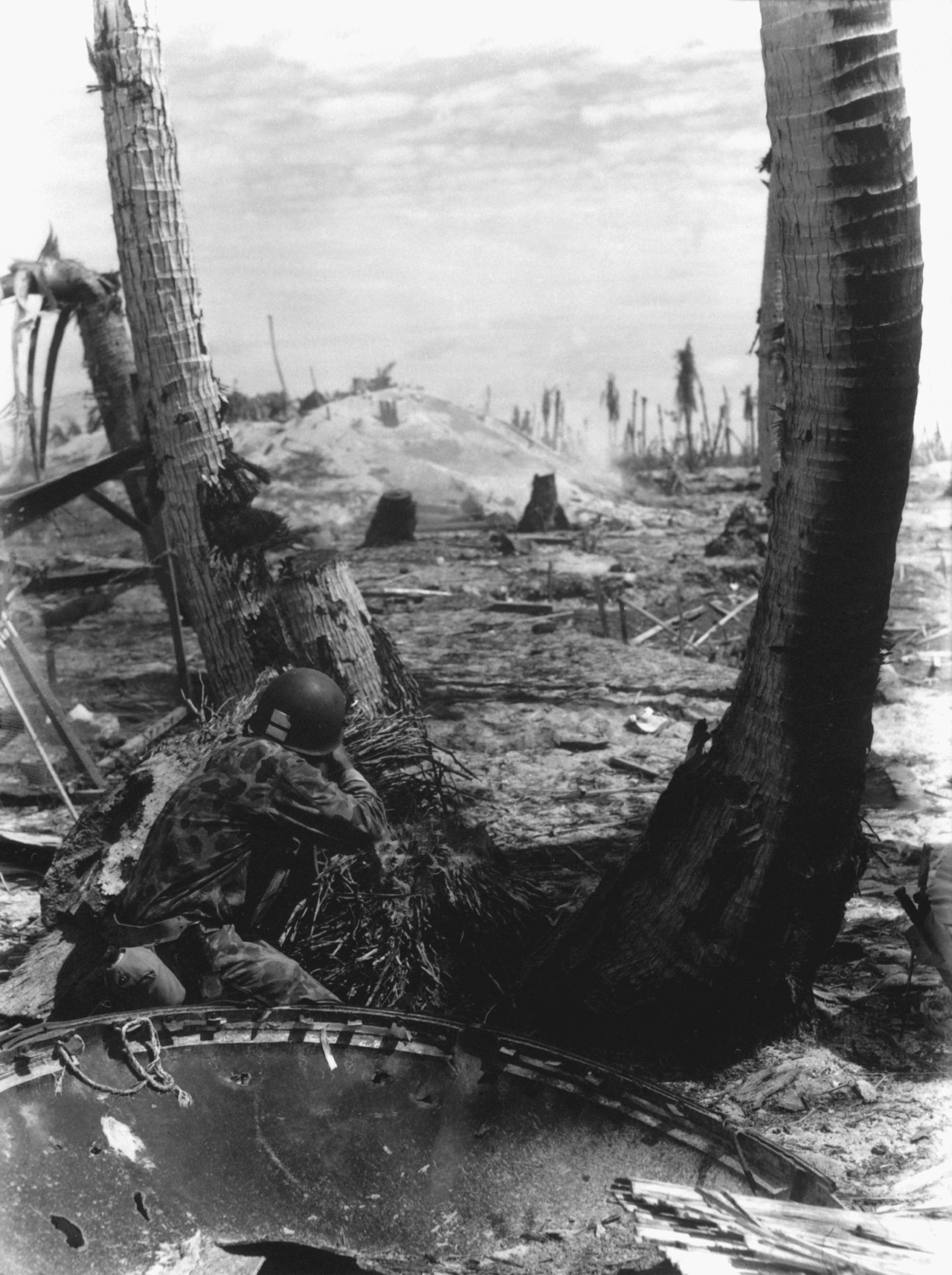
A Marine fires on a Japanese pillbox. November 1943. Image courtesy of US Navy.

Betio Island was three hundred acres, or the size of the Pentagon building and parking lots, and it was the centerpiece of the Gilberts invasion known as Operation Galvanic. The Americans hoped to seize the Gilberts in the Central Pacific as a first step to their continued island hopping toward Japan.

Betio and other islands in the Gilberts had the strategic benefit of airfields that would allow the Americans to reach new strategic points that were closer to Japanese strongholds in the Pacific. 

But it would take 76 hours of intense fighting—called “utmost savagery” by veterans—in order to finally seize the island from the Japanese defenders, many of whom were rikusentai, known by some as “Japanese Marines.”  

During that time, the Marines suffered almost as many killed-in-action casualties—over 1,000—as in the six-month Guadalcanal campaign from late 1942 to early 1943. In fact, the 2nd Marine Division would suffer a thousand casualties a day at Betio, the highest casualty rate sustained by any division in the war.
76 Hours of Battle (November 20-24, 1943)

When the 2nd Marine Division of roughly 20,000 men—including the 2nd Marines, the 6th Marines, and the 8th Marines (infantry); the 10th Marines (artillery); and the 18th Marines (the composite engineer regiment)—landed on Betio on November 20, 1943, there was chaos within the first hour.

Although there had been a naval bombardment a couple of hours earlier, the Marines were not as surprised by the incredibly low tide as they were by the fact that so many of the Japanese had managed to survive the bombardment and were blasting away at those landing. 

Boats received heavy fire even before nearing the reef. “This isn’t going to be a cakewalk!” many Marines quickly realized. 

As the landing craft began to drop waves of Marines off, the later waves at first thought that the rows of Marines ahead of them along the beach were waiting for orders to move, but come to find out that they were dead. More soberly, veterans remembered that they couldn’t move without stepping on a body and that a man could lift his hand and get it shot off.

Things were not going as well as everyone thought or certainly wanted, especially in the first 30 hours. As the assault force commander Colonel David M. Shoup noted, “The situation does not look good ashore.” 

In hindsight, many military leaders believe that if the Japanese had decided to counterattack on the first night, there is a good chance that the Americans would have lost the battle

Major General Julian C. Smith, who led the division during the assault on Tarawa, later remarked, “The night of D-Day was the greatest danger to our landing forces . . . this was the crisis of the battle.”

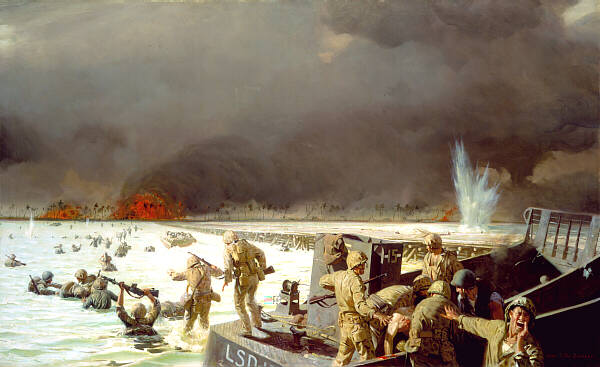
"Tarawa, South Pacific, 1943" painting by Sergeant Tom Lovell, USMC. Imge courtesy of Marine Corps Combat Art Collection.

Fortuitously for the Americans, the commander of the Japanese garrison, Admiral Shibasaki and many of those working with him died on D-Day, leaving the Japanese forces temporarily somewhat chaotic.

But of course, the Marines who had to stay on Betio that first night didn’t know that information. One veteran thought that it was his last night on earth and tried to remember fun times with his wife and son. The darkness was very intimidating with land crabs scuttling around, crashing in the shadows, and wounded men crying for help.

The tide would not turn in the Americans’ favor until the afternoon of the second day. General Julian Smith called the 6th Marines out of reserve and ordered them to land on Betio where some units faced intense hand-to-hand combat. Many American casualties came from rifles, machine guns, and grenades.

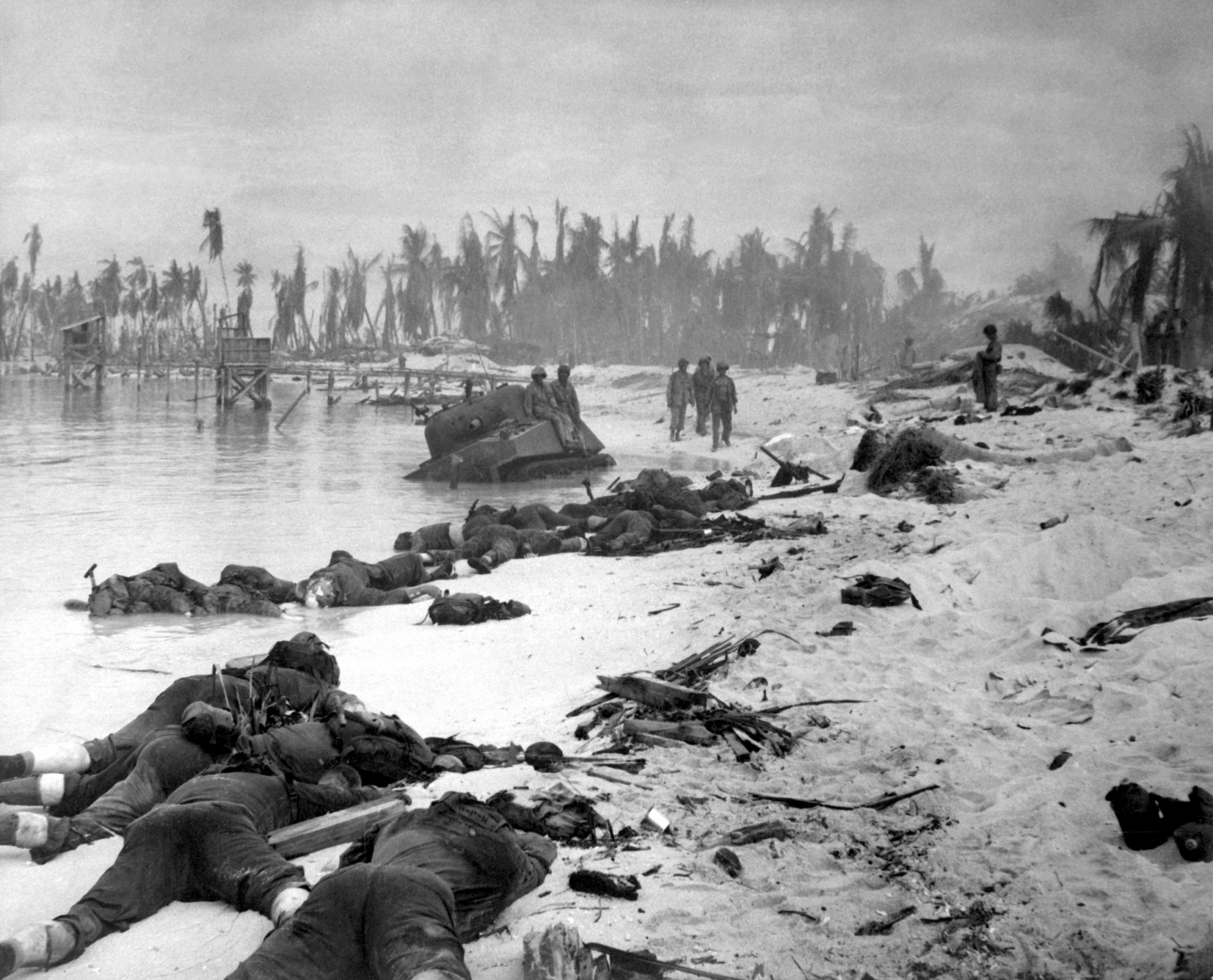
On November 24, 1943 when the island was declared secured, it was riddled with bodies as were the nearby reefs. The only way someone could tell the difference between a Marine or a Japanese soldier was by the wrapped leggings that the Japanese wore.

Several smaller units landed on some of the other islands in the Gilberts to make sure that all Japanese forces had been removed, and on Christmas Eve 1943, the Gilbert Islands were officially free of the Japanese.

The Aftermath of Tarawa

Tarawa would never have the renown of larger battles like Iwo Jima or Okinawa, but it taught American military leaders two important concepts: 1) how to best handle an amphibious assault (some aspects of Tarawa went well while others didn’t) and 2) the realization that the Japanese would fight to the death—this was a new kind of enemy. 

It was also one of the first battles where Americans on the homefront got to experience more of the full brutality the military had faced with the documentary made soon after the battle with real footage from the battle, With the Marines at Tarawa.

Not surprisingly, bond sales went up by quite a bit, but at the same time, Marine recruitment went down by 35 percent. Not as many men were interested in signing up for the horrors of Tarawa.

View of the beach of Betio Island, Tarawa Atoll, Gilbert Islands, after the U.S. invasion in November 1943. Image courtesy of U.S. Defense Visual Information Center.

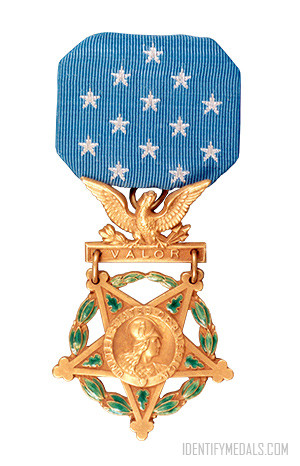
Four men would receive the Medal of Honor, including the assault force commander Colonel David M. Shoup, who was a brand new commander when the battle began. He was the only living recipient of the award.

Shoup himself was on his feet directing the fight for roughly 50 hours, and many believe that without Shoup’s leadership, the Battle of Tarawa would have been a defeat. Shoup would survive the war, be appointed by President Eisenhower as Commandant of the Marine Corps in 1959, and be buried in Arlington National Cemetery after his death in 1983.

The Medals of Tarawa

Colonel Shoup’s Medal of Honor Citation

For conspicuous gallantry and intrepidity at the risk of his own life above and beyond the call of duty as Commanding Officer of all Marine Corps Troops in action against enemy Japanese forces on Betio Island, Tarawa Atoll, Gilbert Islands, from November 20 to 22, 1943. Although severely shocked by an exploding enemy shell soon after landing at the pier, and suffering from a serious, painful leg wound which had become infected, Colonel Shoup fearlessly exposed himself to the terrific, relentless artillery, machine-gun and rifle fire from hostile shore emplacements and, rallying his hesitant troops by his own inspiring herosim, gallantly led them across the fringing reefs to charge the heavily fortified island and reinforce our hard-pressed, thinly held lines. Upon arrival on shore, he assumed command of all landed troops and, working without rest under constant, withering enemy fire during the next two days, conducted smashing attacks against unbeliveable strong and fanatically defended Japanese positions despite innumerable obstacles and heavy casualties. By his brilliant leadership, daring tactics and selfless devotion to duty, Colonel Shoup was largely responsible for the final, decisive defeat of the enemy, and his indomitable fighting spirit reflects great credit upon the United States Naval Service.

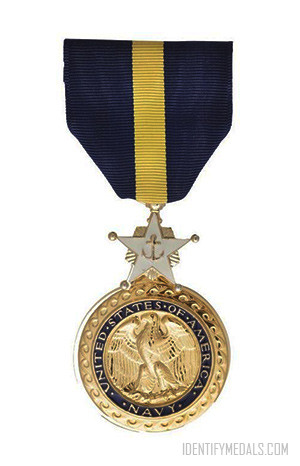
In addition, General Julian Smith nominated 319 other men for the Navy Cross, the Distinguished Service MedalSilver Star, and Legion of Number. As Joseph E. Alexander noted in Utmost Savagery, a book well worth reading, “the total number of 2d Marine Division members nominated represented less than 5 percent of those who participated in the fighting, a healthy restraint.”

The savagery of Tarawa would soon be usurped by Iwo Jima where the Japanese had the opportunity to hide out in caves and inflict substantial amounts of damage on the American landing forces. 

Nonetheless, it remains a significant battle in its own right, as up until that point, every veterans of earlier battles in the Pacific and of other wars—including World War I—were amazed by the intense fighting and entrenched defensive positions that they encountered on Betio Island, Tarawa Atoll, in November 1943.

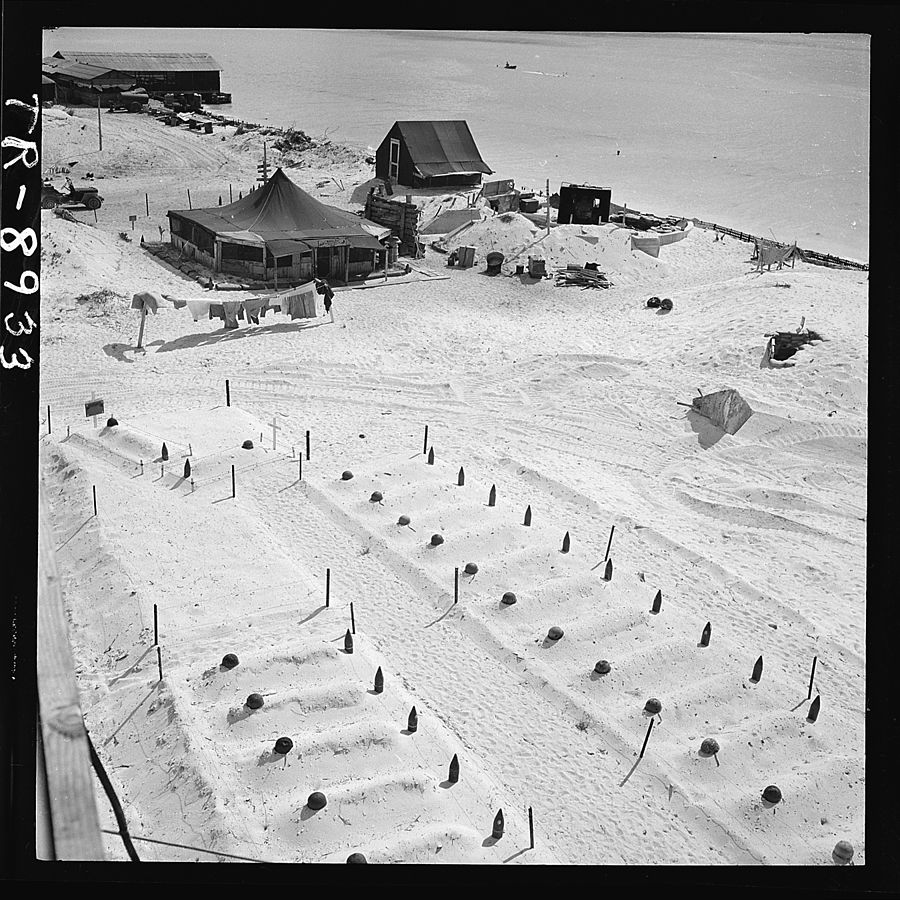
Graves of U.S. Marines who died taking Tarawa, before headstones were prepared. In the background are the first tents put up after occupation of the island. Image courtesy of Department of Defense.

Sources

Guest Contributor: Rachel Basinger is a former history teacher turned freelance writer and editor. She loves studying military history, especially the World Wars, and of course military medals. She has authored three history books for young adults and transcribed interviews of World War II veterans. In her free time, Rachel is a voracious reader and is a runner who completed her first half marathon in May 2019.

The Battle of Verdun, the Frenco-German Bloodbath and its Medal

1915 could have been the turning point of the First World War. What if the German leadership decided to attack further in Russia or choose a different spot on the Western front? Did they really had a chance of choosing which way was the best for 1916?
Which way to go?

he German leadership had multiple options. They could continue to attack and desorganize the Russians or try and break through the French front. The first solution was nearly impossible to achieve; Russia was far too wide and backward for the fight to continue in the country. The war would have been lost, not just because the Russians were fierce fighters, but mostly because of attrition and lack of communications on the front.

Erich Von Falkenhayn, the chief of the German General Staff, had to take the decision to move west. He had to choose the perfect location for the troops to attack and pierce the french lines. Even though most successes by the German Imperial Army were happening on the East, the Western Front was the perfect spot to do something big. It had to happened in France.

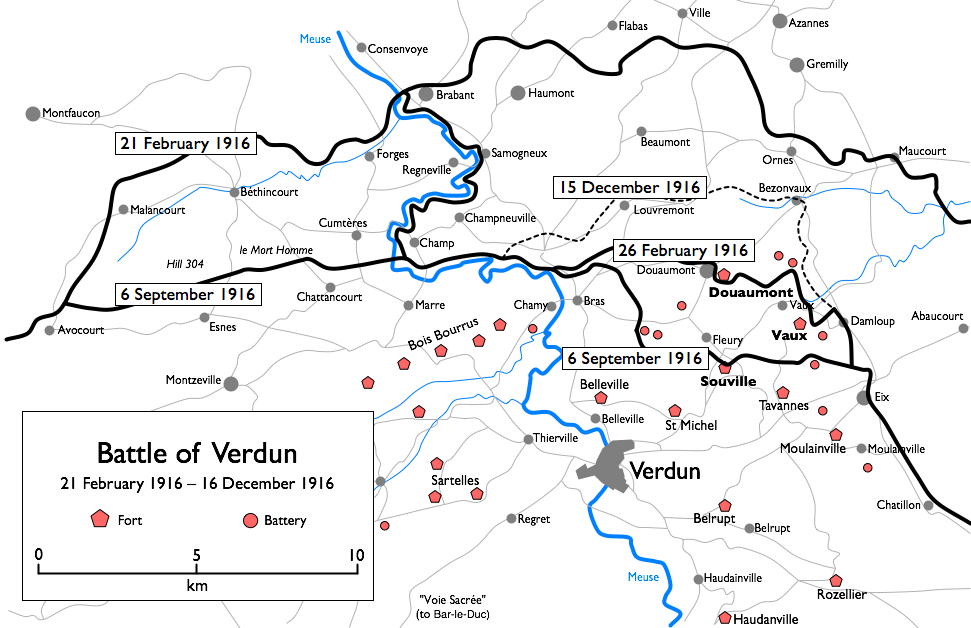
Map of the Battle of Verdun, 1916.
Map of the Battle of Verdun, 1916. Source: Wikipedia. CC.

Verdun, the ideal location?

The German General Staff had to thing fast about what to do. The main idea that was shared by most officers was that Verdun was the ideal location to attack. It was a bulge in the frontlines and could be a location where a major French attack could take place, as it would endanger the German communication and supply lines and break the front for good.

The plan was very simple. Falkenhayn decided to put all the avaiable artillery guns he could find and to stack them in the area. Artillery fire would take place for several hours and then infantry would attack and seize Verdun.

On the French side, the General Staff knew that something was hapening in this area: the German preparations couldn’t go unnoticed but would it be a lure or a real attack?

Monday, 21st February: Hell on Earth

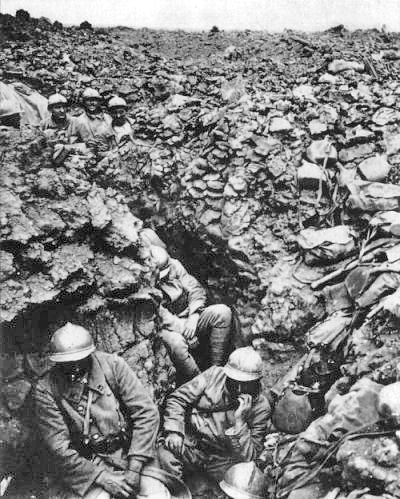
French trench at Côte 304, Verdun
French trench at Côte 304, Verdun. Source: Wikipedia. CC>

In one day, 2 million shells were fired on the French positions. As the fire was raging on and behind the French lines, 60,000 Germans attacked. The Germans expected to find demoralized and desorganized units but they encountered fierce and brave resistance from the French. As the French were trying anything they could do to slow down the German forces, it was looking more and more like Falkenhayn’s plan was starting to fail. Even worse, as the artillery fired more than 2,000,000 shells as previously stated, the ground was destroyed and it was very hard for the infantry to advance into this mayhem. Time was the key in this operation and every minute was important. It would later explain why the attack was a failure in the first days: the Germans were too slow to do capture anything strategic. The French could start firing back with their own artillery fire and reinforce the destroyed divisions.

The first few days of the battle were showing that the Germans advanced. But the main objective was to capture Verdun or at least a large portion of enemy land. The operation was a failure but the battle wasn’t over just yet…

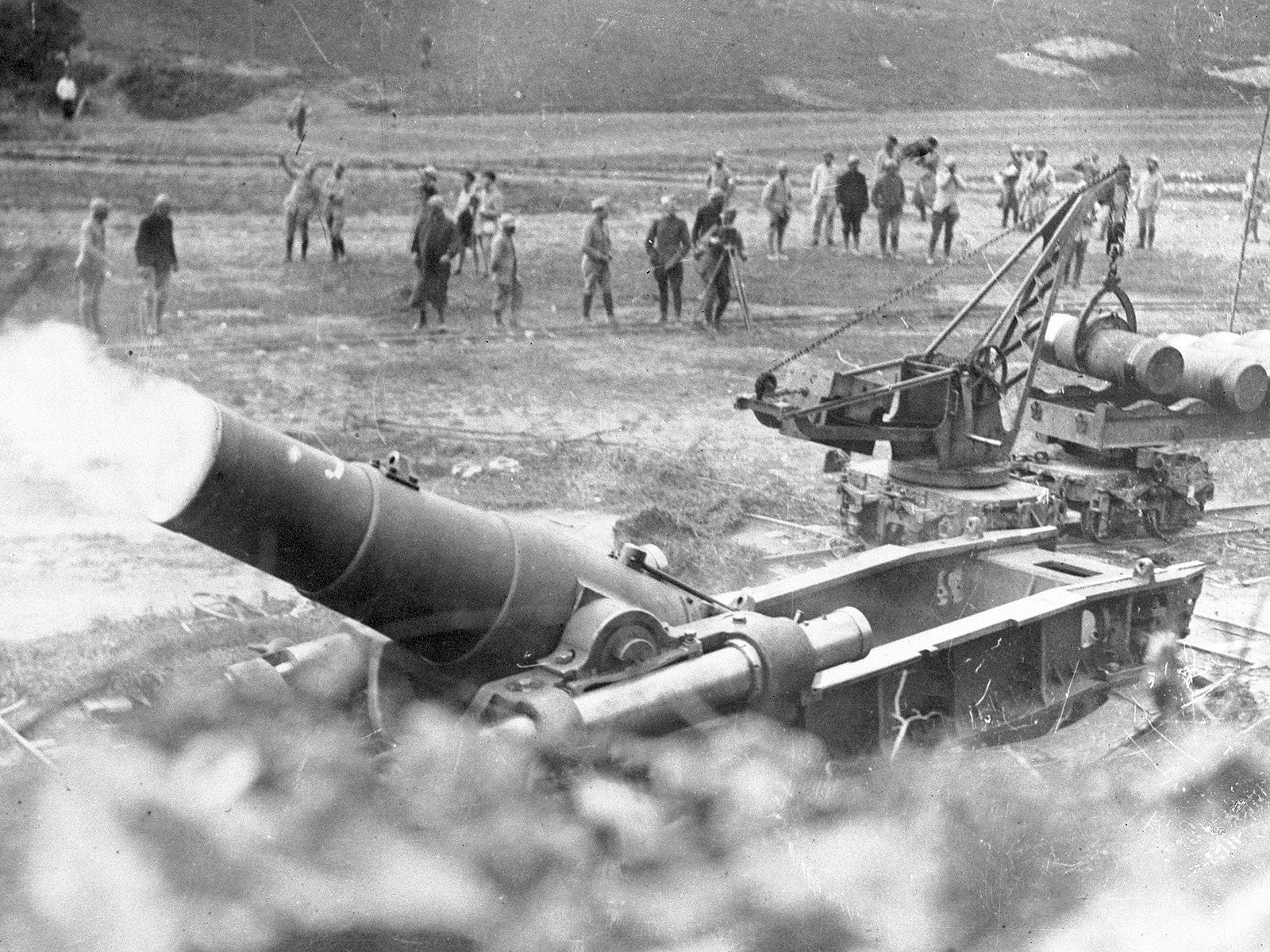
A French Army 370mm mortar being fired from a gully known as La Baraquette.
A French Army 370mm mortar being fired from a gully known as La Baraquette. Source: Wikipedia. CC.

“Ils ne passeront pas!”

For several months, the battle of Verdun would looked as if the fires of hell would burn anything to the ground. Thousands upon thousands of men would die under artillery fire. The French General Staff under Philippe Pétain and Robert Nivelle would prove to be far more effective than the German leadership. The “Voie Sacrée”, a road made to reinforce the French positions, was one of the key factor of why the Frenchs managed to hold for so long. 90,000 men were transported across this road to reinforce the frontlines each week, and you can only imagine how many tons of supplies were shipped across this road.

Unfortunately for the Germans, the general situation of the war was not in their favor. The Russians started the Brussilov Offensive, the Somme Battle started during mid-1916 and the Italians were winning against the Austrians on the Isonzo.
A bas-relief depicting the Voie Sacrée on a commemorative monument near Verdun
A bas-relief depicting the Voie Sacrée on a commemorative monument near Verdun. Source: Wikipedia. CC.

The end of the Battle

The Germans couldn’t hold for long and as the Frenchs attacked to regain the territories they lost in February, they couldn’t do a lot to stop them. Thus retreat was the only solution for the German Army. They virtually gained no land for enormous casualties. The consequences of this battle were not that big for the war in the general but the world would remember the courage and the bravery of the French during this battle.

On the 21st of December 1916, all lost territory was recaptured by the French. The battle of Verdun was finished.

The Verdun medal

Created in late 1916 even before the end of the battle, the medal of Verdun was made for who we call in France, the “Poilus”. These soldiers, holding for several months under intense pressure from infantry attacks and heavy artillery pounding, held their ground. Around 70% of all the French soldiers that were engaged in World War I participated to the battle of Verdun.

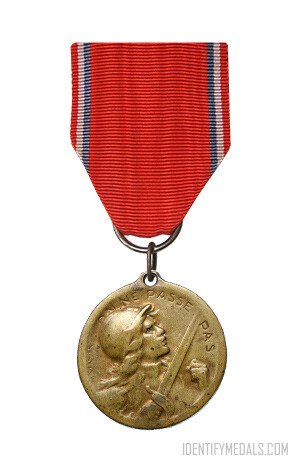
The medal is very simple: A red ribbon with a French flag is supporting a bronze badge. On this badge, you can find the head of the Republic (a symbol of the IIIrd French Republic) and the famous sentence pronounced by Robert Nivelle: “Ils ne passeront pas”, translated as: they will not break through. It is relatively common medal to find but it was an immense measure of respect in the civil life. It was carried with pride to show that these soldiers participated in the biggest attack France had to suffer in its history.

You can still claim the medal today. If you have any relatives that do so for the last 100 years, and if you can show a certificate or anything that shows that a family member particpated in the battle of Verdun, you can officialy claim and get the medal as a show of respect for your relatives. So if you know anybody that has made through the hell of Verdun and that this person never claimed or was decorated, give it a chance!

Conclusion

The battle of Verdun wasn’t decisive in any way for the western front. Status quo was the outcome of the Battle, not much changed. Well, something did actually change: the morale of the French population. Enhanced by this defensive victory which was in the end costly for both sides, the Frenchs were now absolutely sure that the Germans would never break through ever again. In the end, the Germans broke through but the war was already on its way to the victory for France. The French morale couldn’t get down anymore after Verdun. Verdun was the starting point of victory, it was showing that it was possible for France to win. And they did.

Guest Contributor: Kjetil Vion is a writer and a history enthusiast. A passionate of France and modern military history, he has a special interest into the Prussian state, specially since the Sadowa battle against Austria. Always wanting to learn more, he now looks to spread his knowledge in history.

The Cyclist Corps of the First World War (Great Britain, New Zealand and Australia)

Bicycles had been around for a while when thr First World War began. They are lighter, quieter and logistically easier to manage than horses, which need much by way of logistical support for its feeding and care. To the British, it soon became clear that the most mechanised army in the world could use this popular form of transport in the war effort.

The Cyclist Corps could move relatively quickly across poor ground and had long range, making them the perfect group for reconnaissance and communications. In this article, we’ll go through how these battallions were formed and used during WW1.

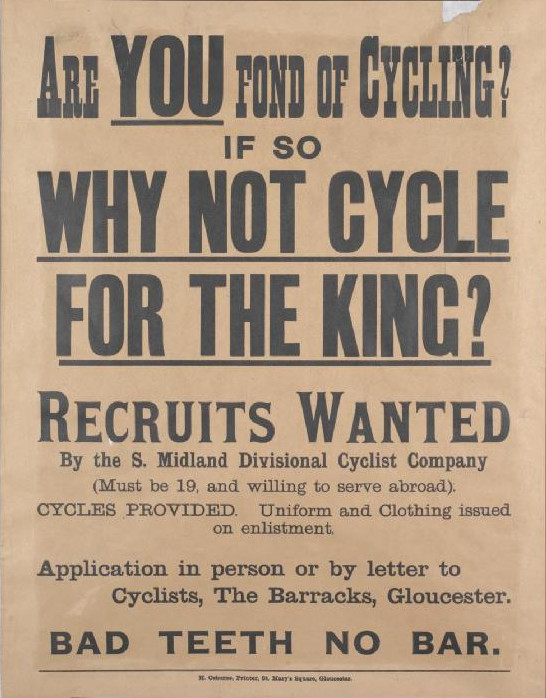
Recruiting poster for the 48th (South Midland) Division Cyclist Company
Recruiting poster for the 48th (South Midland) Division Cyclist Company. Source: Wikipedia.

The Creation of the Cyclist Corps

In Great Britain, volunteer cyclist units had been formed as early as the 1880s. In 1888, for example, the first complete bicycle unit was raised, the 26th Middlesex Rifle Volunteers. These cyclists, while not deployed as organised combat formations, were still employed intermittently during the South African War.

When the Haldane reforms took place (a series of changes in the British Army named after the Secreatry of War Richard Burdon Haldane) the Volunteers, Yeomanry and the Militia Regiments were reorganised into the Territorial Force, forming nince battalions of cycists.

The members of the Territorial Forces could not be compelled to serve outside the country, as they had been created as a home defence force for service during wartime. However, in 1914 many members volunteered for Imperial Service, and the the units had to be split. One was liable for overseas service, and the other for home service for those unable or unwilling to serve overseas. A third line was later created to serve as a reserve.

Recruitment efforts in 1914-1915 aimed at attracting men who were already cyclists, or who were at least interested in things mechanical. On the eve of the First World War, the Territorial Force had a strength of fourteen cyclist battalions, the majority Territorial battalions as part of the regular infantry Regiments except for four: the Huntingdonshire, Highland, Northern and Kent Cyclists, who were independent.

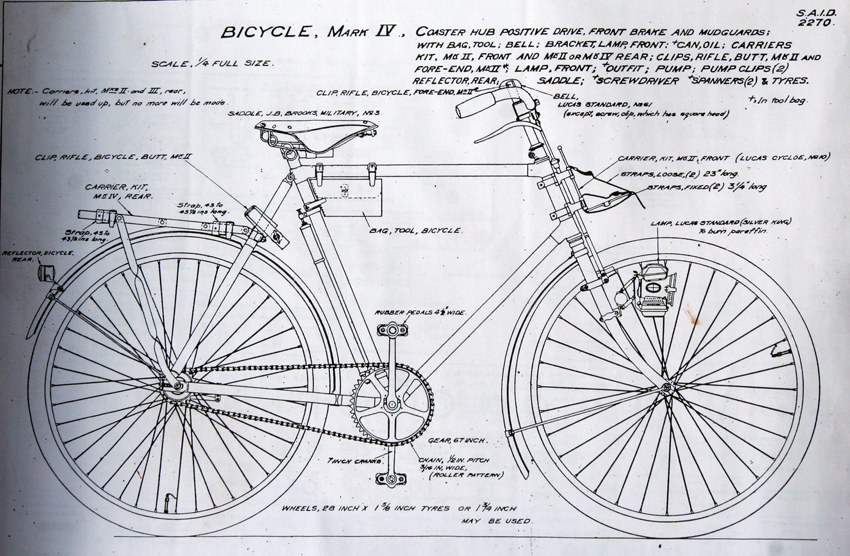
A schematic diagram of the BSA Mark IV bike used by the men of the New Zealand Cyclist Corps.
A schematic diagram of the BSA Mark IV bike used by the men of the New Zealand Cyclist Corps. Courtesy of the BSA & Bicycle Military Museum.

Among the regulations from 1907 for the use of bikes in the field of battle and in drilling and ceremonial occasions, we can find:

‘A cyclist standing with his cycle, with rifle attached to it, will salute with the right hand, as laid down in Section 19, returning the hand to the point of the saddle on the completion of the salute. When at ease, a cyclist, whether mounted or leading his bicycle, will salute by coming to attention, and turning his head to the officer he salutes. A party of cyclists on the march will salute on the command Eyes Right, which will be followed by Eyes Front, from the officer or NCO in charge.’

‘The rate of marching, excluding halts, will generally vary from 8 to 10 miles per hour, according to the weather, the nature of the country, and the state of the roads. A column of battalion size should not be expected to cover more than 50 miles in a day under favourable conditions.’

The Cyclist Corps in WW1

The cyclist battalions were first employed on Coastal Defences and to supply drafts of men to the regular forces in the United Kingdom. This task was crucial, so none of them were sent overseas then, and very few later, in small groups of men with the divisions possessing individual cyclist companies.

Cyclists were usually held back in preparation for the resumption of “normal” mobile warfare between action. They were employed in combat, but in conditions of trench warfare they were generally found to be ineffective, although they proved essential around 1918 for reconnaissance. The terrain on the Western Front was unsuitable for bikes and they were discarded early on with the unit. Still, the cyclist corps were armed as infantry and could provide mobile firepower, if required. Some battalions such as the Kent Cyclists were also converted to infantry and used for foreign service in India, usually working in the rear areas behind the front lines and in traffic control duties.

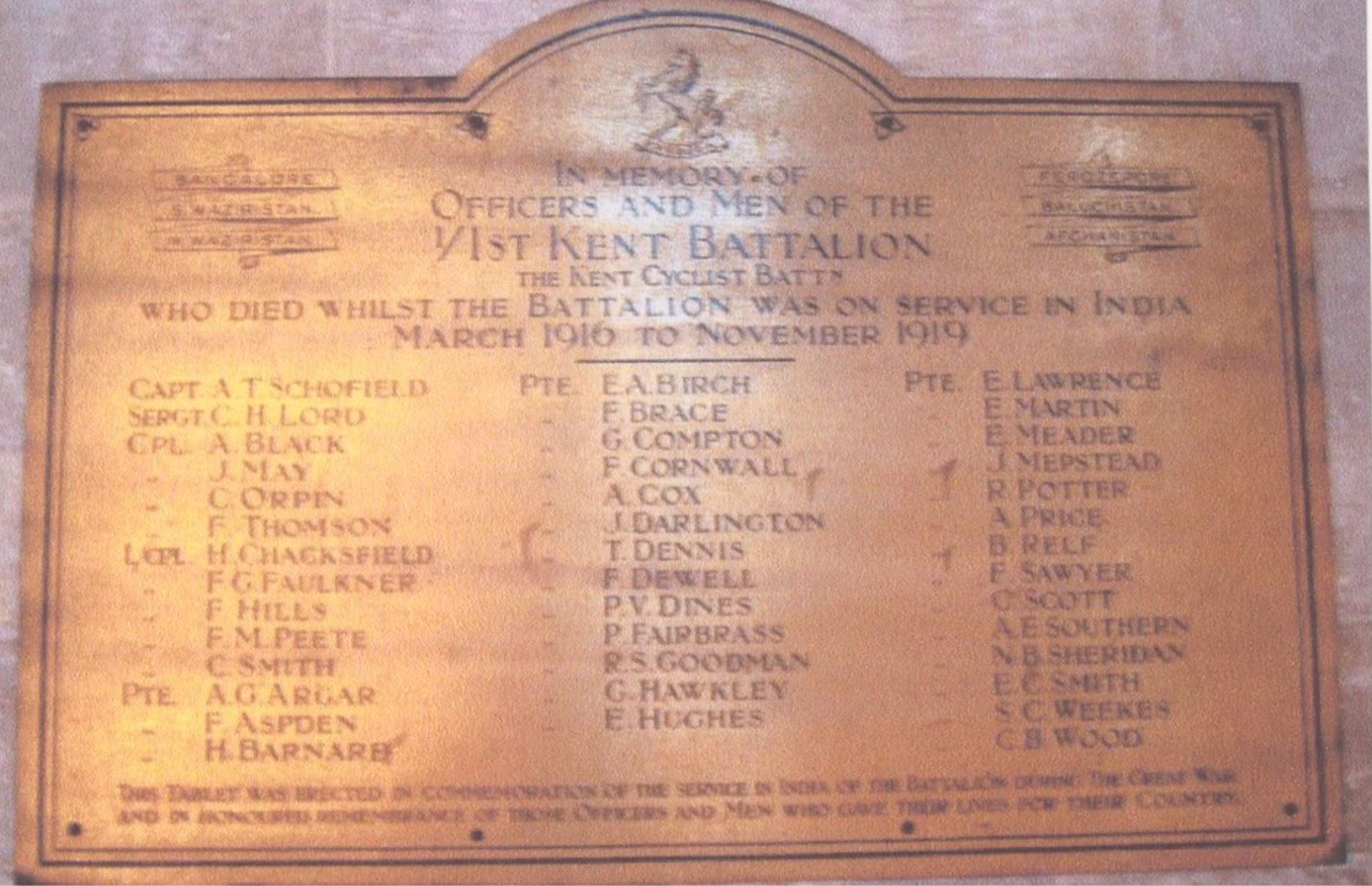
The 1st Kent Cyclist Battalion was the sole battalion to be awarded battle honours – The North West Frontier in 1917, Baluchistan in 1918 and later Afghanistan.

The Corps was disbanded in 1920 because cyclists were perceived as having little future value and the Corps. By 1922 all remaining Territorial cyclist battalions had been converted back to conventional units.

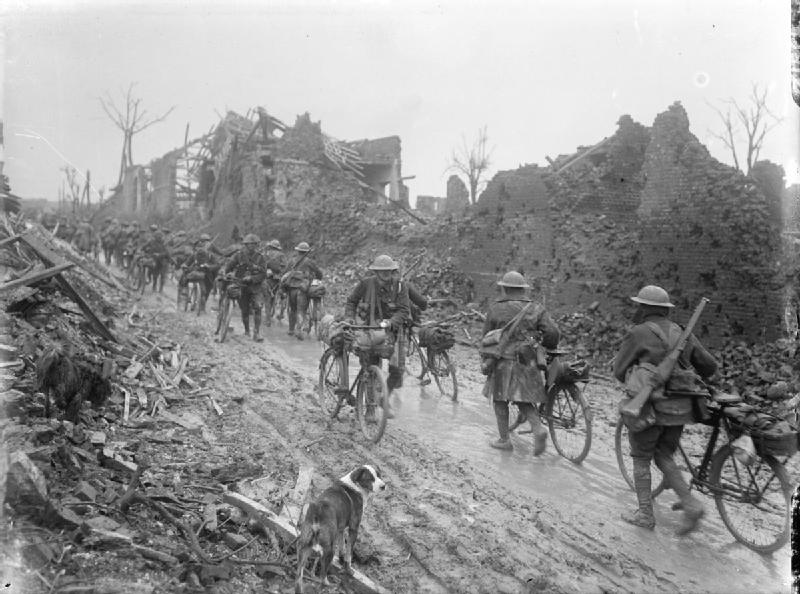
British cyclist troops advance through Brie, Somme, 1917.
British cyclist troops advance through Brie, Somme, 1917. Source: Wikipedia.
A plaque in Canterbury Cathedral records the losses of the 1st Kent Battalion.

The Australian and New Zealand Cyclist Corps

The Australian Cycling Corps were used mainly as despatch riders, to conduct reconnaissance and do patrolling. They were formed in Egypt in 1916 as part of the Australian Imperial Force (AIF) following its evacuation from Gallipoli, and fought on the Western Front in France and Belgium during World War I. Each of its five infantry divisions was allocated a company of cyclists – every company with a headquarter and six cycle platoons with a total strength of 204 men.

Following their arrival in France, they were reorganised as corps troops, with the 1st and 2nd Cyclist Battalions being formed and attached to the I and II Anzac Corps. The 2nd Battalion included two companies of New Zealandersand was commanded mostly by New Zealand officers. The unit arrived on the Western Front in July 1916 and participated in the Messines and Passchendaele offensives in 1917 and the Spring Offensive and Advance to Victory in 1918.

These cyclist battalions were first organised like the infantry (as despatch riders) and later operated in a manner similar to cavalry (doing reconnaissance and patrolling). The II Anzac Corps were particularly involved with burying telegraph cables, and at times served in the trenches as infantrymen.

In early 1918, the New Zealand Cyclist Corps was called upon to fight as infantry, taking part in important defensive actions in the Battle of the Lys (April) and offensive actions in the Second Battle of the Marne (July-August).

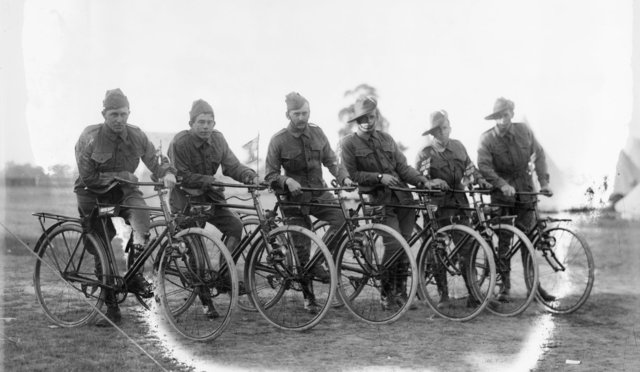
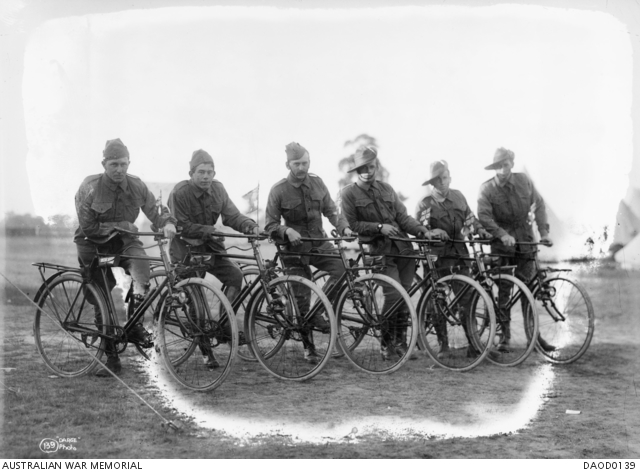
Members of the Australian Cyclist Corps at Broadmeadows, Victoria, c. January 1915
Members of the Australian Cyclist Corps at Broadmeadows, Victoria, c. January 1915. Source: Wikipedia.
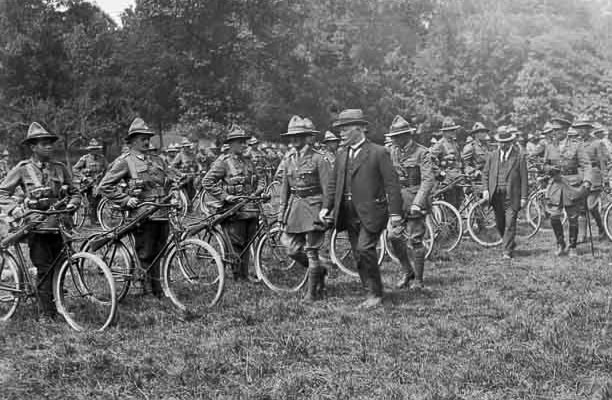
PM William Massey inspects the New Zealand Cyclist Corps at Oissy, 3 July 1918.
PM William Massey inspects the New Zealand Cyclist Corps at Oissy, 3 July 1918. Courtesy of NZ History.

Remembering the Cyclist Corps

It’s not easy to determine how many men served in the various cyclist units during WW1. Some 20,000 names can be traced from the campaign medal rolls, but this does not include the many who served in units at home.

No regimental memorial has been built to commemorate the Cyclist Corps efforts. These men, working in the trenches, were in the most acute danger and carried out many acts of great bravery. Below are a few stories to honor them.

Pte William Liddell DCM

Pte William Liddell was a 33-year-old married man from Leith, Scotland. He served in the 9th Divisional Cyclist Company, after having been with the Seaforth Highlanders. His citation in the London Gazzette for the Distinguished Conduct Medal (junior only to the Victoria Cross) he received speaks of his action during the Battle of Loos in September 1915 at Madagascar. Sadly, Liddell would later die of wounds near Ypres on 25 February 1916.

‘Hearing a wounded man of another battalion, who was lying out in the open, calling for assistance, he, accompanied by Captain Campbell, jumped over the parapet and together they carried the wounded man to safety. Private Liddell’s clothing was hit in several places by enemy bullets.’

Jack Hales

Jack Hales was part of the Huntingdonshire Cyclist Batallion. He was involved in the Gallipoli landings and also served in Turkey and France. He left England shortly after the end of the war, moving to Canada then Australia before finally settling in New Zealand.

John Edward ‘Ned’ Shewry

John Edward “Ned” Shewry (1889-1962) was a world champion woodchopper from New Zealand. HIs good skills and technique with an axe caught the eye of the elder Eastern Taranaki bushman Hughie McLeod, who entered Shewry in his first chopping event. In 1911 he won in Eltham, the “Mecca of axemen”, and carried on his winning streak at a number of other chopping events around Taranaki and the King Country.

In 1915, Ned and his brother David joined the New Zealand Cycling Corps. He served in Egypt, France and Belgium and his service was recognised with the Military Medal for bravery, which he received for saving an officer’s life while under fire at Marfaux, France in 1918. Ned was wounded twice and was even buried alive – only the quick actions of his friends saved him from suffocation. He didn’t totally abandon his axe. He joked that he only received the Military Medal ‘because I kept the cookhouse supplied with kindling wood!

Tragically, his brother David died from injuries received in France in 1917. Ned was twice wounded in battle, but when he returned home he was a fit man keen to return to the woodchopping arena.

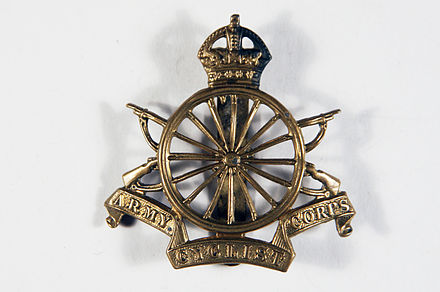
Army Cyclist Corps Badge Of Honour
Army Cyclist Corps Badge Of Honour. Source: Wikipedia.
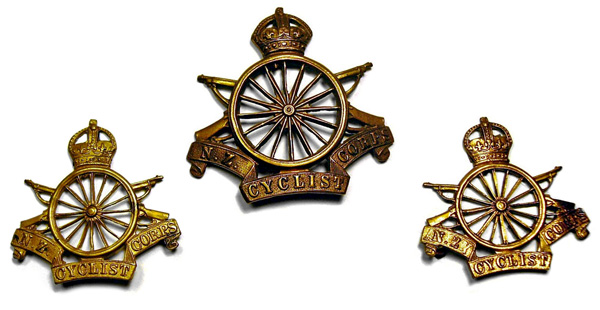
Cap and collar badges: Wheel with crossed rifles surmounted by a crown and a scroll underneath with the words ‘NZ Cyclist Corps’.
Cap and collar badges: Wheel with crossed rifles surmounted by a crown and a scroll underneath with the words ‘NZ Cyclist Corps’. Courtesy of NZ History.

Resources Guide: How to Identify Military Medals and Badges

In this detailed guide, I explain the different ways in which you can identify some of your military medals, badges, or awards online.

In this guide, I explain the different ways in which you can identify some of your military medals, badges or awards online. I apologize but as much as I would like to help, I’m no medal expert – rather an education enthusiast. My knowledge is limited to certain periods and countries only. There are, however, great places where experts and collectors are willing to help. You can find them in the lists below.

Medal Identification Tools

Tools in This Site

If you haven’t already, you can start by visiting the Military Medals database. The medals on this site are categorized by country and time period, so this might be a good start if you believe you know the origin or estimated age of a medal.

The best place to ask for help identifying medals is the Forum (sorry, I don’t have the resources to keep the forum running)

I’ve also been working on a tool to identify medals also based on their shape and material. My collection of images is still not complete, but if your medal is from the United States or United Kingdom, you’ll probably find it in the Medal Identifier (unfortunately, the tool has broken. I’ll try to update on this soon).

Other Places to Identify Medals

Wikipedia has the largest collection of military medals and awards, but you will need to know what you’re looking for if you want to use it as a way of identifying. Go to the Wikipedia Military Medals page to read more.

Some Reddit channels can be great for asking for help identifying medals. You can read how to create a Reddit account at this link. I especially recommend Militaria Collecting and Medals:

You might also want to try:

And I’ve been lucky asking here as well:

Reddit channels about militaria and other useful resources by country:

Using Google’s Reverse Image Search

This tool allows you to use a picture to find related images from the web. A lot of times, these will tell you what you’re looking for. When you search with a picture, your results may include similar images to one you have taken, the websites that contain these images and other sizes of the picture you searched with.

All you need to do to use this feature is to upload an image, go to Google Images, then Search by image Search by image and Click Upload an image and then Choose file or Browse. You can also drag and drop images and search with a URL.

How to do a Google Inverted Image Search

You can read more about Google’s reverse image search here.

What’s the Worth, Value and Price of Military Medals?

The reason many of us collect military medals is because they allow us to discover not only major historical events, but also people’s experiences in such extreme circumstances. They help us appreciate the value of the sacrifices soldiers have made all around the world and, unlike coins which are created in large numbers, they relate to a person’s particular path.

It’s hard to determine the worth of such objects, but the monetary value is something we can calculate based on scarcity and other similar factors. In this article we’ll go through them one by one.

The Value of a Military Medal

Military medals hold various forms of value. For instance, there’s their bouillon value, sentimental value, and collector value, to their insurance value. So, let’s delve into these to see how they contribute to the overall significance and worth of military medals.

Bullion Value

The bullion value of a military medal or award is the value of the metal with which it has been made, for example silver, gold or platinum. The bullion value is measured in dollars and per ounce, although the number can vary on a daily basis as is the case with all precious metals. The bullion value is not the final value of a medal, but only that of its material.

The first thing you need to is to find the fineness of the metal. For gold, the quality is measured in karats, which refers to the purity and ranges from 1 to 24. You can get its percentage purity by dividing any of these numbers by 24. For example, if you have 24K, you get 1.0 which means 100% pure gold.

Once you have this value, all you need to do is weight the medal (in grams) and multiply this value by the metal’s fineness. Then, multiply the result by the daily metal price. If you were to melt your medal, this would be its bullion value. You can use:

Sentimental Value

A medal, especially one that has been in your family for generations or was given to you by a person you care for, can be priceless. Therefore, this value cannot be measured in terms of money.

These medals often represent the bravery, sacrifice, and service of individuals and are cherished as treasured heirlooms, carrying profound meaning and memories. Many medal collectors (me included) consider themselves as the current custodian of a medal, rather than the owner. This fact actually offers comfort to those that have to part with their family heirlooms.

The medal with the highest bullion value is the Congressional Gold Medal, awarded by the United States Congress.

Collector Value

When a medal hasn’t belonged to a family member, we consider it as part of a ‘secondary market’. These medals tend to change hands frequently and usually hold a current market value. In other words, their price is calculated based on how much a collector wants them.

Nowadays, World War II medals can fetch as little as $5 to $10. The main reason is that these medals are usually unnamed and can’t be easily linked to a recipient. Others, however, have been issued in small quantities and have a higher collector’s value. In 2009, a Victoria Cross and Bar awarded to Capt Noel Chavasse for service in the First World War sold for over £1.5m.

Military medals are generally divided into two large groups: Those awarded for gallantry, and those awarded for taking part in a campaign

Insurance Value

You calculate the insurance value of a medal based on how much you would need to pay to locate a similar one. This should include the time to locate it as well. The insurance value is not always easy to determine, so we will go into more detail in the next section.

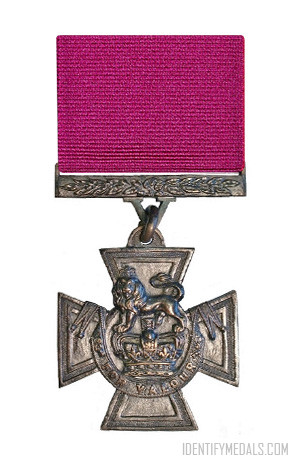
The Victoria Cross holds immense appeal and is highly sought after by military medal collectors and enthusiasts.

Appraising a Military Medal

Appraising a military medal involves considering two key aspects: condition and provenance. Collectors and appraisers assess factors such as wear, damage, and overall preservation. Medals in excellent condition, with minimal signs of wear or damage, generally command higher values compared to those in poor condition. Furthermore, the more comprehensive and well-documented the provenance, the greater the potential impact on the medal’s value.

Condition

There are many factors that come in play when appraising a military medal.

The first one is the condition, whether its highpoints have any wear and the edges are free from nicks. A medal which has lots of wear, edge knocks or is fire damaged is worth less than one that is in an overall ‘good’ condition.

The medal grading terminology based on condition is as follows:

  • Fine (F): Medal shows some slight wear, surface marks and edge knocks.
  • Good Fine (G.F): Worn but shows clear signs of wear.
  • Very Fine (V.F): Shows clear wear on high relief of medal but otherwise displays little wear.
  • Good Very Fine (G.V.F): Shows very few marks or blemishes and/or deeply toned.
  • Extremely Fine (E.F): Shows little wear if any at all.
  • Mint (M): As close as possible to the condition in which it was issued by the mint.
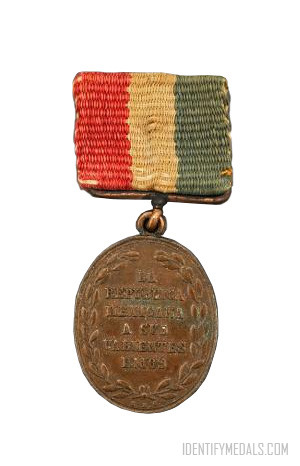
The Medal for Acultzingo - Mexican Medals & Awards - Pre-WW1
Fine: The Medal for Acultzingo (Mexico)
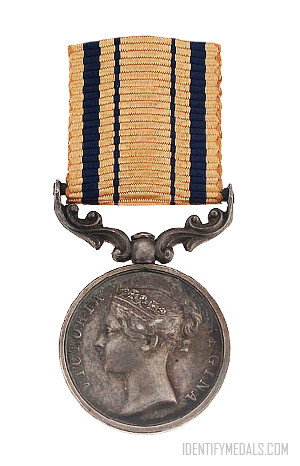
The South Africa Medal (1854) - British Pre-WW1 Medals
Good Fine: The South Africa Medal
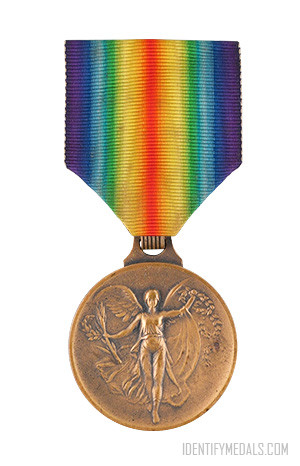
The Inter Allied Victory Medal (Greece)
Very Good Fine: The Inter-Allied Victory Medal (Greece)
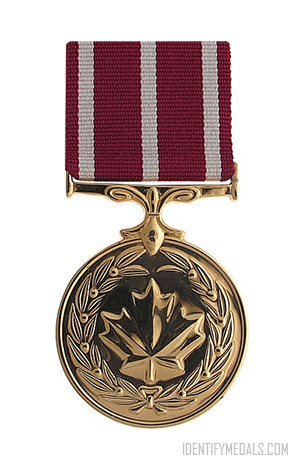
Mint Condition: The Canadian Medal Of Military Valour

Provenance

Condition plays an important part in appraising a military medal, but what’s also incredibly important is its background.

What medal is it, and to whom was it given? How many of it were awarded, and how many are available? Does it have its original ribbon and box of issue? Is there paperwork to follow its provenance?

Collectors are particularly interested in the stories that led to the awards. This is why having documents or related ephemera can significantly add to a medal’s value. They help prove provenance, and create historical interest.

Some medals were issued in large numbers, which brings their monetary value down. This is for example the case of  the British War medal – £10 because they were awarded to any British Empire combatant. The Victoria Cross, on the other hand, only counts with 1,357 medals in existence, making it the holy grail for collectors. Almost every VC from the First World War surpasses £100,000.

It’s hard to determine the worth of such objects, but the monetary value is something we can calculate based on scarcity and other similar factors. 

Conclusion: The Value of a Medal

The combination of condition and provenance helps determine the overall value of a military medal.

An exceptional condition coupled with a well-documented and illustrious provenance can significantly enhance a medal’s worth. However, it’s important to consult experienced professionals, such as military medal experts or reputable appraisers, who possess the necessary knowledge and expertise to accurately evaluate and appraise these historical artifacts

British Medals: Order of Wear, How to Apply and Request Records

In this article we explore the order of wear of British medals and awards, how to apply for them and how to request records of deceased personnel. To see a list of all Great Britain military medals, badges and awards please go to this page.

Order of wear of British Medals and Awards

All services use a common order of wear for medals and awards. You should only wear official decorations, medals or emblems which you are entitled to and have been approved for acceptance and wear. Unofficial medals should not be worn with official orders, decorations and medals. These are the general rules:

  1. The Victoria Cross and the George Cross
  2. United Kingdom Decorations
  3. Order of St John (all classes)
  4. United Kingdom Medals for Gallantry and for Distinguished Service
  5. United Kingdom Operational Service Medals (worn in order of date of award)
  6. United Kingdom Polar Medals, Police Medals for Valuable Service, Jubilee, Coronation and Durbar Medals.
  7. Long Service and Efficiency Awards
  8. Commonwealth Orders, Decorations and Medals instituted by the Sovereign and instituted since 1949 otherwise than by the Sovereign (worn in order of date of award).
  9. Foreign Orders, Decorations and Medals (if approved for wear, worn in order of date of award).

Applying for Medals in the United Kingdom

You can apply for a medal if you served in the armed forces and are eligible, if you were awarded a medal for service in any of the following:

  • the army
  • the Royal Navy
  • the Royal Marines
  • the Royal Air Force (RAF)
  • the Home Guard
  • the reserve forces

You must meet the eligibility requirements for the medal you’re applying for. You can also apply on behalf of a veteran if you have lasting power of attorney.

Download and fill in the medal application form.

How to Request Records of Deceased Service Personnel

The MOD is the custodian of the records of service personnel and Home Guard records until they are opened to general public access at the National Archives.

Subject to the payment of an administration fee and provision of a copy of a death certificate (except where death was in service), certain information can be provided from the records of service of service personnel on request under the publication scheme.

More Information: https://www.gov.uk/guidance/request-records-of-deceased-service-personnel